Sign In or Create an Account.

By continuing, you agree to the Terms of Service and acknowledge our Privacy Policy

Climate

Wednesday Was the Worst Day for Wildfire Pollution in U.S. History

The finding by Stanford researchers confirms the danger — and lack of precedent — for the East Coast’s ongoing wildfire smoke crisis.

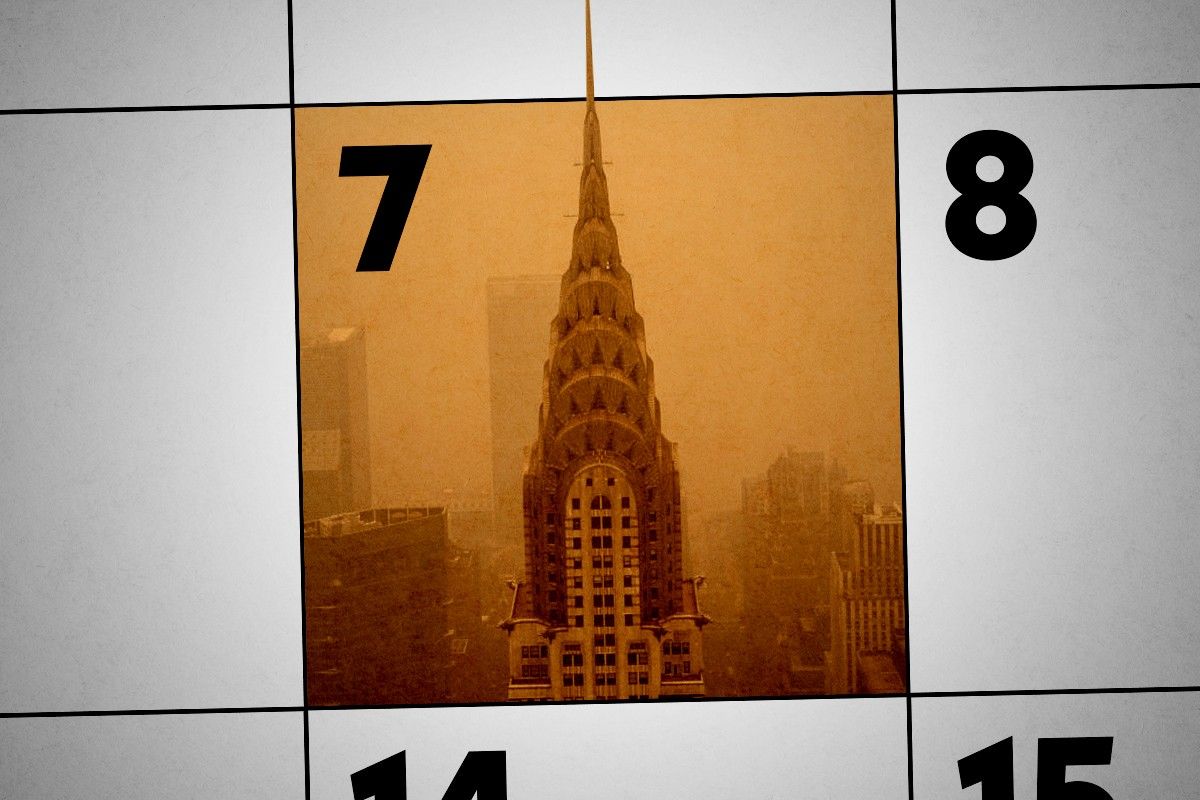
The Chrysler Building.
Heatmap Illustration/Getty Images

Wednesday, June 7, was by far the worst day for wildfire smoke exposure in American history, subjecting more people to greater amounts of soot and ash than any previous day on record, according to a new and rapid analysis conducted by Stanford researchers.

The finding confirms the danger — and lack of precedent — for the ongoing wildfire smoke crisis, which has smothered the northern and eastern United States in an acrid haze. Since Monday, a strong low-pressure system has fanned dozens of wildfires in northern Quebec, then blown the resulting smoke into North America’s most densely populated corridor, covering New York City, Philadelphia, Washington, D.C., and Toronto.

Even as the smoke moved in, it made history. Tuesday became the country’s third-worst day for wildfire smoke on record, according to research from the same Stanford team. Only two days in September 2020 — when vast wildfires sheathed California, Idaho, and the Pacific Northwest in smoke — had exposed more Americans to higher intensities of toxic particulate matter.

Wednesday smashed those records. By the late afternoon, New York and New Jersey’s sky had turned a pungent orange, and their air quality fell to “very unhealthy” or even “hazardous” levels for all groups, the worst category. The rest of the Northeast and Mid-Atlantic faced similar or only slightly better conditions, and wildfire smoke at least somewhat afflicted virtually everywhere between Minneapolis, Atlanta, and Boston.

Stanford chart.Stanford.

The vast geographic sweep of the smoke — and the fact that it was so intense in the country’s biggest city — obliterated the old record. The country’s previous worst day for smoke exposure was September 13, 2020, when nearly 35 million Americans were exposed to more than 50 micrograms per cubic meter of microscopic soot and ash. That is five times worse than what the World Health Organization considers safe.

But on Wednesday, roughly 62 million Americans — nearly one in five — were exposed to such high levels of particulate matter.

Get one great climate story directly in your inbox every day:

* indicates required
  • It was “just a massive, awful event, with highly populated areas getting hit with unprecedented levels of pollution,” Marshall Burke, an economist and professor at the Stanford Doerr School of Sustainability, said on Twitter. He leads the school’s Environmental Change and Human Outcomes Lab, which conducted the research.

    The study encompassed data from 2006 to 2023. The researchers studied which days were worst on a population- and exposure-adjusted basis. In other words, on which days in history were the most Americans subjected to the most intense amounts of wildfire smoke?

    Because the U.S. population has grown over time, and because wildfires have enlarged over the past few decades, it is unlikely that any days prior to 2006 saw so many Americans exposed to so much smoke. Most of the record days in the data set have happened since 2018.

    With the new record in place, Tuesday falls to the fourth-worst day for wildfire smoke on record.

    Speaking earlier this week, Burke said that what made this event so distinct from previous ones is that the wildfire smoke hit the country’s largest and most populated cities. “It’s mainly due to the East Coast having so many people. It’s New York, Boston, D.C., Detroit. Out West, our cities are just smaller,” he told me.

    Read more about the wildfire smoke engulfing the East Coast:

    Wednesday Was the Worst Day for Wildfire Pollution in U.S. History

    The 5 Big Questions About the 2023 Wildfire Smoke Crisis

    Nowhere Is ‘Climate Proof’

    When There’s Smoke, Getting Indoors Isn’t Enough

    How Many People Will This Smoke Kill?

    You’re out of free articles.

    Subscribe today to experience Heatmap’s expert analysis 
of climate change, clean energy, and sustainability.
    To continue reading
    Create a free account or sign in to unlock more free articles.
    or
    Please enter an email address
    By continuing, you agree to the Terms of Service and acknowledge our Privacy Policy
    Politics

    Trump’s Tiny Car Dream Has Big Problems

    Adorable as they are, Japanese kei cars don’t really fit into American driving culture.

    Donald Trump holding a tiny car.
    Heatmap Illustration/Getty Images

    It’s easy to feel jaded about America’s car culture when you travel abroad. Visit other countries and you’re likely to see a variety of cool, quirky, and affordable vehicles that aren’t sold in the United States, where bloated and expensive trucks and SUVs dominate.

    Even President Trump is not immune from this feeling. He recently visited Japan and, like a study abroad student having a globalist epiphany, seems to have become obsessed with the country’s “kei” cars, the itty-bitty city autos that fill up the congested streets of Tokyo and other urban centers. Upon returning to America, Trump blasted out a social media message that led with, “I have just approved TINY CARS to be built in America,” and continued, “START BUILDING THEM NOW!!!”

    Keep reading...Show less
    AM Briefing

    Nuclear Strategy

    On MAHA vs. EPA, Congo’s cobalt curbs, and Chinese-French nuclear

    Nuclear power.
    Heatmap Illustration/Getty Images

    Current conditions: In the Pacific Northwest, parts of the Olympics and Cascades are set for two feet of rain over the next two weeks • Australian firefighters are battling blazes in Victoria, New South Wales, and Tasmania • Temperatures plunged below freezing in New York City.


    THE TOP FIVE

    1. New defense spending bill makes nuclear power a ‘strategic technology’

    The U.S. military is taking on a new role in the Trump administration’s investment strategy, with the Pentagon setting off a wave of quasi-nationalization deals that have seen the Department of Defense taking equity stakes in critical mineral projects. Now the military’s in-house lender, the Office of Strategic Capital, is making nuclear power a “strategic technology.” That’s according to the latest draft, published Sunday, of the National Defense Authorization Act making its way through Congress. The bill also gives the lender new authorities to charge and collect fees, hire specialized help, and insulate its loan agreements from legal challenges. The newly beefed up office could give the Trump administration a new tool for adding to its growing list of investments, as I previously wrote here.

    Keep reading...Show less
    Green
    Bruce Westerman, the Capitol, a data center, and power lines.
    Heatmap Illustration/Getty Images

    After many months of will-they-won’t-they, it seems that the dream (or nightmare, to some) of getting a permitting reform bill through Congress is squarely back on the table.

    “Permitting reform” has become a catch-all term for various ways of taking a machete to the thicket of bureaucracy bogging down infrastructure projects. Comprehensive permitting reform has been tried before but never quite succeeded. Now, a bipartisan group of lawmakers in the House are taking another stab at it with the SPEED Act, which passed the House Natural Resources Committee the week before Thanksgiving. The bill attempts to untangle just one portion of the permitting process — the National Environmental Policy Act, or NEPA.

    Keep reading...Show less
    Blue