Current conditions: A major Atlantic storm called Storm Charles is bearing down on Portugal, which closed schools, canceled all non-essential services, and called off the second day of the WebSummit in Lisbon • A potential nor’easter is threatening New York City with heavy rain and flooding • Jackson, Mississippi — where Democrat Scott Colom declared victory last night to become the state’s first Black senator in nearly 150 years — is set to reach a warm, sunny, 71 degrees Fahrenheit today before dropping off by nearly 20 degrees overnight.
THE TOP FIVE
1. UN chief’s closing climate message: Fossil fuels are ‘killing our planet’
When the Intergovernmental Panel on Climate Change released its landmark report on the closing window to keep global warming within the range set by the Paris Agreement in 2018, António Guterres was just a year into the job as the United Nations’ secretary-general. The left-wing former Portuguese prime minister quickly developed a knack for delivering speeches that contained exactly the kind of rousing soundbites that blared in headlines across the world. That year, he proclaimed climate change “the defining issue of our time – and we are at a defining moment.” As emissions continued to grow, he ratcheted up his language. In 2022, he warned of a world in “great peril.” In 2023, he lamented that “humanity has opened the gates of Hell.” In his likely final speech before the annual global climate summit as the UN chief, Guterres raged against a world still on “the path to mutually assured destruction.”As “heat records keep shattering,” he said, “fossil fuel interests keep making a killing — while killing our planet.”
Meanwhile, at the summit formally known as the 31st Conference of the Parties to the UN Framework Convention on Climate Change, advocates are pushing for nuclear power to be explicitly acknowledged as clean in any official communiques that emerge from the negotiations. The key theme of this year’s event is Turkey’s goal of getting the world to increase the share of end-use energy that comes from electricity from 21% to 35% by 2035. Groups such as the Clean Air Task Force are pushing for the COP31 to name nuclear power as a resource to reach that goal, NucNet reported.
2. Exxon Mobil sues the EU over its carbon capture rules
Exxon Mobil filed a confidential legal challenge to the European Union’s carbon capture rules in what the Financial Times called “the latest attempt by the U.S. energy group to row back Brussels’ flagship green regulations.” In a memo, the European Commission told its trade authorities it was preparing a response to the Texas giant’s argument that requiring the company to build out infrastructure to capture and store carbon dioxide emissions violates its rights against discrimination and expropriation under a 1994 investor protection treaty. The EU left the treaty last year, but is still bound by it.
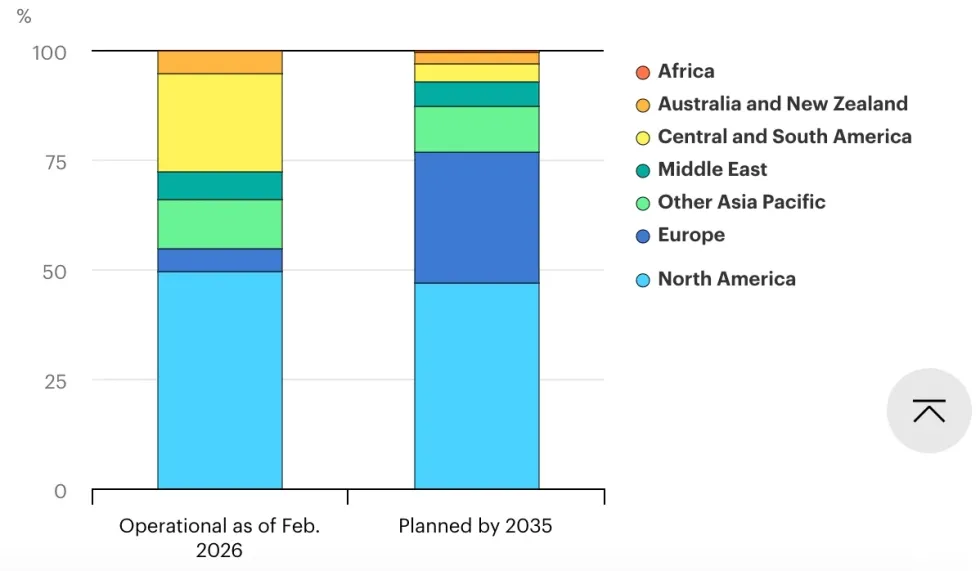
Europe operates just 5.2% of the world’s operational carbon capture capacity as of this year, according to data from the International Energy Agency, putting the continent in a distant third place behind North America and South America. But that figure is on track to top 30% by 2035, easily leapfrogging into the No. 2 spot.
 The European CCS boom. Chart: IEA
3. Masayoshi Son ‘overdid it’ on gas turbines
Last year, Japanese billionaire Masayoshi Son reserved a big portion of the U.S. market for gas turbines in hopes of making his SoftBank Group a top power equipment supplier for the data center boom. But reserving 13 gigawatts of turbines — equivalent to more than six Hoover Dams — drove a $3.7 billion loss in the company’s earnings.
“Like an overeager miner who tries to corner the market for picks and shovels in a gold rush,” The Wall Street Journal wrote in a scoop on the earnings hit, “Son’s SoftBank Group ordered so many turbines that even after fully supplying the world’s largest gas power plant, it was left with reservations for far more than it could possibly use.” It’s a sign, my colleague Robinson Meyer wrote last night, that “data centers may have already peaked as an economic and energy trend.”
Sign up to receive Heatmap AM in your inbox every morning:
4. Vance appeared to help an early backer secure a prized Venezuelan oil contract
Add this to Democrats’ list of potential investigations into conflicts of interests in the Trump administration’s energy deals. A week before the U.S. invaded Venezuela, a plane linked to John Addison, a gasoline trader at the commodities giant Vitol and a friend and early financier of JD Vance’s political career, spent time on the tarmac of Bozeman Yellowstone International Airport alongside the vice president’s jet. Just two days after the capture of Nicolás Maduro, Addison received a call from Secretary of Energy Chris Wright with what Reuters described as “an irresponsible offer.” In a blockbuster investigation, the newswire reported that Vance told Wright to trust Addison despite the fact that he “wasn’t the obvious choice to receive such a call from” the Department of Energy chief. Typically such outreach would go to the company’s regional chief executive, not a senior trader. “And his specialty was buying and selling U.S. gasoline, not Latin American crude oil,” Reuters wrote.
5. Britain and Japan agree to team up on offshore wind
Offshore wind may be out to sea in the U.S. But Britain and Japan just signed a new Offshore Wind Industrial Compact in a bid to increase cooperation on supply chains for all kinds of seaward turbines. The pact encourages joint investments between British developers such as the state-backed Great British Energy and Japanese financiers, offshoreWIND.biz reported.
THE KICKER
Mr. Wonderful isn’t the only male celebrity getting into the data center craze. New England Patriots owner Robert Kraft’s Kraft Group is now seeking to build a 900-megawatt data center campus in Sutton, Massachusetts, an historic, rural enclave roughly an hour southwest of Boston. If completed, The Boston Globe reported, it would be the fourth-largest data center in the U.S.


 The European CCS boom. Chart: IEA