I reached out and asked if Thomas could explain further what all of this means to my readers. She kindly obliged.
The following conversation was lightly edited for clarity.
Let’s start with the elections. What were your takeaways when it came to what voters want to see on data centers?
I think the elections were a rebuke of the status quo on a number of fronts. We saw across the board that people are frustrated with what amounts to legalized corruption and the forcing without consent of new technology, and new infrastructure to support a technology that they didn’t ask for in ways that are harmful to their lives and the country.
What we saw in polling is that the data center backlash is one of the most bipartisan political issues of our time, driven by everything from noise pollution to rate hikes to Big Tech trying to steamroll state and local governments. Americans are sick and tired of the AI industry trying to control our lives by building data centers in our communities, which goes along with trying to control our data and who represents us in government. The AI industry was also trying to spend a lot on elections trying to control the outcome.
When we dig deeper on all that, it’s not just about elections. They’re seeing this unholy alliance between Big Tech and the Trump administration.
In the post-election analysis laid out in that memo, you explain these key narratives that you think Democrats should pick up against the tech sector. Can you explain how you developed these?
What we dug into during the primaries and the lead-up to the general election was questions in focus groups and polling with Republicans and Democrats about what was behind the frustration. Is this just about buildings they don’t want in their backyard or is this connected to AI and bigger picture concerns over who makes choices? About control? The data centers people were most opposed to were data centers specifically for AI, which was a really important indicator it was both/and.
We then started to talk to voters in Ohio and Iowa and Michigan about what they’d want to see in terms of changes, in terms of new leadership, how they would want to see this framed. What was appealing? We tested a number of frames and these key narratives are a compilation of that data. So for example, a key narrative says, The AI oligarchs and their political allies are wildly out of step with a supermajority of the public. There’s also sample messaging under it in the memo. And it’s a reflection of the sentiment and the tone and the language a lot of people used when they got into robust conversations about what they’re really concerned about or what they want to see their leaders doing differently.
Can you say more about these focus groups? And can you say more about what you saw in terms of bipartisan shared concern around not just data centers but these messages you’re bringing up?
I can tell you about some of the key findings of the focus groups we did in Michigan and Ohio and Iowa in August and September. People are generally open to the idea AI can have some benefit to their lives, and they’re open to using it personally. But everyone we talked to expressed some concern about the pace it was being developed. You can see technology having value but also see there’s no regulation in place or guardrails around the technology itself.
Most people we spoke to expressed concerns about how the technology has been affecting society and the environment — that came up a lot in data center conversations. People are also concerned about the role chatbots could have in their children’s lives, and that AI could replace teachers.
It’s also a lot of concern about and a lack of confidence in either government regulators or AI companies to properly regulate the technology. You saw more support for regulators at the state level and people deeply opposed to federal pre-emption, because they see more evidence of democracy working at the state level as opposed to the federal level.
People express mixed reviews about the specific policy solutions. What we’re seeing is people see AI as a vehicle for a small handful to amass more wealth and power. I don’t think we have had enough of a robust debate about how you deal with that problem.
So, on that point in particular, I want to drill down. What do we know about what voters want to see? What does accountability or guardrails look like to them?
First of all, there’s blanket support for federal regulations in general to deal with the way the technology is developed and deployed. We see a lot of clarity from voters about the fact they may not have a lot of confidence the federal government will step in. They want to see it.
When it comes to the economy, where there’s still broad public support is taxing billionaires and CEOs of these companies and raising the minimum wage and raising the social safety net. People’s interest in seeing that move forward has been growing in intensity.
On AI specifically, people don’t want to have a conversation about distribution of wealth without a conversation about distribution of power. They don’t want to be bribed to accept the acceleration of AI in their lives. They want to know that the power of those companies to do what they’re doing is going to be significantly limited and safety guardrails are put in place to keep us all safe from what the new technology is capable of.
I think once the safety conversation is step one. Step two is the conversation about how you distribute wealth from a technology built on other people’s labor and intellectual property.
On the concern about bribes, we’ve been reporting on Trump’s call for cash payments to communities to accept data centers. Are you telling me proposals like that might not be a good political strategy?
It was precisely because Trump was talking about it that we heard it brought up in focus groups, and how it was described was that voters may get some short term incentive to accept a technology they don’t trust is designed to help them fundamentally. They believe it is being deployed to more deeply consolidate power and wealth. And they don’t want that. When the president or a big AI company says they agree with it, it’ll have an impact on how the idea is perceived.
It has to also be coupled with a set of policies that are putting democratic governance over the technology itself before its deployment. People want to see technology isn’t going to continue to advance without guardrails.
Distinct from Trump’s data center dividend, some policymakers have suggested a “data dividend” — a distribution of wealth from the usage of AI products because they’re using people’s data. That’s more of what we’re talking about.
What do we know about what the public wants to see regarding data centers?
It’s important we recognize local leaders have had demands driven by their local communities. But as a structural matter, the public sees slowing down data centers as a mechanism for slowing down the project of AI generally. It remains an open question about how you do that.
There are federal policymakers working on a set of solutions that could create more space for people at the local level to be in the driver’s seat on when, how, or if data centers get built. I think we’ll see more proposals on that front.
So where do you think this conversation goes next?
I would expect the public to continue to make demands from policymakers and I would expect the Big Tech sector to continue down the path they’re going, which is, we were always Democrats and pro-regulation all the time. This will look like policies resembling always being okay with regulation but actually avoid putting checks on their power. And that’ll mean the public has even more at stake and the government has an even bigger obligation to make sure AI is deployed for public benefit as opposed to for the profits of a few companies and CEOs.



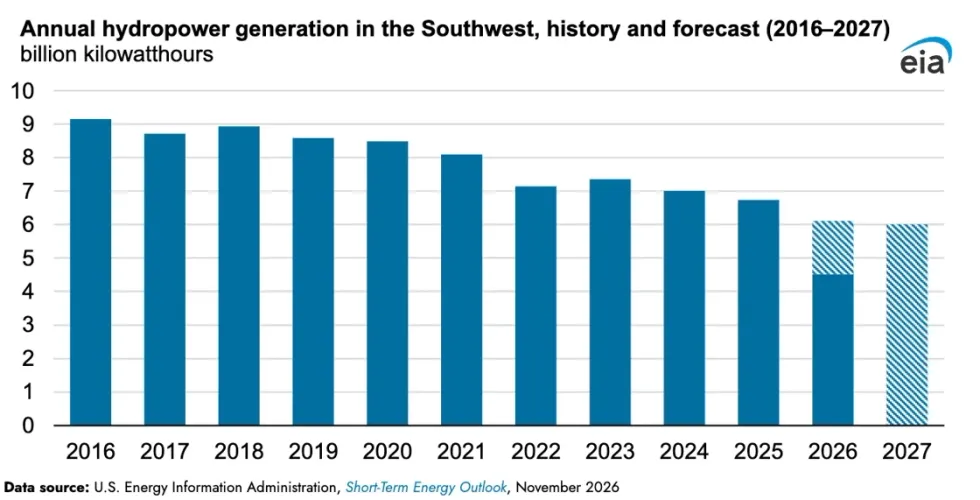 Evaporating. Chart: EIA