Microsoft is betting millions on the promise of some magic dust spread on a bunch of giant baking sheets stacked in 50-foot-tall towers to reverse the company's carbon emissions.
I’m being cheeky, but the truth is really not much more complicated than that.
Heirloom Carbon, a startup that has pioneered a method to absorb CO2 from the air using crushed rocks, just signed the tech giant to one of the biggest carbon removal deals to date. Microsoft has agreed to pay Heirloom to capture 315,000 metric tons of carbon from the atmosphere over 10 years. For a sense of scale, that’s equivalent to about 75% of the carbon Microsoft emitted in 2022 through its direct operations and energy usage. Neither company would disclose the price, but the Wall Street Journalestimated it would likely cost Microsoft a minimum of $200 million, “based on market prices,” or $635 per ton.
Climate scientists warn that we won’t be able to keep global warming in check solely by cutting emissions, no matter how rapidly the world acts to get off fossil fuels in the coming decades. Finding ways to pull what we’ve already emitted back out of the atmosphere and permanently sequester it can help balance out emissions from industries that might take longer to decarbonize, like aviation. In the long term, it could even cool the planet.
There are now hundreds of startups around the world racing to develop a variety of methods to do this. But many of them, including Heirloom, are still operating at a tiny scale, if they are even at the point of removing carbon at all. So this latest Microsoft deal stands out for signaling a high degree of confidence in Heirloom’s unique approach.
“Heirloom is quickly building a runway to low-cost CO2 removal at the gigaton scale,” a Microsoft spokesperson told me in an email. “This agreement accrues to our goal to become carbon negative by 2030 and remove our historic emissions by 2050.”
Heirloom harnesses the natural ability of minerals to absorb carbon from the atmosphere. The process starts with limestone, which is formed from the detritus of corals, clams, and other sea creatures that use the dissolved carbon and calcium in the ocean to build their shells. Heirloom grinds up limestone and does something that humans have been doing for thousands of years — heats it in a kiln. This loosens carbon dioxide from the rock, leaving behind calcium oxide, a white powder commonly called quicklime. The ancient Romans are believed to have done the same thing, using quicklime in the construction of many of their famous architectural marvels that are still standing today.
But Heirloom's modern kiln, which heats the limestone to about 1,650 degrees Fahrenheit, is electric, meaning it can run on renewable energy. Also, because no fuels are being combusted, the CO2 comes out in a pure gas stream that's easy to capture. Heirloom can either pump it permanently into underground wells, or inject it into long-lived products, like concrete.
This is only the first step. The real trick to Heirloom’s solution is what happens next. The leftover calcium oxide is “super thirsty for CO2,” the company's CEO Shashank Samala told me. “If you put that on your desk, it will start pulling out carbon.”
And that’s more or less what the company does. It spreads the powder on large trays stacked in 40- to 50-foot-tall towers, so that the maximum amount of surface area is exposed to the air. This, along with a proprietary bit of engineering that Heirloom has not disclosed, speeds up the material’s ability to absorb carbon even more. On your desk, it might take a year. In Heirloom's system, it takes a matter of days. Then the company pops the powder, which is now chemically similar to limestone, back into its kiln, and starts all over again.
 Stacked trays of calcium oxide at Heirloom's research and development facility in Brisbane, California.Courtesy of Heirloom Carbon
It’s already been a big year for Heirloom. The company was selected by the Department of Energy to receive funding for a commercial-scale plant in Louisiana under the federal government’s $3.5 billion Direct Air Capture Hubs program. Heirloom will fulfill at least some of its contract with Microsoft at that facility, and has plans in the works to build a second plant as well.
Giana Amador, executive director of the Carbon Removal Alliance, an industry association, told me the deal with Microsoft illustrates this positive reinforcing loop that’s happening between the public sector and the private sector, helping the industry to scale faster. She wants to see the federal government do more to set standards around what high quality carbon removal looks like, in order to encourage more deals like this from companies that maybe want to purchase carbon removal, but can’t afford to hire whole teams to vet projects the way Microsoft can.
Samala emphasized that the deal is significant not only for its size but for what he called its “bankability.” It’s “take or pay,” meaning Microsoft has to pay up as long as Heirloom delivers on its end of the bargain. Even though no money is exchanging hands up front, Heirloom can take this binding contract showing a predictable, durable, revenue stream to the bank, and use it to secure financing at a much lower cost than it would otherwise get from a venture capital firm.
Right now, much of the nascent carbon removal industry is being supported by venture capital. One of the obstacles to financing projects is that nobody knows what the business model will ultimately look like. Will this be a public service, like waste disposal? A regulated requirement, where polluters are asked to pay? Something else? And in the meantime, how do you raise enough money to scale your idea up to where you can credibly sell it?
The Heirloom deal shows the industry is increasingly looking to replicate the experience of early wind and solar projects. This long-term contract is similar to a power purchase agreement, where wind and solar developers finance new projects by pre-selling the electricity to corporations like Google or Walmart at a set price.
At 315,000 tons over 10 years, this isn’t the biggest carbon removal deal to date, but it may be the biggest for such a fledgeling company. The oil giant Occidental, which is building a facility in Texas designed to suck 500,000 tons of carbon dioxide from the atmosphere per year, has pre-sold 400,000 tons’ worth of carbon removal credits, over four years, to the aircraft manufacturer Airbus. In May, a coalition of tech companies signed a 112,000-ton offtake agreement, over six years, with a small startup called Charm Industrial, for $53 million. Charm is working to turn agricultural waste into oil that can be pumped underground.
Microsoft was an early investor in Heirloom through its Climate Innovation Fund, providing some of the company’s Series A funding last year. “They’ve seen this in the front row seats as we made progress from pulling grams of CO2 from a Petri dish to pulling kilograms and hundreds of kilograms, to tons and hundreds of tons,” Samala told me when I asked what he thought gave Microsoft confidence in the deal.
Part of it was also showing them that this solution is modular, Samala said.
“It helps to see that okay, you just need to build more of these stacks, more of these trays. If you want to pull more carbon, you stack more trays and you put more stacks of trays around."



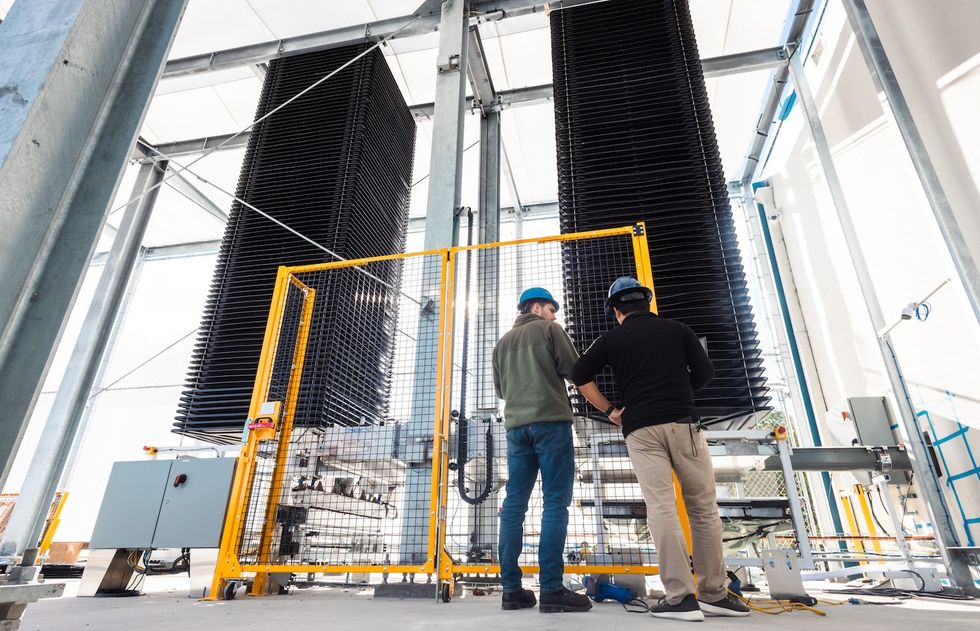 Stacked trays of calcium oxide at Heirloom's research and development facility in Brisbane, California.Courtesy of Heirloom Carbon