Before we jump into the survey, is the data center boom changing the trajectory for renewable energy development in the U.S.?
If you look back over the last decade and a half, the largest global procurer of decarbonized electricity has been the Big Tech industry. I think we’re still seeing the trendlines of that today. The speed and scale of data center development is driving a lot of incremental clean energy growth.
I think we’re really at a crossroads right now because of the speed to meet rising demand and because, as people are scrambling to find electrons, commitments previously around purchasing and procuring decarbonized electricity have slid a little bit. We’ve seen proposals over the last six months or so have roughly doubled for combined cycle gas. We’re at this crossroads: Are we going to leverage this moment to drive incremental clean and protect ratepayers in the process? That’s the only way we’re going to be able to build this infrastructure.
Or are we going to go another path where we’re locking in decades of combined cycle gas?
I think voters across the political spectrum think this is a very important issue, and people are thinking about this as we move closer to November.
Walk my readers through the survey experiment you ran with Data for Progress.
The impetus was that we wanted to demonstrate to any stakeholder in the world — a data center developer, a household concerned with their rising electricity bills, policymakers trying to meet this new energy moment — what Americans want, which is guarantees from data centers that their electric bills won’t increase. They want strong electricity grid upgrades. They want home energy upgrades like rooftop solar, heat pumps, storage systems, or battery walls.
We wanted to make the case. We’ve seen surveys recently that if you say you’ll power them with renewable energy, favorability will increase. We wanted to go a step further and set up an experiment to see the difference between what people say they’ll do and what they’ll actually do. Often there’s a difference when they’re faced with a real-life situation. Even when renewable energy support is high — even Republicans favor large-scale solar — then why do we have NIMBYism? Why do we have public opposition? Why are projects being phased out or canceled entirely because of protests? That’s because of a gap between what people say they’ll do and what they’ll actually do.
The first part of the experiment was a typical poll asking people how they felt and measuring what they said they would do. What people indicated was similar to other polls circulated widely and picked up by the press, that when you say a data center is powered by solar, people say they’ll be more favorable. But then we put them in a setting where we told them a data center in their community was going to be powered by either gas or renewables, and we had other treatment conditions that would be manipulated. We told them, for example, that there would be a rate-binding guarantee, that 100% of their costs would be paid for by the data center and their electricity rates would not go up. We also gave them conditions where they’d get residential solutions.
When we compared what people said they would do with what they actually would do, what we found was pretty definitive. Really, Americans indicated a strong preference that data center developers guarantee stable electricity rates or provide them with meaningful residential or community benefits. Those are really the only two things in a real-life situation that moved support for data centers.
What we didn’t see, actually, is that renewable energy powering the data centers alone was enough. It didn’t have enough statistical significance to improve data centers’ support on its own.
Now, connecting the solar to stable electricity rates or ratepayer protections, that’s helpful. Could we do that? Absolutely, and that’s a strong recommendation to think about centering communities because they want affordability. But the technology alone — solar versus gas — had a null effect.
It’s great to talk about solar, especially because there’s high favorability for solar. Connecting affordability to clean energy is a great strategy, and we hope tech companies take this to heart! The only way we’re going to build social permission for these technologies is to do it in a community-centric way that guarantees rates won’t increase and guarantees community benefits. We want to make sure people ask for all this in negotiations and that policymakers think about all this, especially federally as we think about permitting reform.
What’s the relationship to permitting reform?
I think it’s important that it preserves maximum ratepayer protections and large load tariffs. Thinking about that, as well as bringing-your-own-clean-energy, or BYONCE, is in great parallel with the findings. If we can deliver that through federal legislation, it’s something that would be supported by the data we gathered through this experiment.
Why was there no statistically significant difference between solar and gas?
I don’t think it’s a question of why people were agnostic about technology. I think it all just boils down to pocketbook-kitchen-table issues. We live in a cost of living crisis where upwards of 65% of Americans live paycheck to paycheck. The cost of everything from gas prices at the pump to groceries … When we look at the data and inflation and what it takes to build a home, its very clear the message the American electorate is sending is that affordability is the queen issue right now.
Until we meet demand in a community centered way and a ratepayer centered way, with maximum ratepayer protections and large load tariffs for these companies, we’re going to see incredible polarization across America where these data centers are being built.
What’s next, from a research perspective?
I think there were a few surprising things we found in the data we want to dig into.
For example, there’s been talk of spillover opposition — that by associating solar with data centers, we might pollute public opinion around solar. We actually asked questions in the survey experiment about this and so far, solar hasn’t been tarnished by data centers. It showed zero spillover. It does not drag down favorability for solar.
We also found that Americans trust renewable energy developers second only to consumer watchdogs, which we found to be fascinating. By contrast, they trust data center developers the least. In other words, choose to pay for a decarbonized electron if you can because associating yourself with clean, fast-to-power electrons has a true positive association there. It’s in the data.
One last one: Artificial intelligence and public opinion about AI was the top driver of opposition to data centers. It was feelings about AI as a technology superseding personal ideology and backgrounds, even if they cared about climate change. Skepticism about AI and data centers isn’t a partisan issue. Anti-AI sentiment sits evenly across Democrats, Republicans, and independents alike.



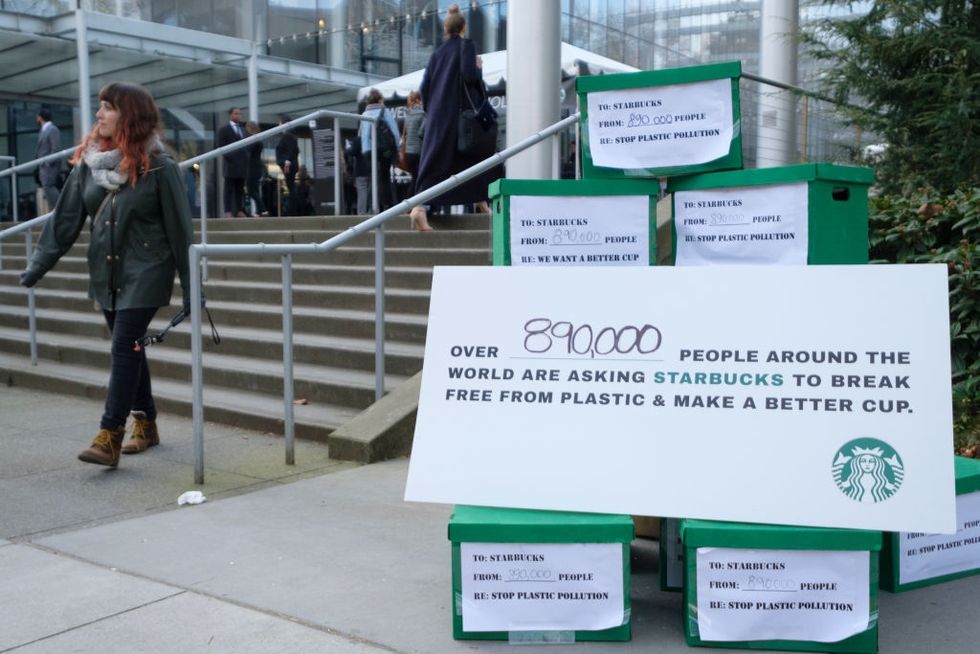 Venti ambition with tall execution.Stephen Brashear/Getty Images

 Збогом! Pedja Milosavljevic / AFP via Getty Images