You’re out of free articles.
Log in
To continue reading, log in to your account.
Create a Free Account
To unlock more free articles, please create a free account.
Sign In or Create an Account.
By continuing, you agree to the Terms of Service and acknowledge our Privacy Policy
Welcome to Heatmap
Thank you for registering with Heatmap. Climate change is one of the greatest challenges of our lives, a force reshaping our economy, our politics, and our culture. We hope to be your trusted, friendly, and insightful guide to that transformation. Please enjoy your free articles. You can check your profile here .
subscribe to get Unlimited access
Offer for a Heatmap News Unlimited Access subscription; please note that your subscription will renew automatically unless you cancel prior to renewal. Cancellation takes effect at the end of your current billing period. We will let you know in advance of any price changes. Taxes may apply. Offer terms are subject to change.
Subscribe to get unlimited Access
Hey, you are out of free articles but you are only a few clicks away from full access. Subscribe below and take advantage of our introductory offer.
subscribe to get Unlimited access
Offer for a Heatmap News Unlimited Access subscription; please note that your subscription will renew automatically unless you cancel prior to renewal. Cancellation takes effect at the end of your current billing period. We will let you know in advance of any price changes. Taxes may apply. Offer terms are subject to change.
Create Your Account
Please Enter Your Password
Forgot your password?
Please enter the email address you use for your account so we can send you a link to reset your password:
On simplified oil and gas leases, lawsuits over plastic and coal, and a new climate research database
Current conditions: The U.K.’s Met Office issued its second-ever Red Extreme Heat Warning for Wednesday and Thursday • A wildfire near Eureka, Utah forced the town’s evacuation • Flash flood warnings are in effect today for Southern Massachusetts.
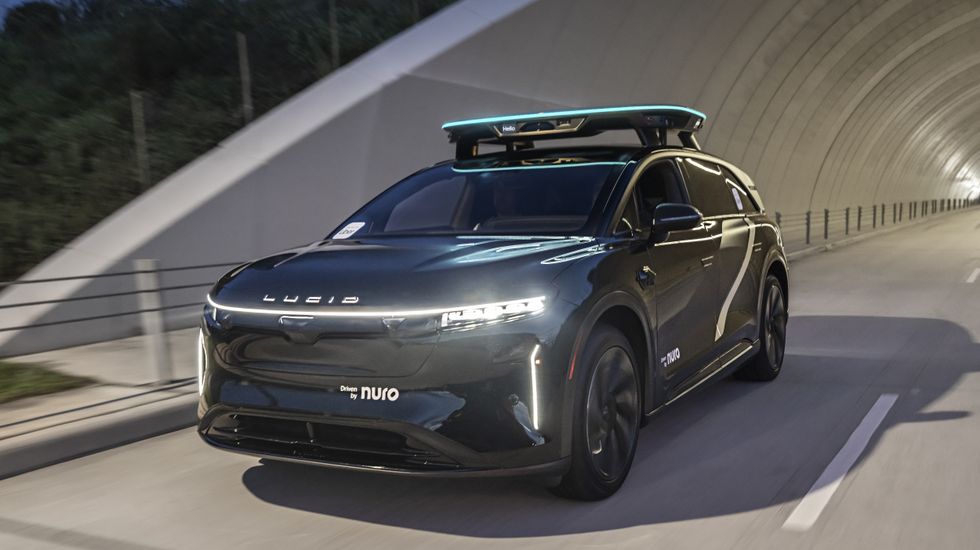
Lucid Motors is downsizing, again. The electric vehicle maker is laying off 18% of its staff just a few months after a 12% reduction in force in February, according to Electrek. The company also eliminated a second production shift at its factory in Casa Grande, Arizona. EV sales plummeted in the U.S. after the federal EV tax credit expired in September. While many automakers are canceling new electric vehicle lines in the U.S., Lucid hasn’t axed any plans yet, and will be releasing its first lower-cost EV, the Lucid Cosmos SUV, later this year with a price tag under $50,000. It’s also preparing to launch a robotaxi service later this year in partnership with Uber and the autonomous driving technology company Nuro. According to Lucid’s new CEO, Silvio Napoli, the staff cuts will help “simplify the company, sharpen execution, and position Lucid to become more competitive over time.”

Trump’s environmental deregulation crusade continues. The Interior Department proposed several changes to the rules governing oil and gas leasing on federal lands Monday that would limit public input and cut costs for companies. Under existing rules, which were updated during the Biden administration, companies must maintain a minimum bond of $500,000 for each state where they hold leases to cover the cost of capping oil and gas wells when they are done drilling. Trump’s proposal would reduce the requirement to $25,000, shifting the financial risk of remediation to state taxpayers. The new rules would also shorten public participation periods from 90 days to 10, and get rid of a requirement that companies include plans to minimize methane emissions when they apply for drilling permits.
Red states are going after California, this time for its nation-leading plastic regulations. In 2022, the Golden State passed a law setting plastic waste reduction targets and requiring companies to cover the cost of recycling of their own products. The state aims to cut single-use plastic packaging on products by 25% by 2032. Now, 17 attorneys general from red states have teamed up with the National Association of Wholesaler-Distributors, a trade group, to sue California, arguing that the rules represent an “unprecedented overreach” that will increase the cost of goods throughout the country.
Sign up to receive Heatmap AM in your inbox every morning:
In the first case of its kind, 10 Australians are suing the government for violating their human rights by failing to limit fossil fuel production. The claimants, each of whom has been personally affected by climate change-fueled extreme weather, brought the case to the United Nations’ Human Rights Committee on Monday. Some of them have lost their homes to wildfires and floods, while others have experienced health impacts from heat waves. The case follows a 2025 ruling by the International Court of Justice that all governments have an obligation to protect people from climate change, citing support for fossil fuel production and consumption as a potential violation of this obligation. While that ruling didn’t have any enforcement power, it teed up the potential for country-level claims like this one in Australia. The country is the second largest exporter of coal in the world and the third largest exporter of liquified natural gas.
The rumors were true. The Trump administration has appointed Travis Kavulla, a former utility regulator and power company executive, to lead the Bonneville Power Administration, a federal agency that sells electricity from the government’s hydroelectric dams in the Pacific Northwest. Kavulla arrives as the agency prepares for a controversial exit from California’s real-time electricity trading market to join a new day-ahead market overseen by the Southwest Power Pool, a regional transmission organization. Environmental groups are urging Kavulla reconsider the decision, arguing that it risks raising energy costs for Northwest ratepayers.
The climate change research and news site Carbon Brief debuted Project Cosmos on Monday, the world’s largest database of research on the warming planet. It includes more than 1.8 million publications and “captures the vast body of human knowledge about climate change that has accumulated over more than a century of academic study.” The architects created a stunning “star” map that visualizes the collection by clustering of fields of study, such as medicine, chemistry, or agriculture. They also identified the 500 most-cited studies and scientists, with French carbon cycle modeler Philippe Ciais earning the top spot.
Log in
To continue reading, log in to your account.
Create a Free Account
To unlock more free articles, please create a free account.
Socialism has found a natural home in America’s cities, but perhaps not for the reason you think.
Socialists are rising in American cities.
It’s not just Mayor Zohran Mamdani in New York City — though he is the most popular and charismatic example. Janeese Lewis George, a member of the Democratic Socialists of America, just won the Democratic mayoral nomination in Washington, D.C. Nithya Raman, another DSA member, will take on the incumbent Karen Bass in Los Angeles’ mayoral race. And on Tuesday, Democratic primary voters across New York will vote on a handful of Mamdani-backed socialists running for Congress.
What’s driving the popularity of urban socialism? The answer matters for climate policy — and much else, of course. You could argue it’s all downstream of demographics: As liberals have flocked to cities, they have pushed the political climate to the left, and sometimes that can erupt into outliers; New York elects socialists, in this model, for the same reason Tennessee picks libertarians. Or you could claim it’s part of a broader and more global shift, of voters turning away from a seemingly dead center to political extremes.
None of these frameworks quite suffices. For one, as New York Times columnist David Wallace-Wells observed recently, New York was trending to the GOP before it elected Mamdani. (It had the biggest Republican swing of any state in the 2024 election.) The trend, too, is a national one. Instead, he argues, “it is in cities that voters most routinely encounter, and thereby come to value, public goods.”
But I want to offer another explanation for why the current version of socialism has found such fertile ground in urban politics. Perhaps it’s my curse to understand all politics through the lens of climate and energy. But I think it’s relevant here: While recent elections have not been about climate per se, many of the socialists now in power initially came to their politics because of the urgency of decarbonization. Mamdani himself once identified as an “ecosocialist,” and Raman was first elected promising to get L.A. to carbon neutrality by 2030.
The story begins in November 2018. After securing her unlikely primary victory against an incumbent Democrat, Representative-elect Alexandria Ocasio-Cortez cemented her national profile by joining an activist group called the Sunrise Movement for a sit-in in Nancy Pelosi’s office and demanding something called a Green New Deal.
What a Green New Deal might entail, exactly, nobody seemed to know. Even the Green New Deal’s supporters called for little more than a select committee to develop a “detailed national, industrial, economic mobilization plan” to phase the country off fossil fuels. But a think tank called New Consensus, led and funded in part by Ocasio-Cortez’s then-chief of staff Saikat Chakrabati, declared that it would flesh out the proposal.
Soon a vision congealed. The idea had long referred to the journalist Thomas Friedman’s broad, patriotic, and vague plan to “to revitalize America.” New Consensus’ website made it clear that the new vision, too, aimed for national rejuvenation: A Green New Deal would be a galvanizing industrial strategy that would decarbonize the economy, put young people back to work, and ensure American greatness for another century. It was all about “industrial policy, industrial policy, industrial policy,” one of the group’s researchers told me.
That moment soon collapsed. Political ineptitude was partly to blame. In early 2019, Ocasio-Cortez published a document that jocularly implied the Green New Deal aimed to eliminate “cow farts and airplanes,” cratering its popularity. But the proposal’s demise was also because the plan’s inherent left-wing patriotism was not palatable to the movement itself. National rejuvenation, it turned out, was not an acceptable goal to the left’s anti-imperial flank, which on its own had the power to destroy any Green New Deal coalition.
And so over time, the left’s climate vision — and the “Green New Deal” that groups like Sunrise clamored for — became anti-imperial. Instead of revitalizing the country’s industrial might, it sought to pacify and dismantle the military industrial complex. Instead of putting young men to work building batteries and electric vehicles, it aimed to create a new socialized economy centered around “care work” — care for children, care for the elderly, care for the natural world.
This transition was partly rooted in objective economic analysis — manufacturing really is becoming less labor-intensive, while healthcare and child care are gobbling up Americans’ incomes — but partly in a more ideological revulsion at the idea of American power itself. If you see the United States not as a flawed, fraught, but fixable actor in global politics, but as a failing empire upholding a disastrous and criminal global order, then any policy that strengthens the country’s economic base is impermissible and evil.
Why do I bring all of this up now? Because it creates political problems the movement has never figured out how to resolve at the national level. Take Darializa Avila Chevalier, for instance, a Mamdani-backed DSA candidate running in New York’s 13th congressional district. Chevalier seems to oppose the modern system of states in any recognizable sense. In a (since deleted) 2019 post, she tweeted that a “world without borders” is “necessary” and “the only moral way forward.” Even in a recent interview, she was so uncomfortable with the state’s power of coercion and incarceration that she declined to affirm murderers should go to jail. Yet she still wants what only a state can provide; her big issues are universal health care and a $15 minimum wage.
Many new leftists find themselves in her position: They want the fruits of a strong state while remaining fundamentally suspicious of states themselves. That can make them skittish and unreliable partners in any national progressive coalition — many young leftists simply don’t trust that even extremely progressive policy will redound to their benefit. (This centripetal force is part of what tore apart the Biden coalition, even before October 7.)
Cities, however, don’t have this problem. They are powerful governments that are not sovereign states. They lack a military, a currency, a central bank, and a foreign policy. From the anti-imperialist’s perspective, there is little risk in making city governments stronger. In this way, so many of the tensions inherent in the Green New Deal and other late 2010s progressive politics are much better suited to cities. Urban politics is a much more natural home for the 2010s left, and its contradictions, than the federal government.
After all, many ecosocialists never quite knew how to feel about patriotism or what the United States should be. (Many might profess doubts about whether the United States should exist at all.) But they know what they want Brooklyn, or Los Angeles, or Oakland to be, and their vision — of a high-tax polity with abundant public leisure, mass transit, and zero-carbon electricity — is much closer to reality in cities, anyway.
It helps, too, that in an era where negative news predominates, cities are small enough for people to feel some pride in them. Nobody experiences “the United States” as anything other than a quasi-mediated phenomenon. Our vast, beautiful, and complicated country of 345 million people is simply too big to keep in our heads.
But New Yorkers experience New York City every day — we shop, work, ride the subway, walk in the park, go to parades, and meet strangers often enough to identify with the reality of this 8 million person city. As a longtime veteran of New York City politics pointed out to me in private after Mamdani’s win, Mamdani ran an extremely patriotic campaign. It had a confidence in the virtue of the New York City experiment that socialists would never extend to the American experiment. You could even argue that the flush of adoration for the patrie that the French felt in the 1780s, as they read a newly liberated press, might not be so different from what New Yorkers feel when they watch an Instagram reel celebrating Knicks in five.
In any case, socialists soon might have to confront these contradictions: As mayor, Mamdani has adopted an essentially status quo approach to the NYPD; if his chosen candidates win in congressional primaries on Tuesday, then they will discover their own willingness to compromise. But even that will be, in a sense, a luxury. Chakrabati, after leaving Ocasio-Cortez’s camp, ran his own campaign for Pelosi’s old San Francisco seat this year. He came in third place with 18% of the vote.
Director Josh Fox on his latest film, The Welcome Table, plus Shakespearean comedy and the New York Knicks.
After images of oil-slicked waterfowl and marching protesters, there is perhaps no visual more representative of the fossil fuel crisis than the flaming faucet in Josh Fox’s 2010 documentary GasLand. The film, which investigated how the fracking boom pollutes local communities, memorably included a scene of a man lighting his kitchen tap water on fire as methane spewed out through the contaminated water line. As one reporter wrote several years after its initial release, GasLand was the film that made “fracking” a household word in the United States.
Over 16 years and about a quarter of a million more American oil and gas wells later, the climate crisis caused by human use of fossil fuels has grown ever more acute. The emissions from burning those hydrocarbons have made the weather more extreme and unpredictable, of course, but they’re also reshaping the human landscape. In 2021, a team of international scientists published a report warning that a third of the world’s population, some 3.5 billion people, may be forced to leave their homes over the next 50 years due to the increasingly hot and unstable climate.
Even as it’s become more critical to make room for these new climate refugees, anti-immigrant politics have gone mainstream around the world. Studies have shown that both Republicans and Democrats become more xenophobic after learning about climate migration, while the annual refugee admission cap is now just 7,500 in the U.S., down 85% from its peak of 50,000 during the first Trump administration.
This week, Fox returns with a new documentary, The Welcome Table. In the film, which will be released on HBO, he travels around the globe, visiting communities in decline — places where the physical catastrophes and political climates have converged to make it impossible to continue living. But as he and I discussed in our conversation below, this story is not a tragedy; rather, Fox aims to answer how we can set the table and embrace neighbors who’ve lost their homes. And here’s the good news: It involves a lot of fun.
Our conversation has been lightly edited and condensed.
Reportage on climate migration almost always focuses on the people who are migrating. What struck me about your documentary was its emphasis on the other subject in this relationship — the people and communities who either receive or exclude the refugees. Can you tell me how you arrived at that starting point?
Well, I’ll tell you a funny story. I first started working on this in 2019 because I was so outraged at the policy of child separation. I went down to El Paso — which you see in part of the movie — to investigate issues of the border. I originally thought of the movie as The Border Table, where we were going to put a table on the border for people to come to from both sides, and we were looking for a section of the border that didn’t have a wall.
I quickly realized that the issues around the border were not my wheelhouse — it is its own subject — and I wanted to focus more broadly on the climate. I was doing an event for Bernie Sanders’ 2020 campaign where I was called to go to Columbia, South Carolina, with Nina Turner, Dr. Cornel West, and Bernie to talk about water issues. My flight came in, then Dr. West’s, and it was like 10 at night. We got in a rental car with Heather Gautney, who’s also an amazing activist. There was no place to eat — everything was closed — so we’re sitting in the back of a rental car, myself and Dr. West, and eating McDonald’s, and he’s like, “What are you working on?” And I said, “Well, we’re working on this film called The Border Table.” He goes, “Oh, well, you know, James Baldwin’s last book was called The Welcome Table, but nobody’s ever read it. He never finished it.” And I thought: The Welcome Table, The Welcome Table… That’s interesting, it’s a better title.
Then I was down in New Orleans, and I went to one of my favorite clubs and saw John Boutté. John and I immediately hit it off. He knew my work. He signed one of his records, and lo and behold, I look on the record, and there’s the song: “The Welcome Table.” Immediately I thought, Well, this movie has to start with John Boutté. From the moment I met him, I felt that there was this weird destiny that was happening.
I said, “John, I want you to sing this song to an empty table on the top of the levee, and at the end of the movie, you’re going to sing the song with 1,000 people at a 1,000-foot-long table, and we’re going to show the Welcome Table as this symbol of togetherness and generosity.” Because my question was, What’s the opposite of a wall? What’s stronger than this xenophobia, this racism, this hate, this militarization? Is there anything stronger than that fascist ideology? And I realized that a wall on its side can be a table. The wall is just a metaphor.
So The Welcome Table is essentially a movie about a song. It’s a movie about imagining a future where we can sing and not get tired, where we’re in a beautiful city and have a place at the table.
In a 2023 interview, you described The Welcome Table as a Shakespearian comedy. I’m curious if you still feel that way and can explain it?
All climate movies are tragedies. They’re about the tragic flaw of this civilization, how we’re all doing ourselves in. A comedy is where everybody gets married at the end. That’s what happens at the end of As You Like It, Twelfth Night, The Two Gentlemen of Verona. At the end of Hamlet, there’s just bodies all over the floor.
To me, that table with 1,000 New Orleanians celebrating, waving handkerchiefs, second lining, having the band — it is a sort of marriage, right? I mean, at every wedding in New Orleans, you have one of those bands. To me, it’s a marriage of true minds; it’s a marriage of our communities; and it’s a question of finding our solidarity and our togetherness. The idea is that we have to be bound to each other.
It’s also a hell of a lot more fun.
You note that climate migration would be the greatest mass migration in human history, with a third of the world projected to move in the next 50 years. But the Welcome Table is already pretty crowded at the end of the movie. How do you navigate that tension in climate storytelling — saying both “this is urgent and happening now” but also “it will also get worse”?
My last film on HBO was How to Let Go of the World and Love All the Things Climate Can’t Change [in 2016], in which we trace the path to 2 degrees Celsius and how dangerously close we were at that time. Now things have gotten worse. We include a climate science update midway through The Welcome Table, which is very dire.
But I think this is probably one of the first movies to deal with climate change as it’s happening now. It’s not saying, in the future this will happen, like An Inconvenient Truth. No, this is a fire right now. We’ve never had conditions that are this hot or this dry. This is a giant mega-storm, back-to-back Category 5s flattening the Virgin Islands. This is a famine that’s been going on for seven years because it hasn’t rained in northern Kenya. This is landslides where you have a whole year’s worth of rain drop in 12 hours and the mud buries whole neighborhoods alive.
This is climate change happening to us right now. It’s not predicting a dire future; it’s showing the one that we predicted 10 years ago.
A recurring pattern in the film is that climate migration doesn’t necessarily mean leaving one’s country, but could mean moving a town or neighborhood or two over. Can you talk a little more about how this was still a traumatic upheaval for your subjects, and why you include those stories alongside the more traditional images of refugees on boats or at the southern border?
If you think about New Orleans after Katrina, they lost half their population to elsewhere. And there is no place like New Orleans anywhere on earth. So you are losing something really fundamental to who you are. And, you know, it’s not as if when Paradise, California, burns down, they’re like, “You can set up your place in Chico! We have tons of empty houses and buildings and money and love for you!” No, it’s: Go [expletive] live in your car. So the idea that you’re a climate refugee doesn’t necessarily mean that you’ve had to cross borders. It just means you’ve lost everything.
I wanted to make the point that the Convention on Refugees defines refugees as people who are oppressed because of politics or because of identity or economic hardship or political violence, but it doesn’t include climate change. And it really should. Climate change should be a reason you can declare asylum, because climate change also makes all of those problems way worse.
I was extremely moved by the fact that many of the people extending their hands to refugees in this movie have faced their own forms of rejection and exile, like the members of the queer mutual aid network that comes together organically in Brazil. But how do we get through to the people who are comfortable in their lives? Yes, there are many empathetic, good people, but I also worry there are many scared, small-minded people, too.
I don’t know how to answer that question in general, but I do know from experience that when we were working on fracking issues, it was the moms who were terrified that their children were going to be poisoned by the chemicals in the water and in the air. Those moms were the backbone of our organizing and our audience, and they were fierce in defending their children’s futures. I think what has to be gotten across is that same generational obligation.
One of the things that we cut out of the film, for time, that I’m sad about is: In Paradise, California, and in Boulder, Colorado, where we covered those fires, the rent goes up 300% after the fire. So your $800 apartment is now a $2,400 apartment. But also, nobody should move to those places. They’re going to be contaminated for decades. Everything you have in your house is basically toxic because of the oil industry, and it becomes 10 times more so if you light it on fire, then pour fire retardant sprays on top of it, which are also carcinogens. Then it rains, and all that’s in the water table. There will be cancer clusters in those fire neighborhoods if people move back into them. It’s so serious that I won’t go to one of those places for more than a couple of hours, and I’m wearing a respirator mask.
And we’re not being upfront about that. Get parents involved and understanding that the legacy of their children means that they have to stop using fossil fuels, and we have to dismantle this system of fascism to do it. They are interrelated. Oil is the blood of climate change, but it’s also the blood of this extractive capitalist system.
Do you have any final thoughts you want to leave with our readers?
I would like to see this 1,000-foot-long Welcome Table brought to cities across America and around the world. It’s not just a scene for the movie; it’s a template for our activism. We’ve got to get really good at welcoming people, because either we’re going to be on the move ourselves because we’ve lost our homes due to climate, or we’ll be welcoming those who’ve lost their homes. One way to do this is to practice singing together, hanging out together, and having a good time.
If there’s anything this week in New York City, and my beloved New York Knicks, have gone to show, it’s that collective joy is possible. We don’t need to win a basketball game to have that, though, and that’s what The Welcome Table shows: Collective joy for the sake of collective joy. Coming together to celebrate migration, to celebrate the crisis, to celebrate how, as human beings, we have this ability to sing, dance, and move — boy, that’s a fun time. Our side is more fun. A wall on its side can be a table, and it’s time to envision a different future.
On Michael Bloomberg’s big climate gift, SMRs in Ohio, and the consequences of a “Super El Niño”
Current conditions: Temperatures in the United Kingdom should break 100 degrees Fahrenheit this week • Heavy rain and thunderstorms are forecast to hit the East Coast later today, potentially affecting World Cup matches in Philadelphia and New Jersey • Thousands were left without power after storms in Oklahoma.
In the early hours of Monday morning in Switzerland, mediators from Pakistan and Qatar announced that talks between the United States and Iran had ended after making “encouraging progress.” Now, a “High Level Committee” will attempt to iron out the specifics of a deal over the next 60 days, covering tense issues such as nuclear enrichment, sanctions, and Israeli military actions in southern Lebanon. The statement also said that a “communication line” had been set up “to avoid incidents and miscommunication with the aim of safe passage for commercial vessels through the Strait of Hormuz.”
The agreement followed several days of confusion over the state of the waterway. While Iran declared the strait closed over the weekend in protest over Israeli actions in Lebanon, a U.S. military spokesman told The New York Times, “Iran does not control the Strait of Hormuz. Traffic continues to flow, and U.S. forces are monitoring the situation to ensure this remains the case.” Meanwhile, Iranian officials have said their own exports are receiving waivers from sanctions, and that a U.S. blockade is no longer in effect. “Oil and petrochem exports are waived, blockade lifted, some frozen assets released, and major reconstruction & development plan launched for Iran,” Iran’s foreign minister Seyed Abbas Araghchi posted on X Sunday evening.
Initial results in Colombia’s presidential election showed Abelardo de la Espriella, the right-wing candidate allied with Donald Trump, winning office against his leftist opponent, Ivan Cepeda, an ally of outgoing President Gustavo Petro. While the campaign largely revolved around issues related to drugs and crime, de la Espriella has also pledged to support the country’s fossil fuel industry, including support for fracking and expanding overall oil and gas production. Petro, by contrast, “sought to wean the Andean nation off fossil fuels by halting new drilling licenses and seeking to ban fracking,” Bloomberg reported. Petro’s environmentalist bent chilled outside investment in the oil and gas sector, which is still Colombia’s No. 1 exporting industry.
China’s Commerce Ministry targeted two favored U.S. rare earth companies with export controls on Monday, Bloomberg reported, adding American mineral producers MP Materials and USA Rare Earth to its export control list. The two companies were among 10 added to the list, Chinese state news agency Xinhua reported. “Organizations and individuals from any country or region are prohibited from transferring or providing dual-use items originating in China to the above-mentioned entities. Relevant ongoing export activities shall be immediately halted, according to the statement,” Xinhua said. Earlier this month, the Pentagon added several Chinese companies to its own list of companies known to support the Chinese military. These included tech giants Baidu and Alibaba, as well as the electric vehicle company BYD. This designation comes with restrictions on the companies’ commercial relationships with the Department of Defense.

The two companies have been the recipient of billions of investment and largesse from the federal government as the U.S. seeks to build up a rare earths mining and processing industry that’s no longer reliant on China, which dominates the sector. MP Materials has received a combination of direct investment, financing, and purchase commitments for its neodymium-praseodymium production and output. While the Trump administration has shown little interest in catalyzing the wind and electric vehicle sectors (both of which use neodymium-praseodymium oxide in their electric motors), the defense industry is a major customer of MP Materials’ rare earths products. USA Rare Earth has received over $1 billion in federal investment.
Sign up to receive Heatmap AM in your inbox every morning:
It’s not just the risk of a West Coast hurricane — the return of the El Niño weather system could portend a “mini-Dust bowl” in the Midwest. AccuWeather forecasters warned over the weekend that there’s a 70% chance already-present El Niño conditions in the Pacific Ocean could develop into what’s known as a “Super El Niño,” characterized by ocean surface temperatures 2 degrees Celsius hotter than average. Though El Niño is notorious for sending extreme rain into the southern U.S., it can also cause drier conditions further north. Combined with the extremity of this year’s projected temperature anomaly, that could lead to a multi-year drought in the Midwest. “The stronger the upcoming El Niño conditions get, the longer it takes for weather patterns to return to their historical average,” AccuWeather senior meteorologist Paul Pastelok explained. Already several Plains and Mountain West states are in “extreme drought,” and the El Niño could set the table for even more dry weather to come.
Michael Bloomberg, founder of financial news service Bloomberg LP and a prolific climate philanthropist, announced a $285 million commitment on Sunday “to help clean energy scale fast enough to power the world’s energy systems,” according to a press release from his charitable organization, Bloomberg Philanthropy. The gift is aimed at accelerating wind and solar deployment both in developed and emerging markets, with the goal that the two technologies should “generate more than half” of electricity in countries responsible for 70% of global emissions. The money will support trade groups for the wind and solar industry, data collection and analysis efforts to demonstrate wind and solar’s capabilities and costs, technical assistance to set up electricity markets in a way that encourages wind and solar deployment, and working with investors and financial institutions to “help unlock private capital for clean energy infrastructure.”
The substantial gift toward two mature technologies stands in contrast to other climate and philanthropic investment approaches (like, say, Bill Gates’) that focus on “breakthrough” technologies that are not currently widely deployed, or may not even exist at all. Bloomberg’s gift comes after Gates closed his main climate giving vehicle’s advocacy and policy shops early last year, and later issued a memo outlining a “strategic pivot” to focus more on global public health and extreme poverty.
Developer Elementl says it will build a new 1.5-gigawatt nuclear plant 100 miles outside Columbus, Ohio. The twist: It’ll be powered by small modular reactors. The proposed plant would features several BWRX-300 SMRs made by GE Vernova Hitachi Nuclear Energy, a design that has also been favored by Ontario Power Generation at its first-on-the-continent SMR facility. Elementl said in a press release Friday that it expects to hear back from PJM Interconnection later this year about interconnection, which would set up the facility to be in service by 2034.
Editor’s note: This article has been updated to correct the location of a potential “mini-Dust Bowl.”