You can also add the show’s RSS feed to your podcast app to follow us directly.
Robinson Meyer:
Hello, it’s Monday, November 23. You know, longtime listeners will remember that back in the spring of 2024, I think it was April, and it was the 10th episode of this show ever, we did an interview with the AI, energy and computing expert Jonathan Koomey. It was really informative. We should have him back. But my takeaway from that conversation was that there were still back then lots of reasons, very rational reasons to be skeptical that AI was about to explode as a major new energy user in the economy. Well, there were good reasons, there were bad reasons how wrong I was. Because as we now know, AI has exploded as the biggest trend in the American economy, at least up until a few weeks ago. The International Energy Agency’s newest outlook, which came out just last week, says that computing’s energy demand is going to double globally by 2030, and AI data centers will drive 75% of that increase. Of course, in the US, data centers have become a major issue. One of our regular heat map polls went viral over the summer. You probably saw it. We found that 75% of Americans would oppose or strongly oppose a data center being built near where they live. A massive shift, a more than 40 point shift from where things stood a year earlier. And I actually think the broader importance of what’s happening here is potentially understated. Obviously, artificial intelligence is extremely important. Depending on who you listen to, it could be existentially important. Obviously, the data center opposition that currently exists is a huge deal. I don’t necessarily expect it to hold up forever, although it could. But the emergence of a new, legitimately industrial-scale energy use across the economy that, even if the financing at the moment is confused or doesn’t always make sense, does seem to be economically valuable, is a huge deal for the global economy and the global energy system and climate change. And it suggests that computing’s share of global energy use is going to continue to rise, even if it continues to get more efficient over time. Well, someone who’s been thinking a lot about this and other questions recently is former federal energy regulator, Alison Clements. She’s now a principal 804 Advisors, but she previously served on the Federal Energy Regulatory Commission, that is FERC, from 2020 until 2024. Before that, she was at the Natural Resources Defense Council, where she led the Sustainable FERC project, and before that, the Energy Foundation. As you may know, she’s also the host of our newest podcast here at Heatmap. Allison has spent the past few months talking to folks who have encountered the data center and AI boom head on as municipal officials, state regulators, power grid operators, utility executives, data center developers, and activists and advocates. And she’s all asked them one question. Is it possible to develop data centers in a responsible way? Well, what she learned is the subject of her new podcast here at Heatmap. It is called Load Bearing. And I have to say, I love this name. And just to explain it briefly, in case you don’t fully get it, and this is the only time I’ll do this, I’m sorry. Data centers are sources of major new load, which is the kind of term of art we use for new load on the power grid. And also load bearing is this phrase that for whatever reason, Claude, the anthropic AI tool, absolutely loves to use in its writing. And so this all together combines for the perfect podcast name, load bearing. I wanted to hear what Allison is thinking about and how this episode has maybe changed her mind for a little while. And so today we have for you a special crossover episode of Shift Key and Load Bearing. And the guest is, of course, none other than our newest podcast host, Allison Clements. We’re going to discuss what she learned from this project, what surprised her, and what it may mean for the future. Of course, if this discussion intrigues you, then you should go find Load Bearing on Heatmap. News or wherever you get your podcasts and subscribe. We’ll also link to it, obviously, in the show notes. I’m Robinson Meyer, the founding executive editor of Heatmap News, and it’s all coming up on this special crossover episode of Shift Key and Load Bearing. Alison Clements, welcome to Shift Key.
Allison Clements:
Thank you for having me, Rob. It’s nice to be here.
Robinson Meyer:
It’s so nice to have you. It’s also fun because we use the same digital recording studio. And so there have been times I’ve like peeked in and then you were still recording your show. So I’m very happy that now we have been formally united in this show, on our both of our shows, really at the right time and can finally have a conversation.
Allison Clements:
Absolutely. Shout out to Nick for putting this all together.
Robinson Meyer:
Shout out to our beleaguered and much overworked producer, Nick, who’s listening to this right now. I remember when you approached us with the idea for what became load-bearing, and it was so exciting because it felt like this data centers are one of those topics. Of course, now it’s the biggest trend and biggest story in the economy. But even when we started Heatmap, I mean, Nico and I joke about this, Nico, our editor-in-chief, and I joke about this, in that, you know, when we started Heatmap, we did not think we were going to spend so much of our time thinking about data centers. So... When did you start realizing you were going to start thinking about data centers so much? And then how did it get you to making load-bearing?
Allison Clements:
No kidding. Who knew how many times a day we would have to say those words? You know, when we first started talking, it was about six months ago. And I had just been to this data center conference in Ann Arbor. And I had heard real people from real life talking about the challenges they were facing in the state of Michigan related to two different data center proposals. And I was like, this is incredibly fascinating. We were just putting large load tariffs in place. I mean, jumping just six months forward, so much has happened. And I never wanted to, you know, catch another political juggernaut of a football in my life after my time at FERC, which is the reason when I left FERC, I thought, wow, this data center thing seems to be coming on strong, new large load growth. That’s pretty exciting for an energy wonk like me. So I’m going to go figure out what the commercial structures are, how these projects are getting financed, what the ecosystem of market players is. And that was the beginning.
Robinson Meyer:
It would almost even be worth going back to your time on FERC because you left in June 24, right?
Allison Clements:
Yep.
Robinson Meyer:
And so I feel like by then we kind of knew that load growth changed. Was going to be ending soon if it wasn’t already ending. But I think we thought that the main driver of that would be just normal economic growth and electrification and manufacturing and EVs, not what has turned out to be the colossus of mid-2020s load growth, which are data centers in computing. How are you thinking about computing-driven load growth or just load growth generally?
Allison Clements:
So two weeks before I left FERC, there was a filing where Susquehanna, which was owned by Talon and then Cumulus was selling a data center development campus to Amazon. They wanted to do behind the meter. They brought the filing to FERC and there were challenges to the filing because there wasn’t going to be a front of meter connection for the data center. And therefore they were bypassing certain charges that all customers get charged on the grid. So that was the start of this whole conversation for regulators at the federal level. So then I leave FERC and I take six months off and I have a little bit of FOMO and everybody gets back from the summer NARUC meeting, and they are all talking about load growth. So this has struck the state regulators at the exact same time. And they’re all kind of wide-eyed telling stories about the conversations that they had that summer related to load growth. So that was two years ago. And that’s where I think we all started realizing we better start running to catch up with this train. Clearly data center and data center development becomes this huge issue. It becomes is a major thing we cover at Heatmap. I mean, frankly, I think as we’re seeing with Baja now, with the bipartisan permitting reform bill now, it becomes the biggest story in energy policy.
Robinson Meyer:
What are you setting out to do in load-bearing, and what were your goals with that project?
Allison Clements:
So two years ago, I started working on data centers based on this understanding that I needed more of a commercial perspective in order to make good policy recommendations. So I start working with data center developers and realize what my job was, was translating a lot, translating from tech and from data center development speak into power and back. And I found that fun, right? Like people need to understand each other. I could see a lot of the inefficiencies at the transactional level all the way up through the policy level because people were kind of talking past each other. Reliability meant one thing to the power sector and one thing to the data center owners, for example. So I do that work for 18 months or so. And I go to this data center conference and I hear in Michigan, I hear real people talking about the challenges they’re facing in this community opposition. I really didn’t understand how intense the battles had gotten over these issues. And the fact that I even felt I felt Washington was a little bit behind, which is not surprising. And so I thought even more important, we got to talk about this stuff. We need to create some nuance. So I ran home. I looked you up on LinkedIn. I typed you a note and said, let’s do a new podcast.
Robinson Meyer:
And now it’s out. Like, tell me a story about something that you learned about on this show that you didn’t know before doing the show.
Allison Clements:
We talked to a couple of town managers, one in Michigan and one in Colorado. We talked to the head of the Utah DPU staff. And there’s a real human element to this. This is a really hard challenge for people who are tasked with thumbs up, thumbs down decisions on any or all part of a new data center. So I hadn’t sat back and said to myself, how does this affect this woman’s life when she goes home at night? Her social media, how she interacts with her neighbors at the grocery store and the soccer games, a lot of stuff like that that felt kind of at a personal level, very powerful. I think it’s important to step back and say, again, you asked me the question, why am I doing this podcast series? And coming from the polar vortex of politics and polarization that is Washington, I just wanted to take some time trying to help fix some problems, right? Like, it didn’t seem to me when I started working on data centers that it was going to become such a political issue. I didn’t understand the pace. I didn’t understand the implications and the speed at which artificial intelligence is going to come into our lives, which is going to make people feel threatened, have them asking questions about their family’s safety and future. And so at the time, I thought, oh, this is a great way to try and take advantage of this new low growth. We’ll get some cool technologies online. Everybody’s going to win more money for the system. This is going to be great. And so two years later, all the political lights are shining down on data center development. Heatmap reported that, what, three out of four people don’t want data centers in their communities. The midterms obviously showed us that it was one of the biggest issues in determining how people made their votes. And so now, to me, the podcast has evolved into a place where we can have some nuanced conversations. As I’ve said on the podcast, compute is becoming as ubiquitous as your utilities, right? Your gas and your electric. And your water. You need to have compute to get through the day. So we’re not going to get rid of data centers. And so what’s the path to try and get different perspectives on how we might lean into responsible data center development?
Robinson Meyer:
What are a few points that you would recommend to folks as the key to that responsible data center development? And what would you say to people who say that it’s not even possible to do that? Because I think a lot of Americans, You might tell them you’re coming in, you’re doing something good for their community. You might even pay them. But as you mentioned, I mean, heat maps polling has found most Americans wouldn’t even accept a payment from data centers to come into their community, which is like the most direct form of you will benefit if we build this. Americans feel like they’re being bribed or that they’re being paid off or that there’s some corrupt bargain they’re on the wrong side of. So what do you think the key to that is? And what would you tell people who think that it’s impossible?
Allison Clements:
We got a lot of different perspectives on this big question on the show. I mean, we interviewed the CEO of an IOU, an investor-owned utility. We interviewed the CEO of a data center development company. But we’re also interviewing next week someone who thinks that there really isn’t a good way to build data centers. And what I’ve tried to do is just let them give their perspectives. Do I think there’s a way? Yes, I actually do. Do I think that there’s trust by Americans in the industry to do responsible development in a way that doesn’t take them down or doesn’t risk their safety and their futures? No, I’m not quite sure about that. And that’s where we’re trying to get these episodes to land. We talked to the town manager of Hayden, Colorado, which I was really interested in speaking with. It’s a small town, 2,300 people on the western slope of Colorado. They are shutting down two, well, one coal plant, two units. And Colorado accelerated the shutdown of those units based on the state’s carbon emissions and clean energy policy. And this is a state for whom 75 plus percent of their fire station budget comes from the property tax being paid by the owner of the coal plant. More than 50% of their school system is paid for by the revenue that comes in from the property tax of this coal plant. And so you’d think these are people who might actually want data centers, right? What a way to bring in new revenues without putting new burdens onto those systems that those public systems and those critical services that the town pays for. And even there, the result of a couple of folks coming to town to look to building data centers resulted in a six-month moratorium. Nothing is straightforward in terms of economic development and the way that you think people might react to these questions.
Robinson Meyer:
Why is that? That’s so interesting because there’s so many cases of communities, whether it’s a coal plant or a nuclear power plant, being built around like a single large-scale industrial facility that generates a lot of value, usually in the form of electricity. In the course of a data center, it would theoretically be compute, and tosses off so much revenue and really enriches that community. I mean, there’s great stories about this with the main Yankee plant in Maine, which was shut down. Do you think that it’s hard to build data centers because it’s hard to build anything or because people don’t trust data centers specifically? And even though they’ll benefit from the revenue, they won’t be employed by it. It’s not a big job generator in the same way, say, a coal plant was. And so therefore, it isn’t seen in the same light.
Allison Clements:
Yeah, I think jobs are part of the answer. And to your point, we’re just getting paid off to host something we don’t want. And part of the answer is also the other thing you mentioned. It’s hard to build infrastructure in this country, period. Right. And that’s why we’re having this large, important permitting conversation in Washington right now. But the meta reason gets back to the other way to answer your previous question, which is data centers are the big box manifestations of our country’s collective angst over artificial intelligence. And the two are completely conflated or We’re inextricably intertwined. And until there is some reset or leveling of the conversation happening between big tech and Americans, we’re going to remain in this muddy middle of this conversation.
Robinson Meyer:
When you’ve talked to officials or developers or communities, folks in the community, is it AI concerns that are driving this backlash? Is it environmental concerns? Is it climate concerns? Because there’s a lot of folks who oppose data centers because they are causing a fossil fuel consumption explosion. As you’ve talked to folks, have you gotten a sense of it being one thing or another thing or a third thing? Or is it really the fact that they all combine into one big morass of public concern, and you might address some concerns, but you can’t address them all, and that’s why they’ve become so toxic?
Allison Clements:
Yeah, the last question I ask all of the guests on Load Bearing is, do you think it’s possible to build a responsible data center, and what does that look like? And we get a lot of different perspectives. And you can tick off the environmental challenges related to any given data center. I think water is actually the biggest misconception. There are the closed-loop cooling approaches that data centers now use can really reduce by orders of magnitude the amount of water required to run a data center. Well, that might not be true depending on the kind of generation you’re using behind the data center, right, and how much water that takes. But let’s say you can solve for the water. You can solve for lighting. You can stick to dark sky standards so that your lighting doesn’t come shining through someone’s dining room window. You can fix some of the issues, but noise is real. The visual is real. And I think there are a whole bunch of good actors trying to do better on those things. But at the end of the day, what I wish I could take out of my brain of 20 plus years of advocacy and organizing and being a regulator who got to listen to communities struggling with new infrastructure. You realize that this isn’t a kind of a one-for-one economic rational conversation, right? This is that bigger thing you’re talking about. And I don’t know that we have a choice but to figure out how to walk through it. But it’s really hard. And if you ask the investor that I interview who’s looking at this low growth as an opportunity to deploy and commercialize new technologies that otherwise wouldn’t make it versus you’re looking at a community activist who really believes that they’re helping out by just saying, no, you’re going to get really different perspectives.
Robinson Meyer:
I feel like part of what has happened with this issue is that you have water, you have energy, you have carbon emissions, you have noise, all of these factors. Are actually covering up the far deeper disquiet that people feel around artificial intelligence. And the fact that people don’t even know really if they want artificial intelligence, to play a larger role in their lives. Now, I think that sometimes what’s going to be increasingly politically confusing is that people will both be using AI in a pretty wide variety of places. They’ll be using AI, not just in places, by the way, that it’s been forced on them, but voluntarily to do work, to do homework, to do lots of things I don’t really think they should be using it to do, but that’s separate from this. And they will oppose the physical manifestation of AI coming to their community. Surveying the whole set of views here, I’m like, yes, I think it is possible for communities to benefit from this. But ultimately, I feel like there’s going to always be this level of disquiet, or at least in the near term, be this level of disquiet from folks about the role that AI is playing in our economy and society and the role that it could play. And where that is eventually going to lead is like just data centers being built outside the United States and places that are willing to accept a much lower level of development. I don’t have a good answer here. I’m just observing how all of this is shaping up.
Allison Clements:
Yeah. And it’s funny, right? We come from the power side of the conversation and it’s not like we have some special skill set to observe. Well, you’re a reporter, so you actually do. I don’t have some special skill set to observe the more general human population and their real angst here. But I don’t think they have words. Like, if I told my sister or my mother, yeah, a data center is a physical manifestation of collective angst, they’d be like, give me a break, Allison. Like, this is nuts. This big tech’s coming into our neighborhood. Like, they’re not analyzing it in that way, right? And this is still a really, really new trajectory for our country. The opportunity here is in the fact that the politics are completely flipped. There are no traditional R versus D makeups, but I do think that that creates opportunity for folks who want to figure out the way to do better and to think about how they can take advantage of the benefits that data centers can bring, if done well. That’s a huge if to their communities. I just think if we’re looking at like the World Series game, we’re in game two of an unknown number of game series and we’re in extra innings.
Robinson Meyer:
Yes, yes, totally. Your sister and your mom might dispute that data centers are the physical manifestation of collective angst. But the phrase big tech is coming into our neighborhoods is literally just describing, this big economic force and it’s coming into our town. I mean, it’s also important for us to remember. I mean, like if you’re kind of a nerd about these things, you’ve like known data centers exist for a long time, but they’re all in northern Virginia. So it’s just not that big a deal. Or they’re all in a few places, actually a lot in the Bay Area as well. And the rise of data centers as the biggest physical investment trend in the economy, as something that’s being built wherever there’s so much demand or there’s so much perceived demand or anticipated demand that they’re being built wherever you can take one. And it doesn’t just need like a T1 internet connection. It doesn’t just need like access to kind of some fiber backbone nearby. You can build one of these things anywhere. Like I was touring data centers in 2015 and I was like, yes, the internet’s a real thing. Here it is. it lives in these buildings. I was a tech reporter at the time, but like the public wasn’t really aware that we were building them in the same way.
Allison Clements:
No, not at all. I think about it, what if it had just kept at the pace it was going? Think of the auto industry. My dad was a GM guy, right? In the 70s and 80s, the industry was booming in the United States. There was the big three auto companies. They were building big manufacturing facilities throughout the Midwest, the Rust Belt, and they were all going to their local utility and hooking up to the grid and getting whatever amount of power they needed. And I guess it was maybe the amount less than where we are on the kind of power hungriness or appetite of data centers. That’s the difference. But you’ve just never seen anything. Like there’s no comparison for how much attention this infrastructure development has gotten around the country.
Robinson Meyer:
Did doing this reporting make you understand why it’s gotten so much attention when you talk to officials, you talk to communities? Or does the explosion of this issue remain somewhat mysterious and ultimately it does come down to, I’d say justified or certainly partially justified anxiety about the technology and the size of the investment. And it’s just that it happened to be happening everywhere at the same time until it became a national story.
Allison Clements:
You know, I did learn a ton. I still think it’s a mystery as to where we are in this moment. But one of my takeaways from my time in really partisan Washington was you have to let people share their perspectives. And so to me, this podcast is letting people be heard. And so we don’t reconcile all the disagreements that come out across the series, right? There are people providing different perspectives on whether and how this should continue and how we should go about it. And I also think the other lesson learned for me from my time at FERC was that we were responsible for the siting of interstate natural gas pipelines. And so you’d have one pipeline and you’d have one or two or five communities or large farmers very upset about that pipeline. But one community didn’t have the strength. They could go to one county commission. They could go to one state senator. They could go to one U.S. Representative or senator. And all the way up the chain, it’s one person who has the ability to try and get their back. But in this case, you have it happening to so many communities at the same time around the country, it reached some sort of tipping point where now they’re all supporting each other in this moment. And because of the permitting rules, which I’d love to get to, they also have that local authority that allows them to push back, that allows them to say, we don’t want it the way it’s coming. It’s going to need to be done differently. Again, I do think that creates opportunity for good actors on the industry side.
Robinson Meyer:
We’ll get to permitting in one second. One of the big tools that has been used, and that developers are hoping to use is, to encourage communities to accept data centers are community benefits agreements. And CBA’s community benefits agreements aren’t just important to data centers. They were actually at the core of how the Biden administration wanted to do its whole re-industrialization agenda. I mean, every major Department of Energy project, factories, fabs, industrial sites, cement, whatever it was, had to have community benefits agreements. After talking to folks, did you get the sense that they regularly work and what are the conditions that make a community benefits agreement work and why do they fail?
Allison Clements:
We have a couple of great conversations on the topic of community benefits and one of our guests is Shalonda Baker who is right in the mix in the Biden administration and the development of what community benefits look like under other infrastructure development. And the data center development industry is getting hip real quick on community development agreements. And I think The ones that work are the ones that don’t feel like one-time buyouts, but feel like long-term partnerships. A data center CEO who’s a leader on these issues, his company thinks of themselves as the 100-year neighbor. So our second episode is called The 100-Year Neighbor. And it’s really, how do you come into a community and try and develop this successful infrastructure project in partnership? For the last 20 years, like you said, data center industry was plodding along, doing just fine. Largely real estate, warehouses, you know, the chips, they weren’t yet AI level. So it was a different conversation. And they never had trouble hooking up to the grid or getting cited or very rarely.
Robinson Meyer:
In fact, communities gave them tax abatements.
Allison Clements:
Exactly. Right.
Robinson Meyer:
Come up. Come right in. We’ll pay you.
Allison Clements:
Yeah. And as you saw, you know, as recently as enough to flip governor’s seats in terms of trying to attract data centers to a place. But imagine being the data center industry. And this is something I can see from where I come from, from an advocacy background. They don’t understand where the community is receiving this project and having a negative reaction to it are coming from relative to their last 10 years of experience building this stuff. And that’s fair. I don’t at all mean to sound like an apologist because I think there’s lots of bad actors who are still trying to get NDA signed and still coming in the dark night and all of those things. But I do think there is some ability to imagine how it feels to just have had the tables flipped on you.
Robinson Meyer:
I think when you talk to folks who’ve been doing any kind of computing development for a long time, which are very important sources if you’re a journalist, right? They do say things like, I feel like this is the result of some foreign influence effort, or I feel like the backlash here is not explainable solely by what’s going on with AI. I mean, whether or not that’s true, it’s like, it would be wholly alienating and completely, crazy to be working on your sleepy, what felt like a sleepy little corner of the economy for 10 years, 15 years, 20 years, and suddenly for it to be the number one political problem in the whole country.
Allison Clements:
To affirm your point, I think it doesn’t forgive bad actors or it doesn’t undermine the reality of how people are feeling about all this.
Robinson Meyer:
What does any of what you’ve learned on doing the show or the conversation you’ve had kind of inform how you’re thinking about the permitting bill?
Allison Clements:
Yeah, it’s amazing that we’re having all of these conversations at the same time. And the last most recent effort on permitting the Barrasso Manchin effort was really largely in front of what has become the data center rush in that small period of two Congresses, right? And I think... The permitting bill does a lot of good on helping to facilitate the buildup of the electricity system. It also has really strong data center kind of cost protections for regular people provisions that ensure that the utilities customers aren’t going to be paying for these new things. Those are pretty powerful provisions. I don’t know if it’s going to get through in the form it’s in, but when it comes to the bucket of issues related to electricity transmission before you get into the environmental permitting section and the historic preservation section, it’s pretty exciting stuff.
Robinson Meyer:
In some ways, this project was so well-timed because you were thinking about data centers and development. I think we started talking about this over the summer or earlier, and then it really became the issue of the 2026 midterms. And you watched the campaigns happen, and then you watched, of course, the result. So what do you think happens to data centers after the midterms and after this most recent election result?
Allison Clements:
I think it could go one of two ways, right? There is a lot of introspection happening. There is a lot of confusion about just how real those concerns were. There’s a lot of empowerment on the part of those concerned about this build out going too fast and without guardrails, and maybe at all in some cases. I think time will tell. Of course, in the near term, we’re going to build slower. We’re going to build less data centers. But I do think it creates an opportunity where I always have seen the pathway on the commercial side, which is it creates an opportunity for excellent actors. And it’s going to cause Harper, going to cause a lot of Harper relative to returns and expectations on profits. And there’s a lot of players in this ecosystem who take some off the top at each time the transaction occurs for the inputs into the end product. So I think it’s going to be tough. But at least now we’re on a direction to the extent that the midterms suggested we have no policy clarity. In some senses, that is policy clarity in and of itself.
Robinson Meyer:
Earlier in the conversation, you mentioned how local permitting rules give towns and counties and municipalities a lot of influence over projects. Is your sense that the permitting bill affects that influence they would have? Or does it mostly leave that influence intact, and then also layers onto it these repair protection provisions?
Allison Clements:
I think it leaves intact the local authority over permitting for data centers, especially zoning, right, which is often the biggest hurdle in addition to getting an electricity supply agreement. But it sits right next to increased federal authority as relates to transmission development, which might drop down a federal decision really close to a locality considering the end infrastructure, which is the data center itself.
Robinson Meyer:
Well, there’s lots more to talk about, but we’ll have to leave it there. Allison Clements, thank you so much for joining us on Shift Key. And everyone should go listen to Load Bearing.
Allison Clements:
Thank you so much for supporting Load Bearing. It’s great to chat with you, Rob.



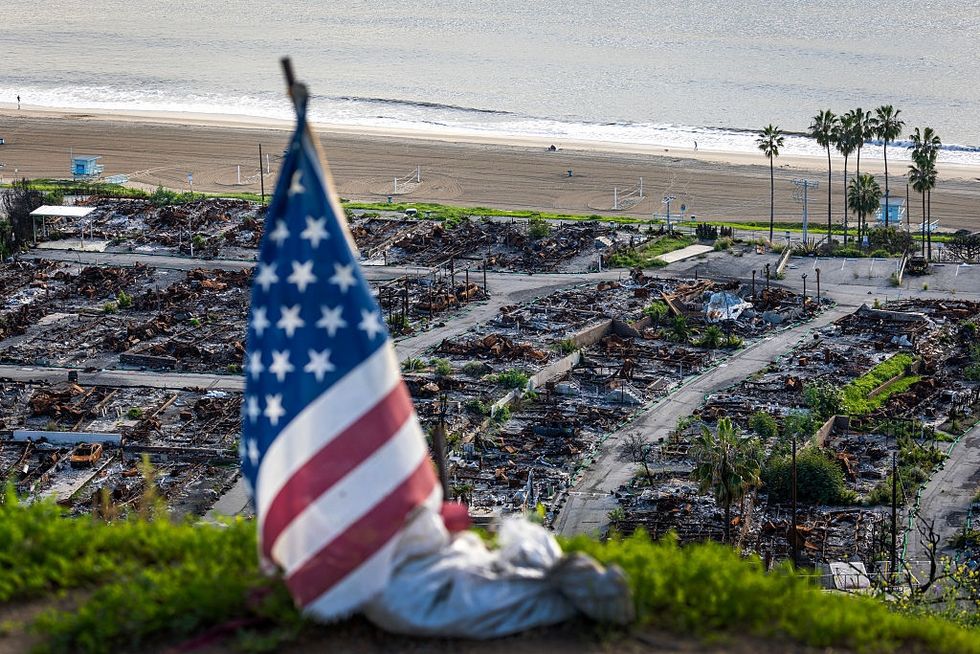 The charred remains of the Pacific Palisades Bowl Mobile Estates trailer park in June. Photo: Allen J. Schaben / Los Angeles Times via Getty Images