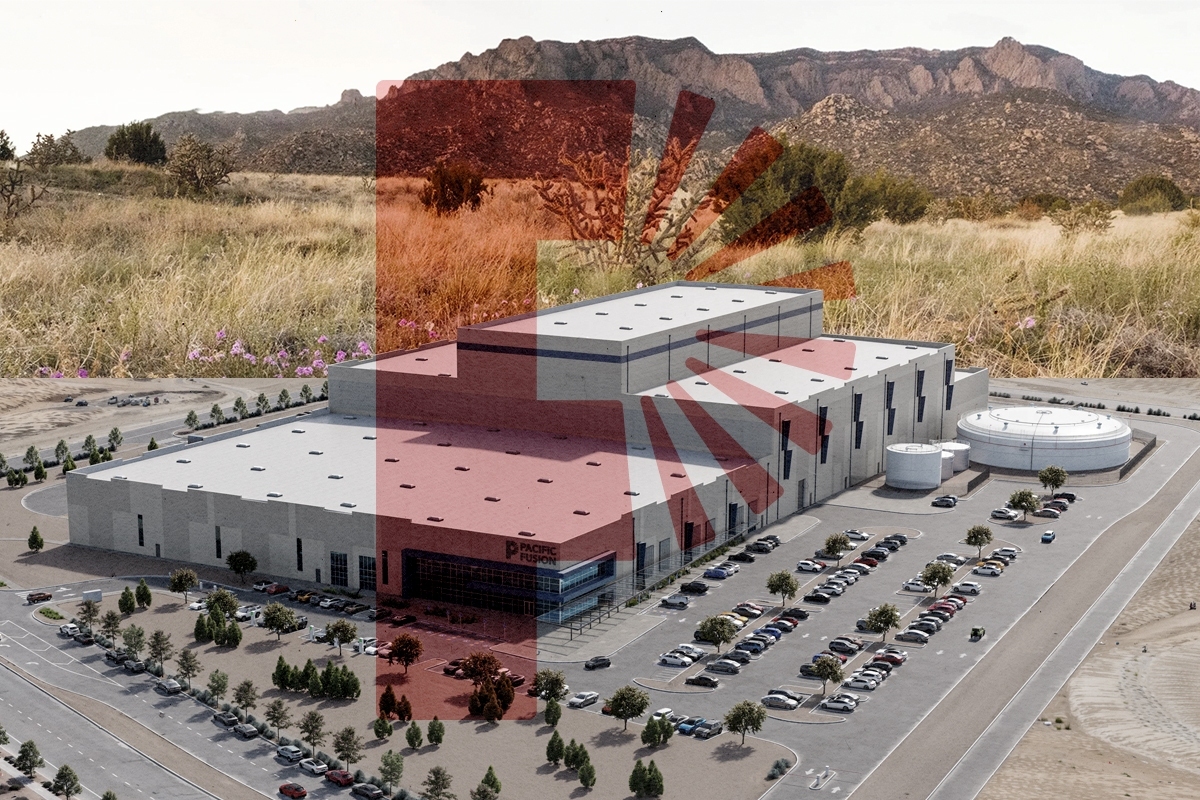
Three-year old startup Pacific Fusion broke ground on Tuesday on what it says will be the world’s first fusion plant to produce more energy than it consumes. The company is aiming to achieve this milestone, known as net facility gain, by 2030. If successful, it would provide the first real-world demonstration that the physics underpinning commercial fusion can work at facility scale.
To date, fusion tests have only achieved scientific net gain — when a reaction produces more energy than was used to ignite it. But that metric ignores the substantial energy lost at other points in the system — whether that's converting stored power into a laser beam or electric current or sustaining powerful magnetic fields to hold the fusion plasma in place. For example, Lawrence Livermore National Lab first achieved scientific breakeven in 2022, and has since repeated the feat numerous times — something no other reactor has replicated. But its laser system, which compresses and heats tiny pellets of fusion fuel, is only about 1% efficient, meaning it draws orders of magnitude more energy from the grid than the reaction produces.
“They proved that with a big laser, if you drive fusion fuel to a certain pressure, you’re going to get more energy out of the fuel than went into the fuel,” Carrie von Muench, Pacific Fusion’s co-founder and COO told me. Indeed, the startup’s founding was partially inspired by the lab’s 2022 breakthrough, which proved fusion ignition is physically possible. “That’s awesome, but not a practical basis for commercial power if you have to store way more energy in the machine than you get into the fuel.”
Other fusion startups, such as Inertia Enterprises and Xcimer Energy, are pursuing the same technical approach as Lawrence Livermore — called inertial confinement fusion — while working to make the lasers dramatically more efficient. Pacific Fusion, however, thinks there’s a cheaper and more effective path, drawing inspiration from another national lab: Sandia.
Like Lawrence Livermore, Sandia National Laboratories built its fusion machine in large part to study nuclear weapons’ performance and impacts without live testing, helping scientists confirm that the country’s aging stockpile would still act as intended. But the Albuquerque, New Mexico-based lab uses a different approach, known as pulsed-power or Z-pinch fusion. It works by sending extremely fast bursts of electric current through a fusion target, generating a magnetic field that pinches and compresses the fuel and heats it enough to trigger a fusion reaction — all while using far less energy than a laser system.
In 2022, Sandia’s Z-machine achieved what was then the second-best fusion performance ever recorded, as measured by what’s known as Lawson’s triple product — the multiple of plasma density, temperature, and confinement time. That result inspired Pacific Fusion to base its reactor on Sandia’s system, scaling it up significantly, with the goal of delivering roughly two to three times more current than the lab’s machine. And while Sandia’s system is a singular, custom built piece of research equipment, Pacific Fusion plans to cut costs by housing its power system in 156 identical, mass-manufacturable modules that can be shipped, assembled, and swapped out for repairs.
The startup raised a whopping $1 billion Series A in 2024, which von Muench told me should be enough to cover the full cost of this demonstration facility, also located in Albuquerque. General Catalyst led the round, with participation from Breakthrough Energy Ventures, Stripe co-founder Patrick Collison, venture capitalist John Doerr, and others. Investors are doling out the funding in three sets of milestone-based tranches, two of which the company has already unlocked.
The first phase involved building the module’s key components and demonstrating that they met the required specifications, validating the company’s in-house simulation tools, and using those tools to show that its fusion targets could achieve ignition in the demo system. In the second phase, the team assembled and tested a scaled-down prototype module, which delivered 440 gigawatts of peak power. Next up is building a full-scale production module that will produce over a terawatt of peak power.
“Especially for these well-established approaches to fusion — like inertial fusion, which now has a proven path to scientific gain — the question is, how fast can we execute, and how cost-effectively can we execute successive first-of-a-kind projects?” von Mench told me. For Pacific Fusion, breaking ground on the demo reactor is a clear sign the company is on the right path, she told me. “Getting to this milestone was the first real test of our team’s ability to do that.”
The company says it’s unlocked each funding tranche ahead of schedule, and has now gone from founding to groundbreaking in less than three years. It’s betting that cheaper hardware — that is, swapping expensive lasers for electrical switches and capacitors — combined with mass manufacturable components and a supply chain that avoids rare and expensive materials, will also give it an edge in the race to commercial fusion.
Once it completes the demo reactor, the company will begin work on its first commercial power plant, which von Muench told me should come online by the mid-2030s. But in the meantime, this first reactor could provide a nearer-term revenue stream by helping the Department of Energy’s National Nuclear Security Administration conduct stockpile stewardship research. Pacific Fusion just signed a non-binding memorandum of understanding with the NNSA that opens the door for the agency to use the startup’s machine for national security purposes.
Pacific Fusion’s tech is uniquely suited for such high-stakes testing. That’s because the company’s process, once scaled up, is designed to produce bursts of fusion energy exceeding 100 megajoules — roughly enough to power over 40 houses for an hour, but released in just a fraction of a second. That’s much more energy than either fusion system at Lawrence Livermore or Sandia produces, and would make Pacific Fusion’s demo plant the world’s first "high-yield" facility, capable of recreating the kind of extreme pressure, heat, and neutron conditions produced by a nuclear detonation. The resulting data could then help the government assess how warheads and other components hold up as they age.
Von Muench views this potential government work as a valuable side benefit of the company’s overall approach, rather than a primary or necessary source of revenue. “But nevertheless, building a diversified and valuable business along the way, I think certainly improves the probability of success and the speed with which you can deliver against the fusion power goal,” she told me.
And for those that still doubt that next decade, we’ll actually see real fusion reactors coming online? “I would just say wait and see,” she told me. “We’re building.







 Збогом! Pedja Milosavljevic / AFP via Getty Images