You’ve reached your free article limit
Log in
To continue reading, log in to your account.
Create a Free Account
To unlock more free articles, please create a free account.
Sign In or Create an Account.
By continuing, you agree to the Terms of Service and acknowledge our Privacy Policy
Welcome to Heatmap
Thank you for registering with Heatmap. Climate change is one of the greatest challenges of our lives, a force reshaping our economy, our politics, and our culture. We hope to be your trusted, friendly, and insightful guide to that transformation. Please enjoy your free articles. You can check your profile here .
subscribe to get Unlimited access
Offer for a Heatmap News Unlimited Access subscription; please note that your subscription will renew automatically unless you cancel prior to renewal. Cancellation takes effect at the end of your current billing period. We will let you know in advance of any price changes. Taxes may apply. Offer terms are subject to change.
Subscribe to get unlimited Access
Hey, you are out of free articles but you are only a few clicks away from full access. Subscribe below and take advantage of our introductory offer.
subscribe to get Unlimited access
Offer for a Heatmap News Unlimited Access subscription; please note that your subscription will renew automatically unless you cancel prior to renewal. Cancellation takes effect at the end of your current billing period. We will let you know in advance of any price changes. Taxes may apply. Offer terms are subject to change.
Create Your Account
Please Enter Your Password
Forgot your password?
Please enter the email address you use for your account so we can send you a link to reset your password:
That’s not an exaggeration, at least by one calculation.

In late March, the board that oversees New York’s Metropolitan Transportation Authority cast a final vote to implement congestion pricing. If the plan survives some last-ditch lawsuits, drivers will soon have to cough up $15 to travel into Lower Manhattan during rush hours. The MTA will get billions every year to make capital improvements, the air will be markedly cleaner, the streets notably less congested, and a proposal that was first pitched by former Mayor Michael Bloomberg 17 years ago will have finally been realized.
“I often wonder what our system would have been like if we passed it back in 2008,” MTA board member Haeda Mihaltses, a veteran of the Bloomberg administration, mused just before she cast her vote in favor.
The price of nearly two decades of procrastination over doing something to alleviate the most densely-populated, traffic-snarled place in North America is, indeed, unfathomably high. There’s the billions of dollars of mass transit infrastructure we missed out on, the billions spent on health care from breathing in dirty air.
And then there’s the most precious resource of all. According to one calculation from transport economist and congestion pricing advocate Charles Komanoff, the plan the MTA adopted last month will save drivers, bus passengers, and subway riders a combined 225,000 hours every single day. Here’s a fun thought experiment: If New York had adopted this plan back in 2008, we could have saved ourselves a combined 1,314,000,000 hours, or 150,000 years.
How could implementing something so obviously necessary and routine — anyone who has paid to camp in a National Park or drive on the New Jersey Turnpike understands the concept — take so long? What does it say about how we govern? And what can we learn from it?
“I think it is fair to say that whatever roadblock congestion pricing could have hit, it hit,” Rachael Fauss, a policy director and MTA researcher for the good government group Reinvent Albany, told me. “It was the worst case scenario of timelines if you were to project out: What are the things that could delay this?”
Some of the delays were deliberate: It’s hard enough for lawmakers to summon the courage to raise taxes on millionaires and billionaires, so charging drivers money for something that used to be “free,” to fund a transit agency that often conjures delayed trains and decades-long boondoggles in the public’s imagination, was always going to require a fortitude that is in chronically short supply in Albany. When then-New York Governor Andrew Cuomo pushed to pass congestion pricing in 2019, he and his fellow lawmakers wrote into the actual bill that the tolling scheme couldn’t be announced for a year and a half — until after the 2020 election. The same politicians who were supposedly brave enough to vote congestion pricing into law didn’t want anything to do with putting that law into practice.
Then there were the bureaucratic delays. The COVID pandemic, of course, redirected much of the government and forced the MTA into survival mode as subway ridership dropped 90%; suddenly the agency’s most important work was to coordinate lifesaving bailouts from the federal and state governments. Then the Trump administration slow-walked the answer to a key question: Because the congestion pricing plan involved placing tolls on roads built with federal funding, the state needed a sign-off from the federal Department of Transportation. But was congestion pricing the kind of massive infrastructure project that, under the National Environmental Policy Act of 1969, required an exhaustive Environmental Impact Statement? Could it pass NEPA review with a less thorough Environmental Assessment? Or, given that nothing was actually being built up or torn down, could it be exempt from these reviews altogether?
Two years after the congestion pricing law passed, and months after the plan was supposed to go into effect in early 2021, the newly installed Biden administration finally asked for the middle option, an Environmental Assessment, which the MTA initially said could be done in a matter of months. In actuality, that timeline stretched to 16 months and produced a 4,000-page behemoth that some experts noted was more comprehensive than the average EIS.
Seemingly nothing escaped the MTA’s scrutiny — it even looked at how congestion pricing would affect traffic in the Philadelphia suburbs (not all that much). The results were not exactly shocking: Tolling vehicles entering Lower Manhattan below 60th Street would result in up to 20% fewer vehicles in the Central Business District, improving air quality while also generating $1 billion in revenue for public transit, which could then be used to secure up to $15 billion in bonds. After more than 50 public meetings and 25,000 written comments (60% in favor of the plan), the Biden administration produced a “finding of no significant impact,” meaning that congestion pricing wouldn’t negatively affect the economy, the environment, or the roads.
There was at least one notable benefit that came from doing such a comprehensive, time-intensive review: The MTA found that congestion pricing could cause an increase in truck traffic to the South Bronx for drivers looking to toll shop, which in turn prompted the agency to allocate $200 million to alleviate pollution in some of New York City’s poorest neighborhoods, which have shamefully high asthma rates that mostly affect Black and Latine New Yorkers. “Is it congestion pricing’s job to remedy those problems? Maybe not,” Fauss, of Reinvent Albany, said. “But is it a really important way to correct some past wrongs? Yeah, absolutely.”
The MTA’s thoroughness may help protect it from the bad faith lawsuits that have been filed to try and shut down the license plate readers before they go live on June 15. But we’re in the midst of a climate crisis. Why should a 54-year-old law designed to prevent overeager developers from doing things like demolishing neighborhoods to build highways discourage cities and states from enacting dynamic, flexible solutions to cut pollution created by those highways — and fund public transit at the same time? And why should a review of a plan that requires no concrete, no demolition — no actual infrastructure — take three years?
The biggest hurdle congestion pricing had to overcome might have been psychological. Let’s call it "car brain": Even though 85% of commuters who travel into the Central Business District take mass transit, for years, lawmakers and congestion pricing opponents have argued (and in the case of the current New York City Mayor Eric Adams, still argue) that charging people to drive into Lower Manhattan was a kind of attack on the middle class. In a city where valuable street real estate has been converted into free parking, congestion pricing was portrayed as profaning the sacred rights of "regular" New Yorkers — never mind the fact that just 2% of New York’s working poor will end up paying the tolls. Driving your car wherever you please, it turns out, is quite expensive.
“Elected officials are facing the world from the front seat of a car, whether they’re driving or being driven,” Danny Pearlstein, the policy and communications director at Riders Alliance, one of the most forceful proponents of congestion pricing, told me. Pearlstein added that “bureaucrats who drive to work” probably contributed to the Biden administration’s slow-walking of the approval process, or so he suspects. “They were very cautious about doing something that alters not just, you know, air patterns, or patterns of inequity, but actual commutes,” Pearlstein said.
As a reporter who has covered congestion pricing for nearly a decade, I have learned never to underestimate the power of “car brain” on public policy. As a New Yorker who lives steps from the entrance of the Williamsburg Bridge on the Lower East Side, who watches mothers push strollers through oceans of hot, heavy steel boxes belching poisonous gasses driven by people on a hair trigger, and who has seen our leaders pretend that this is New York, that we are too exceptional to change, I cannot help but go about my day, doing my best to tune out the incessant honking, feeling like the dog engulfed in flames: “This is fine.”
That it took transportation advocates, regional planners, and forward-looking politicians nearly 20 years to enact congestion pricing in New York City — the U.S. municipality perhaps most amenable to it because of its housing density and excellent mass transit system — reveals the daunting task of weaning Americans off the automobile. More than three-quarters of us drive our own personal cars to our jobs.
“The only thing that’s going to change the fact that the overwhelming majority of Americans drive to work is not permitting reforms to programs like congestion pricing. It’s permitting reforms to allow dense housing development in metropolitan areas across the country,” Pearlstein said.
“It’s a little bit like a Marxian analysis,” he mused. The crisis must come to a head in order to overthrow the status quo. “In order to adopt congestion pricing, you first have to exacerbate congestion significantly by condensing your built environment.”

Log in
To continue reading, log in to your account.
Create a Free Account
To unlock more free articles, please create a free account.
Even the smallest wave, tidal, and river-current projects are currently licensed as if they were 1,000-megawatt dams.
Tucked inside the Senate’s ambitious new permitting bill, the Bipartisan American Affordability and Jobs Act, is a major win for an energy technology that often flies under the radar: marine power. Small-scale wave, tidal, and river-current projects could help power everything from remote communities and military installations to ocean sensors and coastal desalination systems — at least in theory.
Drawing largely from the bipartisan FLOWS Act, introduced in the Senate last December but never brought to a floor vote, BAAJA aims to streamline the licensing pathway for so-called micro hydrokinetic projects, which harness moving water without dams or reservoirs and have a capacity of 5 megawatts or less. The bill would give the Federal Energy Regulatory Commission one year to act on commercial license applications for these projects, while exempting them from full review under the National Environmental Policy Act. It would also allow FERC to issue 10- to 20-year licenses, giving projects a pathway to long-term commercial operation, as opposed to relying on pilot licenses designed for temporary testing.
The bill wouldn’t eliminate environmental oversight altogether. Small-scale marine energy projects would still undergo basic environmental screenings as a part of FERC licensing, and would still require state and local permits, which can trigger their own environmental reviews. They’d also remain subject to the Endangered Species Act and the Clean Water Act — though the bill would expedite reviews under both of those laws, too. On the whole, the reforms are intended to give developers and investors alike a quicker, more predictable timeline.
“Taking a 1-megawatt marine energy project and trying to license it like it’s a 1,000-megawatt conventional dam just wasn’t working. It was apples to oranges,” Matthew Allen, senior director of legislative affairs at the National Hydropower Association, told me. “Recognizing that it deserves its own process could be a tremendous market signal for the technology.”
After all, this tech certainly doesn’t look like large-scale hydropower, where colossal dams unleash thousands of tons of water per second that rush through electricity-generating turbines to the river below. Such gargantuan infrastructure projects typically require favorable geography — think big rivers running through steep, mountainous terrain, where a dam can create a sharp drop in elevation. And with most of the best sites in the U.S. already developed, the country is unlikely to build many new greenfield hydro projects anytime soon.
But less-developed marine energy technologies have barely scratched the surface of their potential. Some look like large buoys, bobbing with the ocean swells and converting that motion into electricity. Others use turbines anchored to the seafloor or riverbed, spinning as tides ebb and flow or river currents rush past. While these devices generate essentially zero power for the grid today, in theory the resource is enormous: The National Renewable Energy Laboratory estimates that wave, tidal, and river-current projects have the technical potential to generate a staggering 2,300 terawatt-hours of electricity annually — more than half of the country’s total electricity generation last year. Wave energy alone accounts for about 60% of that number.
Of course, technical potential is a long way from practical reality. Economic constraints, environmental regulations, competing water uses, and public acceptance could limit uptake of these technologies. NREL suggests that we would be lucky to eventually tap even 10% of marine energy’s potential. Meanwhile, most of the tech remains in the pilot or demonstration stage in the U.S. — which is exactly why expediting permitting for small-scale projects stands to have significant impact.
“Marine energy is so new and still so novel that a 5-megawatt device, it doesn’t even exist right now,” Jennifer Garson, former director of the Water Power Technologies Office during the Biden administration, told me. “So you’re still talking about a good amount of headroom for being able to deploy smaller-scale marine energy devices in rivers and nearshore.”
Early deployments have largely served remote or island communities. In the 70-person Alaska Native village of Igiugig, for example, Ocean Renewable Power Company installed two 35-kilowatt turbine systems on a local riverbed, designed to supply nearly half the village’s power and thus reduce reliance on expensive diesel generators. While the project’s pilot license expires in three years, the permitting bill could offer a pathway to continued power generation.
The lack of a commercial licensing pathway has already led to the demise of one promising project, National Hydropower Association senior program manager Kelly Rogers told me. Verdant Power’s tidal energy pilot in New York City’s East River — the first project of its type to receive a license in the U.S. — officially shuttered in 2021 when said pilot license expired. By then, its turbines had delivered over 312 megawatt-hours of total electricity to the grid, harnessing the tides as they flowed in and out of the saltwater channel.
Other companies in this space include wave energy startups Oscilla Power and CalWave, which make surface-floating and submerged wave energy converters, respectively, with the goal of selling to utility customers and remote communities alike. C-Power, another early-stage wave energy company, is focused on powering off-grid equipment like ocean sensors. And while all have received at least some venture backing, a significant portion of their funding comes from Department of Energy grants.
In 2022, all three received DOE funding to trial their tech at PacWave, an Oregon-based facility that’s the first grid-connected wave energy test site in the continental U.S. Backed by the DOE, the facility secured all its necessary state and federal approvals in advance so that companies working there could largely bypass the permitting process and get their tech straight into the water. But getting there, Garson told me, involved an arduous 15 years of negotiations among the DOE, the Bureau of Ocean Energy Management, and state and local authorities before the facility could open for testing this August.
The permitting bill can only do so much to accelerate a permitting process like this, Garson explained. Even with a faster FERC licensing process, all projects in federal waters — generally those more than 3 nautical miles from shore — will still need a separate lease from BOEM, a complex process that the bill’s new permitting pathway wouldn’t replace. “One of the complexities of anything that you do with water is you just have so many split jurisdictional challenges and questions,” she told me.
It’s also telling that as of yet, there are no wave energy devices in PacWave’s waters, as the Trump administration’s federal funding freeze has scrambled the plans of some of the marine energy developers who’d originally intended to test there. Oregon startup AquaHarmonics, for example, was on track to deploy its wave energy converter at PacWave but had to shut down last year after the Trump administration withheld its previously allocated grant money.
“A lot of the device deployments, particularly in the United States, have been contingent on or reliant on federal funding,” Garson told me. “You’re dealing with still such early-stage R&D that it really points to a necessity for the federal government to be in this space”
But while the federal budget for emerging marine energy technologies has generally grown year over year, Garson said relatively little of that money is actually reaching developers. When she was still at the DOE, for example, the Water Power Technologies Office launched a funding solicitation offering up to $112.5 million in total for wave energy companies to test their devices at sea, including at PacWave. But while the DOE was supposed to announce the winners last year, Garson said it has yet to do so — and it’s disbursed no funding, either.
“That’s a long time for a lot of these companies to sit and wait for any funding to even be available,” she told me. CalWave, at least, still plans to hook its system up at PacWave, as the startup’s CEO, Marcus Lehmann, told me the company is “now in the construction phase of installing the first grid-connected system” and that it plans to launch at PacWave sometime in 2027 or 2028.
He sees the permitting bill as “really critical” in helping early-stage projects “get online faster, and just to prove it out on a community level or a microgrid level” before scaling up to larger installations and device arrays that would likely exceed the 5-megawatt threshold.
“Regulatory certainty, particularly when you’re dealing with capital-tight startups — great. Anything that makes their lives easier, I am all for,” Garson told me, calling the existing permitting structure for marine energy “byzantine.” But she doesn’t think that if the bill passes we’ll suddenly see a slew of wave, tidal, and river-current projects coming online. “You’re still talking about relatively small outputs of power until we reach more [technological] maturity.”
But it could certainly be a first step toward recognizing the potential of water power technologies beyond conventional hydropower — and giving them a place in the broader clean energy conversation. “This is a meaningful amount of power to a lot of people. We just tend to get so lost in the gigawatt conversation,” Garson told me.
And while developers do measure these projects in kilowatts and megawatts for now, one day they too could help move the needle at the gigawatt level. As Garson put it, “If we can figure out how to unlock the ocean — power for everybody, everywhere.”
On methane emissions, renewables’ costs, and Poland’s atomic ambition
Current conditions: Hurricane Simon is lingering off Mexico’s coast as a new tropical depression that could form into a powerful storm begins gathering strength • Iceland has issued an orange-level warning — the notch just below the most severe — across the whole country ahead of an intense storm that could bring vicious winds and snow • The mountain areas surrounding Los Angeles are on red alert for wildfires throughout the rest of the week.
Over Labor Day weekend, I found myself on the upper deck of the ferry to Block Island, a rustic little vacation enclave between Rhode Island and New York’s Long Island, marveling at a seemingly endless horizon of spinning wind turbines. Revolution Wind, Orsted’s first big chunk of the Northeast’s offshore wind buildout, was, as its name implied, an act of defiance. The Trump administration had tried for months to kill the project, which was nearly finished when President Donald Trump returned to office last year. But the Danish energy giant won one battle after another in court, and ultimately brought the 704-megawatt turbine array online. Its completion, however, isn’t the end of the fight.
On Friday, the Department of Justice asked a federal court to rescind the Department of the Interior’s approval of a construction and operation plan for Revolution Wind. Citing a regulatory filing, Bloomberg broke news yesterday that the Interior Department wants to reconsider whether the permit complies with federal law. In response, my colleague Robinson Meyer asked last night whether Trump was “trying to blow up the permitting deal,” which includes a whole section on project certainty. (See my colleague Jael Holzman’s reporting on the bill for more.) White House energy advisor Jarrod Agen appeared to suggest the legal move was a negotiating tactic, calling on “the media” to “stop their attempts to blow up a GREAT deal for the American people.” In a post on X, he said, “This is an old lawsuit brought by the local community—who had serious concerns about this project—against the Biden Administration! The White House maintains support for PERMITTING REFORM! We look forward to the Senate voting on this historic legislation.” In a joint statement Senators Sheldon Whitehouse of Rhode Island and Martin Heinrich of New Mexico, the chief Democratic negotiators of the permitting deal, said “the administration needs to start showing good faith progress on wind permits.”
Of the 1,583 executive orders presidents have issued since 1993, 22 explicitly mention coal. More than a third of those bore Trump’s signature. That’s according to a new analysis by the Financial Times, whose reporting found that lobbying by the coal industry has significantly increased in Trump’s second term. “When we would meet with the Biden administration they were like, ‘Let’s just keep that coal in the ground,’” Michelle Bloodworth, chief executive at trade association America’s Power, told the newspaper. “It’s been just amazing, unbelievable to have President Trump and the administration talk so publicly about the importance of coal.”
Meanwhile, there’s an optimistic climate case for fossil fuel that has driven the shift away from coal and reducing America’s emissions. The problem with natural gas has always been that, despite producing less carbon when burned, the drilling and transportation of the fuel leaks methane, a powerful greenhouse gas that stays in the atmosphere for less time but traps more heat throughout those decades. But methane emissions from the U.S. oil and gas sector are remaining steady despite surging production, according to new research by Johns Hopkins University. The study, published yesterday in the peer-reviewed journal Communications Earth & Environment, highlights a big reason: “Companies have built more infrastructure needed to better capture methane — a vital component of natural gas — and transport it for sale as a fuel, providing a financial incentive to limit the amount escaping into the atmosphere.” That’s a double-edged sword, the paper’s author said. “The good news is that emissions have not markedly increased, as many scientists feared would happen after an enormous increase in natural gas production in the decades following the hydraulic fracturing boom,” Scot Miller, an associate professor of environmental health and engineering at Johns Hopkins University who studies greenhouse gases, said in a statement. “The bad news is that oil and gas production is still a large percentage of U.S. methane emissions, and we do not find any evidence that a flurry of federal legislation had an impact on emissions.”

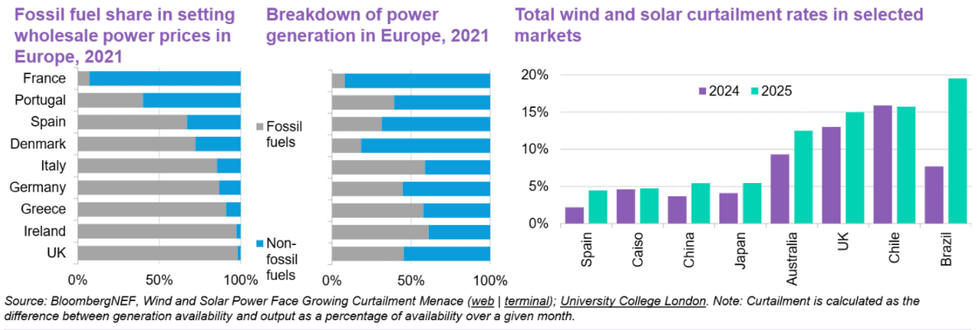
Wind and solar is cheap to build, and even cheaper to operate. But data suggests “there is no meaningful relationship between wind and solar deployment” and lower wholesale electricity prices, according to a new analysis from the consultancy BloombergNEF. “This is also the case when considering all renewable generation, and renewable-plus-nuclear power.” That’s because, in many markets, renewables bid at or below zero, and are thus tapped first. As a result, fossil fuels set the marginal price during the hours when they’re in demand as a dispatchable resource when the sun isn’t shining or the wind isn’t blowing. On average, fossil fuels such as gas or coal set the price in Europe roughly 58% of the time in 2021, despite a declining share of generation. In the United Kingdom, it was around 90% in the early 2020s, but has since shrunk to 60%. In PJM Interconnection, the second-largest U.S. grid system, natural gas set the marginal price 60% of hours last year. A big problem is the high rate at which renewable power plants are forced to reduce output below maximum levels to keep from overloading the grid. Across 27 markets worldwide, BNEF found that the average rate at which wind and solar are curtailed was 10.5% last year. “Indeed, more wind and solar deployment may increase other cost inputs for retail prices unless other fundraising mechanisms are used,” the report warned. “For example, renewables integration is a key driver of grid expansion and reinforcement, for which network charges in consumer bills have been a crucial source of funding in many markets.”
So, when will wind and solar actually start reducing bills? It depends on where you’re talking about. Over the next decade, Germany’s prices are set to fall by 20% below the 2025 average. Britain’s offshore wind and solar buildout are expected to reduce prices by 26% over that same period between now and 2035. Spain, on the other hand, is forecast to see steady power prices over the next few years followed by an increase as its nuclear plants come offline. In the U.S., prices in PJM and the Electric Reliability Council of Texas are set to soar “partly due to the phaseout of wind and solar tax credits” and “delays to new gas-fired capacity and transmission build.” The Texas grid in particular could see prices soar by 160% over 2025 levels by 2035. But the Midcontinent Independent System Operator, the nation’s largest grid spanning the Midwest, and New York’s statewide grid are poised for “a gradual decline from 2026 driven by steady renewable additions, lowering the need for thermal generation.”
Sign up to receive Heatmap AM in your inbox every morning:
The Department of Energy is pumping $581 million into upgrading the Tennessee Valley Authority’s grid system. The agency said Tuesday the funding would support 84 transmission and distribution projects across eight states in the federally owned utility’s territory, adding about 2.5 gigawatts of capacity. While $331 million will go to cost-share programs that require the TVA and local utilities to kick in funding, another $250 million will come as direct federal funding. “America’s electric grid cannot become a roadblock to economic growth,” Katie Jereza, the assistant energy secretary of the Office of Electricity, said in a statement.
When I visited the site where Poland plans to build its first nuclear power station with a trio of America’s flagship reactors, Westinghouse AP1000s, the area was little more than a cleared portion of a rural field on the Baltic Sea, where crews were conducting seismic tests. But as I told you last week, Poland cemented its plans by approving the purchase of long lead-time items. All along, the country had planned to build at least one more atomic power station. At first, the second plant was supposed to be financed with private capital and use South Korean technology. But those plans have largely fallen to the wayside in recent years.
Now the same state-owned firm behind the AP1000 facility has officially committed to building a second plant. The U.S., France, and Canada have all begun bidding to build the No. 2 facility, according to World Nuclear News.
Last month, I told you that the AI energy software provider Verse had tripled that amount of power capacity under its control. Now, I can reveal exclusively for this newsletter, the company is out with a new calculator that shows the potential impact of the data center buildout on Texas ratepayers. Without new power supply, data centers would add $624 per year to the average household’s bills, Verse’s calculations found. But requiring data centers to build their own power would reduce that increase to $35 per year. But data centers that respond to grid demand with flexibility, ramping down when supply when is lower, could actually reduce households' electricity bills by $223 per year. You can play with the calculator here for yourself.
The Trump administration has asked a court to re-examine a key permit for Revolution Wind in Rhode Island.
This is Heatmap Daily, an evening news digest written by our executive editor. Subscribe here.
Updated, 11:05 p.m. ET
At the end of the day, the biggest threat to the bipartisan permitting deal probably isn’t green groups, the fossil fuel industry, or monopoly utilities. It’s President Trump himself.
The legislative proposal is meant to constrain the president from tampering with clean energy projects — and if it passes, then some of its provisions seem like they could do so. But in order for it to pass, Trump must adhere to the deal that he brokered with the bill’s Senate Democratic negotiators, Sheldon Whitehouse of Rhode Island and Martin Heinrich of New Mexico.
Under that deal, the Trump administration must allow the 30 wind farms held up by what is normally a Department of Defense box-checking exercise to proceed. (Trump himself agreed to allow these projects to move forward, according to Politico reporting from last month.) More broadly, the administration has to make a show of good faith that it will return to what Whitehouse has called “regular order” on wind and solar permits. That could include approving a longer list of more than 200 onshore wind projects held up in the queue.
That somewhat informal deal is now facing its biggest test yet. On Friday, the Department of Justice filed a motion in court to re-examine a key permit granted to Revolution Wind, a nearly complete offshore wind farm being built off the coast of Rhode Island. The filing was first reported by Bloomberg.
Revolution Wind is one of six Biden-era offshore projects that is now operating or at least still moving forward. It could eventually produce as much as 700 megawatts of electricity. (Other offshore wind projects have accepted Trump’s $4 billion payouts.)
This isn’t the first time that the Trump administration has gone after this particular offshore project: The White House fought, and then resoundingly lost, an effort to stop work on Revolution Wind last year. But the timing of the filing — and the fact that it’s happening in Senator Whitehouse’s backyard — could make this filing far more significant.
In a post on X, the White House energy official Jarrod Agen seemed to play down the legal move without fully disowning it.
“This is an old lawsuit brought by the local community—who had serious concerns about this project—against the Biden Administration!,” he wrote. (The lawsuit in question was filed by Green Oceans, an anti-wind-energy group. Its law firm has what The New York Times described as “close ties” to the conservative legal movement.)
The White House still supports permitting reform, Agen added, adding that “the media should stop their attempts to blow up a GREAT deal for the American people!”
Sorry, Jarrod — we’re just doing our job. After we initially published this story, Senators Whitehouse and Heinrich sent a joint statement: “Frankly, we need to get permitting certainty in law, and this proves it,” they said. “In the meantime, the administration needs to start showing good faith progress on wind permits.”