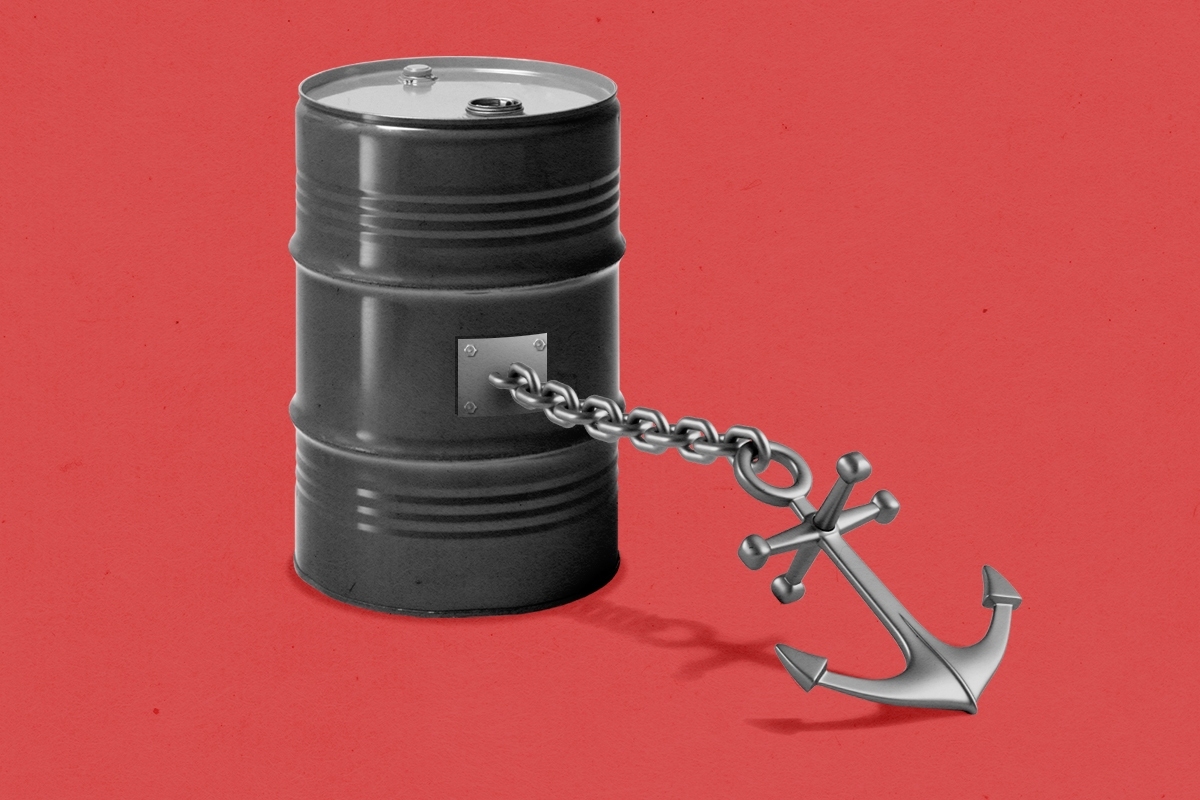
Every day the Strait of Hormuz remains closed, the global oil supply deficit increases by millions of barrels. So far, even the biggest responses to the crisis are at best short-term and partial.
Today the International Energy Agency announced a coordinated deployment of 400 million barrels from its member states’ strategic reserves. The United States, which has a 414 million-barrel Strategic Petroleum Reserve, has yet to detail its plans to deploy reserves. President Trump appeared to confirm, however, that the U.S. would release some oil from the Strategic Petroleum Reserve. “Right now, we’ll reduce it a little bit, and that brings the prices down,” he told a Cincinnati television station Wednesday.
Four-hundred-million barrels may sound like a lot, but even the back-of-the-envelope math about how far that will go is unforgiving.
Around 20 million barrels per day of oil were going through the Strait of Hormuz last year, according to the IEA, representing about a quarter of the world’s seaborne oil trade. Since its effective closure starting February 28 in response to the U.S. and Israeli strikes on Iran, some oil that would otherwise transit the strait is still getting out: The Saudi pipeline to the Red Sea can handle up to 7 million barrels per day; an Emirati pipeline can transit up to 2 million barrels per day; and Iran itself is still managing to export oil. That leaves some 10 million barrels not making it to the market, according to Greg Brew, an analyst at the Eurasia Group.
The IEA’s 400 million barrels therefore add up to just about 40 more days of missing supply — and that doesn’t take into account the matter of actually getting those barrels to market.
That will still take some time, Ben Cahill, a senior associate at the Center for Strategic and International Studies, explained to me.
“The question is how much of that volume can be offset by a stock release, and when. The timing really matters,” he said. “The U.S. SPR, for example, takes 13 days to hit the market from the time of a presidential order, according to the DOE. So we still have a period of big potential supply shortfalls.”
Then there are the shut-ins, oil wells that are no longer being pumped across the Gulf region due to the conflict, which add up to around 6 million to 7 million barrels per day across Saudi Arabia, the United Arab Emirates, Kuwait, and Iraq.
That’s “barrels gone now and barrels gone in the future,” Brew told me. Oil that was loaded on ships or put into storage before the closure could still end up on the market. “But the shut-ins are barrels that have disappeared.”
Prices also spiked after Russia invaded Ukraine in 2022, leading the U.S. to sell around 180 million barrels of oil from the SPR. Then, however, Russia was able to continue selling its oil on the world market, though the United States and its allies implemented a price cap.
This time, explained Employ America’s managing director of policy implementation, Arnab Datta, the price action has been more restrained even as the real supply hit has been far greater.
“It’s important to understand the scale of this supply shortage versus what we had then, which was a speculative supply shortage,” Datta said, comparing the response to the Ukraine invasion with the current conflict in the Persian Gulf. “This one is a physical supply shortage that's not being realized necessarily in prices.”
Exactly how much oil could be drawn out of the U.S. Strategic Petroleum Reserve is unclear. While its legal drawdown limit is 4.4 million barrels per day, it may not be physically able to hit that even if the U.S. wanted to. The four salt caverns where the oil is stored are likely at different levels of operational readiness, Datta explained, with only some of them having completed modernization operations that have been underway for nearly a decade. It’s also possible some are offline entirely. When oil was drawn from the SPR in 2022, outflows were around a million barrels per day.
Datta told me that it’s “unlikely” SPR’s actual drawdown capacity is much higher than that, and that he’d be “surprised if it was higher than two [million barrels per day].”
Other analysts were even more pessimistic. “Realistic U.S. SPR releases today are likely below the 1.0 [million barrels per day] pace averaged in 2022,” J.P. Morgan analyst Natasha Kaneva wrote in a note to clients Tuesday. The combined expected release rate from the IEA countries “would not materially ease” the shortfall, she wrote.
At best, the IEA release can help keep a lid on price increase, Ryan Cummings, a former economist at the White House Council of Economic Advisors and the chief of staff of the Stanford Institute for Economic Policymaking, told me. “But it’s not big enough to fully offset the current supply gap. And as time goes on, this supply gap will only get worse as there’s more shuttered production.”
Datta and his Employ America colleague Skanda Amarnath have called on the administration to at least clarify what the SPR is currently capable of even if they hold off on releases.
“Regardless of when or under what conditions a release occurs, we encourage the administration to take this moment to announce the operational status of the SPR,” Employ America said in a statement Wednesday.
Salt caverns are not the only place there’s oil underground in the United States, however.
While many rich countries have sizable reserves — Japan, which is heavily dependent on oil imports, maintains private and public stockpiles of about 440 million barrels — the United States is unique in its combination of reserves and production capacity, a legacy of the 1970s oil shock and the 2010s shale boom, making it into an exporting powerhouse.
But even if U.S. producers were to respond by ramping up output substantially (which their investors would almost certainly not want them to do) any new supply would not hit the market quickly enough to meet the physical shortage at play now.
“You can’t pull supply forward in a matter of weeks,” Cahill told me. “The only countries that can typically do that are those with spare production capacity.” And the countries with spare capacity that can ramp up production quickly? They’re “almost exclusively in the Gulf,” Cahill said.
While President Trump has trumpeted a new refinery project in Texas, its developers have said they don’t expect it to be operational until next year. That would process some 160,000 barrels per day, not nearly enough to make a dent in the supply shortage currently confronting the world right now.
The solution to the current shortfall therefore lies in the Persian Gulf, not the Gulf of Mexico.
“Policy measures may have limited impact on oil prices unless safe passage through the Strait of Hormuz is assured,” Kaneva wrote.
Absent a ceasefire between the U.S., Israel, and Iran, that day is likely still far off. After all, how can tankers be expected to sail through the strait when, Brew observed, “the U.S. Navy is saying we’re not even sending our ships?”