You’re out of free articles.
Log in
To continue reading, log in to your account.
Create a Free Account
To unlock more free articles, please create a free account.
Sign In or Create an Account.
By continuing, you agree to the Terms of Service and acknowledge our Privacy Policy
Welcome to Heatmap
Thank you for registering with Heatmap. Climate change is one of the greatest challenges of our lives, a force reshaping our economy, our politics, and our culture. We hope to be your trusted, friendly, and insightful guide to that transformation. Please enjoy your free articles. You can check your profile here .
subscribe to get Unlimited access
Offer for a Heatmap News Unlimited Access subscription; please note that your subscription will renew automatically unless you cancel prior to renewal. Cancellation takes effect at the end of your current billing period. We will let you know in advance of any price changes. Taxes may apply. Offer terms are subject to change.
Subscribe to get unlimited Access
Hey, you are out of free articles but you are only a few clicks away from full access. Subscribe below and take advantage of our introductory offer.
subscribe to get Unlimited access
Offer for a Heatmap News Unlimited Access subscription; please note that your subscription will renew automatically unless you cancel prior to renewal. Cancellation takes effect at the end of your current billing period. We will let you know in advance of any price changes. Taxes may apply. Offer terms are subject to change.
Create Your Account
Please Enter Your Password
Forgot your password?
Please enter the email address you use for your account so we can send you a link to reset your password:
The enhanced geothermal darling is spending big on capex, but its shares will be structured more like a software company’s.

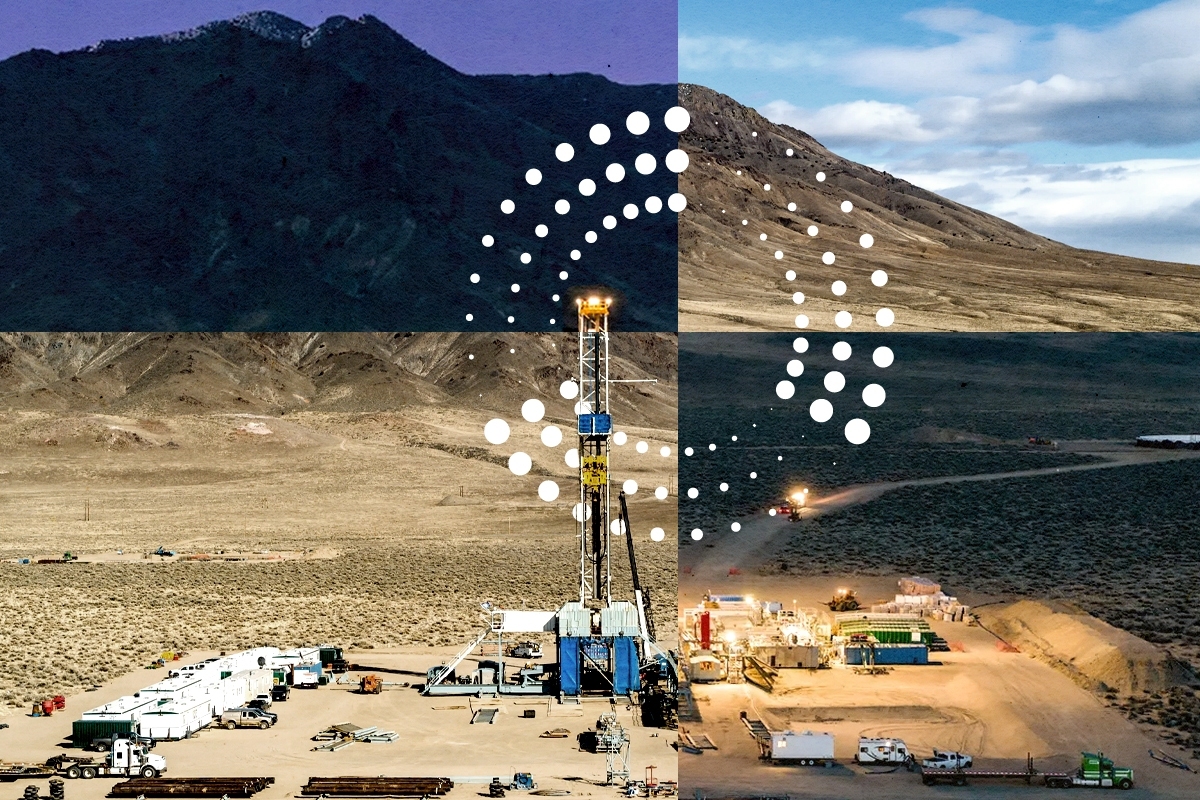
Fervo, the enhanced geothermal company that uses hydraulic fracturing techniques to drill thousands of feet into the Earth to find pockets of heat to tap for geothermal power, is going public.
The Houston-based company was founded in 2017 and has been a longtime favorite of investors, government officials, and the media (not to mention Heatmap’s hand-selected group of climate tech insiders) for its promise of producing 24/7 clean power using tools, techniques, and personnel borrowed from the oil and gas industry.
After much speculation as to when it would go public, Fervo filed the registration document for its initial public offering on Friday evening. Here’s what we were able to glean about the company, its business, and the geothermal industry from the filing.
The main theme of the document, known as an S-1, is the immense potential enhanced geothermal — and, thus, Fervo — has.
The company says that its Cape Station site in Utah, where it’s currently developing its flagship power plants, had “4.3 gigawatts of capacity potential” alone. That’s more than the 3.8 gigawatts of conventional geothermal capacity currently on the grid. Enhanced geothermal technology, otherwise known as EGS, “has the potential to make geothermal generation as ubiquitous as solar generation is in the U.S. today,” the company projects. (There’s about 280 gigawatts of installed solar capacity currently in the U.S., according to the Solar Energy Industries Association) “A broader subset of our reviewed leases represents over 40 gigawatts” of capacity, the document goes on.
Like all investor pitches, the S-1 features some eye-popping “total addressable market” figures. Citing analysis by the consulting firm Rystad, the document says that if there’s a sufficient shortfall in capacity due to retiring power plants (98 gigawatts by 2035), the annual market for enhanced geothermal would be approximately $70 billion by 2035, and that this would represent some $2.1 trillion in revenue potential over 30 years.
The company is already producing 3 megawatts at its Nevada Project Red site for the Nevada grid as part of a deal with Google. It also expects to begin generating power from the Cape Station site “by late 2026,” according to the filing, and get up to 100 megawatts “by early 2027.” In total, Fervo has “658 megawatts of binding power purchase agreements,” which it says represents ”approximately $7.2 billion in potential revenue backlog.”
Beyond that, Fervo says it has 2.6 gigawatts “in advanced development,” and “over 38 gigawatts” in “early-stage development,” where it’s still doing feasibility studies to “validate and confirm the path toward commercial development.”
Fervo says that the energy produced from its Cape Station facility will come in at around $7,000 per kilowatt. That’s already cheaper than “traditional and small modular nuclear power,” which the Department of Energy has estimated costs $6,000 to $10,000 per kilowatt, the filing says. Fervo is aiming to get the total project costs down to $3,000 per kilowatt, at which point it says it would outcompete natural gas without any of the price volatility due to fuel costs going up and down.
But Fervo’s upfront spending is still immense. Fervo says that it expects some $1.2 billion in capital expenditure this year, of which only $125 million is going toward the first phase of its Cape Station project, which it has said would deliver 100 megawatts of power. (Meanwhile, the $940 million it expects to spend on the second phase, which is due to be 400 megawatts, is mostly unfunded.) The company says the public offering will fund “project-level capital expenditures,” as well as land holdings and general corporate expenditures.
Google comes up some 36 times in the document, most times in reference to the “Geothermal Framework Agreement” Fervo signed with the hyperscaler this past March. The S-1 describes the deal as a “3-gigawatt framework agreement … to advance and structure potential power offtake opportunities for current and planned data centers in both grid-connected and alternative energy solutions.” This deal, the company says, “establishes a structured process for the development of geothermal projects across specified regions of the United States,” and could involve the offtake by Google of up to 3 gigawatts of Fervo-generated electricity by the end of 2033.
What the framework is not is a power purchase agreement. One of the risk factors Fervo lists in the IPO document says, “The GFA is a non-binding agreement, and does not obligate Google to purchase power from us.” Instead, it is “a binding framework under which we may propose geothermal development projects to Google, but it does not obligate Google to accept any project, execute any power purchase agreement or provide us with any project financing.”
The agreement also places limits on Fervo, including from whom it can accept investment or financing. (The deal outlines a “broad category of entities defined as competitors,” which are all no-nos.) Overall, the company says, the arrangement gives Google “significant priority over our near-term development pipeline and may limit our flexibility to pursue alternative commercial, strategic, or financing arrangements that would otherwise be available to us.”
Upon going public, the company will have two shares of stock: Class A shares available to the public, and Class B shares owned by its founders, chief executive officer Tim Latimer, and chief technology officer Jack Norbeck. These Class B shares will have 40 times the voting rights of the class A shares and will allow Latimer and Norbeck to “collectively continue to control a significant percentage of the combined voting power of our common stock and therefore are able to control all matters submitted to our stockholders for approval.”
These arrangements are familiar with venture-backed, founder-led software companies. Alphabet and Meta are the most prominent examples of large, publicly traded companies that are under the effective control of their founders thanks to dual class share structures. Tesla, rather famously, does not have a dual class share structure, which is why CEO Elon Musk convinced his board to award him more shares so that he would maintain a high degree of influence over the company.
While other technology companies such as Stripe pile up billions in revenue without any near term prospects of going public, Fervo largely has spending to report on its income statement.
In 2025, the company reported just $138,000 in revenues with a $58 million net loss; that’s compared to a $41 million net loss in 2024. The revenues were “ancillary fees associated with rights to geothermal production at Project Red,” the company said. “This type of revenue is not expected to be significant to our long-term revenue generation, as we have not yet commenced large-scale commercial operations.”
And there’s more spending to come.
Fervo expects that the second phase of its Cape Station project will “require approximately $2.2 billion in capital expenditures through 2028,” which it hopes to pay for with project-level financing.
Fervo said it is “continuing to evaluate the effect of the OBBB” — that is, the One Big Beautiful Bill Act, which slashed or curtailed tax credits for clean energy companies — and that it wasn’t able to “reasonably” estimate the effect on its financial statements by the end of last year. The company does say, however, that it “may benefit from ITCs and PTCs (including the energy community and domestic content bonuses available under the ITC and PTC, in certain circumstances) with respect to qualifying renewable energy projects,” referring to the investment and production tax credits, which acquired a strict set of eligibility rules under OBBBA. It cautioned that the current guidance regarding tax credit eligibility is “subject to a number of uncertainties,” and that “there can be no assurance that the IRS will agree with our approach to determining eligibility for ITCs and PTCs in the event of an audit.”
The company also disclosed that earlier this month, it reached a deal with Liberty Mutual, the insurance company “to sell and transfer tax credits generated at Cape Station Phase I,” taking advantage of a provision of the law that allows credits to be sold to other entities with tax liability, and not just harvested by investors in the project.

Log in
To continue reading, log in to your account.
Create a Free Account
To unlock more free articles, please create a free account.
The COVID-era political divide is still having ripple effects.
Six years ago this month, the Centers for Disease Control and Prevention began advising that even healthy individuals to wear face coverings to protect themselves against the spread of what we were then still calling the “novel coronavirus.” Mask debates, mandates, bans, and confrontations followed. To this day, in the right parts of the country, covering your face will still earn you dirty looks, or worse.
If there were ever another year to have an N95 on hand, though, it’s this one. This winter was the warmest on record in nine U.S. states; Oregon, Colorado, Utah, and Montana have also recorded some of their lowest snowpacks since record-keeping began. That cues up the landscape in the West for “above normal significant fire potential,” in the words of the National Interagency Fire Center, which issues predictive outlooks for the season ahead. And it’s not just the West: the 642,000-acre Morrill grass fire, which ignited in early March, was the largest in Nebraska’s history, while exceptional drought conditions stretching from East Texas through Florida have set the stage for “well above normal fire activity” heading into the spring lightning season. As of the end of March, wildfires have already burned more than 1.6 million acres in the U.S., or 231% of the previous 10-year average.
“Air pollution is the most significant toxic environmental exposure that the average person is ever subjected to, and wildfire smoke in particular is probably the most toxic type of air pollution [they’re] ever exposed to,” Brian Moench, the president at Utah Physicians for a Healthy Environment, a nonprofit clean-air advocacy group, told me.
Our understanding of just how dangerous that smoke is grows by the year. After having their grant pulled by the Trump administration, researchers at the University of California, Davis Health and UCLA persisted in publishing a report this winter reviewing more than 8.6 million births in California and demonstrating a link between exposure to wood smoke during pregnancy and the increased likelihood of autism. Another report, also published this winter by researchers from UCLA, estimated that the particulate matter from wildfire smoke is responsible for nearly 25,000 deaths per year in the United States, with no safe threshold for exposure.
“If a person is in a circumstance where they really can’t avoid wildfire smoke,” Moench added, “they absolutely should be doing everything they can to protect themselves.”
As public health offices around the country will tell you, one of the best ways to do just that is by donning an effective mask. N95 respirators specifically are about 95% effective at protecting the wearer against the dangerous particulates in wildfire smoke (although not gases or asbestos). Though not recommended by public health departments due to their comparative ineffectiveness, even surgical and cloth masks can offer limited particulate protection of about 68% and 33%, respectively.
But you have to actually wear them. After the Los Angeles fires in early 2025, health officials warned that exposure to toxic ash and dust remained a threat even after the air quality index returned to safe levels; one public health official who spoke to The New York Times recommended wearing a face mask for at least a month after the fires, a duration likely to feel interminable to all but the most cautious of people. “I think there’s a reluctance on the part of a lot of people to wear masks based not on anything other than they don’t want to make a political statement with their public outings,” Moench said. “I think there are a lot of people who just want to shy away from the controversy that they represent, irrespective of whether or not it’s a good idea.”
Moench has first-hand experience with the frustrating experience of promoting lung health in the polarized, post-COVID world of masking. Last year, Utah lawmakers floated a statewide mask ban with exceptions only for Halloween and masquerades — but not for legitimate health concerns such as poor air quality due to wildfire smoke. Though the ban was swiftly shot down, in part due to the outcry from disability advocates and environmental health groups, including Physicians for a Healthy Environment, the fact that the legislature floated it at all underscores how masks remain divisive, even years after mandates ended.
Many in public health have approached post-COVID messaging around masking by promoting scientific facts. Bev Stewart, the regional director of health initiatives at the American Lung Association of the Mountain Pacific, told me that in her experience, “It’s rare that somebody would say, ‘I would never, under any circumstance, wear a mask.’” She called the process of trying to reach skeptics a “conversation,” noting that there tends to be “a large misunderstanding about how lungs work” — namely, that masks offer protections that extend beyond the associations with the pandemic.
“Many types of air quality concerns could be mitigated with masks,” Stewart told me. “Sometimes we’re just thinking too narrowly about one specific instance and forgetting the forest for the trees.”
Others I spoke to, though, were doubtful that the populations who are most resistant to mask-wearing could be reached through facts alone. A portion of the country has “lost all respect for empirical evidence, facts, and science — virtually everything that modern civilization was based upon,” Moench said.
Jonas Kaplan, an associate professor of psychology at the University of Southern California, has put numbers to Moench’s conjecture. During the COVID pandemic, Kaplan studied how messaging can reach anti-maskers, discovering that when “information about masks was framed in terms of pure science, there was no significant reduction in anti-mask beliefs or change in mask-wearing behavior.”
Kaplan told me that a lot of the resistance in the anti-masking community comes down to, “What will people in public think of me? What would my friends think of me?” The most effective messages, he’s found, are those that speak to in-group values rather than presenting straight facts. “It wasn’t like, ‘Studies show that this is safe …’” broke through with the skeptics, Kaplan said. “It was more about emphasizing, ‘This is important, and we should care about it.’”
Science, though, does still have a vital role to play. Though we already have a better understanding of the impacts of smoke exposure than we did even a few years ago, more research is needed into its long-term effects. That will also give us greater clarity into how to best protect the more than 25 million Americans who are exposed to wildfire smoke every year — both physically, via better masks and air filters, as well as through better public health messaging.
“Smoke by itself — we know what’s in it, and we know you don’t want to breathe it in,” Emily Fischer, a leading expert on air pollution and a researcher and professor at Colorado State University, told me. “We also know that there are protective actions that families can prepare for, and do their best to take.”
Unfortunately, under the Trump administration, the Environmental Protection Agency, the National Oceanic and Atmospheric Administration, and the National Science Foundation, which had previously led research in the area, have drastically reduced their funding. Just this week, The Hill reported that NOAA has cut off grant funding to the University of Colorado’s Cooperative Institute for Research in Environmental Sciences, which, in addition to research into greenhouse gases, has extensively studied wildfire-related air pollution.
Fischer has been affected, too. “My team has had grants terminated related to air quality and protecting public health, and that’s really sad because the smoke doesn’t care if you’re a kid, if you’re elderly, or if you live in a red or blue state,” she said. “Families really need to think right now about how to protect themselves and their loved ones” against the smoke ahead, she told me.
Current conditions: Temperatures in the Northeast are swinging from last week’s record 90 degrees Fahrenheit to a cold snap with the risk of freezing • After a sunny weekend, the United States’ southernmost capital — Pago Pago, American Samoa — is facing a week of roaring thunderstorms • It’s nearing 100 degrees in Bangui as the Central African Republic’s capital and largest city braces for another day of intense storms.
The price of crude spiked nearly 7% in pre-market trading Sunday after the fragile ceasefire between Iran and the U.S.-Israeli alliance. Things had been looking up on Friday, when President Donald Trump announced what appeared to be a breakthrough in talks with Tehran in a post on Truth Social, saying Iran would “fully reopen” the Strait of Hormuz. By Sunday, however, the U.S. commander in chief was accusing Tehran of firing bullets at French and British vessels in the waterway in “a total violation of our ceasefire agreement,” adding: “That wasn’t nice, was it?” On Sunday afternoon, Trump posted again to announce that the U.S. had seized an Iranian-flagged cargo ship attempting to traverse the strait. The prolonged conflict will only harden the historic rupture the severe contraction of oil and gas supply to the global market in modern history has triggered in global energy planning. “As happened with Russia’s war against Ukraine, the consequences of the Hormuz closure cannot simply be undone. That leaves countries — especially poorer countries dependent on fossil fuel imports — with a stark choice about how to fuel their future economic growth,” Heatmap’s Matthew Zeitlin wrote last week. “The crisis may have tipped the balance towards renewable and storage technology from China over oil and natural gas from the Persian Gulf, Russia, or the United States.”
While the surge in gasoline costs “likely peaked,” Secretary of Energy Chris Wright warned that the price at the pump could remain above $3 a gallon until 2027 during an interview with CNN’s Jake Tapper on Sunday.
The Trump administration pitched its deal to pay TotalEnergies nearly $1 billion to cancel the company’s offshore wind leases as a win-win: The government would reimburse the French energy giant for every penny it spent to acquire the leases, and in exchange, Total would “redirect” the money to U.S. oil and gas development. But new document released Friday and analyzed by Heatmap’s Emily Pontecorvo show that “Americans’ side of the bargain appears to be worthless” given that “Total did not have to make any new investments to get its check.” Indeed, the company was already planning investments in the U.S. that would likely qualify under the deal.
Offshore wind investments are, meanwhile, moving forward. Danish developer Orsted has installed the first wind turbine at its Sunrise Wind project off the coast of New York, offshoreWIND.biz reported. The turbine is the first of what’s expected to be 84 turbines totaling nearly a gigawatt of maximum capacity. It comes just weeks after Wind Scylla, the Cadeler-owned vessel specially designed to deploy turbines, completed work on Revolution Wind, Orsted’s flagship first project off the coast of Rhode Island. That the project is moving ahead as normal is a victory unto itself. The Trump administration pulled out every stop to halt construction of all offshore wind projects.
The Supreme Court ruled Friday that energy companies facing lawsuits over environmental damage to the Louisiana waterfront from oil and gas production can move those cases from state to federal court, where more favorable outcomes are expected. In a unanimous decision in favor of Chevron, Justice Clarence Thomas wrote that “Congress has long authorized” the transfer from state to federal courts. The New York Times described the ruling as “a significant victory for oil companies.”
The decision comes two months after the Supreme Court agreed to hear Suncor Energy Inc. v. County Commissioners of Boulder County, which concerns jurisdiction for “public nuisance” claims. It’s still awaiting a hearing date. But the litigation, which dates back to 2018, came when the city and county of Boulder, Colorado, sued the oil giants Exxon Mobil and Suncor for damages from climate change, bringing charges under state law. “The oil companies tried repeatedly to get the case dismissed, arguing that it belonged in federal court. But time and again, the courts disagreed. The Supreme Court already rejected an earlier petition to review the question of whether the case belonged in state or federal court in 2023,” Emily wrote in February. “Now it has agreed to consider a slightly different petition, filed last summer, over whether federal law preempts Boulder’s state-law claims.”
Sign up to receive Heatmap AM in your inbox every morning:
Pharmaceutical giant Eli Lilly has agreed to work with the state of Indiana to build out “a future pathway for nuclear energy solutions” including “small modular reactors and other advanced nuclear technologies.” The drugmaker behind antidepressant Prozac and erectile dysfunction treatment Cialis signed a letter of intent with the state last month. The deal, first reported by Axios on Friday, marks the latest example of a big corporate power user laying out plans for atomic energy investments for something other than data centers. In 2022, the steelmaker Nucor signed a deal with nuclear developer NuScale to explore building a small modular reactor near one of its electric arc furnaces, and last year forged an alliance with The Nuclear Company to consider backing the startup’s efforts to establish a supply chain for building fleets of reactors. In 2023, Dow Chemical inked a deal with X-energy to use the next-generation nuclear developer’s high-temperature gas-cooled reactors to potentially swap out fossil fuels for splitting atoms as its industrial heat source.
Not all is looking rosy for the nuclear industry. Fermi America, the startup led by former Texas Governor Rick Perry and which promised to build a giant data enter complex backed by, isn’t just “faltering, it’s imploding,” according to a report by independent energy journalist Robert Bryce. But other projects are advancing. On Friday, the next-generation reactor startup Kairos Power broke ground on its demonstration project in Oak Ridge, Tennessee. Then, on Saturday, Bloomberg reported The Nuclear Company was moving forward with a bid to finish construction of either South Carolina's abandoned V.C. Summer nuclear plant or one of two other potential locations in the state.

Brazil is racing to develop its critical minerals as the U.S. looks for new sources in the hemisphere that can help Washington loosen China’s grip over the metals. Just how to regulate the nascent industry is a hot topic in Brazilian politics right now. Lawmakers who back left-wing President Luiz Inácio Lula da Silva are pushing to form a state-owned mining company. In a Sunday post on X, Lula boasted that Brazil “already holds the world’s largest reserve of niobium, the second largest of graphite and rare earths, and the third largest of nickel” — and “only 30% of the mineral potential” is mapped out as of yet. Following the lead of mineral-rich countries in Asia and Africa, Brazil said it would look to make deals for processing and refining. “We will not repeat the role of mere exporters of mineral commodities,” Lula wrote. “We are open to international partnerships that include stages of higher value added and technology transfer.”
That could be an opening for deals with China, which dominates the processing industry. Countries such as Indonesia and Zimbabwe banned exports of raw ore in a bid to capture more of the industrial supply chain. “There are a lot of countries that want something like this right now,” Tim Puko, a minerals analyst at the Eurasia Group, told me on X. “Brazil is one of the few with a good chance of pulling it off.”
Japan may be facing record gas prices as the Iran War squeezed shipments of liquified natural gas. But it’s got some backup coming onto the grid from two sources of clean firm power. Unit 6 of the Tokyo Electric Power Company’s Kashiwazaki-Kariwa nuclear power plant, a 1,356-megawatt Advanced Boiling Water Reactor shut down after Fukushima, has resumed commercial operation, World Nuclear News reported. Furusato Thermal Power has announced that the roughly 5-megawatt Waita No. 2 geothermal power plant, located in Kumamoto Prefecture, Japan, has officially started commercial operations, just two years after construction started, ThinkGeoEnergy reported.
Editor's note: This article was updated after publication to include other sites The Nuclear Company is considering in South Carolina.
Investor and philanthropist John Doerr shares a refresh to his Speed & Scale climate action tracker.
John Doerr thinks it’s time to refresh his grand plan for decarbonization. The Kleiner Perkins chairman and climate-focused philanthropist published his book Speed & Scale: An Action Plan for Solving Our Climate Crisis Now five years ago; then a year later, he introduced an online tracker to measure global progress across the book’s core objectives, which includes sectoral targets such as electrifying transport as well as execution-related goals that cut across all sectors such as winning on politics and policy and increasing investment investing.
But in the time since, both the world and the climate outlook have shifted significantly. So Doerr, alongside his co-author and advisor Ryan Panchadsaram, concluded that both the action plan and the metrics used to assess progress were due for a major revamp.
Heatmap got an exclusive look at the updated Speed & Scale tracker ahead of San Francisco Climate Week, where Doerr and Panchadsaram will unveil the new data and analytical framework underpinning this iteration. Designed to give budding entrepreneurs, business leaders, and policymakers a comprehensive view of where the world stands and how far it has to go in its fight against climate change, the tracker aims to help these stakeholders decide where to deploy their attention and capital.
Doerr told me the original plan has been a success in this regard. “We became convinced by the number of entrepreneurs, founders, technology experts and policy people who said, you know, that Speed & Scale plan influenced my decision about what to do — not how to do it, but what ought to really be done,” he said.
But Doerr is also well aware that we’re living in a different world now. “We had AI arrive and change the demand for electrical power, we have geopolitical forces that we’re trying to understand and cope with,” he told me. “And finally, there’s just the indomitable power of markets and price. All of which is to say, we can’t stick with a plan that’s five years old. It’s time to revise it.”
The updated plan preserves the six main objectives — electrify transportation, decarbonize the grid, fix food, protect nature, clean up industry, and remove carbon from the atmosphere — while including interim 2035 targets as well as 2050 targets aligned with a global net zero pathway. It also retains four other objectives on how to accelerate progress — that is, through politics and policy, turning movements into action, innovation, and investment. The team then breaks these 10 overarching priorities into subtargets called “key results,” in accordance with the goal-setting framework that Doerr famously introduced to Google in the late 1990s that has since become widely adopted across the tech industry.
While the key results in the original plan framed targets in percentage terms — for example, “increase EV sales to 50% of all new car sales by 2030” — the updated version uses absolute figures instead, such as “Increase the number of electric cars to over 600 million by 2035.” The idea, Panchadsaram told me, is to make the targets more tangible and thus easier to understand and act upon.
Another major change is the data that Speed & Scale uses to measure progress, which has altered the emissions picture significantly. Previously, the tracker relied on emissions estimates from the United Nations Environment Programme, but it’s since switched to data from the independent organization Climate TRACE, which combines satellite imagery, remote-sensing, and artificial intelligence to produce a more granular, point-source view of global emissions. The new data illuminated sources that have historically been undercounted, such as wildfire activity and methane leaks. This updated methodology indicates that annual emissions are about 74 gigatons a year, not the 59 gigatons that the old tracker had estimated using the UN’s numbers.
It was a shock for the team to see how drastically the topline figure changed with this new data, Panchadsaram told me, though it reinforced their notion that key results should usually represent gigaton-level opportunities for emissions abatement. But given that the world is still lagging across so many of these metrics, the Speed & Scale team no longer thinks it’s possible to limit global warming to 1.5 degrees Celsius, although they say staying under 2 degrees remains viable with increased ambition.
But it’s not all bad news. The updated tracker highlights six key results — out of 52 total — that the world is on track to meet. These include electric vehicle adoption and achieving cost parity with combustion cars, continued scaling of solar and wind generation, cost reductions for zero-emissions firm and variable power, and reducing operational emissions among Fortune Global 500 companies. There’s even one milestone that has already been reached — clean energy jobs now outnumber fossil fuel jobs, according to data from the International Energy Agency.
When I asked the duo whether they were surprised at where we’d managed to eke out climate wins, Panchadsaram told me, “I think we were right directionally on the technologies. Who ended up scaling them was probably the radical change.” For instance, Speed & Scale spent a lot of words on the electric bus manufacturer Proterra, a Kleiner Perkins-backed startup that filed for bankruptcy in 2023. At the same time, the book devoted just a few paragraphs to the Chinese automaker BYD, which surpassed Tesla in global sales last year.
Yet unfortunately and predictably, there is a lot of bad news to be found in this latest update, too. Seven key results are labeled “code red,” indicating focus areas individually responsible for over 3 gigatons of annual emissions where there’s been little to no progress. These include methane leaks, heating and cooling of buildings, livestock management, and the manufacture of steel and other industrial materials. Beyond this, the tracker is filled with categories where we’re making either “insufficient” progress or “failing,” with the latter indicating stagnation in areas where the impact is less than 3 gigatons per year.
Many of the “code red” results represent hard-to-abate sectors where decarbonization technologies don’t exist at scale, command a high green premium, or frequently both. This is a reality that Doerr and Panchadsaram are well aware of. “Our friend Al Gore always says, ‘We have all the technologies we need to get to where we need to go. All we need is more political will,’” Doerr told me. He thinks Gore is correct — to an extent. “We’ve got all the technologies we need to get us to 2030 or 2035. We don’t have all the innovation we need to get us to 2050.”
To get even more granular on the innovation imperatives most critical to the energy transition, the Speed & Scale team partnered with organizations including Breakthrough Energy, McKinsey, Stanford University’s Doerr School of Sustainability, and Elemental Impact to develop the Climate Tech Map, which I covered last year. In combination with the updated Speed & Scale plan, the map is designed to direct innovators toward key technological frontiers while also giving them a foundational grounding in the structure and challenges of these sectors.
Other updates to the tracker also reflect our changing political and market realities, with certain targets now recalibrated to align with current conditions. For instance, while the old tracker aimed to make climate a top-three voter issue, “we failed in achieving that objective,” Doerr told me. Climate messaging hasn’t proven to be a particularly salient issue for voters on either side of the aisle, and the updated tracker now sets what the team thinks is a more attainable benchmark — making climate a top-five issue.
Of course, even that is still quite a bold goal, as are most of the key results that Speed & Scale hope to achieve. But that’s the way it should be, Doerr said. “What was an opportunity has become an imperative, and so we have really got to step up our game and do it fast.”