A former SpaceX engineer — as so many climate tech founders seem to be — Redd appears quite comfortable with the rapid trial-and-error cycles that hard tech startups often demand. Or as he stated in the company’s press release, which provides a refreshingly frank account of what this first test did and didn’t accomplish, “We follow the adage ‘make it exist, then make it good.’”
Investors seem to be buying it. In June, the startup raised a $54 million Series A, led by Peter Thiel’s Founders Fund — Endurance’s second funding round in less than two years of existence. Still, the team certainly has their work cut out for them. The ocean is a notoriously difficult operating environment: Saltwater is corrosive and offshore infrastructure is difficult and expensive to build, maintain, and repair.
Indeed, Endurance spent the first 11 days of its three-week stint at sea debugging its drill, which the team had never operated underwater before. But with a vessel chartered and a locked-in deployment date, the company couldn’t afford to wait for everything to work out perfectly. “We were still working on that generator hours before it got on the seafloor,” Redd told me. He’s used to that sort of thing, though, comparing it to making final tweaks to rockets already sitting on the launchpad. “That’s kind of the name of the game,” he said.
The trial took place at Axial Seamount, an active underwater volcano and the only place in the world with a cluster of hydrothermal vents connected to shore by fiber optic cable, which allows the Endurance team to monitor and control its system in real time from Seattle. While this was the company’s fifth deep-sea mission, it was the team’s first attempt to actually drill their own well.
After lowering their drill about a mile below the surface, the team bored two holes and turned the second into a well about 2 inches wide, lining it with pipe and sealing it with cement. But after losing so much time to debugging, the team only managed to drill about 52 feet deep — far short of its original 200-foot target.
Water then flowed up the well at about 260 degrees Celsius (around 500 degrees Fahrenheit), but the narrow borehole proved too restrictive to deliver enough heat for the generator to operate. So the team pivoted, connecting the generator directly to a naturally flowing, hotter hydrothermal vent instead. The generator then ran for a total of 29 seconds, producing about 2 kilowatts of net power for 8.7 seconds. That represents the total electricity the turbine generated, minus the 7 to 8 kilowatts needed to run its supporting components, such as the refrigerant pump and other onboard equipment.
Then a software glitch triggered the onboard battery safety system, which shut down the plant. When the team tried to restart the system, the power cable feeding the refrigerant pump failed, leaving the pump unable to restart. That was the end of the road. The mission wrapped up after three weeks at sea, a far shorter run than the team had hoped.
“The success criteria would be if we had left with the generator still on the seafloor; that would have been an example of sustained net power, and we didn’t get there,” Redd told me. Instead, the team brought the system back to Endurance’s Seattle headquarters, where it’s fixing the software as well as refurbishing and upgrading the hardware — which includes changing how it builds and tests subsea cables — to prepare for another mission sometime this winter. This time, the goal will be to generate sustained power from a much deeper well.
The team will need to demonstrate progress soon to keep its next major milestone on track: a planned 2-megawatt deployment off the coast of Tonga by the end of 2027. The project aims to supply electricity directly to the Tongan grid, which today is heavily dependent on expensive, imported diesel. Redd expects subsea geothermal to be cost-competitive with that fuel in this first pilot.
Getting there, however, is a formidable engineering challenge. While it’s long been a subject of academic curiosity, no one prior to Endurance had ever drilled an offshore geothermal well before, meaning the team can’t simply transplant existing land-based technology to the seafloor. “Every component that you would use terrestrially now needs to be either modified or built completely from scratch,” Redd explained. “And so you multiply that across every component required to make these kinds of infrastructure projects happen, and it’s a lot of work.”
No kidding. But if Endurance can pull it off, Redd sees this resource as “the perfect energy source for the future.” A conference paper presented by the geoscience company Viridien last year estimates that offshore geothermal resources worldwide could yield about 6 terawatts of recoverable electric power — nearly twice the world’s current continuous electricity output.
“We can access terawatts of power. There’s no fuel. We can site next to extremely large cities around the Pacific. We have no surface presence,” Redd said, ticking off the advantages. Plus, the three necessary ingredients for a high-quality geothermal well — permeable rock, high heat, and water — are widely accessible offshore, he added. Eventually, he expects subsea geothermal to undercut natural gas in Endurance’s target markets: electricity grids, industrial facilities, and data centers across the Pacific Islands, the U.S. West Coast, and Northeast Asia, all of which sit along the undersea volcanic zone known as the “Ring of Fire.”
The way Redd sees it, advances in subsea technology pioneered by the offshore wind, oil, and gas industries have cleared much of the technological path to making underwater geothermal a viable clean energy resource. In his view, what’s been missing is simply the ambition to chase the opportunity in the private market. SpaceX, he said, really proved what’s possible for a scrappy startup to achieve.
“It is quite new at industrial scale for a small company with a bunch of fairly young people to go after something like this,” he told me. “Before SpaceX went to launch a rocket as a private company, no one thought you could get to orbit as a private company. And so that has really seeded this ambition.”







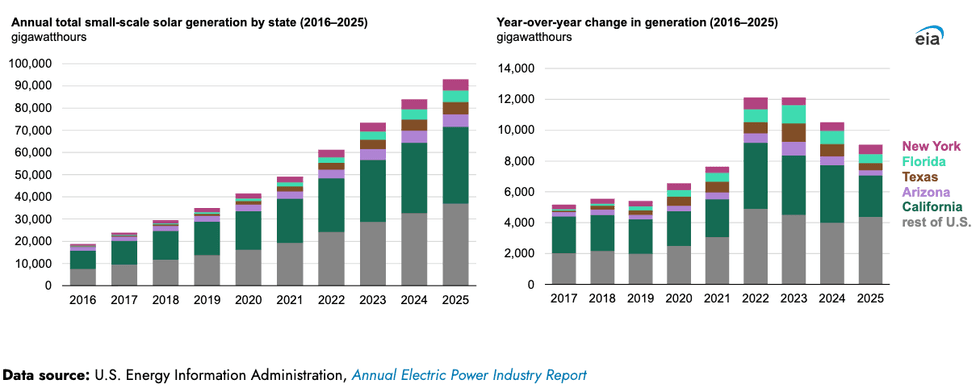 Solar capacity keeps growing. GoodPower