Sign In or Create an Account.

By continuing, you agree to the Terms of Service and acknowledge our Privacy Policy

Sparks

The Startup Behind Lamppost-Mounted EV Chargers Pulls Into the Garage

Voltpost announced two new models today designed to mount on walls and ceilings.

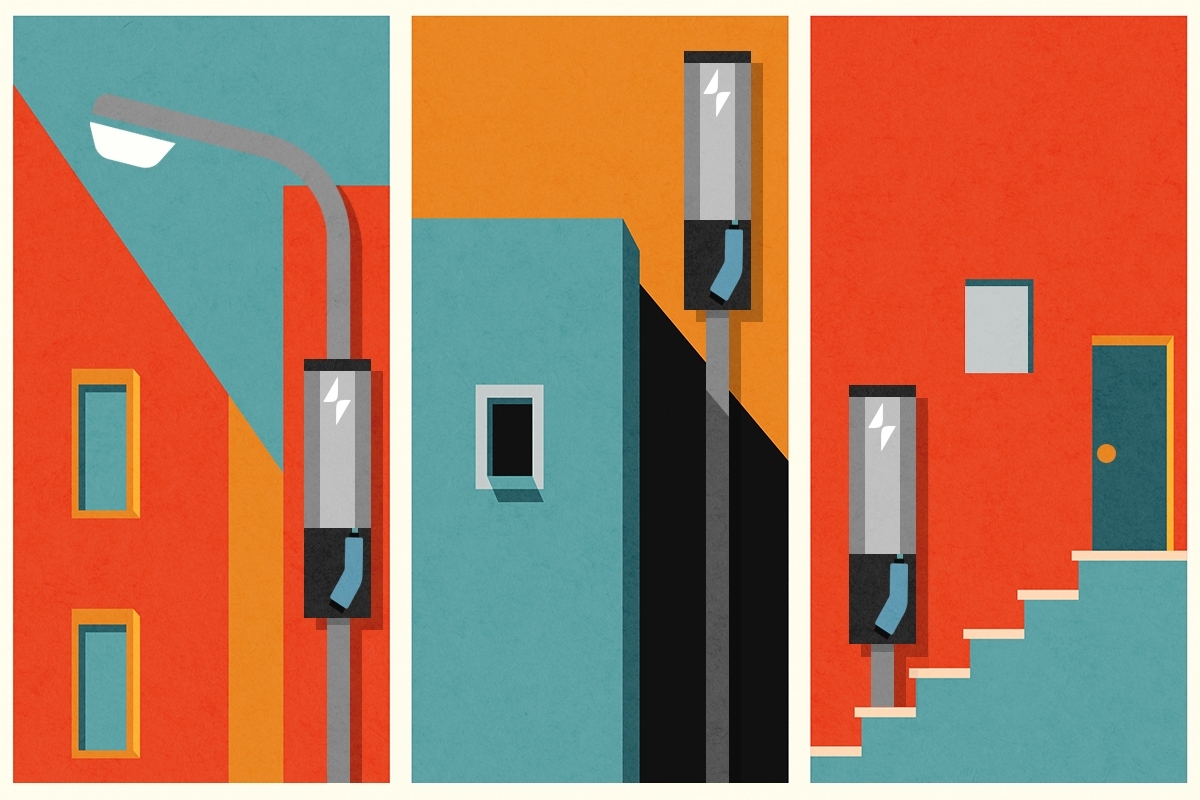
Voltpost chargers.
Heatmap Illustration/Getty Images

Voltpost, the company putting electric vehicle chargers on lampposts, is now expanding to parking garages.

On Wednesday, the company unveiled two new configurations that can attach to the walls and ceilings of parking garages, lots, and other locations without easy access to streetlights or utility poles. Like Voltpost’s signature pole-mounted design, the ceiling- and wall-mounted options avoid the expensive construction work required by freestanding charging infrastructure. In theory at least, that should allow the company to deploy more chargers faster.

“Our mission has always been to decarbonize mobility by democratizing charging access,” Jeff Prosserman, Voltpost’s co-founder and CEO, told me. “And the real value proposition is that, when you can leverage the existing infrastructure, you can significantly reduce the cost, the timeline, and the physical footprint of chargers.”

The second Trump administration hasn’t made things easy. Almost immediately after taking office, Trump officials began slashing Biden-era programs designed to support the EV charging buildout, including the National Electric Vehicle Infrastructure and Charging and Fueling Infrastructure programs. Along with a handful of environmental groups, 17 states sued in May of last year to force the federal government to release NEVI funding and quickly received a preliminary injunction unfreezing the program. A similar group sued in December over the CFI funding, and though that case is still pending, Prosserman told me he expects to see a positive resolution before the end of the year.

Though the death of the EV tax credit has shrunk its addressable market, Voltpost has emerged relatively unscathed. “Honestly, that doesn’t really impact us at all,” Prosserman told Heatmap’s Katie Brigham last year. “At the end of the day, EV adoption will either increase X or Y percent in a given year, but it’s going to continue to increase year over year. We’re past the tipping point, going from early adopters into the mainstream.”

That said, he also told Katie that the company was taking a “more conservative approach” to growth as climate tech investment dried up. Voltpost itself also received several federal grants that are still in limbo. Instead, the company focused on its strategic partnerships with the likes of AT&T and Zipcar, and in July signed an agreement with InCharge Energy to handle installation and maintenance. To date, Voltpost’s funders include RWE Energy Transition Investments, a private equity vehicle within German energy giant RWE, alongside Twynam Funds Management, Exelon Foundation, Good News Ventures, and Climate Capital.

Like its lamppost chargers, Voltpost’s wall- and ceiling-mount kits work with Tesla and non-Tesla vehicles alike, and come with demand management software that responds to electricity time-of-use price signals to enable cheaper charging where and when possible. As for the cost of the kits and how many the company plans to install initially, Prosserman wouldn’t say.

Since deploying its first lamppost chargers in New York in 2024, Voltpost has installed at least 600 chargers in major cities, including Los Angeles, Portland, and Seattle. The point, Prosserman told me, is not to stand out in these communities, but rather to fit in.

“It’s not going to be just about greenfield project development if we’re going to decarbonize a planet across all aspects,” Prosserman said. “We’re really looking at building something that’s integrated, that fits in the fabric of the built environment and communities.”


Blue

You’re out of free articles.

Subscribe to access Heatmap’s expert analysis of energy, climate change, and sustainability, including coverage of our regular survey research. Save $57 on an annual subscription, just $156 $99/year.
To continue reading
Create a free account or sign in to unlock more free articles.
or
Please enter an email address
By continuing, you agree to the Terms of Service and acknowledge our Privacy Policy
Sparks

Trump’s USDA Using Farmland Rule to Go After Energy Companies, Democrats Say

A proposed change in how the agency implements an obscure Cold War-era law would impose onerous reporting requirements on renewables and pipelines.

Wind turbines and a farm.
Heatmap Illustration/Getty Images

Democrats in Congress claim that a new Trump administration proposal will have a chilling effect on the energy sector by subjecting renewables and fossil fuel pipelines alike to an obscure, rarely cited Cold War-era law requiring detailed information on foreign farmland ownership be submitted to the Agriculture Department.

In late June, the Agriculture Department released a proposal to change implementation of the Agricultural Foreign Investment Disclosure Act of 1978, which requires companies to provide information to the federal government on foreign investors in farmland holdings, acquisitions, and sales. If finalized, the new rule would expand the definition of “agricultural land” in regulation to include all renewable energy facilities and pipeline corridors by explicitly tying the term to those industries’ formal codes under the North American Industry Classification System.

Keep reading...Show less
Yellow
Sparks

Electricity Bills Were Higher Than Ever in July

Americans paid $217 on average for electricity last month, according to Heatmap and MIT’s Electricity Price Hub.

A plug graph.
Heatmap Illustration/Getty Images

July is typically the season of high electricity bills, and this year is no exception.

Nationally, the average electricity bill spiked to $217, an all-time high, according to new data from Heatmap and MIT’s Electricity Price Hub. That’s up from $177 in June, and $215 last July. Meanwhile, electricity rates were 19 cents per kilowatt-hour, virtually unchanged from June and slightly higher than July of last year.

Keep reading...Show less
Sparks

Scoop: Clearway Cancels Plan to Swap Solar Farm for Data Center and Gas Plant

The energy developer is backing off after a Heatmap report.

Solar panels and a gas plant.
Heatmap Illustration/Getty Images

Clearway says it is backing off its plans to build a data center and gas power plant on federal land, days after Heatmap revealed the energy developer’s proposal.

Last week, I reported that Clearway asked the Trump administration’s Bureau of Land Management to swap a five year-old application for a solar farm’s permits with “a proposed data center and natural gas facility.” Clearway’s chief development officer John Woody had written in a letter to BLM dated April 3 that the swap was “the result of a shift in our internal development priorities” and intended “to better align with the goals of our Administration.” He also noted the plans were in “exploratory early stages.”

Keep reading...Show less
Yellow