You’ve reached your free article limit
Log in
To continue reading, log in to your account.
Create a Free Account
To unlock more free articles, please create a free account.
Sign In or Create an Account.
By continuing, you agree to the Terms of Service and acknowledge our Privacy Policy
Welcome to Heatmap
Thank you for registering with Heatmap. Climate change is one of the greatest challenges of our lives, a force reshaping our economy, our politics, and our culture. We hope to be your trusted, friendly, and insightful guide to that transformation. Please enjoy your free articles. You can check your profile here .
subscribe to get Unlimited access
Offer for a Heatmap News Unlimited Access subscription; please note that your subscription will renew automatically unless you cancel prior to renewal. Cancellation takes effect at the end of your current billing period. We will let you know in advance of any price changes. Taxes may apply. Offer terms are subject to change.
Subscribe to get unlimited Access
Hey, you are out of free articles but you are only a few clicks away from full access. Subscribe below and take advantage of our introductory offer.
subscribe to get Unlimited access
Offer for a Heatmap News Unlimited Access subscription; please note that your subscription will renew automatically unless you cancel prior to renewal. Cancellation takes effect at the end of your current billing period. We will let you know in advance of any price changes. Taxes may apply. Offer terms are subject to change.
Create Your Account
Please Enter Your Password
Forgot your password?
Please enter the email address you use for your account so we can send you a link to reset your password:
On Fervo’s milestone, a long-duration storage bonanza, and Solar-for-All
Current conditions: Thick fog in South Carolina caused a 50-car pileup on Interstate-95 in which dozens were injured • Tropical Storm Choi-wan was upgraded to “severe” status as the cyclone tracks north of the Northern Mariana Islands toward Japan’s remote Ogasawara archipelago • In the Atlantic, Tropical Storm Hanna is moving northeast toward the Azores, but may weaken before hitting the Portuguese islands.
Almost exactly two years ago, nuclear energy had its Big Tech glow-up. Amazon took an equity stake in X-energy, a developer of helium-cooled small modular reactors. Google invested in Kairos Power, another fourth-generation SMR designer that uses molten salt as a coolant. Microsoft, meanwhile, agreed to pay $16 billion to restart the functioning reactor at Constellation Energy’s Crane Clean Energy Center, formerly known as Three Mile Island. With electricity demand now surging, however, hyperscalers are increasingly following the more conservative Microsoft playbook. Google, as I previously told you, backed plans to bring Iowa’s lone nuclear plant, NextEra Energy’s Duane Arnold station, online again. Facebook-owner Meta — in addition to investments in two next-generation reactor companies, Oklo and TerraPower — inked a deal to buy nuclear electricity from two of utility Vistra’s plants in Ohio and Pennsylvania for the next 20 years.
Now Amazon is securing itself a chunk of the nation’s existing nuclear fleet. This week, the retail and web-hosting giant signed its own 20-year deal to buy power from Constellation’s Calvert Cliffs Clean Energy Center in Maryland, committing more than $3 billion in investments to upgrade the two-reactor facility that will allow the operators to squeeze out another 190 megawatts of capacity on top of the existing 1.8 gigawatts. “This agreement demonstrates how private investment can strengthen critical energy infrastructure,” Constellation CEO Joe Dominguez said in a statement. “Amazon’s commitment supports the long-term operation of Calvert Cliffs for generations to come.”
Fervo Energy announced Thursday morning that it had started selling power from its flagship debut power plant ahead of schedule this week, marking the completion of the world’s first enhanced geothermal generating station just 23 months after construction began. Six days after synchronizing to the grid, Cape Station brought in its first revenue, fulfilling its power purchase agreement with Shell Energy North America with electricity from its first 33-megawatt unit of what will ultimately be a 500-megawatt facility. The commercial milestone came one day before Fervo’s contract required it to sell its first electrons. “Reaching commercial operations at Cape Station is both a huge milestone for Fervo and a turning point for the entire energy industry,” Fervo CEO Tim Latimer said in a statement. “No team has ever built a project like this anywhere in the world, and we did it ahead of schedule. We are excited to prove that Fervo Energy can bring a new track record of execution to the power sector, an industry where project delays are often the norm.” Fervo’s stock price, a hot commodity when it hit the Nasdaq this spring, closed nearly 7% higher on Thursday.
Other companies want to replicate that stock market success. As I exclusively reported yesterday, Controlled Thermal Resources, a geothermal power and critical mineral startup developing a project on the shores of California’s Salton Sea, converted debt from the automaker Stellantis to equity ahead of a planned IPO via a merger with a special purpose acquisition company, or SPAC.

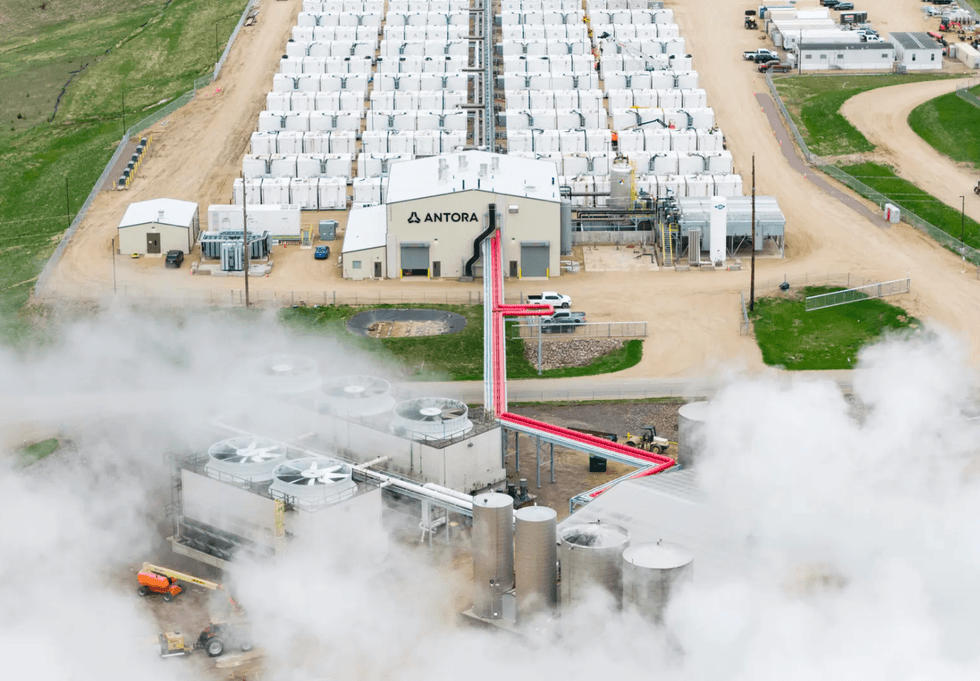
In May, the long-duration storage startup Antora brought one of the world’s largest batteries online at a South Dakota ethanol plant, converting cheap surplus wind power from the grid into heat that stays insulated inside solid carbon blocks at temperatures exceeding 3,632 degrees Fahrenheit, or 2,000 degrees Celsius, and can be released to pump out as much as 5 gigawatt-hours of electricity. Now, with the $550 million I told you in July that it had raised to fund its expansion, the company is going even bigger. On Thursday, Antora announced plans for a nearly 6 gigawatt-hour project at Pratt Energy’s biorefinery in Pratt, Kansas. “Once complete, this project will be one of the largest battery storage systems in the world, delivering 24/7 energy that makes Pratt Energy’s operations more competitive,” Andrew Ponec, Antora’s co-founder and chief executive, wrote in a post on LinkedIn. “And I’m especially proud of the partnerships we’ve built with the Pratt community on local hiring, internships, and scholarships.”
With demand for long-duration storage that doesn’t lose charge like lithium-ion batteries skyrocketing, there are clear signs the market is primed to rip. On Thursday, the iron-sodium battery startup Inlyte Energy announced its first commercial project, supplying power to Berkshire East Mountain Resort’s snow-making machines during ski seasons without enough fresh powder. The 80-megawatt-hour project, one of two long-duration storage projects backed by a state program in Massachusetts, is expected to come online in 2028. “The Berkshire East project shows what becomes possible when Inlyte’s iron-sodium battery does more than one job,” Ben Kaun, Inlyte’s chief commercial officer, said in a press release. “Its efficient, long-duration capability enables clean power during demanding snowmaking peaks, makes better use of renewable electricity, and keeps a critical community resource operating when the grid goes down.” Long-duration storage is one area where the U.S. hopes to gain an edge. With scaled-up versions of electric vehicle batteries now occupying the fastest-growing niche in the global power market, China commands 95% of the sector, the Financial Times reported yesterday.
Sign up to receive Heatmap AM in your inbox every morning:
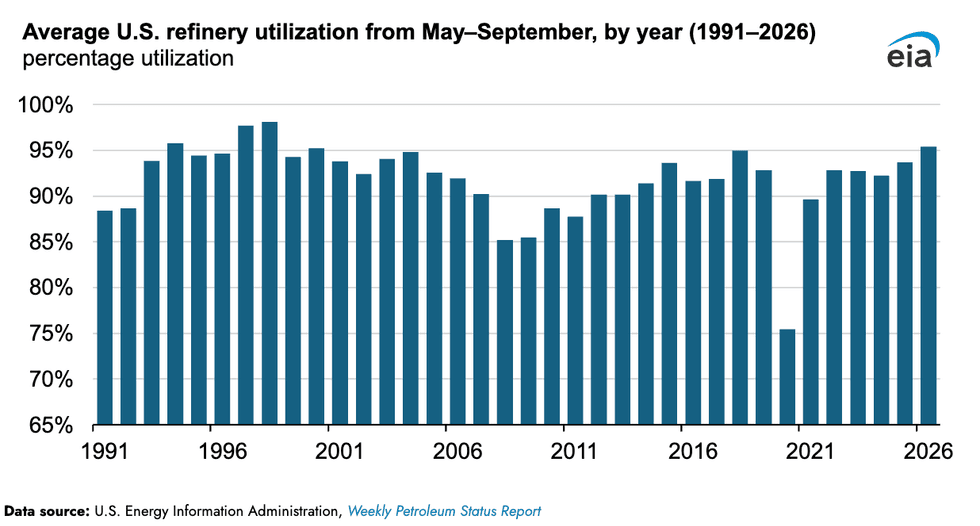
As I told you yesterday, President Donald Trump is seesawing over whether to temporarily ban U.S. exports of diesel, holding crisis talks as he weighs the merits of a brief and uncertain price reprieve for Americans at the cost of a catastrophic price shock in Europe. On Thursday, Reuters reported that the White House is pressing the European Union to release 120 million barrels of diesel. The administration told German and French officials to draw down emergency diesel inventories to help ease global fuel prices or face a U.S. export ban.
Exactly a year ago, the Department of Energy canceled hundreds of grants totaling more than $8 billion, a move the agency later admitted in court was “based solely” on whether the project was located in a state that voted for Kamala Harris in 2024. Now over 60% of those projects remain stuck in administrative limbo, nearly 70% of retained awards have received negligible funding in the past six months, and billions in funding to 1,700 newly identified projects remain “quietly ghosted” without any communications, according to an analysis published this morning by the alumni network of former Energy Department staffers and the watchdog group Lawyers for Good Government. “The U.S. Department of Energy has not been acting in good faith when it comes to grantees working on climate-based solutions,” Jillian Blanchard, the senior vice president of climate change and environmental justice at Lawyers for Good Government, said in a statement.
The Energy Department isn’t the only agency attracting fresh scrutiny for terminating grants for clean energy in the early days of the current Trump administration. Last month, federal district court judges in Rhode Island and the District of Columbia ruled within days of each other that the Environmental Protection Agency had illegally terminated funding promised to low-income Americans to help finance rooftop solar panels from the Biden-era Solar for All program. Now that the $7 billion program is poised to begin flowing again, recipients who were made to wait are suing the Trump administration for damages over the pause. The termination “was devastating on so many levels,” Kerry O’Neill, chief executive of program grantee Inclusive Prosperity Capital, told Utility Dive. Her organization, tasked with using the money to get panels to eligible Americans, had to cut back on staffing. Now it’s “going back and building these teams back up,” she told the trade publication. “We had fully approved work plans, very detailed plans. Our products are designed, sitting, ready to go. It would obviously take time to pull our coalition back together and get on everybody’s work queue. But this is a group that’s super passionate.” The EPA said it was reviewing the suit.
The trillion-dollar question in Washington right now is whether the Senate will actually vote to pass the bipartisan permitting reform bill unveiled yesterday. (Read my colleagues’ super-comprehensive breakdown of the legislation here.) But Wednesday showed that the Senate is perfectly capable of finding consensus when the chamber passed the Wildfire Emissions Prevention Act with unanimous approval. The bill would make it easier for states to deal with wildfire emissions, promote efficient use of air quality resources, and ensure that states won’t face federal penalties for taking action to curb blazes. “Utah has faced a devastating fire season, and we know that preventing catastrophic wildfires starts with giving land managers the tools to reduce hazardous fuels before they burn,” Senator John Curtis, a Republican from Utah, said in a statement. “Prescribed fire works, and states should not be penalized for responsibly using it to protect communities, forests, and air quality.”

Log in
To continue reading, log in to your account.
Create a Free Account
To unlock more free articles, please create a free account.
Matthew Zeitlin talks with the New Jersey leader at Heatmap House at New York Climate Week.
Governor Mikie Sherrill is a former Navy pilot, federal prosecutor, and a member of the U.S. House of Representatives. She was elected New Jersey's governor in November 2025 in a campaign dominated by the state’s surging electricity prices.
For this episode of Shift Key, Governor Sherrill joined Heatmap correspondent Matthew Zeitlin for a live conversation at our Heatmap House event, part of New York Climate Week. She reflected on electricity inflation, power markets, and what a data center developer would need to do to build in New Jersey.
Shift Key is hosted by Robinson Meyer, the founding executive editor of Heatmap News.
Subscribe to “Shift Key” and find this episode on Apple Podcasts, Spotify, Amazon, YouTube, or wherever you get your podcasts.
You can also add the show’s RSS feed to your podcast app to follow us directly.
Here is an excerpt from their conversation:
Matthew Zeitlin: So obviously — we were talking about this backstage — New Jersey has this great history of innovation technological development. And right now you have a lot of advanced industries in New Jersey — a pharmaceutical industry, financial services you have a lot of research around the Princeton National Lab. When you’re trying to attract these kind of next generation industries, how do you kind of assure them that they can set up large energy-consuming facilities that anchor those industries?
Mikie Sherrill: It’s kind of interesting, twofold. I would say to a large extent, we don’t need to attract some of these innovators, we need to keep them. Innovation starts in New Jersey. We have a million different spinoffs. We were talking about, they’ll do fusion, and they’ve already got the magnets that are found few places in the world. I mean, they come and spun off from the National Lab at Princeton. We have companies like that all over the state. And we have states like New Mexico that are constantly saying, you know, here, come here. And people in New Jersey — and if you’re not from New Jersey, this may surprise you — but people in New Jersey love New Jersey, and we want to stay there. And we want our kids to go to the great schools there and we want to continue to grow businesses. So companies don’t want to leave New Jersey. We just have to make sure they have enough, you know, that there’s not some other incentive driving them away.
At the same time, when you say, how can I assure that people are going to have all the power they want? We are creating a structure so that people can make sure that they have clean power generation. That’s why something like a virtual power plant is so interesting. But it is not on the state to kind of assure you can do whatever the heck you want in power generation. It is up to the companies to work with us to say, okay, I want to invest in this. This is going to be a net good for the people of New Jersey. So for example, I’m going to build a virtual power plant. I’m going to have battery packs in everyone’s basement. I’m going to pay them to do that. And we’re going to generate new clean power for this entity. That is how they need to come to work.
And I would again say that that was what was so interesting at the table, because there are people who get that. In some of the most innovative power generating companies, in some of the most innovative technological companies, they get that. They know where this is all going. Some of the old school companies are still sort of coming to the table saying, what can you do for me? That’s not where we are right now. We need to understand what benefit can you bring to the people of New Jersey.
You can find a full transcript of the episode here.
Mentioned:
Matthew on Governor Sherrill’s electricity rate freeze
Previously on Shift Key: Energy Secretary Chris Wright on Trump’s Pro-Nuclear, Pro-Fossil Fuel Agenda
Previously on Shift Key: Al Gore on AI, ‘An Inconvenient Truth,’ and the Biggest Surprises of the Past 20 Yearst 20 Years
This episode of Shift Key is sponsored by ...
Formed through a joint venture between Wärtsilä and RCT Solutions, Valo helps utilities, independent power producers, and developers navigate market and grid complexity without sacrificing system performance. Learn more at valoenergy.com.
RE+ 26 is the largest clean energy event in North America, happening November 16th through 19th at the Las Vegas Convention Center. Register at re-plus.com and use code SHIFTKEY20 to save 20% off a Full Conference pass.
Every year Giving Green researches the top climate nonprofits and sends 100% of every dollar donated to its Giving Green Fund straight to them. Make your first gift before the new year, and it will be matched up to $500. Go to GivingGreen.earth/Shift.
This transcript has been automatically generated.
Subscribe to “Shift Key” and find this episode on Apple Podcasts, Spotify, Amazon, YouTube, or wherever you get your podcasts.
You can also add the show’s RSS feed to your podcast app to follow us directly.
Robinson Meyer:
Hello, it’s Friday, October 2, and this is a special New York Climate Week edition of Shift Key. Last week, Heatmap welcomed climate and energy leaders, experts, and influencers to Heatmap House, our all-day summit in New York City. Among those leaders was New Jersey Governor Mikie Sherrill. Governor Sherrill is a former Navy pilot, federal prosecutor, and member of the House of Representatives. She was elected New Jersey’s governor in November 2025. That campaign, and her election year last year, was dominated by the state’s surging electricity prices, and specifically by how the interaction between the AI data center boom and features of the local multi-state electricity market, PJM, had caused power bills to surge in the state by about $260 per household.
Robinson Meyer:
Governor Sherrill ran on and implemented a one-year rate freeze. She’s since passed other legislation meant to make it easier to build solar and batteries in the state. My colleague, Heatmap correspondent Matthew Zeitlin, has been covering those policies, and last week he sat down at Heatmap House to discuss them with Governor Sherrill, as well as to discuss the future of her climate and electricity agenda. Let’s go to that conversation now.
Robinson Meyer:
Matt and Governor Sherrill were recorded in front of a live audience at Heatmap House at 22 Vanderbilt in New York City on September 23rd. I’m Robinson Meyer, the founding executive editor of Heatmap News, and you are listening to Shift Key.
Matthew Zeitlin:
Mikie Sherrill, thanks. Thanks so much for coming across the Hudson this morning to join us. Let’s just start with, I think, the kind of electricity or energy policy issue most associated with you. Is there a rate freeze in New Jersey right now? And are your constituents, the rate payers, are they still angry about their electricity bills?
Mikie Sherrill:
That’s a great question. So, yes, there is a rate freeze. In fact, that was a commitment I made. And so I didn’t, I would say less than an hour into my administration, the middle of my inaugural address, I declared a state of emergency on utility costs, froze rates, and then at the same time signed executive orders to increase power generation across our state. We’ve been at it ever since. And the movements we’ve made will save New Jersey rate payers over a billion dollars a year as we are implementing all of these changes. And, but no, rate payers are not happy in New Jersey, nor should they be, because rates did go up double digits. So they saw a large increase. And, you know, in large part, there had been a lot of people asleep at the wheel on how we were going to move forward in advanced technologies and generate more power and drive down costs.
Matthew Zeitlin:
So as I understand it, a component of those executive orders was taking some of the funding that comes from the regional greenhouse gas market and putting that into rate relief. You know, there is stuff on any New Jersey ratepayers bill that funds things that are government programs, energy programs. Have you rethought kind of both the RGGI and the societal benefits charges to think about why are we adding stuff onto the bill instead of, you know, making it cheaper?
Mikie Sherrill:
So we actually have taken stuff off the bill. There was an incentive on our bill that had been in place for years to incentivize our utility companies to join PJM. Well, they joined PJM years ago and they weren’t going to leave. So we took that off the bill and we just did that to drive down costs. We did use a little bit of our Reggie friends because there had been some rate cases that had already been made in the previous administration that we had to address so that we could keep rates flat to meet our commitment. What we’ve really done, though, that I’m very excited about with some RGGI funds is to put $100 million incentives into solar and battery storage projects so that we can see more generation in these clean power technologies. And I think that’s something that we’re going to see. EDA has just been putting that at our economic development authorities. So we’re very excited about what’s coming.
Matthew Zeitlin:
Yeah. And then just kind of building off of that. Obviously, New Jersey has aggressive climate commitments. How do you talk to your how you’re going to meet those climate commitments when they’re, I think everyone would say they’re most concerned right now about kind of that number on the bottom of their bill.
Mikie Sherrill:
Certainly. Look, we have, you know, when I say we have an affordability crisis, it’s not just one thing. It’s a crisis because it’s everything. Housing prices are up in some cases by 60% in some towns in the last five years. We have utility costs up by double digits last year. They were set to go up double digits this year until I froze them. We have, you know, the federal government’s cutting health care. So we have 70,000 people that can’t afford to be in the affordable care market anymore. We have about 300,000 people who are being kicked off the Medicaid rolls that we have to deal with. So there is a crisis going on. So you cannot simply say to people, you know, sorry, your bills are just going to keep skyrocketing. That is not the answer, which is why we’ve acted so aggressively.
Mikie Sherrill:
I approved 18 solar and battery storage projects in the first six months because we knew the federal credits were going to run out if we did not get that done. So that’s why we had to take on permitting reform right away to make sure we were growing that. I lifted a 50-year nuclear moratorium.
Mikie Sherrill:
We have continued to look at new and innovative things. A lot of people are talking about virtual power plants to get more capacity and drive-down costs. We are implementing that. I would suggest, and we were talking a little bit about this before we went on, it was so interesting. I’m one of one of the very few people that actually ran in 2025. So we knew the landscape. We knew what Trump was ending. We knew what the future looked like. We knew what we could and couldn’t do and spaces that we’d have opportunity and where opportunity was shut off from us. So we we could hit the ground running. And we also took advantage of best in class people.
Mikie Sherrill:
We have, she’s sitting right there, Maddie, who’s worked in New Jersey Power and understands it very deeply. We have Elizabeth Knoll, who came out of the federal government, who worked for Granholm and now is working for New Jersey. We have amazing people who are developing these new and innovative things. And I think the reason that New Jersey has now become a market leader in how you advance clean energy in a really innovative way is because we’ve just set up this government. So everything’s starting from, okay, where are we and how do we get to a better place and taking on all those new innovations.
Matthew Zeitlin:
Yeah, I mean, we were talking backstage, you know, when I took this job three years ago, I had no idea I’d be writing so much about energy policy in the state of New Jersey, but from the campaign and then, you know, in your first year here, there’s been so much going on. Obviously, we need to talk about data centers, you know, not too long ago. New Jersey had a program, a tax, you know, abatement, a tax incentive to attract data centers to the state. Obviously, there’s been a lot of local backlash to them. There was an enforcement action, I think, this morning in Vineland, New Jersey. That tax incentive has, I believe, been reversed. From your perspective now, if a data center developer wants to set up in New Jersey, what do they need to do?
Mikie Sherrill:
Well, we’ve laid out exactly what they need to do. They need to bring their own energy. They need to invest in our grid. They need to report their water and power usage. They need to hire good talent so that they create jobs in the community. And they need to bring community benefits. We’ve also put them in their own rate class, so they are not harming other rate payers. And we mean business. And I think you can see that with the action we brought against the Vineland data center. So this is not a free ride for anyone. If they want to engage in building this out, it has to be a benefit to our communities in New Jersey.
Mikie Sherrill:
What was so interesting to me, I was telling you about different financing agencies and different power generators and what this was going to look like going forward. And it was so fascinating to me to see the difference between the old and new. Some people at the table are saying, oh, you know, people are saying don’t invest in New Jersey because labor cost of labor is high. And I said, that is so fascinating. You’re telling me that because I have heard from so many people about how they’re dying to invest in New Jersey and they want to know how. And I said, yeah, we’re a labor state. You’re going to have to pay for talent. But at the same time, we are laying out exactly how you invest in New Jersey to take a lot of the risk out of it. But you have to come to the table early. You can’t just come in and say, work out some deal in back rooms and come say, now I’m going to plop a data center here.
Mikie Sherrill:
I mean, there are places in New Jersey where you should not be building data centers. There are places in New Jersey where it might make sense, but the towns and communities are going to decide that. So you have to start engaging early with them to explain what you want to do and why you want to do it. And finally, I’ve said, and you’ve, I told a data center, I said, and you guys have been horrible at it. I’m just telling you, nobody knows what a data center is and you need to explain why it’s even important. Are you curing cancer? You know, what are you doing? Why is this a societal benefit. And then I’ll end by saying, look, it’s up to businesses. They make money, right? Scientists innovate. Government needs to protect people. And that’s where government has been asleep at the wheel. And that’s why I think you see so many people not trusting innovation right now or where it’s going, because government needs to protect people from these downside risks. And right now, I would say the federal government’s not going to do it, which is why as a state, we are engaging so aggressively.
Matthew Zeitlin:
So obviously we were talking about this backstage, New Jersey has this great history of innovation technological development, and right now you have a lot of advanced industries in New Jersey — a pharmaceutical industry, financial services you have a lot of research around the Princeton National Lab. When you’re trying to attract these kind of next generation industries how do you then kind of, on the other way, how do you kind of assure them that they can set up large energy consuming facilities that, you know, are that anchor those industries?
Mikie Sherrill:
It’s kind of interesting twofold. I would say to a large extent, we don’t need to attract some of these innovators. We need to keep them. Innovation starts in New Jersey. We have a million different spinoffs. We were talking about they’ll do fusion and they’ve already got the magnets that are found few places in the world. I mean, they come and spun off from the National Lab at Princeton. We have companies like that all over the state. And we have states like New Mexico that are constantly saying, you know, here, come here. And people in New Jersey, and if you’re not from New Jersey, this may surprise you, but people in New Jersey love New Jersey and we want to stay there. And we want our kids to go to the great schools there and we want to continue to grow businesses. So companies don’t want to leave New Jersey. We just have to make sure they have enough, you know, that there’s not some other incentive driving them away.
Mikie Sherrill:
At the same time, when you say, how can I assure that people are going to have all the power they want, we are creating a structure so that people can make sure that they have clean power generation. That’s why something like a virtual power plant is so interesting. But it is not on the state to kind of assure you can do whatever the heck you want in power generation. It is up to the companies to work with us to say, okay, I want to invest in this. This is going to be a net good for the people of New Jersey. So for example, I’m going to build a virtual power plant. I’m going to have battery packs in everyone’s basement. I’m going to pay them to do that. And we’re going to generate new clean power for this entity. That is how they need to come to work.
Mikie Sherrill:
And I would again say that that was what was so interesting at the table, because there are people who get that. In some of the most innovative power generating companies, in some of the most innovative technological companies, they get that. They know where this is all going. Some of the old school companies are still sort of coming to the table saying, what can you do for me? That’s not where we are right now. We need to understand what benefit can you bring to the people of New Jersey.
Matthew Zeitlin:
And you mentioned earlier that, you know, your gubernatorial race was in 2025. We obviously have the midterms coming up in November, and then we have, you know, another election in 2028. What, when Democratic candidates come to you and ask about how they should talk about energy and electricity policy, or if they’re not coming to you and you would like to say something to them, what are you telling them? How they, you know, obviously every state, every district’s different, but what are some … What are some things you learned in 2025 that could be applied elsewhere in the country?
Mikie Sherrill:
Sure. I just want to go back one second. I know we’re on such limited time. That’s why I’m speaking fast. I would say the reason I was saying what can you bring to New Jersey is because the business case has been made for innovation technologies, and they are raking in billions of dollars. And we just need to make sure that as we build out these systems, that it goes to a benefit to everyone, that we are not simply funneling billions, trillions of dollars into a few people in Silicon Valley. We want to make sure this is a net good. That’s what I said government does, is we protect communities from those downside risks and we invest and create opportunity there. That’s what we’re looking to do, is making sure everybody gains here.
Mikie Sherrill:
The thing I would tell people who are running is you have to be nimble, You have to be innovative and you have to be aggressive and you can’t, you have to take risks. The status quo is not working for anyone. The can has been kicked down the road on too many different issues. And if you were going to try to duck your head and say some mealy mouth thing like, you know, we’re going to do all of the above and, you know, and it’s, you know, everyone’s welcome and we like business. That’s not going to cut it. you have to be able, I mean, we charged through the campaign by understanding deeply what was going on in our state. And so we were joking. I would say, you know, a lot of people in the whole market couldn’t tell you what PJM is, right? Still, a lot of governors probably couldn’t really delineate it. We knew everything about everybody because when your utility bill goes up by double digits, the person you’re going to hire to be the no boss of your state better understand why. And exactly what they can do to fix that.
Mikie Sherrill:
And then I have to convince people, because the final thing I’d say is, I’d say since Reagan, this idea of like government’s always the problem, get them out of the way and everything goes well, has come to its logical conclusion, right? There are areas where we need government to function, and we need government to function well, not just to sort of regulate stuff to actually drive innovation, to drive success for people, to drive opportunity, and make sure the rising tide lifts all boats. That’s what has been missing in so many cases. And so I think if you want to run for us, if you want to hold the public trust, if you want to be a public servant, then you need to engage deeply and you need to be really good at your job. And that means telling people exactly what you can do to make their lives better.
Matthew Zeitlin:
I think that’s probably as good a note as any to end on. Mikie Sherrill, thank you so much.
Mikie Sherrill:
Well, thank you. I really appreciate it.
The bill would let states and utilities discriminate against data centers and crypto miners, requiring them to pay higher rates to cover the full cost of any system upgrades.
Call it the data center double tap.
A wonky set of provisions in the Senate’s bipartisan permitting deal would rewrite federal electricity law to allow states and utilities to discriminate against artificial intelligence data centers and crypto miners for the first time.
The proposal would force AI data centers to pay for any new transmission infrastructure required to serve them — while still paying full freight to use the rest of the power grid. It could even let states require the facilities to subsidize other customers’ power rates.
Senator Martin Heinrich, the ranking Democrat on the Senate energy committee, mentioned the provisions during a press event announcing the deal on Wednesday, but they have so far attracted less attention than the bill’s other measures.
If enacted, the bill will “mean that we actually require big load centers — whether that’s a factory or a data center — to not pass those costs on to the American consumer by statute, not suggestion,” he said.
The bill arguably goes further than that summary. It creates new carve-outs in federal law that disadvantage data centers and crypto miners specifically, allowing states to discriminate against them as compared to other large-scale customers. It also protects electricity customers from the future risk of data centers failing to pay their bills.
The proposal comes at an auspicious time. Utilities are already gearing up to spend tens of billions of dollars building new transmission lines and power infrastructure to meet energy demand from AI data centers. The law would seek to ensure that tech companies and data center developers bear the cost of those upgrades.
Since the data center boom got underway, just about everyone involved — tech companies, utilities, environmentalists, and even President Trump — has agreed on one thing: Normal Americans should not pay for data centers’ burden on the power system.
These expenses can be significant, especially for the transmission system. Because a single computing facility can guzzle gigawatts of energy at once, compressing a city’s worth of power demand into just a few acres, it often requires the construction of specialized new infrastructure, or it risks causing blackouts and brownouts for nearby customers.
In 2024, utility customers in the country’s largest power market paid $4.3 billion for transmission upgrades to supply data centers, according to a Union of Concerned Scientists report.
Trump enshrined guarantees against these payments in his Ratepayer Protection Pledge in March. That document vowed that data center companies must pay for all of the electricity used to run their facilities, any new power plants required to generate that electricity, and any “new power delivery infrastructure upgrades.”
There’s just one issue: Under federal law, the last part of that pledge is nearly impossible.
Since the early 1990s, federal law has prohibited utilities from charging customers for both the cost of using specific transmission infrastructure and the cost of using the rest of the power grid.
The origins of that ban go back to a 1992 case where a power plant in one utility’s service area wanted to sell electricity to a neighboring utility. The local utility wanted to charge it the “normal” cost of using its power grid, plus a special fee to cover the cost of crowding its own customers off the necessary transmission lines.
The Federal Energy Regulatory Commission ruled that was illegal. Instead, it said, utilities could make a customer pay for the “incremental” cost of using specific transmission lines, such as those built to service their facility. Or they could charge for the “embedded” costs of the existing power grid.
Utilities could not charge customers for both “incremental and embedded” costs, it said; instead, utilities had to choose the higher of the two. FERC formalized the policy in 1994.
Electricity law has changed significantly since then, and those FERC rules don’t apply to power plants, Ari Peskoe, the director of the Electricity Law Initiative at Harvard Law School, told me.
But the ban still applies to electricity customers — even very big ones, like data centers. Peskoe wrote a Utility Dive article in April credited with first identifying the clash between the FERC rules, the data center boom, and the White House’s pledge.
The rules have serious implications for energy affordability. In practice, virtually every utility today is charging data centers for the “embedded” cost of using the existing grid, Peskoe told me. That’s because utilities want to avoid fights with each data center about which transmission upgrade costs are “incremental” and which are “embedded.”
Instead, utilities are forcing all of their customers to pay for the cost of transmission upgrades to serve those data centers. That means data centers will likely drive up normal Americans’ electricity rates for the next decade or so, even if officials, lawmakers, and tech companies say they don’t want that to happen.
The Senate proposal would change this, instructing FERC to require utilities to charge data centers for the cost of any new grid upgrades required to serve them as well as the costs of the underlying grid. In other words, it would mandate data centers pay for embedded and incremental costs.
These types of customers “should incur the full cost of the transmission service they require,” the bill says. This change would apply narrowly to data centers, crypto mining operations, and any facilities doing AI training — essentially discriminating against data centers under federal law.
The bill would also write a new section into the Federal Power Act that would require data centers, crypto miners, and other computing facilities larger than 20 megawatts to cover the entire cost of their service. The bill says utilities can’t spread the cost of providing energy or building infrastructure for data centers to any other customer.
If data centers leave a contract early, they will still have to pay for the full cost of those grid upgrades. And before a utility can upgrade any of their infrastructure to serve a data center, it must get “financial assurances or contributions” from that facility to cover the costs of doing so.
The bill also allows states to go further than these provisions — they can discriminate against data centers, set special rates by which data centers subsidize other customers’ power rates, and auction off the right to connect to the power grid.
Since I’ve learned about these provisions, I’ve struggled with what to call them. They aren’t quite a new tax on data centers, because the government does not collect the revenue. But many of them have tax-like qualities: They impose significant new costs on future data centers that would then be used to pay for upgrades to the broader power grid, and they protect the power system from the downside risks of a data center bust. They also allow for cross-subsidy of the power system, where payments from data centers can reduce everyone else’s electricity rates.
The law would bring federal rules governing electricity somewhat closer to those that already exist for natural gas, though it goes much further than those rules, too. Since 1999, FERC has generally assumed new interstate natural gas pipelines should be entirely paid for in an “incremental” way, meaning that new shippers or customers are supposed to bear the costs of service expansion alone. Having customers pay for embedded and incremental pricing remains illegal under federal natural gas law.
When combined with other provisions in the bill — such as those that make building new interstate transmission lines much easier — the new policies could help spur a large-scale buildout of electricity infrastructure paid for by the data center boom.
But even setting that more ambitious potential aside, the law would cover existing holes in the laws protecting Americans from paying for the data center boom.“I think it’s an improvement on the status quo,” Peskoe told me. “I think it’s consistent with data centers paying their ‘fair share,’ and consistent with the text of the Ratepayer Protection Pledge.”
And it is also “consistent,” he added, “with how normal people might think about these issues.”