You’ve reached your free article limit
Log in
To continue reading, log in to your account.
Create a Free Account
To unlock more free articles, please create a free account.
Sign In or Create an Account.
By continuing, you agree to the Terms of Service and acknowledge our Privacy Policy
Welcome to Heatmap
Thank you for registering with Heatmap. Climate change is one of the greatest challenges of our lives, a force reshaping our economy, our politics, and our culture. We hope to be your trusted, friendly, and insightful guide to that transformation. Please enjoy your free articles. You can check your profile here .
subscribe to get Unlimited access
Offer for a Heatmap News Unlimited Access subscription; please note that your subscription will renew automatically unless you cancel prior to renewal. Cancellation takes effect at the end of your current billing period. We will let you know in advance of any price changes. Taxes may apply. Offer terms are subject to change.
Subscribe to get unlimited Access
Hey, you are out of free articles but you are only a few clicks away from full access. Subscribe below and take advantage of our introductory offer.
subscribe to get Unlimited access
Offer for a Heatmap News Unlimited Access subscription; please note that your subscription will renew automatically unless you cancel prior to renewal. Cancellation takes effect at the end of your current billing period. We will let you know in advance of any price changes. Taxes may apply. Offer terms are subject to change.
Create Your Account
Please Enter Your Password
Forgot your password?
Please enter the email address you use for your account so we can send you a link to reset your password:
On Taiwan’s LNG investment, Chinese solar job cuts, and molten chloride fast reactors

Current conditions: Temperatures in Washington, D.C., are climbing up to the mid 80s Fahrenheit today before taking a double-digit plunge as cold air blows in this weekend • California’s biggest utility has warned of looming blackouts as the southern part of the state braces for a potential wildfire • Tropical Storm Trudy is strengthening in the Pacific off the coast of Mexico into what could become a major hurricane.
The Houthis sent a clear signal this week: We are coming for Saudi Arabia’s oil industry. Days after striking Riyadh and scaring Western oil executives away from an industry summit in the Saudi capital, the Iran-backed rebels hit the headquarters of the kingdom’s state energy behemoth, Aramco. Official reports on Tuesday initially downplayed the impact on the sweeping complex in Dhahran, in Saudi Arabia’s oil-rich east. On Wednesday, however, Reuters reported that the missile attack had caused “extensive damage,” including “with a fire spreading across several floors.” Saudi Arabia has at other points during the conflict after proven resilient. After Houthi missiles pulverized a key node on the East-West Pipeline that serves as the main conduit to get oil from the Persian Gulf coast to the Red Sea shore, crews quickly created a workaround to restore the flow of crude. Following a brief uptick, the prices of Brent crude, the global benchmark, and the U.S.-centric West Texas Intermediate both fell on Wednesday. Maybe not for long: The Houthis vowed yesterday to continue targeting oil facilities.
Since shutting down its nuclear plants, Taiwan has become dependent on natural gas for at least half its electricity generation. But the self-governing island democracy doesn’t drill any of the fuel. It’s dependent on imports at a moment when, thanks to the war in Iran, anyone who isn’t producing their own is looking for a cheap, steady supply of liquified natural gas. Taipei has found a supplier. In a Wednesday post on his Truth Social platform, President Donald Trump said Taiwan agreed to buy 30% of the LNG shipped from the proposed $55 billion megaproject to build a gas pipeline from Alaska’s Arctic coast to an export terminal south of Anchorage. As part of the 20-year deal, Trump said the Taiwanese government would pay $4.4 billion for an equity stake in the project. Taiwan’s Ministry of Economic Affairs confirmed the deal and said it would work out the details later.
The pledged investment for the long-delayed project comes days after the Environmental Defense Fund released a new analysis showing that utilities and developers are cooling on clean power and once again pumping money into fossil fuel infrastructure at a rate that could see gas and even coal regain “a market share not seen since the early 2010s.” Amid all this investment, the national average retail price of electricity fell year over year from 20 cents per kilowatt-hour in September 2025 to 19.6 cents per kilowatt-hour last month, according to the freshest data on Heatmap and MIT’s Electricity Price Hub. “Great news, right?” my colleague Matthew Zeitlin wrote yesterday. “Not really.” He explains further: “While this is the first year-over-year decline in average prices since September 2023, it’s mostly due to California moving around its Climate Credit to the late summer months of August and September, historically among the highest-demand periods on the grid. The state previously delivered the credits in April and October. But while this is a nice thing for California ratepayers, it does less to tell us about nationwide electricity price trends.”

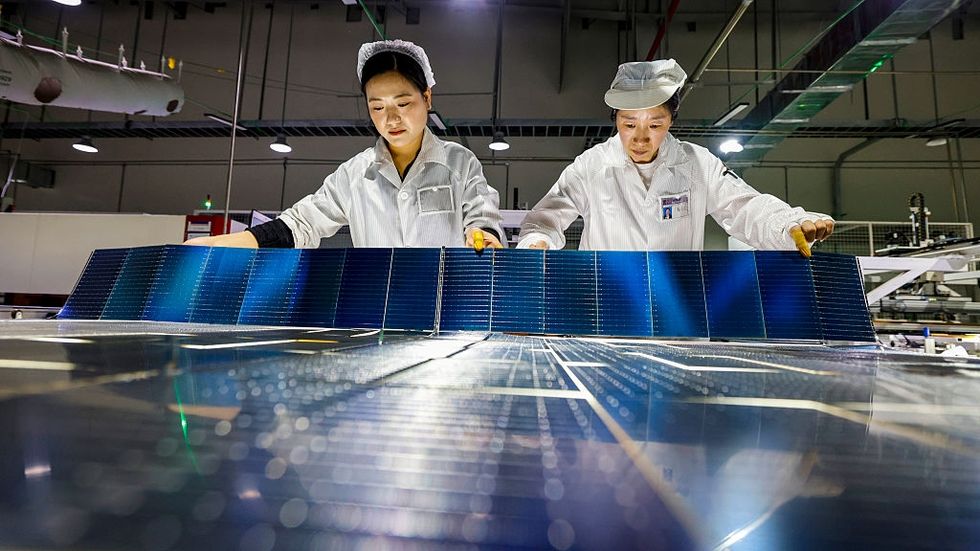
China’s top five solar manufacturers cut nearly 41,000 jobs last year as Beijing cracks down on the overcapacity that made exports so cheap Europeans started building fences out of panels. A new Reuters analysis of company filing shows that Longi Green Energy, Trina Solar, Jinko Solar, JA Solar, and Tongwei employed 40,589 fewer people than a year earlier. That 21% drop followed a 31% decline last year. The job cuts represent what the newswire called a “paradox,” in that the solar sales are booming as the world seeks alternatives to Middle Eastern hydrocarbons, yet the biggest manufacturers built too many factories and now no one can make any money.
The shift in China comes as the U.S. scrambles to rebuild its solar manufacturing capacity. Tariffs that Trump implemented, former President Joe Biden maintained, and Trump doubled down on have already set the stage for what my colleague Emily Pontecorvo reported may or may not be a manufacturing resurgence in the U.S. In August, we reported the Department of Commerce’s new trade restrictions were the administration’s lifeline to solar manufacturers that lost a key incentive when federal tax credits went away, taking with them the bonus for buying domestically-produced panels.
Sign up to receive Heatmap AM in your inbox every morning:
The world has seen experimental reactors that use molten salt as a coolant for a fission reaction fueled by uranium or plutonium. Several startups, including Bill Gates’ TerraPower, are now seeking to commercialize a version of that technology. Recently, the startup partnered with the utility giant Southern Company to examine a whole new possibility: A molten chloride fast reactor that uses liquid salts as both a coolant and a fuel. If that could work, it would be the first in the world. The advantages of the technology, in theory, would be limited enrichment needs, no fuel assemblies of uranium pellets, and a more flexible reactor that can ramp up and down to meet the grid’s needs. On Wednesday, the Department of Energy backed the effort to validate the science behind so-called MCFR reactors. The research will take place at the Idaho National Laboratory and has support from Southern and Core Power, a startup looking to harness fission to power cargo ships.
Is quantum computing a climate technology? Despite overlapping investors, it’s a difficult case to make, my colleague Katie Brigham wrote earlier this year. But the ways in which the technology develops certainly could be a model for other energy breakthroughs. On Wednesday, New York City Mayor Zohran Mamdani unveiled a deal with New York University whereby City Hall will support the construction of a quantum computing lab in exchange for 15% of any proceeds from selling intellectual property developed at the facility. “In the first deal of its kind in NYC history, the public is investing $30 million in a quantum lab — in exchange for three board seats and 15% of the revenue generated from technology it creates,” Lina Khan, the chair of the board of the New York City Economic Development Corporation, wrote in a post on X. “And if any firm coming out of the lab merges, gets acquired, or IPOs, the city gets a payout.”
When the solution to Indonesia’s very modern smog problems was invented, the archipelago nation remained under Dutch colonial rule and the planet was about 1 degree Celsius, or 1.8 degrees Fahrenheit, cooler than it is today. To ease the thick haze in Jakarta and other cities from forest fires the country the country is repurposing a weather-modification technique first invented in the 1940s. Per Bloomberg: “Aircraft will disperse pellets of dry ice above South Sumatra province in an experimental approach that authorities hope will reduce the hazardous smoke that’s blanketed the region for weeks, disrupting economic activity and damaging public health.” The first trial run starts today.
Log in
To continue reading, log in to your account.
Create a Free Account
To unlock more free articles, please create a free account.
Energy costs remain high — and early voting has begun.
The national average retail price of electricity has fallen year over year from 20 cents per kilowatt-hour in September 2025 to 19.6 cents per kilowatt-hour in September of this year, or about 2%, according to the latest update to Heatmap and MIT’s Electricity Price Hub.
Great news, right?
Not really.
While this is the first year-over-year decline in average prices since September 2023, it’s mostly due to California moving around its Climate Credit to the late summer months of August and September, historically among the highest-demand periods on the grid. The state previously delivered the credits in April and October.
But while this is a nice thing for California ratepayers, it does less to tell us about nationwide electricity price trends. Excluding the credit, average prices would have been roughly flat, according to the MIT researchers. And even with the credit, bills are still rising year over year, at around $180 per month, up from $173 a year ago (though down from this year’s all-time high of $217 in July). Forty-five states and Washington, D.C., have seen their average bills go up over the last year.
The Bureau of Labor Statistics’ recently released inflation figures showed electricity prices rising 0.2% in September from August and 4.4% over the last year, while overall prices rose 0.6% and 3.7%, trends largely driven by increases in the price of gasoline.
As we’ve written about several times before, some of the biggest electricity price increases are in the Northeast and mid-Atlantic. In New York, prices in September were 31.5 cents per kilowatt-hour, up from 30 cents in August and 27 cents in September of last year.
In Maine, which sits at the end of the sparse New England natural gas network, prices have been rising sharply. In September, prices were just under 40 cents per kilowatt-hour, compared to 37 cents in August and 31 cents a year ago. Maine’s public advocate has blamed years of price hikes on natural gas prices, distribution costs — especially repairing infrastructure damaged by storms —and, to a lesser extent, subsidies for renewables.
Maine is just one of several midterm battlegrounds where energy costs have taken center stage, especially since the war in Iran spiked oil prices.
In Ohio, where Sherrod Brown is seeking to return to the Senate by defeating Jon Husted, electricity prices stand at just over 20 cents per kilowatt hour, compared to 18 cents last September, while bills have risen from about $129 a month to $162. Brown leads Husted in the polls by about 4 percentage points, according to Nate Silver’s polling average. Ohio started early voting earlier this month.
Fossil fuels are the real October surprise.
This is Heatmap Daily, an evening news digest written by our executive editor. Subscribe here.
At this point, the real October surprise may be the lack of one — because little seems set to change in the U.S. energy economy between now and the midterm elections on November 3.
Inflation certainly isn’t budging. Prices rose 3.7% over the past year, and 0.6% in September alone, according to today’s new government inflation report. That reading was hot — a tenth of a percent above what economists expected.
Surging gasoline and especially diesel fuel prices were to blame. Gasoline prices rose 9.1% last month, which pushed up prices above the economy: Transportation services, a category that includes airfare and Uber rides, increased by 0.6%, while food prices rose by 0.6%. (Read my colleague Matthew Zeitlin on how rising diesel costs can jack up food prices.) Staggeringly, fuel oil prices rose 15.3% — an eye-popping reading for a report where figures are usually in the tenth of a percent.
President Trump seems to be running out of time to repair the U.S. energy economy before Americans elect the last Congress of his presidency. His last-minute deal to free up 2.25 millions barrels of oil from Russia this month — with another 11 million or so to come afterward — seems unlikely to lower diesel prices, given that it represents only a few days of U.S. demand. (The deal has already succeeded in undermining Ukraine, however, and led six Republican senators to rebuke him this week.) Meanwhile, Election Day is in 20 days, and Americans are already voting in 20 states.
This is not how the Trump administration was supposed to play out — at least not according to its proponents. Trump in 2024 ran on taming the energy inflation that had plagued President Biden’s last two years in office. He vowed to “drill, baby, drill” and end Biden’s ambitious climate policies, which he called a “Green New Scam.” He even promised to do the bidding of oil company CEOs if they only steered $1 billion to his campaign.
This flagrant offer of quid pro quo may have mortified some in the industry, but it was coherent with the rest of Trump’s pitch: For more than a decade, he has essentially argued that only by surrendering to the fossil fuel industry, by giving oil and gas companies as much regulatory relief as they can stand, can voters finally escape high energy prices. Trump, of course, cemented this pitch in a typically over-the-top and ill-considered proposal, pledging to cut energy prices in half by 2026 or so. That was never going to happen, and its failure to happen has blown up for the president. But the underlying idea was consistent.
The Trump administration has spent the past two years executing this energy agenda. It repealed large swaths of the Inflation Reduction Act, ending incentives to build new solar and wind farms and terminating consumer-side subsidies for electric vehicles. It rolled back fines and rules restricting wasteful methane pollution. It has effectively eliminated fuel efficiency standards for cars and trucks. And it has declared an extralegal war on the wind industry.
And what has happened? Prices have gone up anyway. Gasoline and diesel are more expensive on an inflation-adjusted basis than they were on the day Trump took office. Now, you might argue that this surge is unrelated to the underlying policy, and that gasoline and diesel prices have surged because of the fallout from Trump’s war in Iran — not his domestic energy policy.
But the Iran crisis reveals the problem that Trump would have faced in any event: Oil prices are set on the global market, and neither the domestic oil industry nor the federal government possess the capacity to swing America’s production or consumption enough to affect those prices. Trump’s presidency, in other words, would always have been held hostage by the global energy markets — just as Biden’s was before him.
There is a deeper lesson here: The fossil fuel industry cannot guarantee low prices for consumers in the enduring way that Trump has promised — even if you give it all the regulatory relief that it demands. Nor can the oil, gasoline, and diesel markets deliver the deep energy security or economic stability that American policymakers want — or that voters desire. Trump’s war on Iran has continually been undermined by the American economy’s exposure to crude oil prices; the president is now compromising Ukraine’s defense in order to secure a dubiously small amount of crude. Fossil fuels remain America’s soft underbelly. Policymakers will keep getting poked until the country diversifies its energy system.
Even the smallest wave, tidal, and river-current projects are currently licensed as if they were 1,000-megawatt dams.
Tucked inside the Senate’s ambitious new permitting bill, the Bipartisan American Affordability and Jobs Act, is a major win for an energy technology that often flies under the radar: marine power. Small-scale wave, tidal, and river-current projects could help power everything from remote communities and military installations to ocean sensors and coastal desalination systems — at least in theory.
Drawing largely from the bipartisan FLOWS Act, introduced in the Senate last December but never brought to a floor vote, BAAJA aims to streamline the licensing pathway for so-called micro hydrokinetic projects, which harness moving water without dams or reservoirs and have a capacity of 5 megawatts or less. The bill would give the Federal Energy Regulatory Commission one year to act on commercial license applications for these projects, while exempting them from full review under the National Environmental Policy Act. It would also allow FERC to issue 10- to 20-year licenses, giving projects a pathway to long-term commercial operation, as opposed to relying on pilot licenses designed for temporary testing.
The bill wouldn’t eliminate environmental oversight altogether. Small-scale marine energy projects would still undergo basic environmental screenings as a part of FERC licensing, and would still require state and local permits, which can trigger their own environmental reviews. They’d also remain subject to the Endangered Species Act and the Clean Water Act — though the bill would expedite reviews under both of those laws, too. On the whole, the reforms are intended to give developers and investors alike a quicker, more predictable timeline.
“Taking a 1-megawatt marine energy project and trying to license it like it’s a 1,000-megawatt conventional dam just wasn’t working. It was apples to oranges,” Matthew Allen, senior director of legislative affairs at the National Hydropower Association, told me. “Recognizing that it deserves its own process could be a tremendous market signal for the technology.”
After all, this tech certainly doesn’t look like large-scale hydropower, where colossal dams unleash thousands of tons of water per second that rush through electricity-generating turbines to the river below. Such gargantuan infrastructure projects typically require favorable geography — think big rivers running through steep, mountainous terrain, where a dam can create a sharp drop in elevation. And with most of the best sites in the U.S. already developed, the country is unlikely to build many new greenfield hydro projects anytime soon.
But less-developed marine energy technologies have barely scratched the surface of their potential. Some look like large buoys, bobbing with the ocean swells and converting that motion into electricity. Others use turbines anchored to the seafloor or riverbed, spinning as tides ebb and flow or river currents rush past. While these devices generate essentially zero power for the grid today, in theory the resource is enormous: The National Renewable Energy Laboratory estimates that wave, tidal, and river-current projects have the technical potential to generate a staggering 2,300 terawatt-hours of electricity annually — more than half of the country’s total electricity generation last year. Wave energy alone accounts for about 60% of that number.
Of course, technical potential is a long way from practical reality. Economic constraints, environmental regulations, competing water uses, and public acceptance could limit uptake of these technologies. NREL suggests that we would be lucky to eventually tap even 10% of marine energy’s potential. Meanwhile, most of the tech remains in the pilot or demonstration stage in the U.S. — which is exactly why expediting permitting for small-scale projects stands to have significant impact.
“Marine energy is so new and still so novel that a 5-megawatt device, it doesn’t even exist right now,” Jennifer Garson, former director of the Water Power Technologies Office during the Biden administration, told me. “So you’re still talking about a good amount of headroom for being able to deploy smaller-scale marine energy devices in rivers and nearshore.”
Early deployments have largely served remote or island communities. In the 70-person Alaska Native village of Igiugig, for example, Ocean Renewable Power Company installed two 35-kilowatt turbine systems on a local riverbed, designed to supply nearly half the village’s power and thus reduce reliance on expensive diesel generators. While the project’s pilot license expires in three years, the permitting bill could offer a pathway to continued power generation.
The lack of a commercial licensing pathway has already led to the demise of one promising project, National Hydropower Association senior program manager Kelly Rogers told me. Verdant Power’s tidal energy pilot in New York City’s East River — the first project of its type to receive a license in the U.S. — officially shuttered in 2021 when said pilot license expired. By then, its turbines had delivered over 312 megawatt-hours of total electricity to the grid, harnessing the tides as they flowed in and out of the saltwater channel.
Other companies in this space include wave energy startups Oscilla Power and CalWave, which make surface-floating and submerged wave energy converters, respectively, with the goal of selling to utility customers and remote communities alike. C-Power, another early-stage wave energy company, is focused on powering off-grid equipment like ocean sensors. And while all have received at least some venture backing, a significant portion of their funding comes from Department of Energy grants.
In 2022, all three received DOE funding to trial their tech at PacWave, an Oregon-based facility that’s the first grid-connected wave energy test site in the continental U.S. Backed by the DOE, the facility secured all its necessary state and federal approvals in advance so that companies working there could largely bypass the permitting process and get their tech straight into the water. But getting there, Garson told me, involved an arduous 15 years of negotiations among the DOE, the Bureau of Ocean Energy Management, and state and local authorities before the facility could open for testing this August.
The permitting bill can only do so much to accelerate a permitting process like this, Garson explained. Even with a faster FERC licensing process, all projects in federal waters — generally those more than 3 nautical miles from shore — will still need a separate lease from BOEM, a complex process that the bill’s new permitting pathway wouldn’t replace. “One of the complexities of anything that you do with water is you just have so many split jurisdictional challenges and questions,” she told me.
It’s also telling that as of yet, there are no wave energy devices in PacWave’s waters, as the Trump administration’s federal funding freeze has scrambled the plans of some of the marine energy developers who’d originally intended to test there. Oregon startup AquaHarmonics, for example, was on track to deploy its wave energy converter at PacWave but had to shut down last year after the Trump administration withheld its previously allocated grant money.
“A lot of the device deployments, particularly in the United States, have been contingent on or reliant on federal funding,” Garson told me. “You’re dealing with still such early-stage R&D that it really points to a necessity for the federal government to be in this space”
But while the federal budget for emerging marine energy technologies has generally grown year over year, Garson said relatively little of that money is actually reaching developers. When she was still at the DOE, for example, the Water Power Technologies Office launched a funding solicitation offering up to $112.5 million in total for wave energy companies to test their devices at sea, including at PacWave. But while the DOE was supposed to announce the winners last year, Garson said it has yet to do so — and it’s disbursed no funding, either.
“That’s a long time for a lot of these companies to sit and wait for any funding to even be available,” she told me. CalWave, at least, still plans to hook its system up at PacWave, as the startup’s CEO, Marcus Lehmann, told me the company is “now in the construction phase of installing the first grid-connected system” and that it plans to launch at PacWave sometime in 2027 or 2028.
He sees the permitting bill as “really critical” in helping early-stage projects “get online faster, and just to prove it out on a community level or a microgrid level” before scaling up to larger installations and device arrays that would likely exceed the 5-megawatt threshold.
“Regulatory certainty, particularly when you’re dealing with capital-tight startups — great. Anything that makes their lives easier, I am all for,” Garson told me, calling the existing permitting structure for marine energy “byzantine.” But she doesn’t think that if the bill passes we’ll suddenly see a slew of wave, tidal, and river-current projects coming online. “You’re still talking about relatively small outputs of power until we reach more [technological] maturity.”
But it could certainly be a first step toward recognizing the potential of water power technologies beyond conventional hydropower — and giving them a place in the broader clean energy conversation. “This is a meaningful amount of power to a lot of people. We just tend to get so lost in the gigawatt conversation,” Garson told me.
And while developers do measure these projects in kilowatts and megawatts for now, one day they too could help move the needle at the gigawatt level. As Garson put it, “If we can figure out how to unlock the ocean — power for everybody, everywhere.”