You’re out of free articles.
Log in
To continue reading, log in to your account.
Create a Free Account
To unlock more free articles, please create a free account.
Sign In or Create an Account.
By continuing, you agree to the Terms of Service and acknowledge our Privacy Policy
Welcome to Heatmap
Thank you for registering with Heatmap. Climate change is one of the greatest challenges of our lives, a force reshaping our economy, our politics, and our culture. We hope to be your trusted, friendly, and insightful guide to that transformation. Please enjoy your free articles. You can check your profile here .
subscribe to get Unlimited access
Offer for a Heatmap News Unlimited Access subscription; please note that your subscription will renew automatically unless you cancel prior to renewal. Cancellation takes effect at the end of your current billing period. We will let you know in advance of any price changes. Taxes may apply. Offer terms are subject to change.
Subscribe to get unlimited Access
Hey, you are out of free articles but you are only a few clicks away from full access. Subscribe below and take advantage of our introductory offer.
subscribe to get Unlimited access
Offer for a Heatmap News Unlimited Access subscription; please note that your subscription will renew automatically unless you cancel prior to renewal. Cancellation takes effect at the end of your current billing period. We will let you know in advance of any price changes. Taxes may apply. Offer terms are subject to change.
Create Your Account
Please Enter Your Password
Forgot your password?
Please enter the email address you use for your account so we can send you a link to reset your password:
Two new reports out this week create a seemingly contradictory portrait of the country’s energy transition progress.

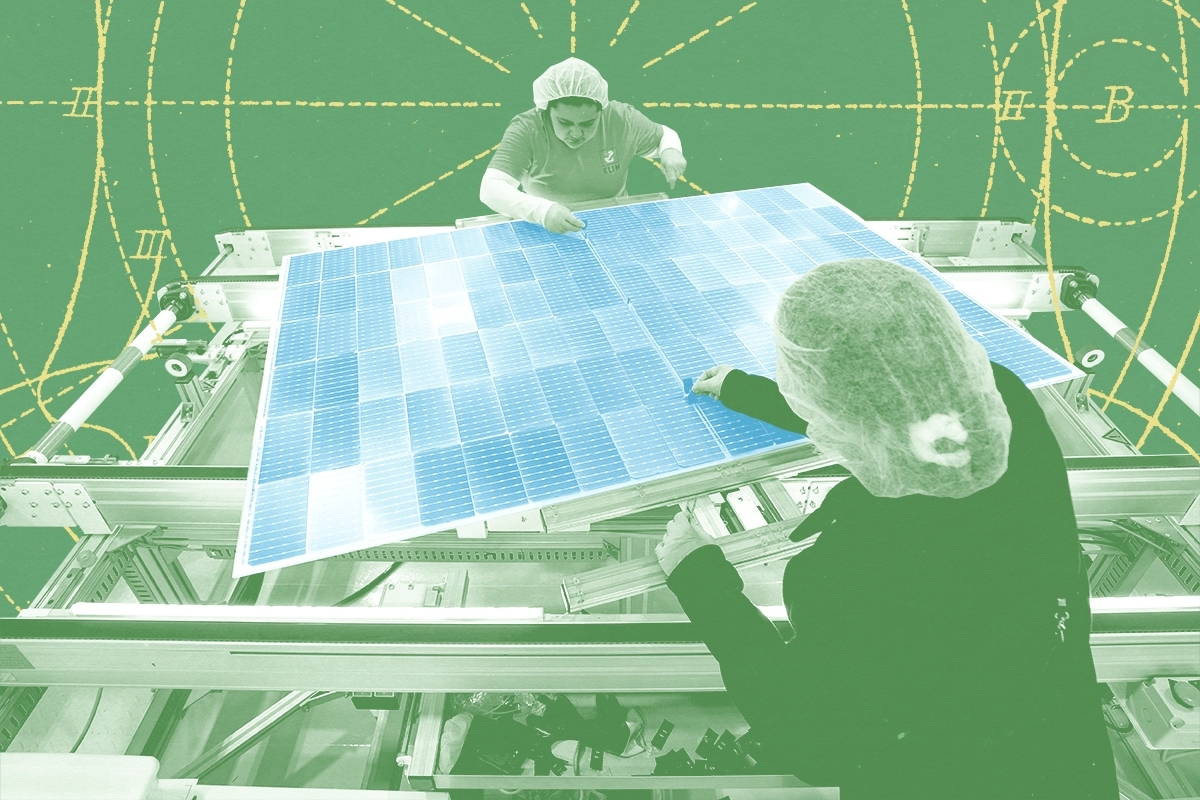
Two clean energy reports out this week offer seemingly contradictory snapshots of domestic solar and battery manufacturing. One, released Wednesday by the Rhodium Group’s Clean Investment Monitor, shows a distinct decline in investment going into U.S. factories to make more of these technologies. The other, released today by the trade group American Clean Power Association, shows staggering recent growth in production capacity.
So which is it? Is U.S. clean energy manufacturing booming or busting?
Maybe both.
The U.S. is suddenly producing more solar and batteries than ever before — enough to meet current domestic demand — so it makes sense that investment in new factories is starting to slow. At the same time, there’s a lot of room for growth in producing the upstream components that go into these technologies, but the U.S. is no longer as attractive a place to set up shop as it was over the past four years.
The U.S. saw 30 new utility-scale solar factories and 30 new battery factories come online last year alone, according to ACP. The country now has the capacity to meet average domestic demand for storage systems through 2030, and can produce enough solar panels to satisfy demand two times over.
In both industries, nearly all of that capacity has been added since 2022, when the Inflation Reduction Act created new subsidies for domestic manufacturing. The advanced manufacturing production tax credit incentivized not just solar and battery factories, but also all the production of components that go into these technologies, including solar and battery cells, polysilicon, wafers, and anodes. On top of these direct subsidies, the IRA generated demand for U.S.-made products by granting bonus tax credits for utility-scale solar and battery projects built with domestically produced parts.
“The policy definitely laid the right foundation for a lot of this investment to take place,” John Hensley, ACP’s senior vice president of markets and policy analysis, told me.
Trump’s One Big Beautiful Bill Act has changed the environment, however. The utility-scale wind and solar tax credits were supposed to apply through at least 2033, but now projects have to start construction by July 4, 2026 — just over a month from now — in order to claim them. Any of those projects that got started this year will also have to adhere to complex new sourcing rules prohibiting Chinese-made materials.
Now, dollars flowing into new U.S. solar factories appears to be on the decline. Investment fell 22% between the fourth quarter of last year and the first of 2026. Battery manufacturing investment dropped by 16%.
The reason investment is declining is not entirely because of OBBBA — it’s partly a function of the fact that a lot of the projects announced immediately after the IRA passed are entering operations, Hannah Hess, director of climate and energy at the Rhodium Group, told me.
Rhodium’s Clean Investment Monitor tracks two metrics, announcements and investment. Announcements are when a company says it’s building a new factory or expanding an existing one, usually with some kind of projected cost. Investments are an estimate of the actual dollars spent during a given quarter on facility construction, calculated based on the total project budget and the expected amount of time it will take to complete after breaking ground.
According to Rhodium’s data, the peak period for new solar manufacturing project announcements was the second half of 2022 through the first quarter of 2025. During that time, announcements averaged more than $2 billion per quarter. New solar factories announced this past quarter, by contrast, fell to about $350 million.
Since it can take a while to get steel in the ground, the peak period for investment was slightly later, with $13.5 billion invested between the second quarter of 2023 and the third quarter of 2025.
“What we were seeing in that post-IRA period was huge, almost unconstrained growth in that sector, and that’s not happening anymore,” Hess said.
Most of this growth occurred all the way downstream, at the final product assembly level — i.e. factories making solar and battery modules that still had to import many of the components that went into them. This was the “lowest hanging fruit” to bring to the U.S., Hensley, of ACP, told me, as the final assembly is the least technologically challenging part of the supply chain.
“These supply chains have momentum as they get going,” he said, “so as you establish those far downstream component manufacturing, you start to recruit all of the upstream manufacturing.” In other words, a solar cell manufacturer is far more likely to build in the U.S. if there’s a robust local market of module factories to buy the cells.
There’s evidence that’s still happening in spite of changes to the tax credit structure. The ACP report says that three solar cell factories came online between 2024 and today — one per year. If all of the additional factories that have been announced are built by 2030, the U.S. will have nearly enough capacity to meet all of its own demand for solar with domestic cells. Battery cell capacity is growing even faster, with three factories as of the end of 2025 and seven more expected to be complete by the end of this year, which will produce more than enough units to meet average annual demand.
It’s the next step up on the supply chain that spells trouble. For solar, that’s ingots and wafers, followed by polysilicon. Today, the only producer of ingots and wafers in the U.S. is a company called Corning. It produces enough to meet about 25% of current domestic solar cell production, but cell production will more than quadruple by the end of this year compared to last year, according to ACP. Similarly, we produce enough polysilicon to meet Corning’s current needs, but not enough to meet anticipated cell demand. The announced projects in the pipeline will not add much on either front.
For batteries, it’s the anodes and cathodes. There’s currently one factory in California producing cathodes and at least one more under construction, but as there is nothing else in the pipeline, the ACP report expects cell manufacturers to rely on imported cathodes for the foreseeable future. Anodes are the one bright spot — there’s one factory producing what’s known as active anode material factory in the U.S., and four more anticipated by the end of this year. Together, they have the potential to meet demand by 2028, according to ACP.
The question now is whether that snowball effect kicked off by the IRA will continue. “A lot has changed about the outlook for future demand after the One Big Beautiful Bill Act passed,” Hess said. “We have seen some more project cancellations and pauses in construction recently.”
Most recently, a company called Maxeon Solar Technologies canceled a $1 billion cell and module factory in New Mexico. The company had been “fighting for its life” since 2024, according to Canary Media. It’s also majority owned by a Chinese state-owned company. The OBBBA was likely the nail in the coffin, as it penalizes solar developers who source panels from companies with Chinese ownership.
OBBBA also shortened the timeline for the wind and solar tax credits, while the Trump administration’s hostility to wind and solar permitting has made it more difficult for projects to get built before the credits expire. Hensley said the Trump administration’s hostility toward clean energy has added a lot of risk into the system, complicating final investment decisions for manufacturers.
On the flip side, tariffs have the potential to help some domestic producers. Duties on imports from countries such as Cambodia, India, and Vietnam, all major manufacturers of solar panels, “have made their exports to the U.S. almost prohibitive,” Lara Hayim, the head of solar research at BloombergNEF, told me in an email. “This sort of policy framework could continue to provide some protection for domestic manufacturers,” she said, but there are still plenty of countries with low enough tariffs that they will continue to serve the U.S. and compete with domestic manufacturers.
Hensley said that the Trump administration’s tariffs were a double edged sword. They can help domestic manufacturers, but not if they make all of the inputs into the product more expensive.
“That’s a problem with these blanket type of tariffs that aren’t really fine-tuned to target the behavior that you’d like to see,” he told me. “I think we’re seeing a lot of that push and pull and tension in the system at the moment.”
Between Trump’s tariffs and the OBBBA, there’s no doubt that the manufacturing boom sparked by the IRA is slowing. But Hensley is optimistic that the progress will continue. “We haven’t attracted all of the supply chain yet. It’s still a work in progress, but so far the signs are quite good.”

Log in
To continue reading, log in to your account.
Create a Free Account
To unlock more free articles, please create a free account.
Seattle practiced responding to a heat dome during the international soccer tournament. It didn’t go well.
Welcome to Seattle! If you’re one of the 750,000 visitors in town to watch the 2026 North American FIFA World Cup, you’re going to love it here. For one thing, you’ve arrived just in time for the city to suspend its interminable construction for the games. That’s a plus! Be sure to check out our newly pedestrianized Pike Place Market and stroll along the waterfront to “Seattle Stadium” (or sound like a local and call it “Qwest”). You might even get a little chilly from the wind off the bay — you can thank our “temperate, oceanic climate” for that. It’s what makes Seattle the safest place in the United States to attend (or play in) a World Cup game, per researchers at Queen’s University Belfast — at least, from the perspective of extreme heat.
That’s worth bragging about. Extreme heat has been a concern at almost every subsequent World Cup going back to the 2014 World Cup in Brazil, including the 2022 tournament in Qatar, which FIFA had to reschedule to the winter. The 2026 World Cup could get dicey, too. Of the 104 scheduled matches in 16 host cities in the U.S., Canada, and Mexico over the next month, at least half have a 50% chance or greater of being played in temperatures of 82 degrees Fahrenheit or higher, according to research by Climate Central — that being the threshold at which player performance begins to suffer, with athletes slowing down, getting sick, and making poorer decisions because of the heat. The odds of there being impairing heat during the World Cup final in New York on July 19 are basically a coin flip, and 17% higher than they otherwise would have been due to climate change-induced warming.
All of that is just part of what makes Seattle’s host city status so appealing. There is only about a 3% chance of performance-impairing heat during its two mid-June fixtures, rising to 6% later in the month and into July.
Unless, of course, there’s another heat dome.
In 2021, temperatures in Seattle peaked at 108 degrees on June 28, which this year will fall between when the city hosts Egypt vs. Iran and a Round of 32 match. Needless to say, 108 degrees is not just perspiration-inducing; it is well beyond the 89.6-degree wet-bulb globe temperature threshold at which FIFA considers postponing matches. While the possibility of another heat dome in the next few weeks is admittedly an edge case — before 2021, Seattle had only touched 100 degrees three times in 126 years of recorded-keeping— it’s still a realistic enough possibility that last spring, the National Weather Service’s Seattle office ran a tabletop exercise with its local partners to game out just that.
“Before 2021, heat [in Seattle] was just another hazard alongside fire and smoke and those sorts of things,” Reid Wolcott, the warning coordination meteorologist with the NWS Seattle, who helped lead the two-day-long run-through, told me. The heat dome “really highlighted that heat is a powerful hazard that can cause significant loss of life.”
After more than 400 people died in Washington alone, the NWS dedicated considerable time and resources to its heat preparedness and messaging in the Pacific Northwest. Beginning in 2022, the National Integrated Heat Health Information System began offering technical support for heat tabletop exercises in communities around the country. Seattle was supposed to participate in 2024 but “due to some logistical reasons, we ended up delaying it until 2025,” Wolcott said. “And because of that, we were like, We’re well on our way into World Cup planning, here.”
The idea of the “Heat Dome Cup” exercise was to kill two birds with one stone — to test the Seattle area’s response four years after the heat dome, as well as its ability to respond to a weather crisis when thousands of visitors are in the city for the World Cup. Participants included representatives from surrounding cities such as Bellevue, Everett, and Portland, Oregon; county-level offices including from climate, emergency management, and public health; the University of Washington; and the Port Gamble S’Klallam Tribe.
The results of the exercise were both encouraging and not: For every core capability tested, from “threat/hazard identification” to “communication” and “community resilience,” the after-action report found that Seattle “performed with some challenges.” There was “limited local data” on the compounding hazards of heat, cooling center efficiency, and — particularly alarming — the local healthcare system’s ability to respond during such an event. “Prehospital triage, surge planning, and better integration with public health systems are urgently needed,” the report found. Because paramedics attempt to bring down a heat stroke patients’ temperature before transporting them to a hospital — a laborious process often involving filling a home bathtub with ice, setting the patient in it, and waiting — the emergency response during heat events is slow, and can quickly back up and overwhelm the system.
Heat Dome Cup partners directed my questions about King County’s readiness to handle extreme heat during the World Cup to the public health office, which told me no one was available for an interview.
Carlos Martinez, a senior climate scientist with the climate and energy program at the Union of Concerned Scientists who did not participate in the exercise, told me that after reading the report, he hopes that “there’s a recognition and awareness of the fact that there’s a lot of work that needs to be done.” He also flagged an observation from the exercise regarding the development of stronger workplace protections during the World Cup.
“That sometimes can be neglected,” he went on. “You have folks in construction, food service, retail, landscaping, and sanitation who work a full day outside during these events. What are the protocols that are out there to ensure that they are protected from heat-related illnesses?”
I put the question to Hollie Stark, the communications coordinator for the Office of Emergency Management in Seattle. (While Stark’s office participated in the exercise, Stark did not.) She told me that Washington’s Department of Labor & Industries offers recommendations for how employers can protect their workers from heat and smoke, including running trainings and publishing posters and pocket cards in multiple languages that promote offering adequate water, shade, and breaks. “We’re thinking about maybe bars and places that might be hosting [FIFA viewing parties] that don’t have access to AC but might have an influx of people,” she said as a hypothetical, “and we’re encouraging them to listen to those recommendations.”
In general, the people I spoke with in Seattle who were involved in the exercise acknowledged that messaging and communication were the areas the city struggled with the most. “That has definitely been the single biggest thing — trying to make sure that we’re all singing from the same sheet of music,” Wolcott told me. “Because we weren’t prior to 2021.”
One of the biggest hurdles has been figuring out exactly how to communicate potential extreme heat warnings to the thousands of visitors traveling to Seattle. During my conversations with officials involved in the Heat Dome Cup, officials pointed me to myriad preparedness websites, real-time risk tools, opt-in alert systems, and health and safety resources for out-of-town visitors, which left me — a local fluent in English — feeling even more confused.
Language itself is one thing — on that front, Stark told me her office has already pre-scripted messaging for extreme heat translated into Spanish and the eight threshold languages of King County — Vietnamese, Somali, Russian, Chinese, Korean, Amharic, Arabic, and Ukrainian — as well as seven additional World Cup spectator-specific languages — Arabic, Farsi, Dutch, French, Bosnian, Serbian, and Croatian. But one of the threats of having a heat dome during a major sporting event is that “you have a lot of visitors coming from all different parts of the world,” Wolcott said. “Some come from locations where they are probably more acclimated to heat than we are, but some may be coming from areas that are cooler climates than ours.” Proper acclimation can take weeks, if not an entire season — far longer than most spectators will be in town.
But perhaps the biggest takeaway is that a heat dome isn’t required for people to be under heat stress, even in a place as temperate as Seattle. Wolcott told me the NWS’s seasonal outlook for the summer in the region indicates above-average temperatures, and while that “does increase the risk of a heat event occurring, it has nothing to do with the actual magnitude of it. You could have a 2021-level event, or you could have 30 smaller events, and there is no way to tell exactly what’s going to happen.”
Indeed, even fairly moderate temperatures can sneak up on spectators. While FIFA is in charge of making decisions that impact their athletes’ health, Shel Winkley, the senior engagement specialist and meteorologist at Climate Central, pointed out that “fans are still sitting in the sun in the heat, and if they’re fans like me, they’re not drinking water during [the FIFA-mandated in-game] cooling breaks.” Spectators get to the stadium early, stand in long lines in the sun, sit in crowded stadiums with potentially no shade — and essentially endure an entire day of heat, even if the temperatures seemed manageable when they walked out their hotel door.
At this point, there is nothing to indicate Seattle’s worst-case scenario will come true. (Stark also mentioned that a true worst-case scenario more likely involves the Big One than extreme heat, but we won’t go there.) But “just because historically the odds are low” for a heat dome in the Seattle area “doesn’t mean that they’re zero,” Winkley said.
Martinez, the climate scientist with UCS, stressed to me that while the Heat Dome Cup was an engaging thought experiment, bringing together 30 distinct partners for two whole days, he fears that a gutted NWS and Federal Emergency Management Agency might lack the funding or personnel to act on the weaknesses the exercise exposed. “If you have this one exercise but no follow-through, that can risk eroding trust by those populations who gave time out of their day to come and speak to the federal government about the importance of this issue,” he told me. “We shouldn’t just do this for well-renowned events. This should be an evergreen thing.”
But Wolcott, the lead on the Heat Dome Cup, sounded to me like he was at the end of a long marathon when I spoke to him. “I’ve been planning for [the World Cup] for three years now. I’m ready for it to be over,” he told me, laughing.
“We are always doing this; it was just one exercise that we did last May,” he added. “I’m just looking forward to late July at this point.”
Current conditions: Tropical Storm Cristina is inching north toward landfall in Central America, threatening floods, landslides, and winds of up to 73 miles per hour • Washington, D.C., is poised for rain for the rest of the week as temperatures rise to nearly 100 degrees Fahrenheit by Friday • By contrast, Cartersville, Georgia, where the solar manufacturer Qcells just started up its factory, is looking at a two-day break of sunshine from an otherwise gray and wet forecast.
At the start of 2023, South Korea’s biggest solar manufacturer, Qcells, began construction on a sweeping new factory northwest of Atlanta in Cartersville, Georgia. Betting that U.S. tariffs on Chinese solar panels were here to stay, the company gambled on bringing most of the supply chain under one roof. On Tuesday, Qcells started producing solar cells at the plant, marking what it called “a major milestone toward completing the country’s only vertically integrated solar manufacturing plant.” The firm expects to reach full production by the third quarter of this year. The factory’s module assembly line, meanwhile, is now at full capacity, building 16,700 panels per day. “Producing the first solar cells at Cartersville is a milestone for Qcells and for American manufacturing,” Andy Park, the global chief executive of Qcells, said in a statement. “As our ingot, wafer, and cell lines reach full capacity, we’ll be making the major components of a solar panel right here in Georgia.”
The U.S. could be seeing the start of a small solar boom. Last year alone, at least 30 new utility-scale solar factories came online, as Heatmap’s Emily Pontecorvo reported last month.
Over the weekend, as I told you on Monday, a federal court blocked the Trump administration’s rules for using the soon-to-expire tax writeoffs for investing in or producing electricity from solar panels and wind turbines. But with just 24 days to go until the tax credits officially end, few developers are likely to move quickly enough to benefit from the ruling. “Practically speaking, I don’t think this is likely to have much impact on the market or behavior in the coming weeks,” Heather Cooper, a tax lawyer at McDermott Will & Schulte, told E&E News. “The deadline is less than four weeks away.”
Investments into electrical grids are on track to surpass $650 billion globally this year, according to new data from the consultancy Rystad Energy. That’s up 5% from last year and more than double the investments recorded in 2020, PV Magazine reported. The high cost comes as long lead times and pricy components for transformers, high-voltage circuit breakers, and switchgears strain and stall upgrades and expansions to power systems all over the world. The soaring growth of wind and solar is propelling grid investments, which are needed to patch more intermittent and often far-flung renewables onto the system. In 2010, wind and solar made up just 2% of global generation. By 2040, Rystad expects them to make up nearly half the mix.
Sign up to receive Heatmap AM in your inbox every morning:
Everyone recognizes Canada as a major oil producer, metal miner, and hydroelectricity generator. But did you know the Canucks are not just a serious player in nuclear power, but actually have their own domestically-designed reactor that can run on raw uranium? Get this, it even has a catchy name: the CANDU. Pronounced CAN-do and short for Canada Deuterium Uranium, the pressurized heavy water reactors are among the only commercial designs in the world that can run on unenriched, natural uranium. The advantage, especially for a country like Canada with vast uranium deposits, is that they’re faster to build, cheaper to fuel, and free of the international scrutiny that comes with enriching uranium. The downside is that they break down faster than the light water reactors that make up the entirety of the U.S. fleet. But Canada is demonstrating that isn’t a big problem. On Monday, the Bruce nuclear power station brought its Unit 3 reactor back online, completing refurbishments seven months early and $107 million under budget, NucNet reported. You don’t need to know a lot about the American or European nuclear industries to know “early and under budget” aren’t words typically associated with any recent or ongoing projects.
The best-proven way to make truly green steel involves turning iron ore into direct reduced iron through a process that, when powered by green hydrogen instead of natural gas, significantly slashes any carbon emissions associated with its production. Assuming it’s finished off in an electric arc furnace, it’s green steel — and even greener if that final process was powered by renewables or nuclear. Yet despite some high-profile projects, green hydrogen has remained too expensive in the West, even as China’s industry starts to boom. That could be changing. On Tuesday, the German steelmaker Salzgitter inked its first major offtake agreement for green hydrogen from the supplier EWE, Hydrogen Insight reported. One of Germany’s largest steel producers, Salzgitter will buy roughly 10,000 metric tons of hydrogen per year from the electrolyzer plant EWE is building in Emden, near the Dutch border.
Meanwhile in America, U.S. Steel unveiled plans to invest up to $2.5 billion into upgrading the Mon Valley Works, southeast of Pittsburgh. The renovations come after Japanese steel giant Nippon’s takeover of the iconic American firm last year. To win President Donald Trump’s blessing, Nippon gave the federal government a “golden share” in the company. As Heatmap’s Matthew Zeitlin wrote last year, that could ultimately give a future administration leverage to press U.S. Steel to green its operations.

If you’re booking a flight right now, you might not yet be feeling the difference. But U.S. production of jet fuel has reached record highs as refiners scramble to respond to soaring prices following the closure of the Strait of Hormuz. By the start of May, the four-week average estimate of fuel production surpassed 2 million barrels per day for the first time on record, according to new analysis by the Energy Information Administration. But with domestic inventories still relatively high, much of that increased production is being exported.
Entech’s S2 platform debuted last year to help make century-old boilers more efficient.
Emissions from existing buildings are responsible for about 70% of New York City’s climate emissions, with space heating as the dominant source. Yet most of the city’s multifamily buildings still rely on central steam boilers that cycle on and off when the outdoor temperature drops below a certain threshold, regardless of indoor conditions. The result is a system that leaves many residents sweltering in the dead of winter, wasting fuel and money while releasing unnecessary greenhouse gases.
Completely overhauling and modernizing a central boiler system — many of which date to the early 1900s — and installing a building-scale heat pump could address many of these issues. But that’s an expensive, complex, and disruptive endeavor that many building owners either can’t afford or simply don’t want to undertake. And while heat pump startups such as Quilt and Gradient are making inroads in single-family homes and individual apartment units respectively, neither is working to optimize the operations of existing steam boilers, which remain the dominant heating source for New York’s apartment stock.
That’s where Entech, a 30-year-old building energy management company, comes in. The company’s platform has long used indoor sensors to monitor the performance of central boilers and help them run more efficiently. Last year, however, the company revamped its software to incorporate artificial intelligence. The new system, called S2, autonomously monitors 20-plus sensors installed throughout the buildings where it operates, adjusting heating cycles with greater precision while continuously tracking the overall health and performance of boiler room operations.
On Wednesday, the company announced the results from the S2’s first year of operations: Across 401 New York City apartment buildings, the platform slashed emissions by nearly 25%, avoiding more than 16,000 metric tons of carbon pollution and generating over $5 million in savings for property owners.
Previous iterations of the company’s tech relied on preset rules such as, “When it’s 55 degrees [Fahrenheit], you need a shorter cycle, and when it’s 20 degrees, you need a longer cycle,” Heather Zoberman, Entech’s director of product development, explained to me. Those settings dictated how long a boiler turned on and how long it stayed off. With AI, however, the company can measure how quickly individual units are actually heating up and adjust performance in real-time.
For a company that spent decades focused on incremental improvements to boiler operations, it’s a meaningful shift. “Now we have the ability to do flame modulation — so a higher flame, a lower flame— based on the load, based on the building temperatures,” Zoberman told me. The same level of granular control applies to the fans and pumps that move heat through the building, too. “A little bit slower fan, a little bit lower flame is really where you get those savings that add up,” she said. According to Entech, those savings are typically passed onto the residents, with the average tenant saving roughly $200 on heating costs last year.
While building owners are happy to see these savings too, many are turning to Entech primarily to comply with the New York City Council’s Local Law 97, which requires buildings larger than 25,000 square feet to cut emissions 40% by 2030 compared to 2005 levels, and reach net zero emissions by 2050.
The nonprofit housing developer and operator Breaking Ground, for example, builds supportive housing for low-income and formerly homeless New Yorkers, and has been doing so for decades. It adopted Entech’s new boiler control system just six months ago to comply with the emissions law. While Breaking Ground’s deputy VP of facility operations, Lorenzo Torres, didn’t have exact savings figures on hand, he said the system has saved the organization “a lot of money,” largely by enabling staff to remotely identify equipment issues such as leaks and temperature fluctuations without having to send anyone to the building and before they develop into expensive headaches.
“We do have a work order system, but data is only as true as the person that’s entering the data,” Torres explained. Thus if a tenant misidentifies an issue or fails to file a work order in the first place, Breaking Ground might assume everything is running efficiently. By contrast, “the S2 controller actually is able to, with conviction, let us know that there is an issue with the boiler,” he said.
What Entech’s system still can’t do is solve the problem of unit-level temperature variation. Factors such as floor level, window exposure, and radiator placement mean some apartments will naturally run hotter or colder than others. But because Entech primarily operates in apartment complexes with central boilers, it can still only make adjustments at the building level Because of this, its system could be a complement to something like a smart radiator, which can control how much heat each apartment receives.
Now, Entech is looking to expand beyond New York. Boston is a natural next market, Zoberman told me, given its stringent building emissions requirements. Chicago is also on the company’s radar, thanks in part to incentives from the natural gas utility People’s Gas, which can help offset the cost of energy efficiency upgrades. The company’s ambitions extend beyond just geographic expansion, however — it’s also broadening its platform to monitor and optimize central cooling systems and other electrified technologies such as heat pumps and mini splits.
It looks like it should have plenty of room to run. Additional jurisdictions from Washington D.C. to St. Louis are increasingly adopting hard caps on building emissions, while dozens more now require annual energy-use reporting — often a first step towards more stringent regulation.