Current conditions: A “rain bomb” just deluged parts of southeastern Florida, with as much as 15 inches pouring on suburbs west of Fort Lauderdale • As Pacific storms drench California, downtown San Francisco recorded more than 2.6 inches of rain on Wednesday alone, exceeding the 2.2-inch record set in 1918 • Indian authorities have upgraded Cyclone Akvan to a “severe cyclonic storm” as it makes landfall today in Andhra Pradesh.
THE TOP FIVE
1. The Senate passes permitting reform
The Senate passed the bipartisan permitting reform bill Thursday night on a 62-33 vote. Every Republican except Missouri’s Josh Hawley and South Dakota’s Mike Rounds, critics of the legislation’s provisions for transmission lines, joined more than a dozen Democrats to pass the Bipartisan American Affordability and Jobs Act. The bill passed without an 11th-hour amendment designed to address the concerns of some tribal groups, which was blocked by Oregon Senator Jeff Merkley, who objected that the body was not voting on his separate amendment to ban data centers on federal lands. “Tribes are being screwed by a last ditch environmental Hail Mary to make the bill as bad as possible before it gets to the House,” Julian Brave NoiseCat, a Native writer and filmmaker, wrote in a post on X. Earlier this week, NoiseCat explained to my colleague Robinson Meyer how tribal groups became power players in the negotiations over the legislation on an episode of our Shift Key podcast. Senator Lisa Murkowski, the Alaska Republican who had coauthored the tribal amendment with the Hawaii’s Democratic Senator Brian Schatz, told Punchbowl News’ Josh Siegel before the vote that it would be “short sighted” to pass BAAJA without the amendment, and said she would “find another way” to write the protections into law. “Not only is it significant from the tribal protections but there were issues in other parts of the country worried on the transmission side. So there was a good reason we worked so hard on this,” Murkowski said, according Siegel’s tweet. Renewable energy trade associations lauded the vote, even without the last-minute changes. “The Senate has cleared a path to enable the construction of hundreds of additional clean energy projects and strengthen rural communities,” Jason Grumet, the CEO of American Clean Power, said in a statement.
Still, BAAJA’s passage in the Senate is no guarantee of its sailing through the House of Representatives. Under a mechanism House leadership may use to attempt to pass the bill, two-thirds of present House members would need to vote for the legislation. After Merkley’s blockade of moderating fixes to the bill, the vote’s support among centrist Democrats is unclear. Republicans who lost in this month’s midterm elections may decide not to come back for the vote, and it remains to be seen whether progressives emboldened by Democrats’ recent victory will heed increasingly vociferous opposition from anti-fossil fuels groups. Oceana, the largest global conservation group focused on the oceans, called the version that passed the Senate a “smokescreen that disguises harmful environmental policies behind the promise of permitting reform.”
2. The world can manage without the Strait of Hormuz, IEA says
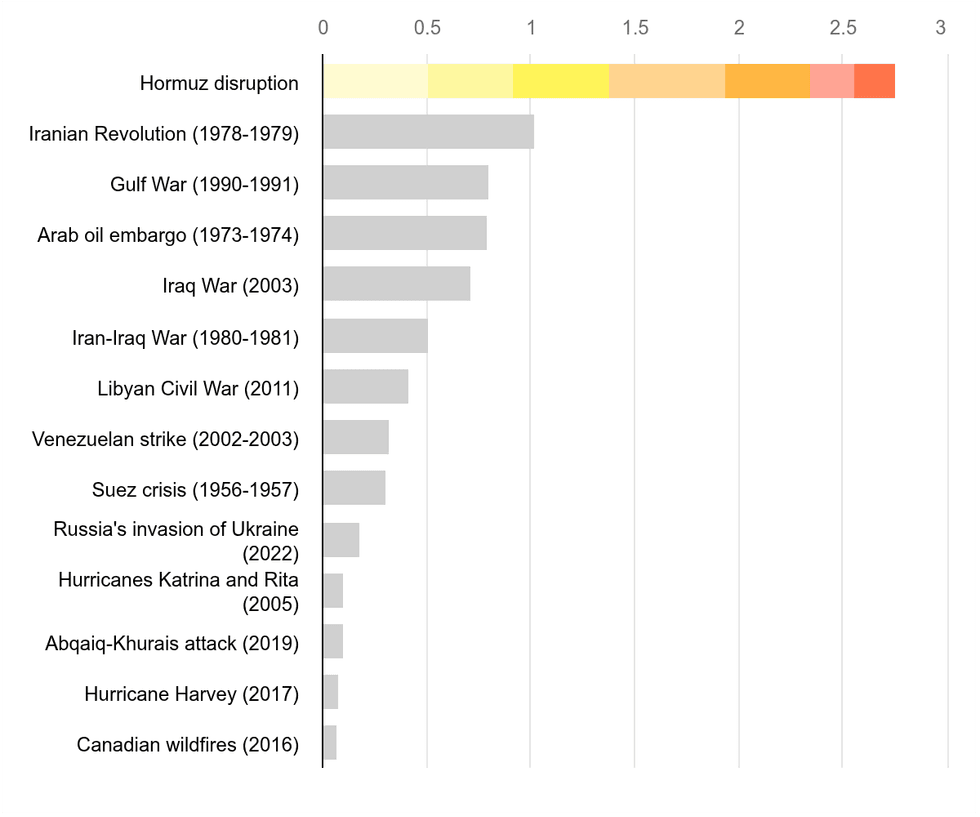
Global energy markets “could conceivably manage without” the Strait of Hormuz, International Energy Agency chief Fatih Birol said Thursday on the release of the latest World Energy Outlook, the Paris-based institution’s flagship report. Yet the world “cannot manage without the Middle East,” he added. He called the Hormuz crisis brought on by the U.S. and Israeli war with Iran “a huge shock to the system” with “deeper” effects the longer the conflict lasts. “I don’t see any credible pathway for the energy world to return to the way it was before,” he said. The good news, he said, is that, as a result of the war, “energy security and energy transitions have never been so closely aligned.”
 EIA
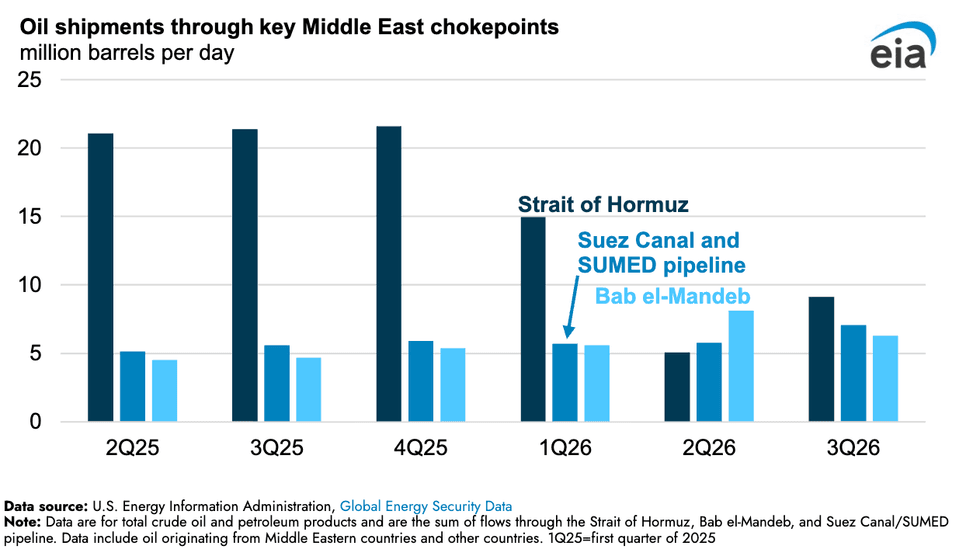
Either way, the flow of crude through the narrow waterway near the mouth of the Persian Gulf has increased since the early days of the conflict. Oil shipments have surged lately through two of the Middle East’s three major chokepoints, the Strait of Hormuz, between Iran and the United Arab Emirates, and Egypt’s Suez Canal, according to an analysis published Thursday by the U.S. Energy Information Administration. The Bab el Mandeb Strait, near the mouth of the Red Sea, saw flows decrease, however, after the Houthis’ conquest of key coastal areas halted shipments. Overall, the three arteries saw a combined traffic increase of 19% in the most recent three months of this year compared to the quarter just prior. “Flows around the Middle East increased because of the use of smaller ships to move oil out of the Persian Gulf for ship-to-ship transfers of crude” into what are known as “Very Large Crude Carrier” tankers, the EIA said. Producers also “maximized utilization of infrastructure to bypass the areas of highest risk,” the agency said, meaning drillers shipped crude through pipelines across Saudi Arabia to Red Sea ports, from which oil could travel via the Suez Canal without passing through either contested strait.
3. The West’s effort to catch up to China’s green manufacturing is losing steam
 CleanEcon
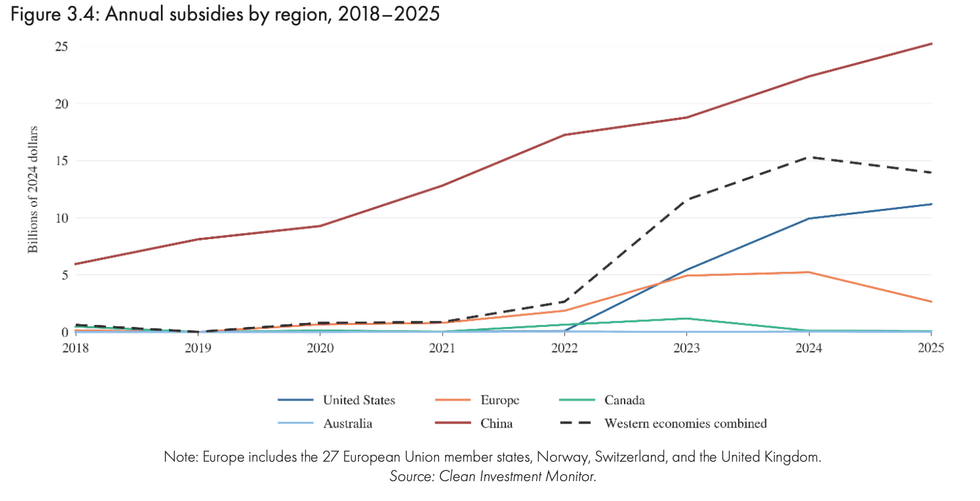
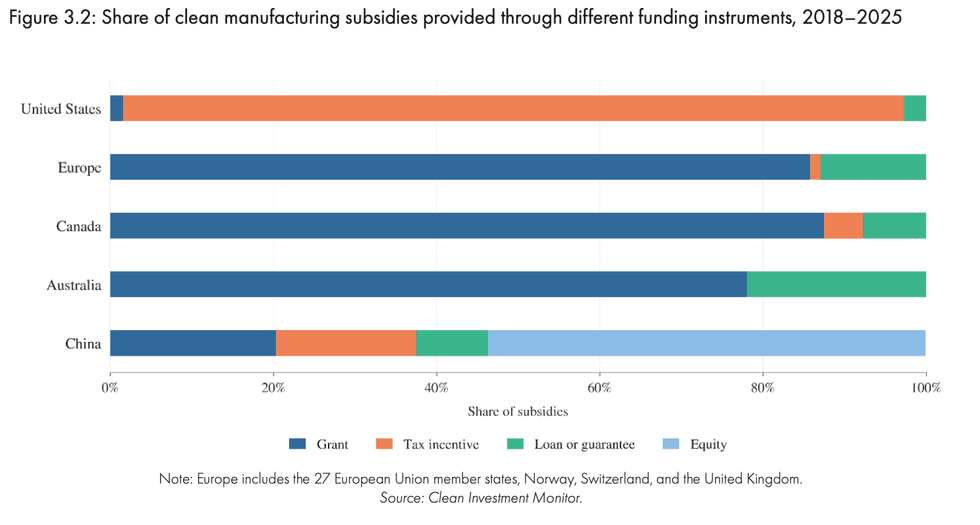
After 2022, the United States, Europe, Canada, and Australia poured money into clean manufacturing industries to make batteries, wind turbine equipment, and rare-earth magnets. But the subsidies didn’t always work as planned, and the spending began to decline just two years later. That’s a key finding from the latest report by the think tank CleanEcon and the Massachusetts Institute of Technology’s Center for Energy and Environmental Policy Research. Different countries opted for disparate incentives. The Europeans, Canadians, and Australians all relied primarily on grants. The Americans, by contrast, leaned most heavily on tax credits. China pursued a mix of options, with the government taking equity stakes in projects as the primary subsidy vehicle. In Europe and Canada, subsidies delivered to companies in the rare earths supply chain aligned with the amount of money those governments planned to spend. In Australia and the U.S., only tiny fractions of the announced value of the subsidies actually reached projects. The existence of “more financing industry instruments” in those countries meant that government support was largely in line with what a private lender would offer, and the report only counted as a subsidy money that could be considered “more generous than a loan term,” Rob Reese, a co-author of the report and CleanEcon’s policy adviser, told me. “When you see this vast disparity between how much support is being provided in China versus the other countries, it shows that throwing money at these industries isn’t going to actually help you compete with China,” he said. Instead, governments should target specific sectors, such as rare earth processing, then provide a company with “a generous loan, or even a loan at competitive terms that’s going to bring in more capital that they can use to get it off the ground.” That “could have more of an impact than just broadly giving a lot of grant or tax credit support to these firms,” Reese said. “It’s about deciding what the best way is to target the barriers that may exist.”
 CleanEcon
he World Energy Outlook also has insight on the manufacturing front. For solar panels and batteries, “manufacturing capacity has expanded much faster than deployment,” the report said. “Current global manufacturing capacity for both technologies is sufficient to produce roughly twice the volumes deployed in 2025, contributing to intense competition and falling equipment prices,” it said, but cautioned that the effects of that cheap equipment don’t translate to lower electricity prices in many places due to the struggle to integrate renewables onto the grid.
Sign up to receive Heatmap AM in your inbox every morning:
4. Defying court ruling, Trump auctions off 32 million acres of Pacific Ocean seabed to a deep-sea mining company
The Trump administration leased nearly 32 million acres of the Pacific Ocean to a deep-sea mining company after an auction Thursday. The event, which The New York Times called “the first sale of its kind,” came despite a ruling from a federal judge this week that the bidding was illegal. New York-based Wetstone U.S. Ventures was the only firm that bid on the lease for a chunk of U.S. seabed off American Samoa. While the lease would not allow the company to mine just yet, its $6 million offer would allow it to map the area and conduct preliminary research. Rivals in the nascent industry saw the lease as a positive sign. In a statement to me, the Washington, D.C.-based deep-sea mining startup Glomar Minerals called the auction “an important step toward advancing exploration and developing the credible scientific knowledge needed to better understand the responsible collection” of critical minerals on the seafloor. “China is moving forward, and the United States should as well,” Robbie Diamond, Glomar Minerals’ executive chairman, told me. While his company did not bid on the auction, it already holds the exploration rights to at least three sites in international waters in the Pacific Ocean’s Clarion Clipperton Zone.
The U.S. is looking beyond the seafloor for minerals. On Thursday, the Financial Times reported that Kenya had awarded the rights to its prized rare earth deposit at Mrima Hill to Frontier Minerals, a startup backed by the U.S. government. The deal follows “a campaign of American diplomatic pressure,” the newspaper wrote, and delivers the Trump administration “a rare victory in its bid to counter China’s global dominance of rare earth metals.” Kenya’s mining ministry said it had “insisted on identifying the most qualified, technically competent, and financially capable investors.”
5. Commonwealth Fusion Systems declares 2027 the year fusion will ‘start working’
A little over 20 years ago, I became a subscriber to The Economist and began my annual tradition of reading the storied magazine’s — er, newspaper’s — The World Ahead issue. Around that same time, fusion energy researcher Bob Mumgaard arrived at the Massachusetts Institute of Technology, where he quickly realized that “advances in other fields had started to change what such machines could do.” Suddenly, he wrote this week in an essay in the look ahead for 2027, “more powerful computers could simulate how plasma behaves; advanced manufacturing was changing how fusion facilities were designed and built; new superconducting materials in magnets let the fuel reach star-like conditions inside smaller machines.” He founded Commonwealth Fusion Systems in 2018 on the belief that these advancements could, in fact, make the so-called holy grail of clean energy a reality. When the company turns on its demonstration reactor, SPARC, next year, he wrote, “it will be fusion’s Kitty Hawk, its punch-through moment. We will have built the working heart of a fusion power-station. Hooking one up to the grid will follow in the early 2030s.” I look forward to The World Ahead 2029.
THE KICKER
The carbon removal industry is in a “sorry state,” my colleague Emily Pontecorvo wrote in June. Not so in the country whose sovereignty President Donald Trump has frequently mocked. On Thursday, the Canadian government established a standing tender for carbon removal credits, making Ottawa the first national government to use competitive procurement to buy permanent carbon removal. The portfolio, according to Forbes, “is deliberately broad, spanning five pathways and nearly every region.” There’s direct air capture in Quebec and Newfoundland and Labrador. Bioenergy with carbon storage in Nova Scotia. Biochar in Manitoba and Vancouver Island. There’s even a project to store carbon from forest biomass to reduce wildfire risk in the Pessamit Innu First Nation.


 EIA
 CleanEcon
 CleanEcon



 IEA / CC BY



 The Bataan nuclear plant. Photo: Martin San Diego/For The Washington Post via Getty Images