When I helped start Heatmap News three years ago, I didn’t think I would be writing this much about big tech companies.
I knew that, sure, they were crucial to America’s ability to develop and scale some next-generation emissions-reducing technologies. (By then, Microsoft had already started its huge carbon removal purchasing program.) And, yes, I knew they bought a lot of renewables. But I still understood their clean energy programs chiefly as an employee perk — a way for some of the economy’s richest firms to show their largely urban, college-educated, and liberal employees that they cared.
Perhaps that was true once. It’s not true anymore. Over the past several years, the tech companies have become major electricity consumers and producers in their own right. Artificial intelligence has turned their electricity procurement and development businesses into core operational competencies. (Meta and Microsoft have even considered entering the electricity trading business.) Some of the thorniest questions in climate policy were first encountered by these tech companies.
More importantly, their hunger for electricity has transformed them into quasi-industrial companies — and given them enough heft in the market to sometimes counterbalance (and sometimes collaborate with) the utilities and fossil fuel firms that previously steered the sector. As such, they’re now crucial parts of the U.S. decarbonization story.
Three companies in particular dominate the artificial intelligence cloud business: Google, Amazon, and Microsoft.
The country’s best-known frontier labs, such as OpenAI and Anthropic, rely on these companies to provide their compute power; Amazon Web Services is the backbone of virtually the entire online software industry. Amazon, Google, and Microsoft account for more than half of the country’s data center power capacity, according to the investment firm Jeffries.
So these companies’ emissions are, in a sense, not only their own; they also give us a view into the AI industry’s carbon footprint more broadly.
Over the past two weeks, all three of these cloud providers released their energy and emissions data for the past year, and we’ve looked at the top line findings from these reports in past editions. Today I want to briefly dive into what they could mean together.
Energy use and emissions are surging
Let’s handle the part you already know: Everyone’s emissions are up.
Microsoft’s emissions grew by 25% last year, their largest year-over-year leap since the pandemic. Amazon’s emissions leapt by 16%, its largest one-year increase ever. Google’s emissions increased by 18%, rising above their pre-pandemic level.
This surge will make the companies’ climate goals increasingly difficult to meet — and some of them are coming up fast. Microsoft has pledged to become ‘carbon negative’ by 2030, meaning it must remove more climate pollution from the atmosphere than it emits in that year. Google has pledged to achieve net zero by 2030, a goal that requires — by its own estimate — cutting its emissions in half by that year, as compared to their 2019 level. Amazon, meanwhile, has pledged to achieve net-zero in its operations by 2040.
All three firms’ greenhouse gas emissions are up because of the AI data center boom. Microsoft consumes nearly four times as much electricity as it did before the pandemic; Google’s electricity use has more than doubled.
These companies’ energy use has swelled, too, but at least as of last year, nearly all of their energy demand still took the form of electricity. When we think about “electrification” in the national context, perhaps we should think at least as much about these AI megalodons as we do about heat pump or battery manufacturers.
Amazon, to its shame, does not publish recent electricity usage data, so it doesn’t appear on either of these charts.
But outsiders have estimated its power consumption based on the numbers it does publish. Hendrik Rood, an IT researcher and consultant in the Netherlands, calculates that Amazon’s data center business used 78,000 gigawatt-hours in 2025. That would mean it consumes nearly as much electricity as Microsoft and Google combined.
As I cautioned yesterday, some of these figures are already outdated. Although all three companies just released their 2025 sustainability data, Microsoft brackets its report to the fiscal year, which ended on June 30, 2025. Google and Amazon’s data covers the calendar year.
It could all theoretically be worse
In what might be a quirk inherent to the genre, all three sustainability reports have a somewhat defensive tone (or at least a writing style that tries to anticipate quibbles). These companies know that their sustainability pledges, embraced in the heady flush of 2020 and 2021, have become much more difficult to fulfill in the AI era. And they want you to know that all of their emissions could be worse — if not for their corporate policies, pollution might be much higher.
I can’t say I find these counterfactuals entirely believable. We don’t know what Google or Microsoft or Amazon would do if, say, computing were more energy intensive or a certain process more environmentally damaging. And Jevon’s paradox suggests that every gain in efficiency — especially for a service as in-demand as AI — will make it cheaper to use AI, therefore raising its energy demand.
But I do think it’s worth sharing these claims to get some perspective. Google, for its part, says that its corporate emissions would be five times higher than they are if not for its total slate of policies:
 courtesy of Google
Microsoft takes a more clinical approach. It selects four of its corporate policies: “carbon-free electricity, sustainable fuels, XBOX console efficiency,” as well as efforts to decarbonize its Surface tablet production. If not for these interventions, it says, it would have emitted 34 million tons of greenhouse gas into the atmosphere last year, not the 21 million tons that it did produce.
Most emissions still aren’t from electricity
For all the focus on the difficulty of powering data centers (including by Heatmap), electricity does not drive most of these companies’ emissions — or it didn’t in the first half of last year, at least. The majority of Microsoft, Google, and Amazon’s greenhouse gas emissions came from what are dubbed “scope 3” emissions, a somewhat nebulous category that includes buildings, employee travel, and the full carbon footprint of their supply chain. This category reflects the AI boom in its own way.
(Skip this if you’re a sustainability nerd: In the classic schema used for corporate emissions accounting, “scope 1” emissions are direct fossil fuel pollution from an asset that the company owns or controls, “scope 2” emissions are pollution associated with the electricity, steam, or chilled water purchased by the company, and “scope 3” emissions are everything else — pollution from the company’s upstream supply chain and its downstream product use. I find this scheme makes somewhat more sense for businesses like airlines and automakers than it does for technology conglomerates. But that’s a different newsletter.)
It makes sense, then, that Amazon should have huge scope 3 emissions. The scope 3 subcategory called “Purchased Goods and Services” drives the largest share of its emissions; these include pollution from goods and services that Amazon buys for its employees to use, as well as all the embodied carbon in its line of Amazon Basics products.
But the biggest driver of scope 3 emissions — and thus for emissions overall — for Microsoft and Google came from “capital goods,” a category that covers new construction, physical assets and other fixed infrastructure used to produce products and services. More than 40% of Microsoft’s total emissions came from capital goods, and they made up more than 9 million metric tons of the company’s greenhouse gases. Google doesn’t fully aggregate out its “capital goods” category, combining it with the “use of sold products” subcategory, but it was responsible for almost 9 million tons as well.
These capital goods include the new data centers themselves: all the cement, steel, server racks, and silicon that actually make up the physical infrastructure supporting the AI boom. Here at Heatmap, we often focus on the electricity sector because it’s where so much change. But it’s good to remember that construction remains enormously carbon-intensive, and the literal buildings that house AI are, in many cases, still driving a disproportionate amount of emissions.



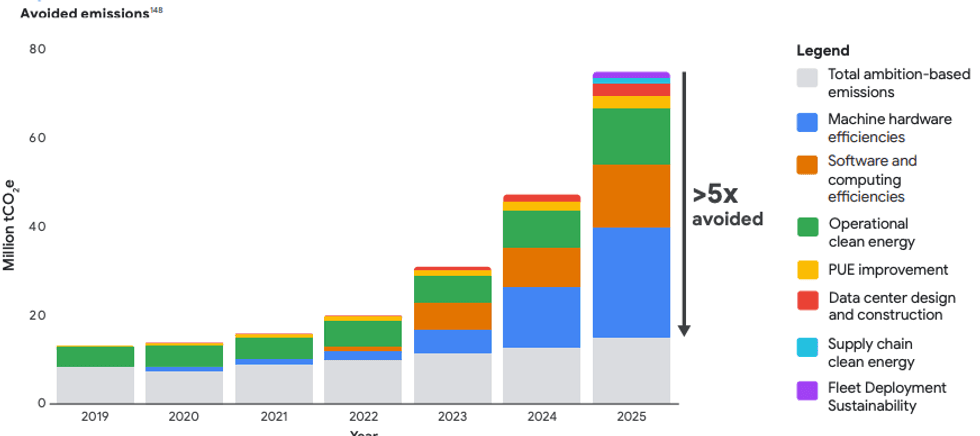 courtesy of Google