The nuclear headlines just keep stacking up. This week, Inertial Enterprises landed one of the largest Series A rounds I’ve ever seen, making it an instant contender in the race to commercialize fusion energy. Meanwhile, there was a smaller raise for a company aiming to squeeze more juice out of the reactors we already have.
Elsewhere over in Latvia, investors are backing an early stage bid to bring power infrastructure to the moon, while in France, yet another ultra-long-duration battery energy storage company has successfully piloted their tech.
Inertia Enterprises Nets $450 Million For Laser-Based Fusion
Inertia Enterprises, yet another fusion energy startup, raised an eye-popping $450 million Series A round this week, led by Bessemer Venture Partners with participation from Alphabet’s venture arm GV, among others. Founded in 2024 and officially launched last summer, the company aims to develop a commercial fusion reactor based on the only experiment yet to achieve scientific breakeven, the point at which a fusion reaction generates more energy than it took to initiate it.
This milestone was first reached in 2022 at Lawrence Livermore National Laboratory’s National Ignition Facility, using an approach known as inertial confinement fusion. In this method, powerful lasers fire at a small pellet of fusion fuel, compressing it until the extremely high temperature and pressure cause the atoms inside to fuse and release energy. Annie Kritcher, who leads LLNL’s inertial confinement fusion program, is one of the cofounders of Inertia, alongside Twilio co-founder Jeff Lawson and Stanford professor Mike Dunne, who formerly led a program at the lab to design a power plant based on its approach to fusion.
The Inertia team plans to commercialize LLNL’s breakthrough by developing a new fusion laser system it’s calling Thunderwall, which it says will be 50 times more powerful than any laser of its type to date. Inertia isn’t the only player trying to commercialize laser-driven fusion energy — Xcimer Energy, for example, raised a $100 million Series A in 2024 — but with its recent financing, it’s now by far the best capitalized of the bunch.
As Lawson, the CEO of the new endeavor said in the company’s press release, “Our plan is clear: build on proven science to develop the technology and supply chain required to deliver the world’s highest average power laser, the first fusion target assembly plant, and the first gigawatt, utility-scale fusion power plant to the grid.” Great, but how soon can they do it? The goal, he says, is to “make this real within the next decade.”
Alva Energy Bets on More Megawatts, Not More Reactors
In more nuclear news, the startup Alva Energy launched from stealth on Thursday with $33 million in funding and a proposal to squeeze more capacity out of the existing nuclear fleet by retrofitting pressurized-water reactors. The round was led by the venture firm Playground Global.
The startup plans to boost capacity by building new steam turbines and electricity generators adjacent to existing facilities, such that plants can stay online during the upgrade. Then when a plant shuts down for scheduled maintenance, Alva will upgrade its steam generator within the nuclear containment dome. That will allow the system to make 20% to 30% more steam, to be handled by the newly built turbine-generator system.
The company estimates that these retrofits will boost each reactor’s output by 200 megawatts to 300 megawatts. Applied across the dozens of existing facilities that could be similarly upgraded, Alva says this strategy could yield roughly 10 new gigawatts of additional nuclear capacity through the 2030s — the equivalent of building about 10 new large reactors.
Biden’s Department of Energy identified this strategy, known as “uprating”, as capable of adding 2 gigawatts to 8 gigawatts of new capacity to the grid. Alva thinks it can go further. The company promises to manage the entire uprate process from ensuring regulatory compliance to the procurement and installation of new reactor components. The company says its upgrades could be deployed as quickly as gas turbines are today — a five- to six-year timeline — at a comparable cost of around $1 billion per gigawatt.
Deep Space Energy Raises $1 Million to Power the Moon Economy
Deep Space Energy, a Latvian space tech startup, has closed a pre-seed funding round to advance its goal of becoming a commercial supplier of electricity for space missions on the moon, Mars, or even deeper into space where sunlight is scarce. The company is developing power systems that convert heat from the natural decay of radioisotopes — unstable atoms that emit radiation as they decay — into electricity.
While it’s still very early-stage, this tech’s first application will likely be backup power for defense satellites. Long term, Deep Space Energy says it “aims to focus on the moon economy” by powering rovers and other lunar installations, supporting Europe’s goal of increasing its space sovereignty by reducing its reliance on U.S. defense assets such as satellites. While radioisotope generators are already used in some space missions, the company says its system requires five times less fuel than existing designs.
Roughly $400,000 of the funding came from equity investments from the Baltic-focused VC Outlast Fund and a Lithuanian angel investor. The company also secured nearly $700,000 from public contracts and grants from the European Space Agency, the Latvian Government, and a NATO program to accelerate innovation with dual-use potential for both defense and commercial applications.
Ore Energy Completes 100-Hour Iron-Air Energy Storage Pilot
As I wrote a few weeks ago, Form Energy’s iron-air battery isn’t the only player targeting 100-plus hours of low-cost energy storage. In that piece, I highlighted Noon Energy, a startup that recently demoed its solid-oxide fuel cell system. But there’s another company aiming to compete even more directly with Form by bringing its own iron-air battery to the European market: Ore Energy. And it just completed a grid-connected pilot.
Ore piloted its 100-hour battery at an R&D center in France run by EDF, the state-owned electric utility company. While the company didn’t disclose the battery’s size, it said the pilot demonstrated its ability to discharge energy continuously for about four days while integrating with real-world grid operations. The test was supported by the European Union’s Storage Research Infrastructure Eco-System, which aims to accelerate the development of innovative storage solutions, and builds on the startup’s earlier grid-connected installation at a climate tech testbed in the Netherlands last summer.
Founded in 2023, Ore plans to scale quickly. As Bas Kil, the company’s business development lead, told Latitude Media after its first pilot went live, “We’re not planning to do years and years of pilot-scale [projects]; we believe that our system is now ready for commercial deployment.” According to Latitude, Ore aims to reach 50 gigawatt-hours of storage per year by 2030, an ambitious goal considering its initial grid-connected battery had less than one megawatt-hour of capacity. So far, the company has raised just shy of $30 million to date, compared to Form’s $1.2 billion.
Bonus: Sonnen And Solrite Launch Battery-Only VPP For “Solar Orphans”
Battery storage manufacturer and virtual power plant operator Sonnen, together with the clean energy financing company Solrite, have launched a Texas-based VPP composed exclusively of home batteries. They’re offering customers a Solrite-owned 60-kilowatt-hour battery for a $20 monthly fee, in exchange for a fixed retail electricity rate of 12 cents per kilowatt-hour — a few cents lower than the market’s average — and the backup power capability inherent to the system. Over 3,000 customers have already enrolled, and the companies are expecting up to 10,000 customers to join by year’s end.
The program is targeting Texans with residential solar who previously sold their excess electricity back to the grid. But now that there’s so much cheap, utility-scale solar available in Texas, electricity retailers simply aren’t as incentivized to offer homeowners favorable rates. This has left many residents with “stranded” solar assets, turning them into what the companies call “solar orphans” in need of a new way to make money on their solar investment. Customers without rooftop solar can participate in the program as well, though they don’t get a catchy moniker.







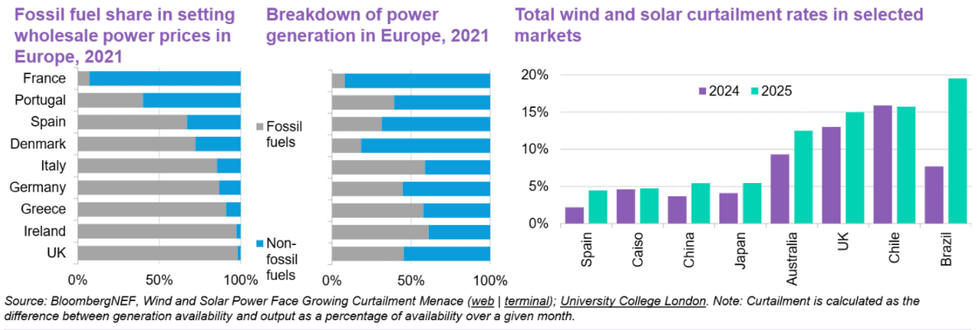 Curtailments are on the rise. BNEF