Whatever you think of as the most important topic in energy right now — whether it’s electricity affordability, grid resilience, or deep decarbonization — long-duration energy storage will be essential to achieving it. While standard lithium-ion batteries are great for smoothing out the ups and downs of wind and solar generation over shorter periods, we’ll need systems that can store energy for days or even weeks to bridge prolonged shifts and fluctuations in weather patterns.
That’s why Form Energy made such a big splash. In 2021, the startup announced its plans to commercialize a 100-plus-hour iron-air battery that charges and discharges by converting iron into rust and back again. The company’s CEO, Mateo Jaramillo, told The Wall Street Journal at the time that this was the “kind of battery you need to fully retire thermal assets like coal and natural gas power plants.” Form went on to raise a $240 million Series D that same year, and is now deploying its very first commercial batteries in Minnesota.
But it’s not the only player in the rarified space of ultra-long-duration energy storage. While so far competitor Noon Energy has gotten less attention and less funding, it was also raising money four years ago — a more humble $3 million seed round, followed by a $28 million Series A in early 2023. Like Form, it’s targeting a price of $20 per kilowatt-hour of energy storage capacity, often considered the threshold at which this type of storage becomes economically viable and materially valuable for the grid.
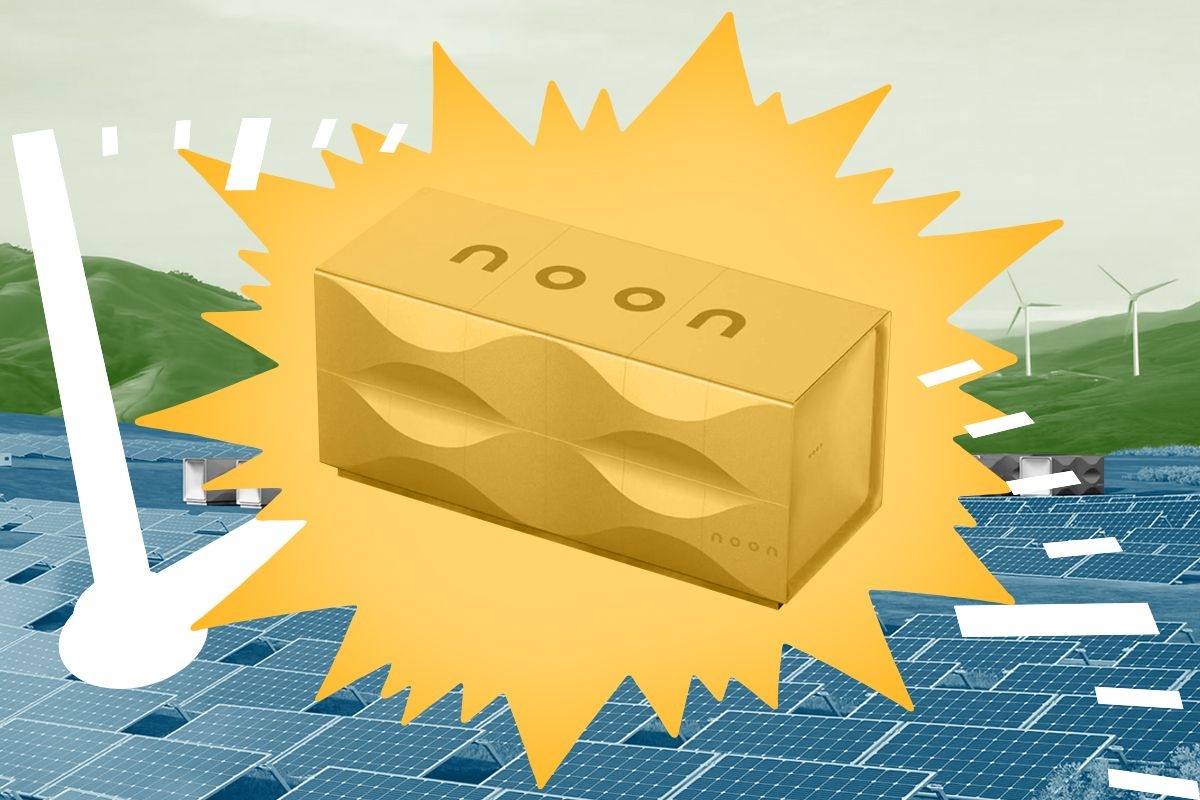
Last week, Noon announced that it had completed a successful demonstration of its 100-plus-hour carbon-oxygen battery, partially funded with a grant from the California Energy Commission, which charges by breaking down CO2 and discharges by recombining it using a technology known as a reversible solid-oxide fuel cell. The system has three main components: a power block that contains the fuel cell stack, a charge tank, and a discharge tank. During charging, clean electricity flows through the power block, converting carbon dioxide from the discharge tank into solid carbon that gets stored in the charge tank. During discharge, the system recombines stored carbon with oxygen from the air to generate electricity and reform carbon dioxide.
Importantly, Noon’s system is designed to scale up cost-effectively. That’s baked into its architecture, which separates the energy storage tanks from the power generating unit. That makes it simple to increase the total amount of electricity stored independent of the power output, i.e. the rate at which that energy is delivered.
Most other batteries, including lithium-ion and Form’s iron-air system, store energy inside the battery cells themselves. Those same cells also deliver power; thus, increasing the energy capacity of the system requires adding more battery cells, which increases power whether it’s needed or not. Because lithium-ion cells are costly, this makes scaling these systems for multi-day energy storage completely uneconomical.
In concept, Noon’s ability to independently scale energy capacity is “similar to pumped hydro storage or a flow battery,” Chris Graves, the startup’s CEO, told me. “But in our case, many times higher energy density than those — 50 times higher than a flow battery, even more so than pumped hydro.” It’s also significantly more energy dense than Form’s battery, he said, likely making it cheaper to ship and install (although the dirt cheap cost of Form’s materials could offset this advantage.)
Noon’s system would be the first grid-scale deployment of reversible solid-oxide fuel cells specifically for long-duration energy storage. While the technology is well understood, historically reversible fuel cells have struggled to operate consistently and reliably, suffering from low round trip efficiency — meaning that much of the energy used to charge the battery is lost before it’s used — and high overall costs. Graves conceded Noon has implemented a “really unique twist” on this tech that’s allowed it to overcome these barriers and move toward commercialization, but that was as much as he would reveal.
Last week’s demonstration, however, is a big step toward validating this approach. “They’re one of the first ones to get to this stage,” Alexander Hogeveen Rutter, a manager at the climate tech accelerator Third Derivative, told me. “There’s certainly many other companies that are working on a variance of this,” he said, referring to reversible fuel cell systems overall. But none have done this much to show that the technology can be viable for long-duration storage.
One of Noon’s initial target markets is — surprise, surprise — data centers, where Graves said its system will complement lithium-ion batteries. “Lithium ion is very good for peak hours and fast response times, and our system is complementary in that it handles the bulk of the energy capacity,” Graves explained, saying that Noon could provide up to 98% of a system’s total energy storage needs, with lithium-ion delivering shorter streams of high power.
Graves expects that initial commercial deployments — projected to come online as soon as next year — will be behind-the-meter, meaning data centers or other large loads will draw power directly from Noon’s batteries rather than the grid. That stands in contrast to Form’s approach, which is building projects in tandem with utilities such as Great River Energy in Minnesota and PG&E in California.
Hogeveen Rutter, of Third Derivative, called Noon’s strategy “super logical” given the lengthy grid interconnection queue as well as the recent order from the Federal Energy Regulatory Commission intended to make it easier for data centers to co-locate with power plants. Essentially, he told me, FERC demanded a loosening of the reins. “If you’re a data center or any large load, you can go build whatever you want, and if you just don’t connect to the grid, that’s fine,” Hogeveen Rutter said. “Just don’t bother us, and we won’t bother you.”
Building behind-the-meter also solves a key challenge for ultra-long-duration storage — the fact that in most regions, renewables comprise too small a share of the grid to make long-duration energy storage critical for the system’s resilience. Because fossil fuels still meet the majority of the U.S.’s electricity needs, grids can typically handle a few days without sun or wind. In a world where renewables play a larger role, long-duration storage would be critical to bridging those gaps — we’re just not there yet. But when a battery is paired with an off-grid wind or solar plant, that effectively creates a microgrid with 100% renewables penetration, providing a raison d’être for the long-duration storage system.
“Utility costs are going up often because of transmission and distribution costs — mainly distribution — and there’s a crossover point where it becomes cheaper to just tell the utility to go pound sand and build your power plant,” Richard Swanson, the founder of SunPower and a board member at Noon, told me. Data centers in some geographies might have already reached that juncture. “So I think you’re simply going to see it slowly become cost effective to self generate bigger and bigger sizes in more and more applications and in more and more locations over time.”
As renewables penetration on the grid rises and long-duration storage becomes an increasing necessity, Swanson expects we’ll see more batteries like Noon’s getting grid connected, where they’ll help to increase the grid’s capacity factor without the need to build more poles and wires. “We’re really talking about something that’s going to happen over the next century,” he told me.
Noon’s initial demo has been operational for months, cycling for thousands of hours and achieving discharge durations of over 200 hours. The company is now fundraising for its Series B round, while a larger demo, already built and backed by another California Energy Commission grant, is set to come online soon.
While Graves would not reveal the size of the pilot that’s wrapping up now, this subsequent demo is set to deliver up to 100 kilowatts of power at once while storing 10 megawatt-hours of energy, enough to operate at full power for 100 hours. Noon’s full-scale commercial system is designed to deliver the same 100-hour discharge duration while increasing the power output to 300 kilowatts and the energy storage capacity to 30 megawatt-hours.
This standard commercial-scale unit will be shipping container-sized, making it simple to add capacity by deploying additional modules. Noon says it already has a large customer pipeline, though these agreements have yet to be announced. Those deals should come to light soon though, as Swanson says this technology represents the “missing link” for achieving full decarbonization of the electricity sector.
Or as Hogeveen Rutter put it, “When people talk about, I’m gonna get rid of all my fossil fuels by 2030 or 2035 — like the United Kingdom and California — well this is what you need to do that.”
Editor’s note: This story has been updated to correct Richard Swanson’s role at Noon. He is a member of the board, not an independent observer. It has also been updated to clarify Noon’s target energy storage price.