You’ve reached your free article limit
Log in
To continue reading, log in to your account.
Create a Free Account
To unlock more free articles, please create a free account.
Sign In or Create an Account.
By continuing, you agree to the Terms of Service and acknowledge our Privacy Policy
Welcome to Heatmap
Thank you for registering with Heatmap. Climate change is one of the greatest challenges of our lives, a force reshaping our economy, our politics, and our culture. We hope to be your trusted, friendly, and insightful guide to that transformation. Please enjoy your free articles. You can check your profile here .
subscribe to get Unlimited access
Offer for a Heatmap News Unlimited Access subscription; please note that your subscription will renew automatically unless you cancel prior to renewal. Cancellation takes effect at the end of your current billing period. We will let you know in advance of any price changes. Taxes may apply. Offer terms are subject to change.
Subscribe to get unlimited Access
Hey, you are out of free articles but you are only a few clicks away from full access. Subscribe below and take advantage of our introductory offer.
subscribe to get Unlimited access
Offer for a Heatmap News Unlimited Access subscription; please note that your subscription will renew automatically unless you cancel prior to renewal. Cancellation takes effect at the end of your current billing period. We will let you know in advance of any price changes. Taxes may apply. Offer terms are subject to change.
Create Your Account
Please Enter Your Password
Forgot your password?
Please enter the email address you use for your account so we can send you a link to reset your password:
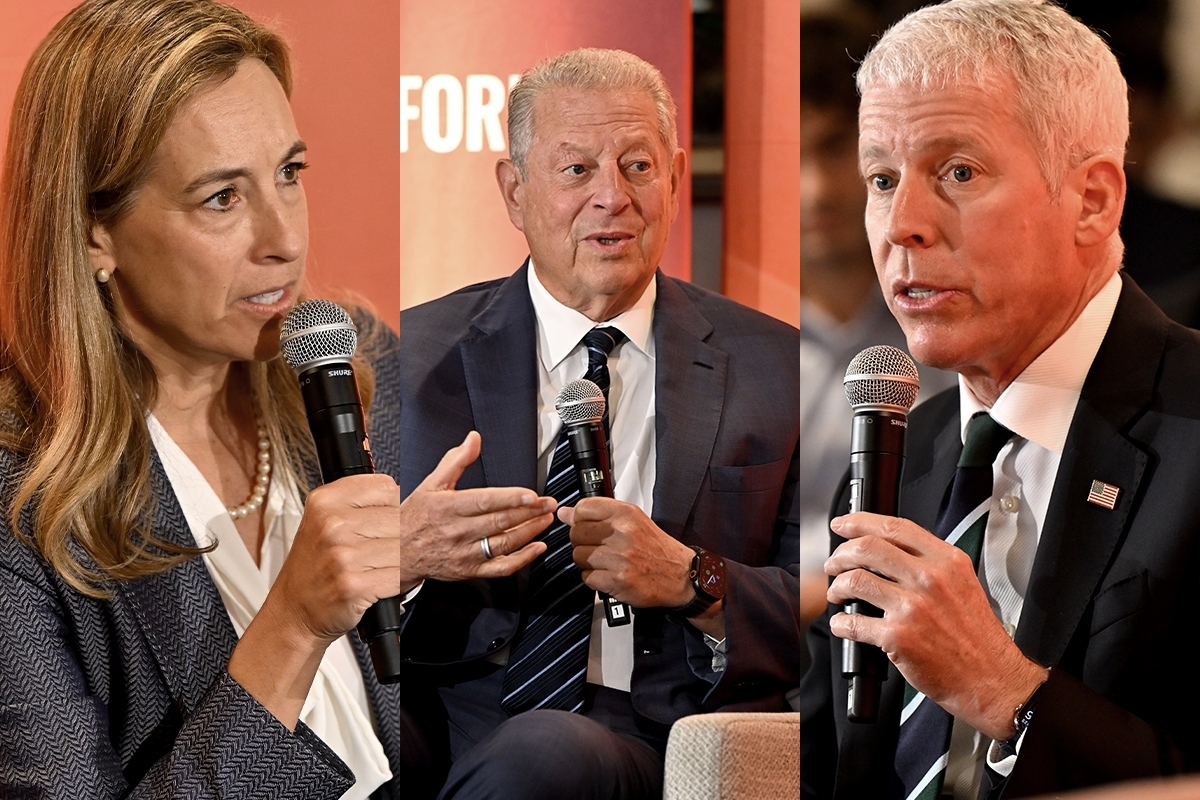
Tales from a day of “thoughtful dialogues on energy, climate change, and human lives” on Day 3 of New York Climate Week.

“I’m here because I love thoughtful dialogues on energy, climate change, and human lives,” Energy Secretary Chris Wright told my colleague Robinson Meyer this afternoon. “That’s been a passion my whole life, and nothing will change that.”
It’s our passion too — and was a defining theme of Heatmap House on Wednesday at New York Climate Week, with 27 sessions across topics including clean energy development, U.S. climate policy, the future of mobility, climate tech, and reindustrialization. From Wright backpedaling on President Trump’s embrace of a diesel export ban to former Vice President Al Gore asserting that 2026 might mark “the positive tipping point on climate,” it was a full day of news, contrarian opinions, juicy predictions, and lots and lots of coffee (consumed by yours truly).
Early in the day, Carlos Araque, the CEO and co-founder of Quaise, an advanced geothermal company, started things off by addressing the elephant in the room: potentially imminent movement on permitting reform. “It’s always easy to be picky and want for more,” he acknowledged, although he added that “my ask has always been — as far back as 2018 — if you can do for geothermal what you do for oil as in terms of regulatory permitting exclusions, then you’re moving 90% of the way to the goal. So that’s happening — that’s slowly and surely happening.”
Get Heatmap in your inbox daily.
New Jersey Governor Mikie Sherrill also spoke about permitting reform at a local scale. “You cannot simply say to people, ‘Sorry, your bills are just going to keep skyrocketing,’” she stressed. “That is not the answer, which is why we’ve acted so aggressively. I approved 18 solar and battery storage projects in the first six months [of my term]. We knew the federal credits were going to run out if we did not get that done, so that’s why we had to take on permitting reform right away to make sure we were growing that.”
And while Jane Flegal, the principal at Flegal Energy Advisors, didn’t have any secret insight into the potential deal, she broke down her predictions into three buckets: reforms to conventional environmental statutes such as the National Environmental Policy Act, the Clean Water Act, and the National Historic Preservation Act; transmission, “which, no one knows what’s in there, but we all know what was in the Manchin deal, and I think we can and should expect something at least that ambitious;” and permitting certainty, which would constrain executive power to cancel permits after they’ve been issued.
Chris Hayes, the host of All In with Chris Hayes on MS NOW and a former climate reporter, took the stage just after Gore, who marked the 20-year anniversary of his Academy Award-winning documentary An Inconvenient Truth. Like Gore, Hayes was in a reflective mood. “I think to some degree, we’re kind of moving forward in this understanding that all of us are implicated in the system that’s going to change very slowly over time,” he said, calling it one of the lessons of the past 20 years. “But I think there was a high-water mark of consumer activism that is sort of gone.”
Then, of course, there was Wright. The energy secretary — whom climate insiders have described to us as the biggest climate villain in the Trump administration after Trump himself — talked to Rob about as many fuels as they could cover. Wind: “There have been very spirited dialogues in the administration about this. I do believe a successful permitting reform thing changes the playing field for anything you want to build in this country, including wind.” Nuclear: “Our thing is just to try to get it back on its feet and get out of the way.” Natural gas: “Gas in my lifetime is going to be the American energy superpower for sure, but you never want all your eggs in one basket.” Batteries: “I’m all in.” And EVs: “Should we have the broader America subsidizing, you know, the habits of wealthy people? I don’t think we should.”
Another running theme of the day was data centers and AI. “We all feel a little bit used by data centers,” Dawn Lippert, the founder and CEO of Elemental Impact, a nonprofit climate tech investor, and a general partner at Earthshot Ventures, its sister fund, told my colleague, Katie Brigham. “We thought, how can you actually use data centers to do the things that we need to do as society? And pulling forward clean energy technologies and sustainable technologies is one of the most interesting ways that they can be a real service to society.”
That thought was explored further when the evening wrapped with a focus on reindustrialization. Tom Steyer, the co-executive chair of Galvanize Solutions, told us he’s doing fine after his unsuccessful bid for California governor. (Nothing a trip to Tahoe with the family couldn’t cure.) He also shared that the climate movement may have lessons for the modern movement opposing AI and data centers. The world’s richest companies can’t just “come in and take people’s water, especially at a time when people are so water insecure,” he stressed. “How could that possibly be right?”
AI — and water — also came up in conversation with Emilio Tenuta, the senior vice president and chief sustainability officer of Ecolab, which provides industrial and commercial water and hygiene solutions. (Ecolab also sponsored our reindustrialization section.) He argued that “what we really need to focus on is the Water Efficiency Index” when evaluating, for example, semiconductor fabrication plants, because it contextualizes water use in more absolute terms than traditional metrics.
Page Crahan, general manager of Tapestry, an Alphabet X moonshot project that uses AI to develop a model of the grid’s electricity network, zeroed in on how best to use artificial intelligence. “We had 10 years to build what it took us 110 years to build globally” in order to meet anticipated energy demand, she told my colleague Jael Holzman. “And that was in 2023, before data centers.” For “computationally intensive challenges, data-heavy challenges, and certainly running simulations and insights for a system this size,” AI is a good use case, she said.
Tapestry is using its models in partnership with PJM Interconnection (as we’ve covered here at Heatmap) — and speaking of PJM, its executive director of strategic policy and external affairs, Asim Haque, spoke to my colleague Matthew Zeitlin next. “If you do not bring your own new capacity, we are going to curtail you before we curtail your average residential consumer for sure,” he said, adding, “this is a concept that is pending in front of the FERC right now. We can talk about carrots. We can talk about sticks. I don’t know which one this is. I think from the data center perspective, it’s likely a stick.”
Josh Parker, the head of sustainability at Nvidia, rounded the day out on a positive note. “The good news is, we are very quickly unlocking new capacity with clean energy,” he said, including developing new clean energy technologies like advanced fission and geothermal. “All of these technologies are benefiting from AI, and so that, coupled with the fact that data center operators with AI factories generally are some of the largest consumers of clean energy and are still are looking for all the clean energy they can, leads me to believe — and I think this is the most credible forecast — that very soon we’re going to see all of that convert over to clean as soon as we can get through the supply constraints that we’re currently in.”
If you were with us in person, thank you again. You’re what made our event one to remember. And if you weren’t able to join us this year — we hope to see you in 2027.
But wait! Before I send you on your way, you can find all of our coverage of the day below along with some additional quotes from some of my favorite conversations:
Log in
To continue reading, log in to your account.
Create a Free Account
To unlock more free articles, please create a free account.
What 700 math problems say about the AI economy’s biggest open question
This is Heatmap Daily, an evening news digest written by our executive editor. Subscribe here.
Happy Monday and welcome back.
It’s been a big weekend: I’m fairly certain Saturday Night Live mentioned Heatmap’s data center polling in one of its Weekend Update segments over the weekend. Watch here.
There are 22 days to the midterm elections here in the United States. We’ll soon enter that pre-election wormhole where only national politics can break through. So today I wanted to look at a story that might, on its face, seem like it has nothing to do with climate or energy. And warning: It’s a little bit of a weird one.
Last week, OpenAI released what it described as the solution to more than 700 open problems in mathematics. Many of the problems, such as the Quasi-Riemann hypothesis, had gone unsolved for decades. Some of the solutions came with proofs written in the programming language Lean.
The release made a stir in part because OpenAI had reached the solutions by using an internal model — that is, a version of ChatGPT not yet open to the general public. In a statement, the Association for Human Mathematics lambasted OpenAI for using an internal model to do research, violating what it described as a precept of AI-driven math research. (I’ve since seen speculation that OpenAI may not have even meant to solve the problems, but gave them to the internal model as a test … and then got the answers.) It’s also not clear whether all of OpenAI’s 700 solutions are correct — in many cases the proofs are so intricate that mathematicians are still wrapping their heads around them.
“There are some sad stories related to their users getting scooped [and] conflicts of interest,” Levent Alpöge, a mathematician at Anthropic, posted on X. “It’s obviously the most significant moment in mathematical history.”
On Friday night, the UCLA mathematician Terence Tao gave a pre-planned lecture at Caltech about what he called “Math 2.0”; it considered the revolution the field had seemingly undergone in the previous few days. (He posted the slides to his blog over the weekend, and I’m using them to summarize his talk here.) For most of math’s history, he said, the field operated under “proof scarcity,” in which finding a solution to an open math problem and confirming it as true was “difficult and rare,” requiring “significant human expertise.”
But AI, it has turned out, is well suited to solving math problems. This is partly because math, like the large language models themselves, is entirely conceptual, so confirming a proof as true requires no recourse to the physical. But it’s also because math’s solutions are “objectively verifiable”: “There is broad consensus on what constitutes a correct and complete proof of a given problem,” and thanks to the existence of proof programming languages like Lean, they can even be checked by computer.
The end result is that math is now entering a world of “proof abundance,” he said.
That is, perhaps surprisingly, a problem for math’s practitioners, and it will mandate a new intellectual regime for the discipline. Mathematicians have often used open problems as “lighthouses,” Tao wrote, “not destinations to be reached … but useful guides to explore the mathematical landscape.” Mathematicians often learn more in the solving than in the solution, in other words. But if mathematicians can now generate shortcuts to math problems without knowing how they got there, or even how the problem works, then actual human mathematical understanding will suffer. (One way to understand this is that mathematicians are now dealing with the same problem that math teachers have faced since the invention of the pocket calculator: How do you confirm students actually understand the material? Except the world’s most elite mathematicians themselves are the students in question.)
This disconnect can pose its own AI alignment problems, Tao said, analogizing math to pharmaceuticals. Suppose an advanced AI found what appears to be a cure for cancer that can pass a stage 3 clinical trial: “After a large amount of compute, it produces a cocktail of previously unknown chemicals which it claims, when mixed and injected into a patient, will kill all their cancer cells,” he said. It even generates a programmatic proof of the cocktail’s effectiveness.
“Before injecting this cocktail into your bloodstream,” he asked, “would you find it reassuring to know that there is at least one human cancer expert who understands — even partially — the mechanism behind this cure?” If not, you can see mathematicians’ problem, confronted by a surfeit of proofs that seem to work, but nobody who can explain how or why they do.
Now, Tao’s analogy is somewhat peculiar because something like this actually does happen all the time in medicine: Doctors still don’t fully understand how many drugs work, including acetaminophen, SSRIs, and lithium. (That said, those compounds were identified by trial and error, not by a mechanical superintelligence.) But the broader situation that Tao is painting — as well as the crisis posed by OpenAI’s 700 proofs — get at a significant question with economic importance far beyond just math: Will AI solve the economy’s secular attention shortage or worsen it?
This question has greater import than it may seem — but let me qualify what I mean by “attention shortage.” Writing in 1971, the economist Herber Simon observed the sudden superabundance of information that had exploded in every economic domain. There were more facts, data, news articles, and opportunities than any individual or organization knew what to do with. He pointed out that this newfound “wealth” of information implied an insufficiency of something else: attention.
“What information consumes is rather obvious: it consumes the attention of its recipients,” he wrote in Designing Organizations for an Information-Rich World. “Hence a wealth of information creates a poverty of attention and a need to allocate that attention efficiently among the overabundance of information sources that might consume it.”
He wrote this, of course, well before the advent of internet, smartphones, sensors, or networked cameras — all of which have worsened the problem. But in the ensuing half century, the economy has learned to deal (or at least intermittently manage) this secular scarcity of attention. Much of what we now call knowledge work is devoted to filtering, siphoning, processing, and otherwise attending to the information superabundance.
AI is, in theory, supposed to help address this same set of problems. AI is commodified attention — or, at least, that is its promise. (The most important machine learning paper of the past decade, after all, is entitled “Attention Is All You Need.”) Many AI products, such as Meta’s Muse, now want you to believe that by ceding control of your email, your calendar, your restaurant reservations, and your digital life to AI, you will gain an attentional edge. The AI will do the grunt-work of attending to boring things for you, and you will feel less overwhelmed. If this vision comes true, the economy’s mismatch of information and attention will prove to be a short-lived historical blip.
But the past week of math news and Tao’s “Math 2.0” regime suggest a different scenario is more likely, at least in the immediate near term. By allowing far faster and more automated information production, AI will create a new, more vicious, and even more abstract form of information overload. Every profession and intellectual discipline will be overwhelmed with new papers, ideas, observations, proofs, or choices. Yet the human understanding required to convert this new information into useful action will become even more scarce. In such a world, AI will not solve the economy’s attention shortage, but worsen it.
I’m not sure which world would be worse for humanity, to be candid. One world suggests the eventual automation of all human effort. But in Tao’s world, many of us might still have jobs — they will just involve even more filtering, sorting, and processing of an ever-deepening pile of automated idea generation than we do today.
And what is the connection to climate and energy? One easy connection might be to the permitting process: If you think a new transit line (at the local level) or transmission line (at the state or federal level) could be overwhelmed with procedural concerns 10 years ago, wait until you see what happens when information itself can be mechanically produced. But that is only one example of a more general problem. Soon, if not already, any process of providing input to an important policy question — on energy, decarbonization, or anything else — will be overwhelmed with facially high-quality analysis. It will be left to policy officials and elected leaders to sort through it.
This past weekend’s storms caused flooding and property damage up and down the coast — and it’s going to get worse.
California has around 3,400 miles of shoreline, ranging from the wild, foggy beaches of the North Coast to the sunbather-studded sands of Orange and San Diego counties. That’s a whole lot of border to share with the Pacific Ocean, especially when the water is as hot and tempestuous a neighbor as it is right now.
Just ask the city of Long Beach, which this weekend was on the receiving end of some Super El Niño mischief. Swells from the storm briefly dubbed Hurricane Rachel “annihilated” beachfront mansions and flooded city streets, causing pieces of the local boardwalk to “shred away.” “It’s never happened like this before,” one resident of 64 years told the New York Post.
But while things might look bad in California at the moment, they can still get much worse. One disaster modeler recently estimated the state could see as much as $3 billion in flooding and mudslide-related losses alone this winter — not to mention coastal erosion, king tides, and storm swell. Governor Gavin Newsom declared a state of emergency at the end of September, while many cities, including San Diego, have declared their own local emergencies.
El Niño will likely peak in December, meaning that towns and cities across the state have just a few remaining weeks to finalize projects, whether that means improving drainage in landslide-prone environments such as Rancho Palos Verdes or distributing NOAA weather radios in areas likely to lose power, as emergency managers are in Santa Cruz. The approaching winter storms, combined with El Niño, represent “a humbling reminder of the ongoing effects of climate change and the importance of emergency preparedness,” Laath Martin, the public affairs lead for the city of Long Beach, wrote to me in an email.
El Niño is a cyclical phenomenon, occurring when temperatures in a particular stretch of the Pacific Ocean rise half-a-degree Celsius above the average of the preceding 30 years. But there are signs these natural variations are happening less predictably because of climate change, and we know for sure that a warmer atmosphere makes the baseline for its impacts worse: king tides, Kelvin waves, and storm surge piggyback on top of rising sea levels to result in more severe coastal flooding and erosion. A warmer atmosphere also holds more water, which means more rain — perhaps 200% above normal — which, in turn, results in flooding and mudslides further inland, as well.
“Based on what I am seeing now, I am officially concerned,” Daniel Swain, a climate scientist at the University of California Agriculture and Natural Resources, said last week after reviewing the latest outlook. There’s a reason this year’s El Niño is being called a Godzilla.
In general, the weather pattern causes the jet stream to shift south in the winter, bringing wetter and snowier conditions to the lower U.S. while the northern part of the country stays drier and mild. (It’s also responsible for a weaker Atlantic hurricane season, as we’ve already seen this year.) In addition to El Niño-driven Kelvin waves, warm bulges of water that raise the sea level on the coast by as much as 18 inches, the state of California — and particularly southern California — sits directly in a storm track that will deliver “atmospheric rivers” of heavy rain to a region prone to landslides and flash floods.
In many parts of the state, that rain will test the best-made plans in addition to plans deferred. In Los Angeles, the Department of Sanitation and Environment, or LASAN, has told the City Council it has concerns about the ability of the aging wastewater pipes and plants to handle heavy rainfall associated with a supercharged El Niño. In San Diego, which requires some $3.3 billion to upgrade what is in some places a century-old wastewater system, emergency managers are preparing to work with what they have by clearing debris and brush that could back up in the drains, CalMatters reports. In both cases, the time required for systemwide repairs far exceeds the time remaining before the winter’s supercharged atmospheric rivers are due to arrive. (Rezende told me inland flooding affects more businesses and residents in San Diego than coastal flooding, since the population in the city is set further back from the coastline.)
The city of Roseville, northeast of Sacramento, by contrast, is leaning on decades of flood planning to get through the season. After a series of back-to-back storms in 1986 that killed 13 people and caused $400 million in damage, the city and FEMA invested $39 million to upgrade Roseville’s infrastructure, including widening streams and adding levees and stormwater bypass channels. With more accurate floodplain modeling that has “helped keep new construction at higher elevations,” Helen Dyda, the city manager’s public information officer told me that “less than 7% of the city is within a floodplain” today. Dyda added that the city prepares for winter storms every year — it has some 160 miles of creek shoreline, after all — but that the El Niño-specific preparations are, as a result, more similar to routine maintenance: “clearing more dense vegetation and fallen trees from key creek areas.”
Long Beach is caught somewhere in the middle. After swells from Hurricanes Marie and Polo hammered the city in September, Long Beach hastily developed a seven-point plan to strengthen its peninsula in the near and long term. It will also begin a $11.4 million dredging project this fall that will place 415,000 cubic yards of sand on the beach as a buffer zone. “While this effort will achieve a much-desired result, it will not stop the ocean from pulling sand from the peninsula with every wave, especially during the significant weather systems Long Beach continues to experience,” Martin, the city’s public affairs lead, wrote to me. “Back-passing will need to continue to return sand back to the peninsula each day until more permanent, long-term man-made and environmental solutions can be identified, permitted and implemented.”
In certain cities, preparations for the peak of El Niño overlap with ongoing repairs from the last bad storm season. In Santa Cruz County, the 2016 El Niño caused an estimated $9 million in damage, while many in the community of Pajaro are still recovering from the flood damage caused by a series of severe atmospheric rivers in 2023. “We have a list of hazards that the city is vulnerable to, and we plan for all of them not individually, but all together,” Meredith Albert, Santa Cruz’s emergency management manager, told me. She added that many of the city’s preparedness activities and El Niño initiatives, like urging the community to be prepared to spend 72 hours unsupported, overlap with other disasters it works year-round to prepare for, like earthquakes, landslides, and wildfires.
“El Niño turns up the volume a little bit, but it doesn’t necessarily change our hazard landscape,” is how Albert put it to me.
Santa Cruz has not declared a local state of emergency, and Albert told me they won’t until they “run out of resources.” Other cities, like San Diego, have declared one preemptively. “In the past, you’d have to go through a longer review if you wanted to make some headway on projects, and sometimes that would take many weeks or many months of permitting,” Rezende said. “With a state of emergency, we streamline that process and get projects in the queue.”
Both Rezende and Albert told me the governor's statewide emergency declaration mostly helps state agencies position themselves for a faster response or has implications for higher-level permitting processes. (In Carlsbad, for example, which has seven miles of badly eroding beach, just one mile is controlled by the city; the other six are managed by the State Parks.) The state has also teamed up with ICEYE, a satellite imaging company, to receive information about flooding even in the dark or through rain clouds.
No state of emergency, though, can make it so a city can replace a century-old sewer system by Christmas or reengineer a beach by the time January’s storms begin to make landfall. But if a Godzilla analogy fits the onslaught of a super El Niño, it also offers a classic disaster-movie lesson on how to survive it.
Albert’s advice for how to prepare? Ask a neighbor for a cup of sugar. Take their dog for a walk. Build a relationship that could prevent a tragedy. “We know that our city will be cut off for at least a couple of days,” she told me of a hypothetical major disaster, referring back to Santa Cruz’s experience after the 1989 Loma Prieta earthquake, which cut off the city’s power, communication, and supply lines. “And we also know that we can’t build those relationships during the disaster. We’re trying to build them before.”
The city is doing a lot to prepare for the storm, she said. “But the question is also, what are all of us doing?” Albert went on. “You know better than I do, at the city level, who’s not going to receive that alert,” whether that be an elderly or unhoused neighbor or a nonnative English speaker who might not receive or understand emergency communications.
“Check in on a neighbor” is easier said than done — active engagement and connection to one’s community is trending downward in most parts of the U.S. But the people and places that bounce back from disaster and tragedy are almost uniformly the ones that look after each other. Borrowing a cup of sugar, to this introvert, sounds like a nightmare. But there’s never been a better time than a Godzilla El Niño to bake a poorly resourced cake.
Heatmap News is looking for an ambitious, energetic senior editor to join our growing newsroom.
The senior editor will report to the deputy editor of the website and will be tasked with assisting in running all aspects of our coverage. This individual will be the primary editor on many of the site’s stories, including breaking news, features, and long-term projects, on topics ranging from permitting reform to decarbonized fuels to greenhouse gas accounting to the electric vehicle market. This person will also play a role in overseeing and furthering our cross-platform efforts such as newsletters, events, and podcasts. Additional duties will include managing and maintaining the site’s social media presence and digital production on stories, newsletters, and podcasts.
Candidates should be intellectually curious news junkies with a deep interest in climate change and the energy transition. They should have a proven ability to work in a fast-paced digital newsroom, spot great angles, line edit stories, and change hats quickly as needed. They should also be responsible, reliable, and a good colleague.
Candidates should have 5+ years experience editing for a digital publication. A background in climate or energy coverage is an obvious plus, but compelling candidates from other verticals, particularly politics and business, will also be considered. Heatmap is a fully remote workplace, so candidates from all U.S. locales are encouraged to apply.
Above all, candidates should be passionate about Heatmap’s mission and absolutely thrilled about building something from the ground up.
The salary minimum is $100,000 and the maximum is $120,000. Competitive benefits, unlimited paid time off, and a generous equity plan, which gives employees a real stake in the company, are also offered. This position is remote.
Interested candidates should send a brief cover letter and resume to editors@heatmap.news with the subject line ‘Senior Editor Application.’
Heatmap News is a media platform focused on the energy transition.
Heatmap News is an equal opportunity employer. All qualified applicants will receive consideration for employment without regard to sex, gender identity, sexual orientation, race, color, religion, national origin, disability, protected veteran status, age, or any other characteristic protected by applicable law.
To sample Heatmap’s work, poke around the site and sign up for our newsletter: