You’re out of free articles.
This Halloween, get 20% off using code ADVANCED
Log in
To continue reading, log in to your account.
Create a Free Account
To unlock more free articles, please create a free account.
Sign In or Create an Account.
By continuing, you agree to the Terms of Service and acknowledge our Privacy Policy
Welcome to Heatmap
Thank you for registering with Heatmap. Climate change is one of the greatest challenges of our lives, a force reshaping our economy, our politics, and our culture. We hope to be your trusted, friendly, and insightful guide to that transformation. Please enjoy your free articles. You can check your profile here .
subscribe to get Unlimited access
Offer for a Heatmap News Unlimited Access subscription; please note that your subscription will renew automatically unless you cancel prior to renewal. Cancellation takes effect at the end of your current billing period. We will let you know in advance of any price changes. Taxes may apply. Offer terms are subject to change.
Subscribe to get unlimited Access
Hey, you are out of free articles but you are only a few clicks away from full access. Subscribe below and take advantage of our introductory offer.
subscribe to get Unlimited access
Offer for a Heatmap News Unlimited Access subscription; please note that your subscription will renew automatically unless you cancel prior to renewal. Cancellation takes effect at the end of your current billing period. We will let you know in advance of any price changes. Taxes may apply. Offer terms are subject to change.
Create Your Account
Please Enter Your Password
Forgot your password?
Please enter the email address you use for your account so we can send you a link to reset your password:
Clean energy stocks are up, unless they’re firm.

The market has rendered its provisional judgment on the midterm elections, seeing threats to the AI datacenter complex and Elon Musk. Here are the winners and losers of the big blue wave.
Elon Musk’s companies
Tesla shares fell over 3% on Wednesday while SpaceX shares fell 3.8%.
Before the election, several Congressional Democrats who will now be serving in the majority made it clear that their oversight powers across a number of domains would be turned on the Trump-supporting sometimes-trillionaire.
“We think the market fears Democrats will look to target Tesla, as Tesla CEO Elon Musk heavily campaigned for the Republican Party leading up to the election,” Morningstar analyst Seth Goldstein wrote in a note to clients.
AI-related companies
But of course Elon Musk isn’t just a Trump-connected electric car and battery chief executive, he also runs an artificial intelligence model developer and “neocloud” (i.e. a builder and renter out of data centers for artificial intelligence) by the name of SpaceX (it also launches rockets).
Several other companies who rent out compute to AI developers saw their shares decline, including CoreWeave (down 10%) and Nebius (down over 6.5%), as Democrats who criticized data center developers won up and down the ballot, including at the state level in data-center-heavy states like Georgia, Texas, and Ohio.
The results imply “incrementally negative AI sentiment on greater expectations for data center restrictions,” Morgan Stanley equity strategists wrote in a note to clients.
“Any investors adding 10 or more GW of compute to SpaceX's SI business in 2027 may want to revise down. State pushback on terrestrial/atmospheric datacenters has a head of steam,” Morgan Stanley analyst Adam Jonas wrote in a note to clients.
Semiconductor companies Nvidia and Broadcom were also down around 3% and 2% respectively.
Firm power companies (including clean ones)
Of course those data centers are largely consumers of power, so as the data center industry got sick, the power industry caught a cold.
Companies that own fossil fuel and nuclear power plants were hit hard today. Shares of Vistra (which has a 44,000-megawatt power plant portfolio) were down almost 14%, Constellation (which owns and operates 21 nuclear reactors) was down 6% and Talen (which owns 14 power plants largely in the PJM region) fell 8.5%. GE Vernova, which has been riding the AI boom by selling gas turbines to power plant developers, was down over 9%.
“Laggards include anything that touches data centers,” Jefferies analyst Julien Dumoulin-Smith wrote in a note to clients. “Expect a difficult unwind day given the scale of the upset in the single biggest state for data center activity,” he wrote, referring to Texas.
And Fervo, the enhanced geothermal developer, really is being treated like a "normal" energy company: its shares were down 4.5%. X-Energy, the advanced nuclear developer, was also down almost 8.5%.
Utilities, especially one specific utility
The vertically integrated utility Southern Company was essentially on the ballot by way of its subsidiary Georgia Power in the Georgia Public Service Commission race and lost. Georgia Power represents about 60% of Southern’s earnings. “Southern Company remains the clearest commission-control risk after Democrats sweep Georgia’s two PSC seats,” Dumoulin Smith wrote.
Across the whole sector, newly elected governors and public utility commissioners could put pressure on the return on equity that utilities are allowed to earn on their investments.
“ROEs are one of the only things utility regulators have to reduce rates,” Rains told me.
Clean Energy
In the energy sector, the big winners were renewables. The S&P Global Clean Energy Transition Index was up over 3% today, while the Danish wind manufacturer Vestas was up almost 3%, while shares in Orsted, the Danish wind developer, were up around 5%. Domestic solar First Solar was up 5% while Sunrun, the solar installer, was up almost 1.5%.
“The blue wave improves the federal outlook for renewables, with Democratic leaders pledging to restore wind and solar tax credits if they regain congressional control,” Dumoulin-Smith wrote.
But the Democratic victory does not necessarily mean the end of the war on offshore wind, although it puts the industry’s defenders in a stronger position.
“While a positive development, we believe it is premature to call a renaissance in US offshore wind,” Morningstar analyst Tancrede Fulop wrote in a note to clients.
EV makers not named Tesla
Shares in Rivian were up almost 6%, while Lucid shares were up almost 12%, indicating bullishness for the larger EV sector as Democrats may be able to push for a return to subsidies for electric vehicles or harsher mileage standards while also putting pressure on Elon Musk personally.
The stock market as a whole
The market is up over 1.5%, likely thanks to oil prices dropping.
This Halloween, get 20% off using code ADVANCED
Log in
To continue reading, log in to your account.
Create a Free Account
To unlock more free articles, please create a free account.
The focus on affordability could put the party in a bind.
It’s bad when gas prices are high.
This was close to the consensus explanation for the size and scale of the Democratic victory on Tuesday, with even Donald Trump admitting it in his own way, telling Fox News, “We actually have the greatest economy … but because of the gasoline price, people don’t see it as much as they would have without it.”
In exit polls, 87% of respondents told NBC they were somewhat or very concerned about the price of gas and diesel. Annie Andrews, who had perhaps the most shocking Senate win of the night (at least at the time of publication) in South Carolina, called for suspending state and federal taxes on diesel and gasoline.
At first blush, this may seem awkward for advocates who want more aggressive action on climate change. After all, decarbonization requires moving towards electrified mass transit and personal transportation — not lowering gas prices.
But climate groups were happy to point to high gas prices as an explanation for the Republican humiliation at the polls. “Republicans backed Trump at every turn, blocking cheaper clean energy and supporting a war that drove up gas prices. Tonight, that record cost them,” Climate Power President Lori Lodes said in a statement.
And it wasn’t just gas! Scott Colom, who may yet pull off the most shocking upset when all races are called, ran a viral ad slamming his Republican opponent Cindy Hyde-Smith for her suggestion that, in response to high beef prices, Mississippians should realize there are “so many proteins to choose from.” We’re a long way from the notorious Green New Deal factsheet and its lament that “we aren’t sure that we will be able to fully get rid of, for example, emissions from cows.”
For Democrats and climate advocates, the midterm wave is a clear sign that their approach to energy policy — and politics — has been proven out. “This was the affordability election,” Climate Cabinet Executive Director Caroline Spears said in a press call Wednesday. “Utility bills, electricity prices, gas prices, affordability came up over and over and over on the doors.”
Americans’ outrage over high gas and electricity prices provides the perfect opportunity to pivot to advocating for increased deployment of renewable power, the thinking goes. “These are winning issues, and we proved that big time last night, because simultaneously everything we do to get people cheaper energy, we’re also getting them cleaner energy,” former Washington Governor Jay Inslee said on the Climate Cabinet call. “It’s our responsibility and our advantage to add some discussion of climate when we lead with the discussion of cost in these clean energy systems,” he added.
But some Democratic strategists were more cautious, seeing some of the most notable Democratic victories as vindicating a strategy of being more open to the oil and gas industry.
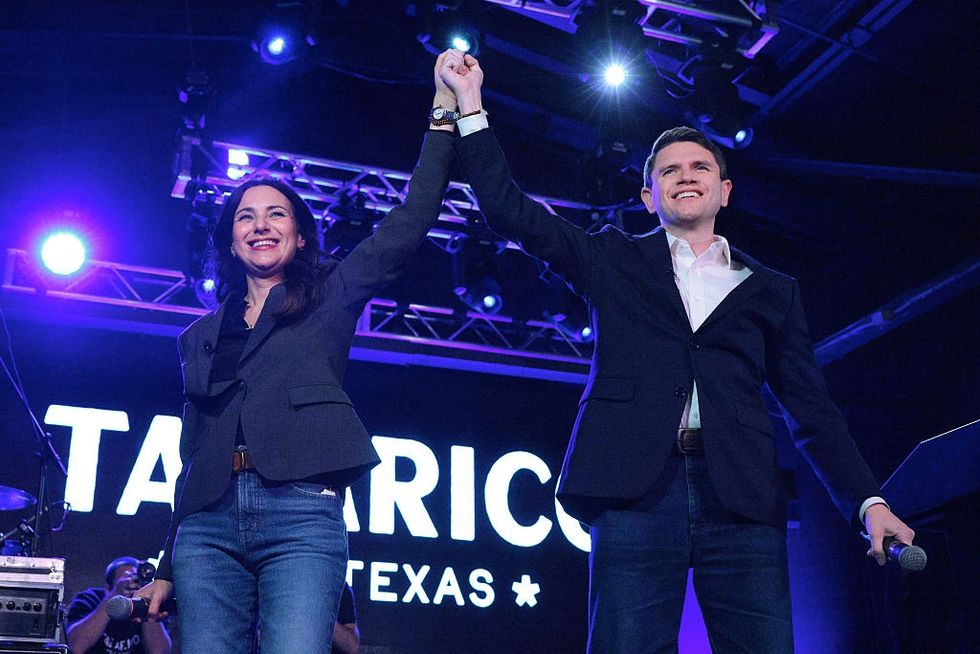
Adam Jentleson, founder and president of the Searchlight Institute, said in a statement that Democrats benefitted from adopting “heterodox” positions, pointing specifically to James Talarico “embracing the fossil fuel industry as critical to the Texas economy.” Bobby Pulido, another victorious Texas Democrat supported by Searchlight, has defended the oil and gas industry as a major job provider in his South Texas district.
“Voters gave us a mandate to focus on affordability,” Jentleson told me. “There are things we can do that tackle both carbon emissions and affordability, starting with permitting reform. Let’s focus on those priorities.”
While Democrats on the trail spoke little about decarbonizing the electric grid by 2035 or reaching net zero by 2050, all the happy talk in the world about how “cheap is clean and clean is cheap” won’t resolve real conflicts and tradeoffs when it comes to energy and fossil fuels. The Bipartisan American Affordability and Jobs Act, which several analysts say will lower energy costs compared to the baseline, has already split the Democratic Party — with the main line of criticism being that it’s too friendly to fossil fuel projects.
Climate advocates are convinced they can turn dissatisfaction with expensive gasoline into support for non-emitting alternatives powered by renewable energy. Any new Democratic administration would immediately face pressure to not just support renewables deployment, but also to restrict oil and gas exploration and production and the construction of new fossil fuel infrastructure, thus potentially raising prices and hurting the domestic industry.
In short, “cheap is clean and clean is cheap” isn’t an axiom, but an argument that needs to be won.
On Democrats’ very good night, Russian uranium, and a cane toad plague
Current conditions: Heavy rainfall in Florida and the Southwest caused flooding that forced local officials to enact emergency Election Day measures to make accommodate voters • Temperatures are up to nearly 90 degrees Fahrenheit amid a major rainstorm in Puerto Rico, the most populous U.S. territory, where the limits of federal representation mean there was no election yesterday • The eastern Pacific basin has broken multiple records with 24 named storms and 13 hurricanes so far, and nearly four weeks before the season ends.

In 2010, then-President Barack Obama introduced the term “shellacking” into the American political lexicon when he described the depth of Democrats’ loss in the midterm elections. Sixteen years later, Democrats are the ones doing the shellacking. The party surged to victory in places long considered deep-red GOP strongholds. Kansas elected Adam Hamilton as its first Democratic U.S. senator in 94 years. Texas hadn’t elected a Democrat statewide in 32 years, yet gave the party a U.S. Senate seat and the governor’s mansion. South Carolina’s incoming Democratic senator is its first since 1998. Hours before polls closed in the nation’s westernmost reaches, Democrats had won control over both the House of Representatives and the Senate.
Ahead of the vote, I spoke to half a dozen experts on what we should expect from the new Democratic Congress. Among the energy policies the party will want to enact: Restrictions on data centers, a restoration of renewable energy tax credits, and the creation of a new tax credit to support batteries. Among the issues expected to see congressional probes: Trump’s gutting of climate rules, funding cuts for clean energy, deals to kill offshore wind projects, and the redirection of Department of Energy funding from green projects to dirty ones. Aligning with Democrats on the need for clean energy tax credits wasn’t enough to save many Republicans in blue and purple states. At least nine Republicans who signed at least one public letter calling on the Trump administration to preserve tax credits for renewables lost reelection Tuesday night, including Jen Kiggans of Virginia, Juan Ciscomani of Arizona, Gabe Evans of Colorado, David Valadao of California, Mike Lawler of New York, Thomas Kean Jr. of New Jersey, Mariannette Miller-Meeks of Iowa, and Ryan Mackenzie and Rob Bresnahan, both of Pennsylvania.
To go deeper into the outcomes of the election, check out these stories by my colleagues:
Strange bedfellows are coming together to form the Responsible Data Center Development Collaborative. In an election night scoop, The Hill reported that green groups such as the Sierra Club, the League of Conservation Voters, and the Natural Resources Defense Council were working with Microsoft, Amazon, Meta, and Google to develop “a common national framework for responsible data development.” The document, leaked to the publication, details the need for “durable economic development,” “more affordable, reliable, and emissions-free energy,” and “community agency and support for responsibly developed projects.” Other parties involved in the effort include the U.S. Chamber of Commerce, Anthropic, Nvidia, and Oracle.
The world’s biggest banks, meanwhile, are once again making more money from green energy projects than fossil fuel ones. For a fifth straight year, according to a Bloomberg analysis published Tuesday, the 2025 revenue from servicing debt on climate-related financing topped $3 billion, eclipsing the $2.9 billion from deals for oil, gas, and coal producers.
Sign up to receive Heatmap AM in your inbox every morning:
The U.S. is racing to replace the Russian enriched uranium that fuels roughly a quarter of its fleet of civilian nuclear plants before federal law bans imports at the end of next year. Industry sources tell me that utilities have about enough fuel to get through the end of the decade before the absence of Russian uranium starts forcing reactors to shut down. Some still expect Trump to find a way to intervene, like when he unilaterally relaxed sanctions on Russian diesel last month. But the few U.S. uranium enrichers that survived the 1990s and 2000s, when cheap imports put much of the domestic industry out of business, are scrambling to erect new centrifuges and pump out more fuel. A new player, the Peter Thiel-backed General Matter, is on track to begin construction as early as next year, as I reported last week. On Monday, Urenco USA, the American subsidiary of the European enrichment giant, announced that it had churned out its first shipment of LEU+, the higher-enriched version of low-enrich uranium that U.S. utilities are pioneering. The Kremlin, however, is beefing up its own operations to maintain its share of the global market. On Tuesday, NucNet reported that Russia planned to build a new facility to process uranium from two mining sites in Zabaikalsky Krai, a landlocked federal jurisdiction in the Russian Far East covering much of the area once known as Transbaikal. The two deposits, located more than 3,700 miles from Moscow, are part of one of the largest volcanic-hosted uranium clusters in the world. Russia is developing the new processing plant in hopes of shoring up its supplies for export.
Meanwhile, Germany is showing signs of the energy vulnerabilities that may have encouraged Russia’s invasion of Ukraine nearly five years ago. In 2021, Germany and much of Western Europe burned through its stores of natural gas to make up for a shortfall of wind power during a “dunkelflaute,” a period in which previously forecasted gusts never blew. That intensified the pain when Brussels was seeking to cut off Russian supplies and the Kremlin throttled the flow of gas into pipelines. On Tuesday, Reuters reported that Germany has entered winter with its lowest gas stocks on record, far below the EU average.
A California court ruled this week in favor of activists seeking to shut down a first-of-a-kind carbon capture project in inland Kern County, north of Santa Barbara. The decision found that the Carbon TerraVault I, which stores CO2 captured from the California Resources Corporation’s Elk Hills cryogenic natural gas-processing facility, broke the California Environmental Quality Act by failing to evaluate, disclose and mitigate potential environmental effects from the facility. The facility, which started running in May, must now halt all operations until it can carry out a new environmental review. “This is a tremendous victory for Kern County communities,” Lupe Martinez, an advocate with the community group Delano Guardians, said in a statement. “We live in one of the most polluted regions in the nation, yet the county and powerful corporations attempted to push forward a project that threatened our air, water, and public health without conducting the proper environmental review required by law.”
It feels almost biblical. One of the world’s biggest mining companies is facing a brutal invasion of toads. Rio Tinto plans to spend $20 million to battle what the Financial Times called “a marauding can toad that is threatening to encroach on Australia’s iron ore-rich Pilbara region.” The company is working with scientists to establish a “kill zone” between the Indian Ocean and the Great Sandy Desert in Western Australia. While the amphibians don’t affect Rio Tinto’s mining operations, an invasive pest that upsets the region’s unique biodiversity threatens to make future permitting harder since regulators will face new pressures to protect endangered native species.

Rep. Jeff Van Drew was defeated by ... another wind opponent.
Democrat Zack Mullock unseated Representative Jeff Van Drew, one of offshore wind’s biggest foes, on Tuesday night in the race for New Jersey’s second district. But while Mullock is a fan of renewable energy, he’s still a man of the south Jersey shore — and unlikely to be a champion for turbines off his coast.
District 2 encompasses the entire lower quarter of the state, covering six coastal counties from Atlantic City down to the tip of Cape May and around to the Delaware Bay. The area is a hotbed for offshore wind opposition, where groups like Protect our Coasts NJ have filed legal challenges against almost every wind project proposed in the region.
After heading to Congress in 2019, Van Drew, who was previously a Democrat, switched parties and became a key ally to this movement. He called for a moratorium on offshore wind development, held hearings on offshore wind “industrialization”, and requested that the Government Accountability Office investigate the industry. He also worked with the Trump administration to block projects that were under construction.
During a debate in late October, Mullock accused Van Drew of flip flopping on wind, arguing that the congressman was a staunch supporter of the industry during his decade-long tenure in the New Jersey legislature. Mullock, who is currently serving his second term as mayor of the city of Cape May, summed up his own position by citing a resolution he signed in 2023 calling for a moratorium on surveying and acoustic testing for offshore wind development pending an investigation into a spate of whale deaths. He signed it due to “concerns” about the environment and commercial fishing, he said.
“I believe very much in our future with renewable energy,” he said. “We need to go full steam ahead with solar panels. And yes we should do wind where it is appropriate, where it doesn't hurt our environment and it doesn't hurt our commercial fishing industry.”
Mullock’s campaign website says he supports federal investments in renewable energy and incentives for energy-efficient homes. He also wants “stricter enforcement of the Clean Air Act and the Clean Water Act,” and to fund coastal resiliency and other “smart infrastructure” projects that protect against climate impacts. He also campaigned in support of a data center moratorium.