We now have the updated final text of the bipartisan Senate permitting deal. Will it be enough to get the bill across the finish line?
On Saturday morning, senators released a reworked version of the Bipartisan Affordability and American Jobs Act. This version, known as a “manager’s amendment” under parliamentary procedure, aims to address many of the concerns and criticisms raised about the bill and will become the official legislative text that ultimately gets a vote in the Senate. There’s something in these changes for everyone – environmentalists, tribes, utilities – but it remains to be seen if they put the bill into a Goldilocks zone.
Let’s walk through some of the most significant changes. There are a lot of changes, and we’re sure people will spend the coming weeks poring over them, but here are a few key ones.
Transmission and Utilities
The amendment preserves — and even strengthens — many of the bill’s most important (and praised) transmission provisions, while addressing and easing some of the loudest Republican criticisms of the bill.
The new text leaves the bill’s core transmission mechanisms intact: Every grid region will have to run a long-term planning process with its neighbors, overseen by the Federal Energy Regulatory Commission, focused on how it can build more interregional lines. The bill lays out how these new power lines should be paid for, via a cost allocation formula that says customers who benefit from the lines need to pay for them. And it creates a new federal siting backstop, which allows the federal government to step in and approve the route for a line if a state has refused to do so.
The amendment deals with one of the provisions that faced the most criticism from former Republican regulators and ends one — but not all — of the bill’s mandates for vertically integrated monopoly utilities, which are largely in the Southeast.
In return, it strengthens the bill’s federal backstop siting provision for transmission lines, and it makes the overall bill more useful for transmission developers. It also clarifies that transmission developers can use some of the bill’s expedited powers without needing to use all of them.
“I think there’s some really good improvements in [the new text], and they provide more flexibility for more types of projects to go through,” said Rob Gramlich, a longtime advocate of federal transmission reform and the president of Grid Strategies, a power sector consulting firm.
In the original bill, a transmission developer could apply for state permits and the FERC federal backstop permit at the same time. A former Republican FERC Commissioner Mark Christie had savaged that provision, arguing recently in Utility Dive that it “effectively renders the state proceeding meaningless, and states will perceive it exactly that way.”
Now, for some advocates, rendering the state process moot was the whole point. But it also wasn’t clear whether developers would ever actually go to FERC and states simultaneously. Doing so would shove a finger in the eye of state regulators, essentially telling them, “We can do this the easy way or the hard way.” The amendment removes the possibility of a simultaneous process; now developers must go to states for a year before they apply for the federal backstop.
The new version of the bill also exempts vertically integrated utilities that aren’t in an electricity market from an otherwise mandatory new process that will require utilities to plan their long-term transmission and their power plant expansion at the same time. That new process is inspired by the planning process used in the Southwest Power Pool, a Midwestern electricity market Midwestern grid.
The Southeast’s monopoly utilities, which are vertically integrated and don’t participate in a regional transmission organization, had disliked that provision, and it wasn’t clear the bill as written actually worked for their operations. That requirement has now been removed from the bill. Utilities won another victory by preserving existing rights of first refusal to build transmission infrastructure in federal law.
But they didn’t win every fight. These utilities will still be subject to the mandate requiring them to participate in an interregional planning process for transmission.
And the utilities will remain subject to a provision, particularly praised by anti-monopoly advocates, that allows states and FERC to exercise oversight over local transmission projects that can drive up electricity costs. The new bill clarifies that state public utility regulators are responsible for asking FERC to investigate these types of projects, and that a utility can invite scrutiny even if it’s replacing an old line, not just building a new one.
“I am relieved that the section survived generally, given what a target this was for utility lobbying. It was strengthened significantly by covering replacement of local facilities in addition to new-build,” David Pomerantz, the executive director of the utility watchdog the Energy and Policy Institute, said in a statement.
In return, Democrats secured a few big changes in the bill that could benefit transmission developers. First, transmission projects will now be able to use the bill’s cost allocation formula even if they don’t use the federal backstop authority. Second, transmission developers will be able to use the bill’s cost allocation formula for only part of their projects.
This makes the bill better in a few ways for transmission developers. First, a developer could get a route entirely approved by the states without having to come up with a new way to pay for it — they can use the formula that’s already in the bill. It also means a power line could use the formula to monetize one of its benefits to the grid without using them all. That could sweeten the economics for projects meant to, say, arbitrage power between two regions, allowing it to make money off its reliability benefits without altering its broader economics.
The amendment also clarifies that the new federal backstop siting authority applies to state-owned land. That closes a potential loophole in which a state government could acquire land from a property owner in order to block a federally approved project from getting built.
The bill also makes some technical changes to the 230-kilovolt floor for projects that can use the federal backstop. It establishes that a line using advanced conductoring technology — which generally allows more electricity at lower voltage — can use the backstop even if it’s not at least 230 kilovolts. But it must have a throughput roughly similar to what a conventional line of 230 kilovolts would have.
The amendment also makes it clear that a utility can’t decline to upgrade a piece of infrastructure — even one at lower voltage — in order to block a transmission line. In 2021, the utility NextEra had fought a major power line in Maine because it required the utility to upgrade a single power circuit at its Seabrook nuclear plant in New Hampshire.
These provisions broadly strengthen the most popular parts of the bill and may address some concerns from southeastern utilities, which could have torpedoed the bill in the House of Representatives.
Certainty, Preservation and Data Centers
At the same time, new text attempts to assuage opposition in both the environmental and tribal advocacy spaces, and it’s undeniable that on first blush, the manager’s amendment does address complaints from those camps about the bill. But as we’ll explain however, it’s unclear if this will be good enough for either community to lay down their arms.
First, Senate negotiators clearly took complaints about the “project certainty” provision seriously, including by dealing with language that would allegedly protect unlawful actions. Under the new bill text, agencies will be explicitly allowed to revoke or alter permits “in response to an order by a court”. The prior text of the bill did not grant federal agencies this explicit jurisdiction and said it could only rely on court orders to make those permit changes if a judge required it. As our colleague Emily Pontecorvo recently wrote, some environmental lawyers were concerned that this original text would inadvertently protect individual permits granted under policies that violated the law.
Other changes are similarly geared towards addressing complaints in the environmental legal space. The original text of the bill allowed companies to sue the federal government for “disparate treatment” against their industry, which would theoretically assist renewable energy companies gain legal leverage against the Trump administration’s permitting freeze. However, the old text used a 5-year baseline of past projects for determining “disparate treatment,” which could mean the president’s anti-wind and pro-fossil actions weren’t built into the baseline. The new bill extends that baseline to 10 years, potentially diluting the influence of Trumpian permitting practices over the next administration.
New language would explicitly stipulate that court settlements brought under these lawsuits must be approved by a court, an apparent nod to claims from critics that this provision could encourage more offshore wind buyouts.
The new text also cuts out or modifies reforms to the National Historic Preservation Act geared towards addressing complaints from Native American tribes. It strikes a controversial attempt to define “property of traditional religious or cultural importance” that was in the original text, and it eliminates a much-maligned provision that would let the Interior Secretary assume the role of a tribal historic preservation officer in certain cases.
These changes were insufficient to thaw the bloc of tribes opposed to the bill. The 106 Coalition, a group of tribal organizations including the National College of American Indians, sent a statement to media saying they’ll still oppose the bill and want the entire section of NHPA changes removed. The leader of the Coalition of Large Tribes, which has pushed for technical fixes to the bill but not opposed it outright, said in a statement it was “grateful to see many positive changes for tribes” but added there was “still room for improvement.”
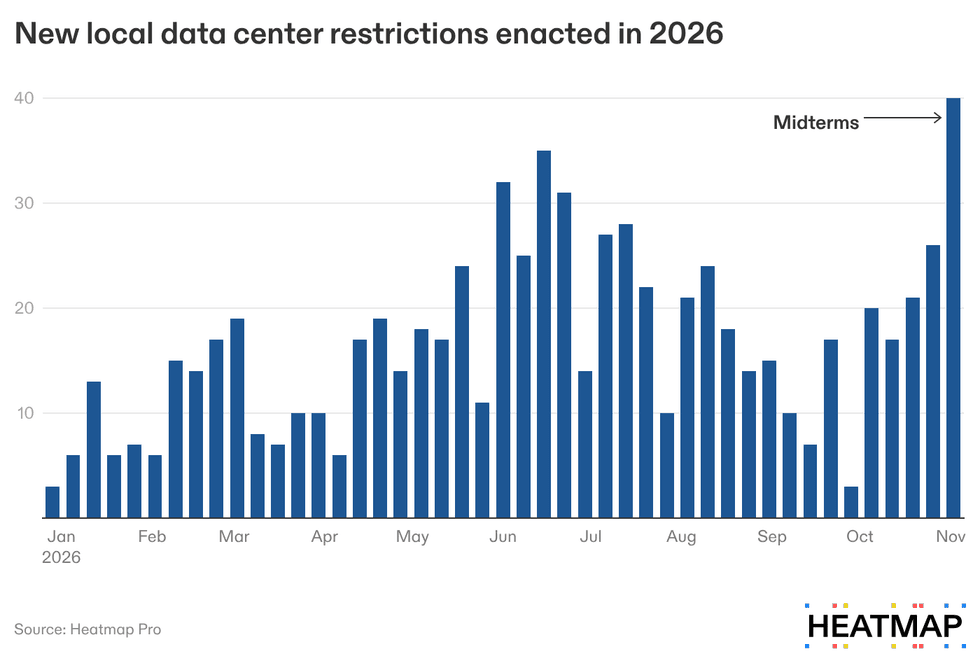
Lastly, the new version of the bill adds another provision to address concerns that it doesn’t do enough to address the national backlash to data centers, which opponents have argued is necessary.
As we’ve explained, the bill already would create the toughest measure against data centers ever enacted – a ratepayer protection program that would let states and utilities require data centers to pay full freight for system upgrades. And now the bill would additionally create a new federal Data Center Community Assistance Program within the Energy Department whereby local communities could request assistance from agencies to get information and technical expertise on how data centers work and what impacts specific projects could have on their areas. The language mirrors legislation introduced last month by Sens. John Curtis of Utah and Lisa Blunt Rochester of Delaware.
Such a program could be a big deal. But it’s important to emphasize that the text leaves a lot of details to be worked out. It does not say how this program would be set up within the Energy Department and the provision does not explicitly lay out funding authorization language.
The amendment also closes a loophole that might have allowed data centers with behind-the-meter natural gas power plants to profit by selling excess power to the grid. The original bill contained a provision meant to force grids to allow more residential batteries or the creation of virtual power plants. But that provision, as written, could have applied to behind-the-meter gas plants at data centers. The new text clarifies that the requirement only applies to resources below 5 megawatts, which is smaller than a data center power source.
What’s Next
It remains to be seen whether these changes and the myriad other tweaks to the bill’s project certainty and historic preservation titles will win over lawmakers previously hesitant to vote yes.
The Wilderness Society, whose president is Tracy Stone-Manning, Biden’s former director of the Bureau of Land Management, released a statement shortly after the new bill text was released reaffirming its opposition. “Americans deserve permitting reform that isn’t crafted behind closed doors and rushed to the Senate floor,” Manning said in a statement. Meanwhile, House Natural Resources Jared Huffman provided comments to Punchbowl News reacting to the text that said some of the changes to the permit certainty provision represented an “improvement” but “we could improve it further in this and other areas with a hearing and a more open negotiation process with more Democrats in the room.”
It’s unclear these voices would ultimately ever support this bill. “Manager’s [amendment] does a good job of accounting for the stated concerns of anybody looking to get to yes,” Liam Donovan, a veteran GOP political strategist, wrote on the social network X.
The Senate is scheduled to vote Monday on a motion invoking cloture – ending debate – on the permitting bill, per the Senate cloakroom. The motion will require at least 60 votes to pass. Senators are probably hoping for far more than 61 votes though, because as we’ve explained, House legislative rules may require overwhelming bipartisan support to get the measure to the president’s desk.