The Fight

Sign In or Create an Account.

By continuing, you agree to the Terms of Service and acknowledge our Privacy Policy

Hotspots

It’s Hard Out Here for a Tiny Solar Farm in Upstate New York

And more of the week’s biggest conflicts around renewable energy projects.

The United States.
Heatmap Illustration/Getty Images

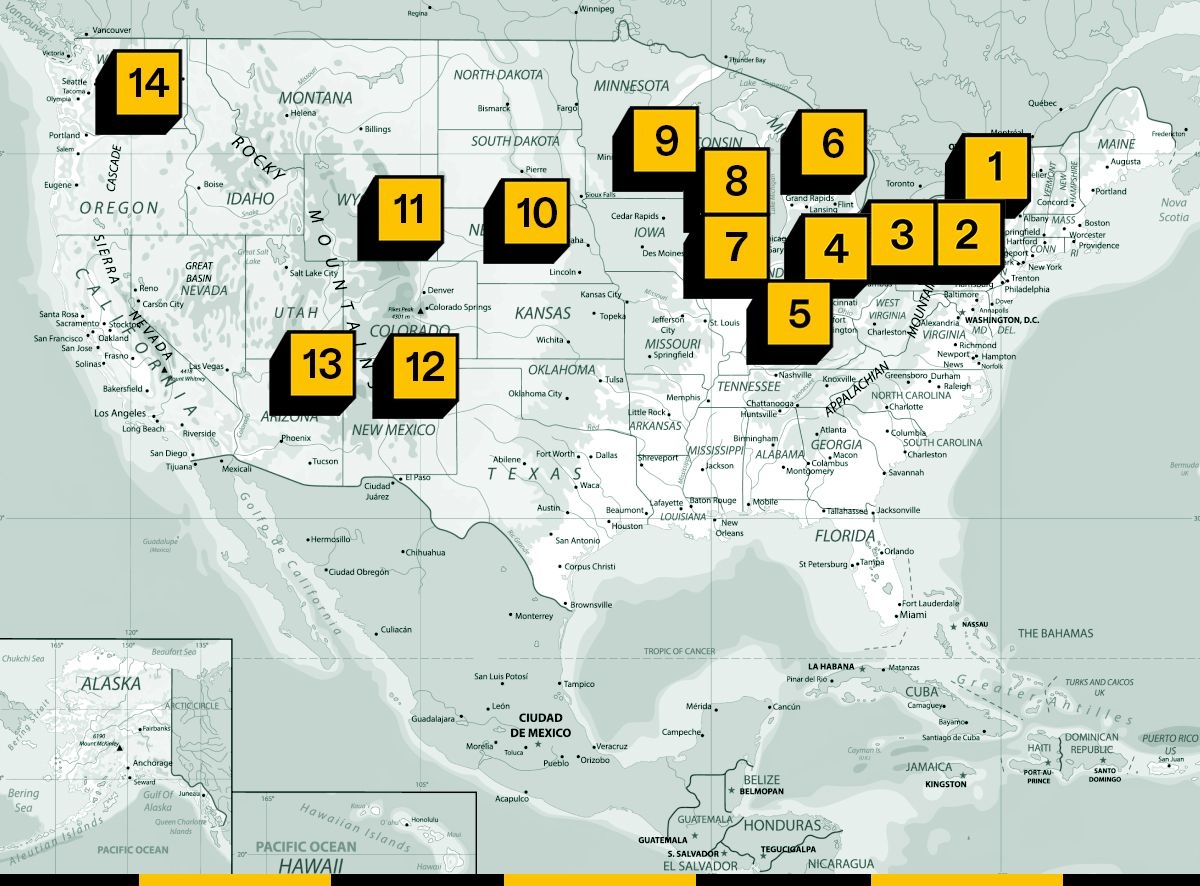
1. St. Lawrence County, New York – It’s hard out here for a 2-megawatt solar project in upstate New York.

  • A Delaware River Solar project proposed in the town of Madrid is sparking fire concerns, with county officials now supposedly seeking guidance from the state on the risk of a blaze occurring from any solar farms or energy storage sites attached to them. Madrid reportedly has a new solar moratorium in effect through October, though one can imagine it being extended or revised to apply to this project if officials can’t be brought on board.

2. McKean County, Pennsylvania – Swift Current Energy is now dealing with an insurgent opposition campaign against its Black Cherry wind project.

  • A new petition against Black Cherry and calling for an end to wind turbine construction in the township of Norwich has garnered more than 800 signatures in less than a week. Local blog coverage of this growing opposition indicates that a setback ordinance adopted last year was not enough to quell frustrations.
  • We’ll be on the lookout for the next shoe to drop here.

3. Blair County, Pennsylvania – Good news is elsewhere in Pennsylvania though as this county has given the go-ahead for a new utility-scale Ampliform solar project, the BL Hileman Hollow Solar project.

  • While Blair County has a relatively high opposition risk score of 70, it has no previous reported history of opposition against solar farms – and renewable energy enjoys a majority of popular support in polling data, per Heatmap Pro.

4. Allen County, Ohio – The mayor of Lima, a small city in this county, is publicly calling on Ohio senators to make sure that the pending reconciliation bill in Congress ensures Inflation Reduction Act tax credits can still apply to municipalities.

  • “Not only does the posturing of the current legislation threaten this project,” Lima mayor Sharetta Smith said on a virtual panel this week. “It also threatens us being able to be innovative and think about other ways we can protect our environment as well as continue to save energy costs for our residents.”

5. Vanderburgh County, Indiana – Orion Energy’s Blue Grass Creek solar project is now facing opposition too, with Orion representatives telling local press they actually expected some locals to be against the project.

  • If I was in their shoes, I’d expect opposition too: Heatmap Pro gives Vanderburgh County a 94 opposition risk score, meaning there was always an outsized risk of NIMBYs cropping up.

6. Otsego County, Michigan – That state forest-felling solar farm that Fox News loved to hate? That idea is no more.

  • Michigan officials previously proposed allowing RWE access to a few hundred acres of state forest to build a utility-scale solar project. That idea has been formally scrapped, according to an analysis of public comments released by the agency late last week.

7. Adams County, Illinois – The Green Key solar project we’ve been following in the town of Ursa has received its special use permit from the county after vociferous local opposition.

  • County board members told the public its hands were essentially tied under an Illinois law limiting local power in the renewables permitting process.

8. Dane County, Wisconsin – We’re getting a taste of local worry about how the GOP’s efforts to change the IRA could affect municipal energy planning, thanks to the village of Waukanee.

  • Waukanee has plans to build a solar project on top of the police station and had expected to use existing tax credits to pay for it. This is precisely the kind of approach opponents of solar on farmland like to ask for – why not put the farms on top of existing structures instead?
  • Well, now the solar project is in doubt. At a May 5 village meeting, officials essentially said the project could ultimately lose the municipality money if they move ahead but Congress curtails the credits.
  • “Things are so fluid in D.C. these days,” Waukanee trustee Jake Heinmann reportedly told attendees. “I wonder if we’re going to get the credits.”

9. Olmsted County, Minnesota – The fight over Ranger Power’s Lemon Hill solar project is evolving into a nascent bid to give localities more control over permitting renewables projects.

  • Steve Drazkowski, a state senator who represents townships that would host and neighbor the project, offered an amendment to the state’s energy budget this week that would allow towns and cities to set standards for solar and wind projects that are more stringent than the rules set forth by the Minnesota Public Utilities Commission.
  • Drazkowski said he was inspired to offer the amendment by the fight over Lemon Hill, which has a galvanized local movement to stop development.
  • The amendment was rejected, but Drazkowski told local TV station KTTC he plans to continue pressing the matter with the state senate’s Democratic leadership, who control the chamber.

10. Cherry County, Nebraska – This county is seeking an investigation into whether Sandhills Energy’s BSH Kilgore wind farm is violating zoning standards after receiving requests from residents who are against the project.

  • If a violation is found, construction on the project may be ordered to stop, per local media reports.

11. Albany County, Wyoming – Bird conservation activists fighting wind projects in Wyoming claim the Interior Department is providing them incomplete information under the Freedom of Information Act about wind turbines and eagle deaths.

  • In a May 8 filing to Interior, the Albany County Conservancy appealed the response it received to a public records request for documents about “any and all records” of golden eagle deaths resulting from PacifiCorp’s Seven Mile Hill, Ekola Flat, and Dunlap wind projects. This sort of appeal is a prerequisite to any litigation under FOIA.
  • As we previously reported, the Albany County Conservancy is trying to stop other wind farms from being built, including the Repsol Rail Tie and BluEarth Two Rivers projects.

12. Santa Fe County, New Mexico – Renowned climate activist Bill McKibben is publicly going on the attack against opponents of an individual solar project, the AES Rancho Viejo solar farm near Santa Fe.

  • In an opinion article published Sunday in the Santa Fe New Mexican, McKibben – who lives in Vermont – weighed in on the project and accused opponents of being “liberals spreading misinformation.” Frustrations about the project has largely focused on the risk of battery fires, the likes of which are quite rare.

13. Apache County, Arizona – Opponents of the Repsol Lava Run wind project are now rallying around trying to stop transmission for the project.

  • A letter dated May 5 delivered to a resident near the project has been circulating on Facebook inviting individuals to a public open-house about Lava Run and transmission at a nearby high school.
  • In that letter, a Repsol representative also states that CG Apache County Wind and CG Apache County Solar, subsidiaries of ConnectGen, plan to file an interconnection application for Lava Run to the state’s transmission line siting committee.
  • This letter is already being incorporated into the Lava Run opposition’s social media graphics and public statements against it.

14. Klickitat County, Washington – The Cypress Creek Renewables solar project we told you last week got fast-tracked by the state Energy Facility Site Evaluation Council? Turns out the county had a moratorium on new solar and anticipated a chance to formally file public comments before that would happen.

  • Klickitat County Commissioner Lori Zeller lashed out at the state’s permitting agency in a comment to local paper Goldendale Sentinel: “The [agency] process was set up by Gov. [Jay] Inslee with the intent to bypass the local process … We really need to keep that relationship as civil as possible. But a decision like this did not help the situation.”
Yellow

This article is exclusively
for Heatmap Plus subscribers.

Go deeper inside the politics, projects, and personalities
shaping the energy transition.
To continue reading
Create a free account or sign in to unlock more free articles.
or
Please enter an email address
By continuing, you agree to the Terms of Service and acknowledge our Privacy Policy
Spotlight

An Energy Developer Is Fighting a Data Center in Texas

Things in Sulphur Springs are getting weird.

Energy production and a data center.
Heatmap Illustration/Library of Congress, MSB Global, Luminant

Texas Attorney General Ken Paxton is trying to pressure a company into breaking a legal agreement for land conservation so a giant data center can be built on the property.

The Lone Star town of Sulphur Springs really wants to welcome data center developer MSB Global, striking a deal this year to bring several data centers with on-site power to the community. The influx of money to the community would be massive: the town would get at least $100 million in annual tax revenue, nearly three times its annual budget. Except there’s a big problem: The project site is on land gifted by a former coal mining company to Sulphur Springs expressly on the condition that it not be used for future energy generation. Part of the reason for this was that the lands were contaminated as a former mine site, and it was expected this property would turn into something like a housing development or public works project.

Keep reading...Show less
Yellow
Hotspots

Who Really Speaks for the Trees in Sacramento?

A solar developer gets into a forest fight in California, and more of the week’s top conflicts around renewables.

The United States.
Heatmap Illustration/Getty Images

1. Sacramento County, California – A solar project has become a national symbol of the conflicts over large-scale renewables development in forested areas.

  • This week the Sacramento County Board of Supervisors unanimously voted to advance the environmental review for D.E. Shaw Renewables’ Coyote Creek agrivoltaics solar and battery project, which would provide 200 megawatts to the regional energy grid in Sacramento County. As we’ve previously explained, this is a part of central California in needs of a significant renewables build-out to meet its decarbonization goals and wean off a reliance on fossil energy.
  • But a lot of people seem upset over Coyote Creek. The plan for the project currently includes removing thousands of old growth trees, which environmental groups, members of Native tribes, local activists and even The Sacramento Bee have joined hands to oppose. One illustrious person wore a Lorax costume to a hearing on the project in protest.
  • Coyote Creek does represent the quintessential decarb vs. conservation trade-off. D.E. Shaw took at least 1,000 trees off the chopping block in response to the pressure and plans to plant fresh saplings to replace them, but critics have correctly noted that those will potentially take centuries to have the same natural carbon removal capabilities as old growth trees. We’ve seen this kind of story blow up in the solar industry’s face before – do you remember the Fox News scare cycle over Michigan solar and deforestation?
  • But there would be a significant cost to any return to the drawing board: Republicans in Congress have, of course, succeeded in accelerating the phase-out of tax credits under the Inflation Reduction Act. Work on Coyote Creek is expected to start next year, in time to potentially still qualify for the IRA clean electricity credit. I suspect this may have contributed to the county’s decision to advance Coyote Creek without a second look.
  • I believe Coyote Creek represents a new kind of battlefield for conservation groups seeking to compel renewable energy developers into greater accountability for environmental impacts. Is it a good thing that ancient trees might get cut down to build a clean energy project? Absolutely not. But faced with a belligerent federal government and a shrinking window to qualify for tax credits, companies can’t just restart a project at a new site. Meanwhile, the clock is ticking on decarbonizing the electricity grid. .

2. Sedgwick County, Kansas – I am eyeing this county to see whether a fight over a solar farm turns into a full-blown ban on future projects.

Keep reading...Show less
Yellow
Q&A

How to Build a Data Center, According to an AI-Curious Conservationist

A conversation with Renee Grabe of Nature Forward

Renee Grebe.
Heatmap Illustration

This week’s conversation is with Renee Grabe, a conservation advocate for the environmental group Nature Forward who is focused intently on data center development in Northern Virginia. I reached out to her for a fresh perspective on where data centers and renewable energy development fits in the Commonwealth amidst heightened frustration over land use and agricultural impacts, especially after this past election cycle. I thought her views on policy-making here were refreshingly nuanced.

This transcript was lightly edited for clarity.

Keep reading...Show less
Yellow