The data center water issues are real – but they aren’t what you think.
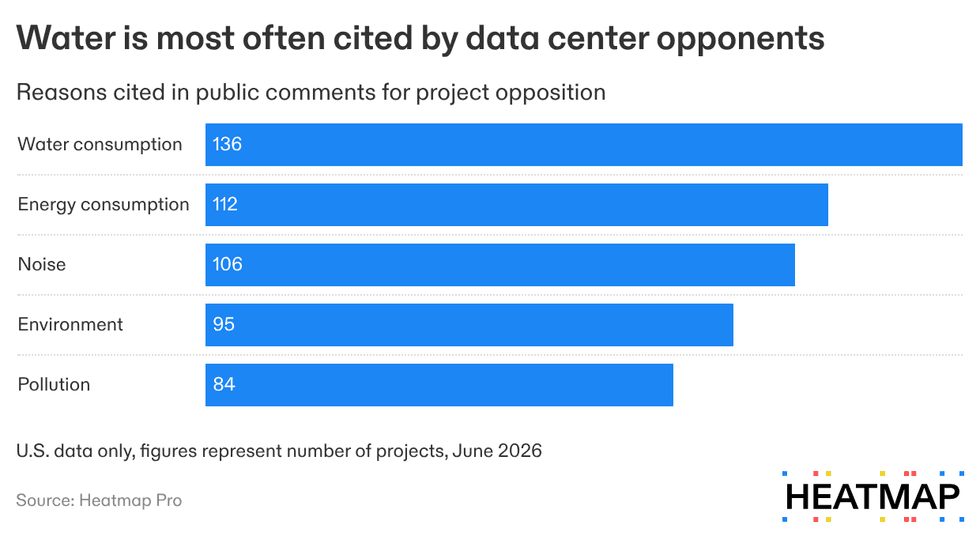
Too often, I hear people say the number one reason they’re against data center development is water use. Heatmap’s data shows water consumption is historically the reason cited most often by activists when opposing projects. This complaint, they often say, is rooted in the fear that this nascent buildout of AI infrastructure will simply draw so much H2O it will leave little liquid left for the rest of us.
I spent weeks trying to understand how real the water use problem is when it comes to data centers, reading research and speaking to some of the world’s leading academics, large tech firms, and environmental advocates to make my best attempt at answering some of the most important questions being asked about data centers.
Before I jump into this thicket, a few caveats. I’m not going to address the host of water pollution concerns many have raised about data centers because that is for a future article. If you want me to dissect how Rep. Alexandria Ocasio-Cortez got a jar of dirty water near a Meta data center, that was poor construction practices – not a data center’s water demand. By that same token, if you're itching for me to find out how much PFAS is in data center water, I’m not delving into that here, though I’ll just say PFAS is everywhere and isn’t a data center-specific issue.
So are there problems with AI data centers’ water use? Yes. Are data centers using too much water for society to handle? It depends on what “too much” means to you. Is the AI data center boom going to usher in a new era of drought across the United States? Probably not, but there’s a few places we should be mindful of.

Researchers told me data center water use is a painfully understudied topic rendered more obscure by a lack of public information about individual H2O consumption at the project level. Those I spoke to were split on how seriously to take the topic.
Some analyses insist the sector’s water use should be regulated and tackled head-on by the sector. I spoke with Yi Ding, an assistant professor at Purdue University, who co-authored a paper laying out a framework for evaluating the water impact of computing weighted specifically for water stress. Ding told me there is currently no set of industry-led best practices for sustainable water-conscious data center operation and her work aims to fill that gap.
When I asked Ding if data centers are actually threatening individual towns’ water supplies, she didn’t hesitate: “Yes, it’s significant.”
Others in this field have the opposite view.
“Water is often brought up as the primary concern when it’s less important,” David Mytton, a sustainable computing researcher at Oxford University, told me. “The more important thing is going to be how you bring more clean energy onto the grid, and nuclear power, so that we can generate sufficient energy to build these centers.”
Large tech companies are starting to spend less time debating the extent of the problem and more bandwidth addressing the PR crisis surrounding data center and AI water use.
Ben Townsend, Google’s head of infrastructure and sustainability, told me he believes that “from a comms and PR perspective” he has “no doubt” it would be easier to build data centers without the debate over water. “Data centers operators are not explaining why they’re using water or how much water they use. There’s a complete lack of transparency or discussion.”
Google has been getting splashy around this topic, a public relations strategy that reminds me of Meta’s recent workforce training investments. Last week, Google announced five fresh “commitments” towards its “climate-conscious approach” to water use, including a pledge to “replenish more water than we consume at our sites” by 2030.
This week, Amazon made a similar declaration and claimed its operations are 75% of the way to accomplishing this goal, which it’s calling “water positive.” Brandon Oyer, director of energy and water at Amazon Web Services, told me he thinks the industry “could’ve done better” and “come out earlier” to address its water use.
“There’s just been a lot of misinformation that has led people to [be] a little bit alarmist. And rightfully so. I would get alarmed if I thought that water was going to be impacted in my community,” Oyer said.
The basics of data center water use
Data centers need water to cool large server racks whizzing away to power AI and most other internet practices, from streaming to online banking. Normally, you don’t want computers to get too hot because then they can crash causing potentially catastrophic harm to the machine.
This water use presents a number of environmental challenges. Often, server farms rely on clean, fresh water, or filtered drinking water, a need largely for functionality reasons. They’re competing for this resource at a time when supply is dwindling amidst the crisis of global warming.
Making matters worse, much of the U.S. has faced drought conditions over the past year, including states that are typically water abundant, like Virginia and Georgia, that are at the center of the data center boom. On Monday, The Guardian reported that more than half of all planned data centers in the U.S. are in “locations that have been in drought conditions throughout the past year,” citing data center site information from federal agencies and the energy data firm Cleanview.
In the top data center destination of Texas, where peak electricity demand could more than quadruple in the near future, analysis from state university researchers released in May found data centers could wind up between 3% to 9% of water demand by 2040. Projects are being developed near cities like Corpus Christi and El Paso that were already fearful their drinking water supplies would dry up before the AI infrastructure boom came to town.
“The impact of building a data center in Arizona versus Wyoming is very different,” said Ding, the Purdue University researcher. “[Companies] will say different things because of their position. The problem is substantial and sometimes it’s not that they don’t want to use water – it means they don’t have water to use.”
The most water intensive version of data center cooling is called “evaporative cooling,” which mixes water evaporation and ventilation air flow to cool rooms in ways industry compares to human sweat. Evaporative cooling uses a lot of water and regular fresh supply because, well, the water goes away once it evaporates.
One Google data center using evaporative cooling in Council Bluffs, Iowa used more than 1 billion gallons of water in 2024, a stat that made the project a poster child for perceived excesses in water use. Somewhat ironically, we know this because Google is one of the few large tech companies to voluntarily disclose direct water consumption from individual data centers on an annual basis.
But cooling tech is becoming much more water efficient. You may have heard of “closed loop cooling” – that’s when a chilling system is supposedly self-contained. These systems as designed typically rely on loops of pipes filled with coolant flowing through them. This means they should not expel much liquid. If the modern trend in data center development skewed towards closed-loop systems, it would theoretically mean very little new water supply drawn on the average day.
“If you’re using a closed loop system, the water goes into the data center and then it doesn’t really require a refill every so often. It’s a one-time thing,” Mytton said. “If you’re using evaporative cooling, the water is continuously evaporating into the atmosphere. That’s when it’s being drawn from water sources.”
Closed-loop systems aren’t perfect because of ordinary issues like leaks. These flaws have meant this innovation has done little to assuage the loudest local concerns about water use. Critics of the sector have pointed to estimates pegging a closed-loop failure rate up to 25%. But Mytton said this criticism against closed-loop cooling systems is a little misguided. “They’re just wrong. They just don’t understand how data centers work.”
Closed loop systems and water-free cooling processes (like simple air vent-based cooling) also have trade-offs, particularly the extra energy and chemicals required to make these loops work to spec. Given data center developers are often choosing gas-fired power, which also requires water and produces greenhouse gas emissions, more power for less water is hardly a comfortable trade-off from an environmental perspective.
“‘Closed-loop cooling’ is a marketing gimmick,” proclaimed anti-data center group Food and Water Watch in an April blog post, calling the practice “greenwashing” and “just clever advertising.”
We do not know right now how much water most data centers are actually using, sans a handful of companies reporting individual facility use like Google. The data center development space – Big Tech, their subsidiaries, start ups, real estate firms – is mostly keeping their individual facility water usage private, and there isn’t really any regulation at any level of government to compel this information to be released in the United States, despite it being the number one destination for data center development. Corporations often consider these figures proprietary and municipal governments often consider this confidential business information, making it likely to be redacted or withheld from public records requests.
For example, in Wisconsin, an environmental group sued the city of Racine when officials refused to give water use projections for Microsoft’s data center campus in the nearby village of Mount Pleasant, about five miles from the shores of Lake Michigan. The projections were ultimately released under court order, showing Microsoft’s data center campus was projected to use up to 234,000 gallons of water on peak days or up to 2.8 million per year; eventually those numbers could almost triple to 702,000 gallons on peak days, or almost 8.5 million gallons a year.
These projections, according to Microsoft, are for a facility where more than 90% of the facility will rely on closed-loop cooling. The rest of the data center campus “will use outside air for cooling, switching to water only on the hottest days.” The company has called this design a “technological milestone” that’ll use “roughly the amount of water a typical restaurant uses annually.”
Microsoft is accurate here: the average eatery uses roughly 250,000-to-300,000 gallons of water a year according to restaurant sustainability advocates, a level of consumption that’s led restaurants to be roughly 15 percent of total water use in commercial facilities in the United States.
Personally I think it is easier and more useful to compare a data center to a farm, especially given how many are fighting to stop these projects to preserve prime farmland. Agriculture doesn’t measure water consumption by the gallon; farms use far too much water for those stats to work here. Instead farms use acre-feet, which is calculated using the volume of water necessary to entirely cover an acre of land with one foot of water. For posterity, one acre-foot is almost 326,000 gallons of water, which is about the maximum daily water consumption of that Microsoft data center in Mount Pleasant, Wisconsin. In 2023, the average amount of water applied to a single acre of farmland for irrigation was 1.5 acre-feet, rendering this figure comparable to a large Microsoft data center. This is still a lot of water and not a 1:1 comparison, since different crops require water at different times. But even if a data center consumed that much water every day for a full year, that’s 365 days. An average large farm is a little more than 1,400 acres and many farms span far more acreage. That’s the sort of relative scale we’re working with. So, for instance, a large family farm in Stafford County, Kansas, might use something like 420 million gallons of water over roughly 1,000 irrigated acres of corn in an average year.
I’m no farming expert – there might be things about farmland irrigation I don’t necessarily understand. But it's hard for me to look at these numbers and not long for some sort of rethinking about how we’re doing water math with data centers, especially given the environmental trade-offs around using less water.
Honestly I don’t think trying to explain this math helps anymore because secrecy may have spoiled the well in Racine, pun intended. In September, a peer-reviewed study by University of Wisconsin researchers found the Mount Pleasant datacenter had become “a microcosm of a macro problem with secrecy.” The paper stated that while closed-loop systems at the Mount Pleasant facility “may significantly reduce water use during some of the year, there is still a question of transparency and why it has been so difficult to obtain clear answers about water use.” Full transparency around water use, as well as the energy required for water-lite cooling practices, would be “essential” for any future research into industry practices “to have credibility,” the study stated.
Asked for comment on the study, a Microsoft spokesperson said via email: “Our datacenter campus in Mount Pleasant leverages the latest and most innovative cooling technology available. In past datacenter designs, water has played a key role in datacenter cooling and humidification, but our new designs aim to eliminate this continuous need for municipal water for cooling. The bottom line is that this data center, and others we build in the future, will not require massive amounts of water.”
When you zoom out further, water use by sector shows that U.S. data centers are not the leading driver of water use and its scarcity to date. Thermal power (fossil energy) and agriculture are by far the largest users of water in the U.S. economy, and it would be challenging for the data center industry to ever catch up. Industry figures collected in 2015 found thermo-electric power used roughly 132.4 billion gallons of water per day. Irrigation was a close second at 118 billion gallons of water daily. By comparison, researchers have noted International Energy Agency estimates that the entire global data center sector consumed a comparable amount of water during all of 2023. These are pre-AI boom numbers, but they tell us a lot about relative scale.
However, once again, researchers, tech companies, and advocates alike all told me they believe this macro picture elides individual communities and transparency issues are rendering these comparisons unhelpful for calming concerns down. The data center conflicts are local matters felt acutely, especially in places where drinking water is either hard to come by or expensive. Your average rural desert town or midwestern farming district cares little about the world; they want to know if their own wells will run dry. As Amazon’s Oyer told me, “The hyperlocal influence you can have on a water supply is why it becomes top of mind for people.”
One way to measure data center water impacts in aggregate may be to quantify the potential infrastructure upgrades necessary to meet the industry’s demand. A new study by researchers at University of California-Riverside and CalTech found that new water infrastructure spending for data centers alone could total as much as $58 billion in only four years time. These upgrades will be necessary in order for municipal water supplies to withstand peak demand on the hottest days of the year, a need akin to grid resilience upgrades. Not to mention our nation’s sewer systems are in desperate need of upgrades.
“If a data center was able to show they weren’t stripping our water resources and convinced a community they have mitigation strategies at the local level, that’s a theoretical path,” said Kathryn Hoffman, executive director of the Minnesota Center for Environmental Advocacy. Her organization has successfully stalled data center projects in the state with lawsuits arguing city and county environmental reviews are failing to account for the full extent of local resource usage, including water.
“Unfortunately, we’re a long way from that,” Hoffman added.