This year’s midterm elections called into question the efficacy of a push to pay local residents directly in exchange for building data centers.
Before the elections, I profiled the campaign for politicians to embrace the data center “dividend,” a policy idea modeled off Alaska’s Permanent Fund, which doles out checks to residents from profits off state oil, gas and mineral royalties. The Bitcoin Policy Institute, a tech policy think tank, was one of the first to trumpet the concept, but it was quickly taken up by President Donald Trump, who started raising it in speeches and on social media. “If companies want to make their Data Centers popular, pay the community, and/or individuals within the community, a ‘dividend,’” Trump posted to Truth Social on October 21.
Clearly the idea didn’t stop the bleeding. Democrats trounced Trump’s party in the midterms on a message that was heavy on attacks against data centers. But that still doesn’t explain why direct payments did so little to move the American public.
A Heatmap Pro poll conducted in early-to-mid October, right before the midterm elections, gives us an answer. As part of a broader survey of 2,500 registered voters, we asked about the idea — what we believe to be the first independent poll on direct payments for data centers by a news organization. We asked respondents whether there was a specific dollar amount they’d accept as a one-time cash payment in exchange for a data center being built near them. We also gave them the option to say no amount of money was sufficient.
Shockingly, a majority of people surveyed said they’d reject the data center cash payment in any amount. Among those who said they’d actually take the money, the median figure was around $10,000. The average was a whopping $146,000, skewed by the number of people who wrote $999,999, the maximum allowed by the survey.
This tracks what we’re seeing play out in communities where developers have tried this idea. In Hazle Township, Pennsylvania, NorthPoint — developer of an Amazon-linked data center project — proposed $10,000 cash payments to residents, no catch. Residents compared it to a bribe. In De Soto, Kansas, data center developer Digital Realty is offering annual $1,000 tax credits for a decade to neighbors of its proposed data center project. That proposal has been reportedly met with mixed reviews, too.
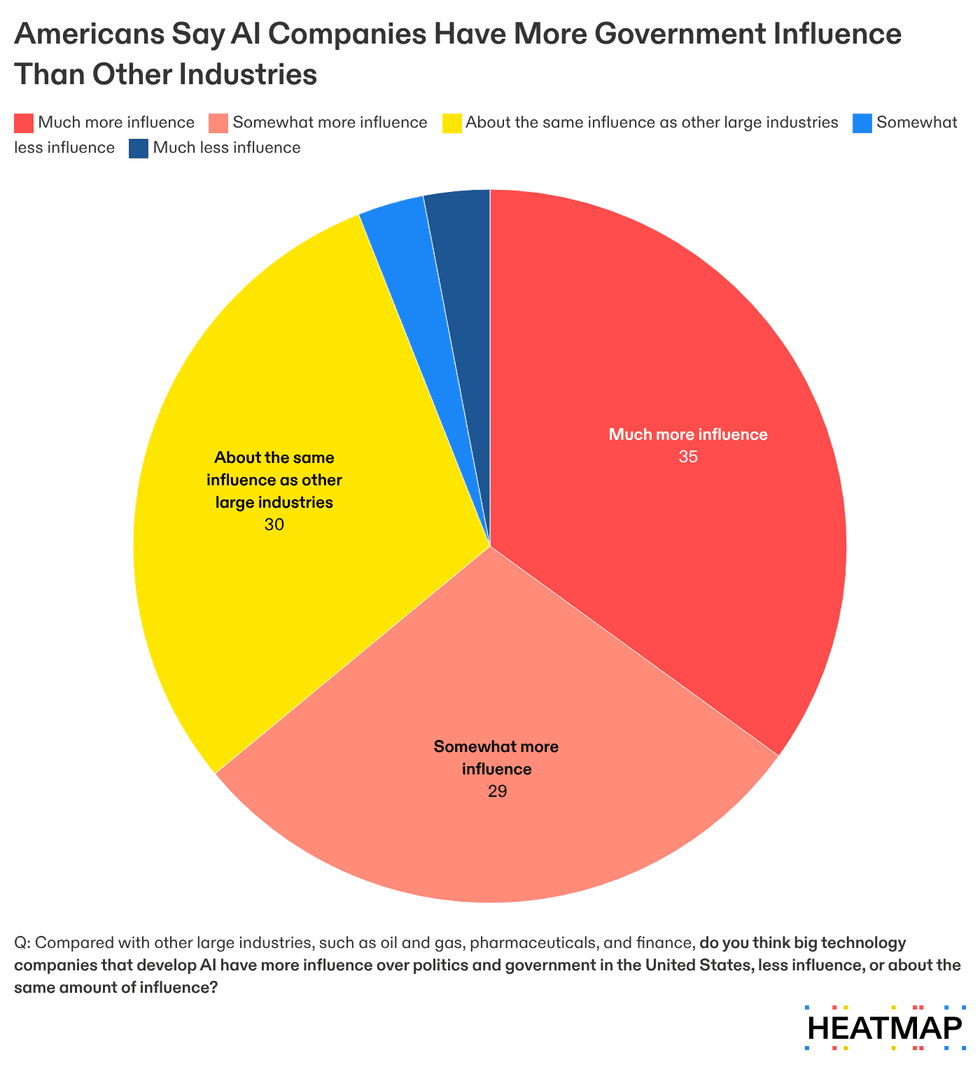
Clearly one of the problems here is that data centers not only face public perception issues around their local impacts, but are also more broadly associated with systemic inequality in the U.S. economy. The same Heatmap Pro survey found that a majority of voters believed AI companies have more control over the government than the oil and gas industry, pharmaceutical companies, banks, or other large industries.
Shaunna Thomas, executive director of Democratic-allied super PAC Guardrails Alliance, told me that during the campaign season they found that residents often associated the dividends with bribes, and that the president’s support for direct payments ultimately fed into voter sentiments about the tech sector controlling the government and society.
“People don’t want to have a conversation about distribution of wealth disconnected from a conversation about distribution of power,” Thomas said. “Specifically because Trump was saying that, we started hearing from voters in focus groups that it didn’t work for them. They’re hearing it as a bribe. They’re hearing they may get some sort of short-term economic or financial incentive to accept a technology they don’t trust is designed to help them.”
The Heatmap Pro survey results about cash payments ultimately reveal how emotionally driven the data center debate has become, said Sam Lyman of the Bitcoin Policy Institute. I asked Lyman to respond to the results because I thought they called into question the political effectiveness of the proposal we’d discussed months earlier. Lyman stipulated that he thinks the one-time payment nature of the question may have undermined the results, saying he prefers the dividends be paid out “in perpetuity.” But he acknowledged they also show “there’s still a lot of education to be done on data centers, what they do, and the impacts they have on the places where they’re built.”
“I think there’s a lot of Americans out there who have legitimate concerns that the future economy doesn’t include them. That’s something that needs to be addressed,” said Lyman, who said he laid part of the blame on what he called “irresponsible rhetoric” from AI industry executives about their technology’s impacts on society. “With data center dividends, the idea behind this policy is to help Americans understand the AI economy includes them. To give them a very material stake in that economy as it gets built out, especially in the rural communities that make data centers possible in the first place.”