This article is exclusively
for Heatmap Plus subscribers.
Log in
To continue reading, log in to your account.
Create a Free Account
To unlock more free articles, please create a free account.

Sign In or Create an Account.
By continuing, you agree to the Terms of Service and acknowledge our Privacy Policy
Welcome to Heatmap
Thank you for registering with Heatmap. Climate change is one of the greatest challenges of our lives, a force reshaping our economy, our politics, and our culture. We hope to be your trusted, friendly, and insightful guide to that transformation. Please enjoy your free articles. You can check your profile here .
subscribe to get Unlimited access
Offer for a Heatmap News Unlimited Access subscription; please note that your subscription will renew automatically unless you cancel prior to renewal. Cancellation takes effect at the end of your current billing period. We will let you know in advance of any price changes. Taxes may apply. Offer terms are subject to change.
Subscribe to get unlimited Access
Hey, you are out of free articles but you are only a few clicks away from full access. Subscribe below and take advantage of our introductory offer.
subscribe to get Unlimited access
Offer for a Heatmap News Unlimited Access subscription; please note that your subscription will renew automatically unless you cancel prior to renewal. Cancellation takes effect at the end of your current billing period. We will let you know in advance of any price changes. Taxes may apply. Offer terms are subject to change.
Create Your Account
Please Enter Your Password
Forgot your password?
Please enter the email address you use for your account so we can send you a link to reset your password:
It’s pause vs pause-nots.
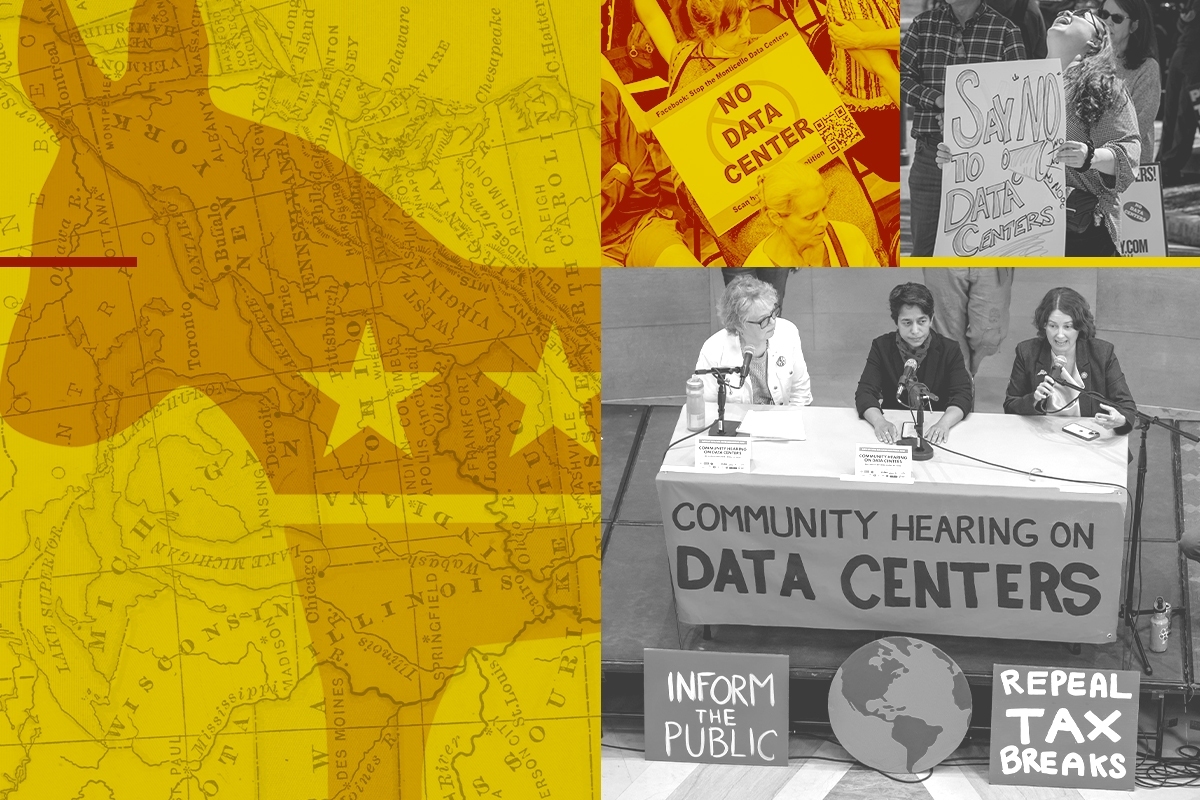
The American climate movement is beginning to look a lot like AI doomers versus the techno-optimists. It’s a dynamic that is winning local bans – and very little else for now.
On one side, you’ve got the left-leaning insurgent grassroots movement against data centers. In many cases this push is in the name of climate action and environmental justice, with activists citing the risks of pollution from gas-fired power and the potential for strain on existing electricity supplies. But in many, many other cases, this movement is decidedly not about climate action; instead it’s a movement addressing everything from energy prices and power over large corporations to AI use generally.
Or, perhaps the anti-data center movement’s big tent is best summarized in this quote from comedian and activist Ilana Glazer: “The thing that is genuinely waiting for us on the other side of AI and data centers is the collective.”
On the other end of the spectrum, you have a raft of data center-curious centrists, liberals, and, for lack of a better term, capitalists. This diametrically oppositional political force wants to ensure data centers continue being built as states and the federal government figure out how to make policy surrounding them. Yes, they want regulations, but they’ll have to qualify even supporting the idea of a single full state – any state – pausing data centers.
“I tend to find myself in the middle of all of this AI and data center policy, because I don’t think a heavy-handed approach in either direction is smart or productive,” said Tre Easton, vice president of public affairs for the Searchlight Institute, a policy think tank geared toward pushing Democrats into positions more broadly popular in the general electorate. “If you’re doing moratoria in one state and Meta says, okay, fine, they’ll go to a different state where they’ll run roughshod.” He added: “This buildout is happening. Let’s just make the rules. Put out rules of what this should look like.”
I spent weeks talking to activists fighting data centers to better understand their end goals. Right now what folks want to talk about most is moratoria, until industry-specific regulation is in place governing all things energy, water, noise, and labor.
“Our motto is ban, legislate, regulate,” said Ben Dziobek, founder of Climate Revolution Action Network, which is fighting data center expansion in New Jersey. Dziobek’s organization is one of roughly five dozen in the Garden State that have called on newly-elected Democratic Gov. Mikie Sherill to institute a moratorium on data centers, including state representatives from The Nature Conservancy and ACLU.
When I asked Dziobek what he’d like to see after a moratorium, the answer was clear: he wants to see Big Tech pay for the energy transition. “It would be beneficial if we could get companies who are using more load than entire states to build out the clean energy future. Someone’s gotta pay for this. The largest companies in the world have to come in.”
Undoubtedly this movement is increasingly influential and rooted in a now bipartisan concern about data centers founded in valid concerns about data center impacts and the rise of AI. But at least right now, In New Jersey, and so many other Democrat-controlled states, this movement has won little ground outside the local level and no statewide Democratic leader (e.g. governor) has made a data center moratorium their raison d'être. Neither have I seen the push for a moratorium pick up steam in any state known as a deep blue bastion for climate policy. Its greatest achievements by the numbers are the cancellation rate of projects that have faced local pushback (37%, according to Heatmap Pro), the city-wide moratoria in large left-leaning bastions like Denver, and the sheer existence of a federal data center moratorium bill led by progressive celebrities like Sen. Bernie Sanders and Rep. Alexandria Ocasio-Cortez.
In fact, what I am seeing is Democratic statewide leaders rejecting efforts to curtail their development or regulate energy and water usage. In California last year, Gov. Gavin Newsom vetoed a bill requiring data center developers to report their water use. In New York, Gov. Kathy Hochul has so far shrugged off a push for her to back a three-year moratorium on new data centers. In Massachusetts, Gov. Maura Healey supports continuing to foster the state’s data center buildout and the state is preserving its data center sales tax exemption at a time when GOP leaders in other states want to repeal similar subsidies. Colorado legislators abandoned a push to regulate data centers earlier this month, after Washington state did the same.
Perhaps infamously in Maine, the Democrat-led state legislature nearly enacted a two-year moratorium on data center development only to be vetoed by Gov. Janet Mills. Democrats then failed to override the veto.
Some Democratic leaders are taking up the light-touch approach. On Wednesday, Pennsylvania Gov. Josh Shapiro released long-awaited principles for data center developers seeking fast-track permitting processes with state agencies. Under these policies, companies can get permitted more quickly if they abide by a number of energy, water, and labor standards.
On a granular level, even this policy quietly represented a disappointment for climate activists. One of the principles called for data centers to get at least one third of their power from “clean” sources by 2035 – which sounds nice until you realize Shapiro only two years ago was calling for utilities to get at least half of their electricity from carbon-free sources by then. Food & Water Watch, a national group calling for country-wide data center moratoria, blasted a press release going after Shapiro to the media after the principles were released: “[This] is a naive effort to placate widespread data center opposition. It won’t work.”
For climate activists, the best case scenario right now may be blue states taking up bills to regulate the sector as opposed to a blanket moratorium, where the push for a pause functions as leverage. Often these bills are focused on energy costs for consumers, not environmental protection, like in Oregon where last year legislators enacted a measure requiring data center companies to pay for their share of electricity demand. In Vermont this week, the state legislature passed a similar bipartisan data center bill focused on energy affordability, with some restrictions on fossil fuel generation. (Republican Gov. Phil Scott is expected to sign it.)
Indeed, the climate movement’s smartest play could be to push legislation requiring facilities not only pay for their power but ensure it is zero-carbon emissions. So far, Democrat-led bills that would accomplish this goal gained steam this year in other states but struggled to become law before the end of the legislative session too (Washington, for example).
In Illinois, the bill is known as the POWER Act, but despite lots of Democratic support behind it, it’s languishing in committee limbo ahead of the end of legislative session this week. One can imagine Illinois Gov. J.B. Pritzker getting a bill like the POWER Act into law and then running for president as The Guy Who Made Data Centers Cleaner. Heaven knows that’s why folks like Hannah Flath, climate communications manager for the Illinois Environmental Council, are so bullish on the bill. “I think it’ll eventually become law. Just not this session.”
I asked Flath why her organization was so focused on this bill as opposed to a data center moratorium. “We just don’t think it is politically feasible. Especially given how attractive these things are to our governor and some state lawmakers,” she said. “Currently, I view climate work as harm reduction work. This is perhaps a cynical view to have but that’s unfortunately where we’re at. How can we ensure changes happening in the world bring more benefits than they do harms?”
But Flath said that as a push for moratoria grows, it provides pressure on state policymakers to act: “What we’re offering state legislators now is a middle ground solution.”
I suppose for now, we’ll have to see if this side can come together on any solution – let alone a middle ground.

Log in
To continue reading, log in to your account.
Create a Free Account
To unlock more free articles, please create a free account.
And more of the week’s top news around development fights.
1. Jefferson County, Alabama – A law firm is alleging that police in the city of Birmingham retaliated against a woman for suing developers of a data center. It might just be a wake-up call for data center developers.
2. Mason County, Kentucky – This county is the site of yet another eminent domain debacle and I suggest you pay attention to it because it’s now represented by an outgoing congressman with nothing left to lose: Thomas Massie.
3. Montgomery County, Missouri – A Google data center project celebrated by the White House is facing harsh local backlash.
4. Iron County, Utah – Yet another county is banning data centers and solar energy.
5. Oconto County, Wisconsin – At least one developer is definitely thanking their lucky stars for state primacy over renewable permitting in the Badger State.
A conversation with Travis Fisher of the Cato Institute.
This week’s conversation is with Travis Fisher, an energy policy analyst with the Cato Institute and one of my favorite people to chop it up with on Energy Twitter. I reached out to Fisher for a conversation about how he’s approaching the data center boom as a free market-minded wonk at a time when other figures on the so-called Right are calling for strict regulations on the sector. What I learned is that folks like Fisher are concerned about the scale of the buildout too, but their ideas and approaches wildly differ from the Tucker Carlsons of the world.
As always, our conversation was edited for length and clarity.
What’s your approach to the data centers debate in the Republican camp right now?
My bias is towards free markets. So as long as we’re talking about voluntary exchanges with property rights, it's fair game.
The sticking points for me are: is cost being socialized? Is there too much special treatment, like tax credits or overt subsidies or eminent domain? All of that stuff is problematic to me.
There is a world where we have massive expansion and it's still very consistent with my view of how things ought to go. But I’m not sure I love the approach I’ve seen on the siting end of things. There’s stories of private land takings, or private companies taking land, and that’s very problematic for me.
I see this as a huge growth area and a huge opportunity, so the idea of pausing even for a year feels like the wrong way to go about it. There’s a lot of parallels where folks want to slow things down but in hindsight it feels like a silly thing to stop progress.
[And] it really shines a light on conservatives versus free-market people. They’re not always the same.
How do you view data centers as an opportunity for building out the energy grid?
There’s two conversations here, really: improving the grid as we know it and expanding access to power off-grid.
Data centers are very large customers if we can free up supply to increase the quantity on the grid and then reduce average costs. That’s a whiteboard approach. But I can spend all day on why the whiteboard approach to economics on the power grid does not show up in reality. If you reduce average costs, what incentives do utilities have to pass lower costs onto consumers? They’ll just maximize shareholder returns. I don’t like the status quo utility model but there is a white board approach where if we believe in a natural monopoly thesis, then an expansion on the demand side moves you further down a downward sloping supply curve.
If you buy this argument, there’s an opportunity to cut costs. But I’m skeptical of that argument.
You’ve advocated for consumer regulated electricity reform in this situation. How does that relate?
This is the second prong, the off-grid solution. We have customers that want to move faster than the grid allows. We have a very regulated grid which is not compatible with the fast growth these customers want. And they have an enormous willingness to pay for that speed-to-power, so in terms of their opportunity cost, this sets up an opportunity to essentially build new power networks. If you’re a private utility and not a public utility, public utility regulations should not apply to you. And if you can build a private utility without oversight from Public Utility Commissioners or FERC, you’re free to innovate. Then this all becomes a new sector we can transfer learnings from back to the grid.
This idea – which I’ve seen you describe to my colleague Matthew Zeitlin – does it require policy change?
Yes, but it depends on what state. Ohio, Utah, and Oklahoma, maybe West Virginia… Those states already have systems kind of like this. It’s why you may be seeing private [energy and data center] networks there. In Ohio, at the New Albany site. In Utah, which is its own thing. But there are already state laws trending in this direction.
My view on this is you need a reform at the state level saying if you’re a private utility, you’re not under the jurisdiction of the PUC. At the federal level, it would mean the regs that do not apply to the bulk system do not apply to you.
So then, is your goal to create “power islands” here off grid using the free market?
The goal is to be as pro-consumer and free market and fast-moving as possible. This policy change would open that avenue and make it clear this is a greenlit activity. A thing that can happen and investors have certainty they won’t be side-swiped later.
I think we’re approaching the point where a lot of observers recognize the status quo is untenable. They say we had [utility] restructuring and now the status quo is untenable after restructuring, so let’s re-vertically integrate utilities or nationalize them. Those are all terrible, terrible, awful options. But the moment is so dire that a lot of bad ideas are on the table. I’m trying as hard as I can to parse the free market ideas from pro-utility ideas.
Vertical integration – where’s the momentum against that situation? I understand you’re trying to combat monopoly here, without being too heavy-handed from a regulatory level.
Even in a vertically integrated space, there’s pro-consumer reforms and consumer choice. Consumer-regulated electricity would do that in a clean and aggressive way but there is plenty you can do to tinker. How do we fight back against incumbent utilities? There’s many answers to that question but the last thing we should do responding to data centers is give them more control.
For example, the one thing we absolutely cannot do is reintrench the franchise. If a state says nobody else can be a utility in this state, why is that even a thing in the year 2026? That is backwards thinking, 100-year-old thinking we need to move on from.
My last question, since you keep bringing this conversation to utilities, is… why are we seeing so much upset in the utility sector?
I can only answer on my own behalf: They are monopolies. Since when was a monopoly industry friendly to free-market thinking? It’s historically been friendly to conservatives, because of the status quo bias, and I’m trying as best as I can to cleave the conservatives off being pro-utility because if you’re free market and conservative you shouldn’t like what they’re doing.
If you’re pro-consumer, you don’t like whatever the incumbent set up is. There’s an element of both the left and the right seeing this.
As rates go up, and as problems persist, we’re not getting anything more even though we’re paying more. It’s not a good environment for the utilities, who want to keep things the way they are.
This week’s conversation is with Duncan Campbell of DER Task Force and it’s about a big question: What makes a socially responsible data center? Campbell’s expansive background and recent focus on this issue made me take note when he recently asked that question on X. Instead of popping up in his replies, I asked him to join me here in The Fight. So shall we get started?
Oh, as always, the following conversation was lightly edited for clarity.
Alright let’s start with the big question: What is a socially responsible data center?
So first, there’s water, which I think is pretty solvable.
Part of me thinks water is not even the right thing to be focusing on necessarily, and it’s surprising that it became at least for a while the center of the controversy around data centers.
I think there’s energy, which is mostly a don’t-raise-people’s-bills kind of thing. Or in extreme cases, actually reducing people’s access to energy.”
I think air pollution is another key. This is one of the biggest own-goals our [climate] space is making, because people are installing behind-the-meter power and we can talk about why they’re doing that, the shifting reasons, but the real shame in it is you really shouldn’t have to run those 24/7. If you’re building your own power plant, it should enable you to get a grid connection, because you’re bringing your own capacity and they can provide you firm service, and you should only have to run that gas plant 1% of the year, so air pollution is a non-issue. If only the grid and its institutions could get their act together, this is a no-brainer. But instead people run them 24/7.
There’s noise, which has been very misunderstood and bungled on a handful of well-known projects. That’s just a do-good engineering and site layout type of problem.
And then there’s other. Beyond the very concrete impacts of a data center, what else can it do for the community it's siting itself in? That’s going to be specific for every community.
There’s going to be a perspective that data centers are takers. They get tax incentives. They’re this big new thing. If data centers were to bring something compelling when [they’re] siting in communities, and it is specific to whatever they’re dealing with, maybe they’d be considered socially responsible.
I don’t think I have the master answer here. Everyone’s trying to figure it out.”
What do you hear from other folks in decarb and climate spaces when you ask this question? Do you hear people come up with solutions, or do they knock down the entire premise of the question — that there isn’t such a thing as a socially responsible data center?
You get both. You definitely get both. It depends on who you're talking to.
I can understand both sides of the equation here. There’s definitely solutions, first of all. I do think there’s a group of people whether it is in the energy world or the data center world or tech who would have this incredulous disbelief that anyone could not want what they’re doing. And that then, after being poked and prodded enough, transforms into a very elitist, almost pejorative explanation of everybody’s just NIMBYs.
I think that’s really unproductive. It kind of just throws gas on the fire.
But there’s a lot of people working on solutions, too. The non-firm grid service thing is just a huge opportunity. To be able to connect these sites to the grid in such a manner they either get curtailed some small amount of hours per year or they show up with accredited capacity, absolving them from curtailing. I mean, we can do that. It’s very doable.
The second question becomes, what are the forms of accredited capacity that can be deployed quickly? I think that’s where there’s a lot of cool stuff around VPPs and such. Sure, build a gas power plant, run it once or twice a year. If anything that’s good for a community — back-up power at grid scale.
There’s also other solutions. A really cool effort right now, former Tesla people building a purely solar and battery DC microgrid in New Mexico.
And there’s also a lot of inertia. The folks making decisions about data centers have been doing stuff a certain way for 20 years and it’s hard to change. The inertia within the culture combined with the enormous pressure to deploy just makes it less dynamic than one would hope.
On my end, I’ve been grappling with the issue of tax revenue. We’re seeing a declining amount of money for social services, things that can really help people for both personal and academic reasons. There's quite a bit a lot of people could say on that topic. At the same time, this is another form of industrial development. People are upset at the amount of resources going to this specific thing.
So when it comes to the data center boom in general, where do you stand on social cost-versus-benefit analysis?
That’s a good question. I’m not an expert. I’m mostly just someone who designs energy projects. But I can say where I’m at personally.
Yeah, but isn’t everyone in the energy space talking about data centers? Shouldn’t we all be thinking about this?
Of course. I’m not in a place to proclaim what is right but I’ll tell you where I’m at right now.
With any large-scale industrial build out it is tough relative to other technological changes that were simpler at the infrastructure layer. Like, the smartphone. Massive technological change but pretty straightforward in a lot of ways. But industrial buildout stresses real physical resources, so people have much more of an opinion of whether it’s worth it or not.
I’m pretty optimistic about AI generally. It’s very hand-wave-y. It’s hard to cite data or anything, because we’re talking about something that hasn’t happened yet, but I’m very optimistic about increasing the amount of intelligence we have access to per person on Earth.
A similar thing I think about is when everyone stopped getting lead poisoning all the time, we all jumped five IQ points and killed each other less. Intelligence is good. A lot of our story as a species is about increasing intelligence and learnings-per-person so we can do more. The idea that we would be able to synthesize it, operate it as a machine outside of our own bodies. It feels pretty inevitable.
There’s questions about what that [AI] will do to the economy and jobs, which is what people are really concerned about and is the case with any major technological change.
Are data centers being deployed at a rate and in a way that is responsible? Like, does it need to be this fast? That’s a question people ask and that’s in a way the question being posed by the moratoriums. They’re not saying let’s ban this forever. They’re saying, let’s take a breather. And I do understand that.
There’s a lot of good solutions that could just be pursued and it’s hard for me to separate my feelings about the current path data centers are taking from what I think is objectively right. We could just be doing way better.
On the energy front, what do you make of the way our energy mix — carbon versus renewables, our resilience — is headed? And where do you think we’re heading in five years?
For the energy and climate world, this is the real question. Data centers are a complicated thing but at the end of the day, for us, they’re a source of electricity demand.
From an electricity perspective, there’s been no growth for 20 years. So the theory of addressing climate change was, as the old stuff breaks we’ll replace it with new clean stuff. That was what we were doing, while saying, a lot of the old stuff we’ll keep around. We’ll layer on the new clean stuff.
It was always the case though that we could enter a new phase of electricity growth. Actually, five years ago, when the phrase “electrify everything” was coined, it explicitly became our goal! We were going to massively and rapidly grow the electricity system in order to switch industry, heating, and transport off of fossil fuels. That’s the right prescription, the right way to do it.
My understanding of it is that while this feels really big, because we haven’t grown in so long, compared to the challenge we were all talking about doing is not big at all. It increases the challenge by 15% or 20%. That’s meaningful. But it just seems like we should be able to do this.
From a climate perspective, as someone who’s been trying to do everything I can on it for a while now, I can’t help but feel a little dismayed that today the growth we’re experiencing is some tiny, tiny percentage of what we actually set out to do. And it’s causing chaos. We’re institutionally falling apart from a single percent of what our goals should be.
This is the time for the electrification case. We can all demonstrate this is possible over the next few years. I think confidence in the electricity system as our energy path can remain high. Or this utterly fails, where it’s really hard to imagine governments and businesses making any sincere attempt at a high electrification pathway.