This article is exclusively
for Heatmap Plus subscribers.
Log in
To continue reading, log in to your account.
Create a Free Account
To unlock more free articles, please create a free account.

Sign In or Create an Account.
By continuing, you agree to the Terms of Service and acknowledge our Privacy Policy
Welcome to Heatmap
Thank you for registering with Heatmap. Climate change is one of the greatest challenges of our lives, a force reshaping our economy, our politics, and our culture. We hope to be your trusted, friendly, and insightful guide to that transformation. Please enjoy your free articles. You can check your profile here .
subscribe to get Unlimited access
Offer for a Heatmap News Unlimited Access subscription; please note that your subscription will renew automatically unless you cancel prior to renewal. Cancellation takes effect at the end of your current billing period. We will let you know in advance of any price changes. Taxes may apply. Offer terms are subject to change.
Subscribe to get unlimited Access
Hey, you are out of free articles but you are only a few clicks away from full access. Subscribe below and take advantage of our introductory offer.
subscribe to get Unlimited access
Offer for a Heatmap News Unlimited Access subscription; please note that your subscription will renew automatically unless you cancel prior to renewal. Cancellation takes effect at the end of your current billing period. We will let you know in advance of any price changes. Taxes may apply. Offer terms are subject to change.
Create Your Account
Please Enter Your Password
Forgot your password?
Please enter the email address you use for your account so we can send you a link to reset your password:
The race for the top job in McCracken County, Kentucky, might hinge on the importance of a community benefit agreement.

An election-season battle is brewing over what could be the nation’s first massive data center operating on federal land. And you almost certainly have never heard of it.
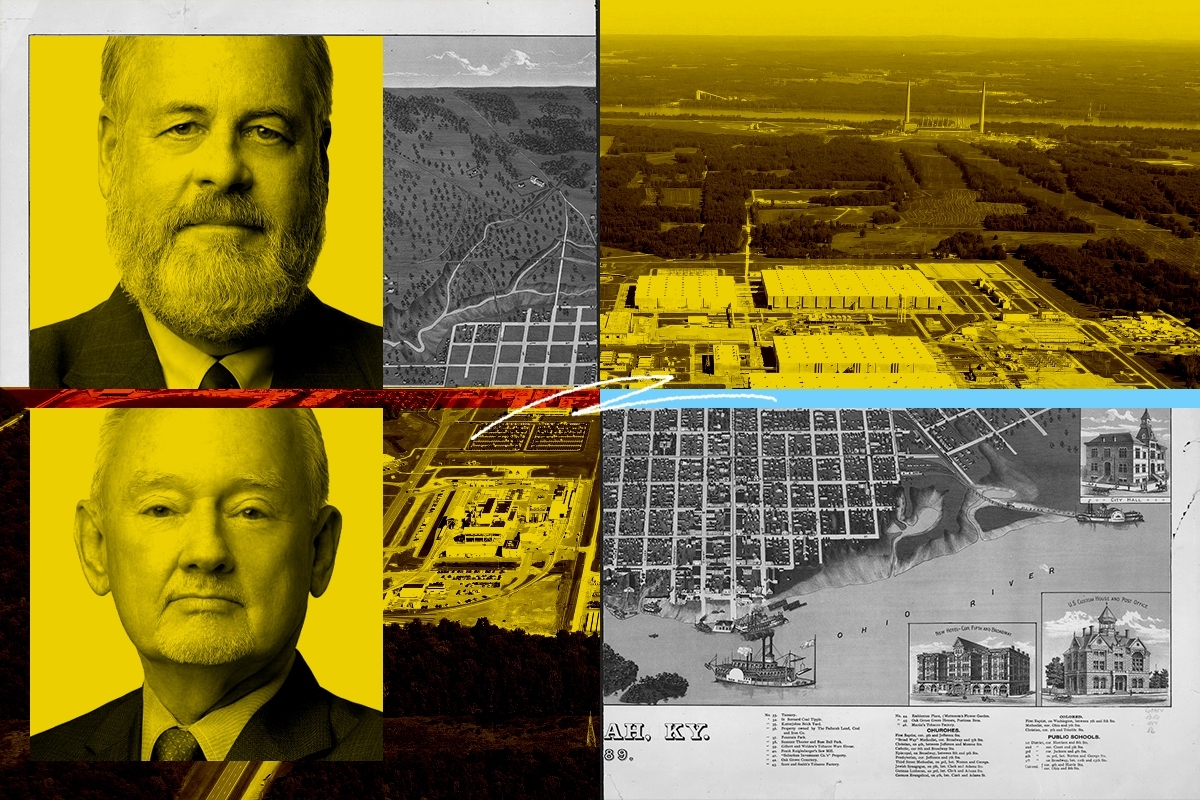
Come with me to McCracken County, Kentucky, just outside its largest city, Paducah, where the Energy Department is allowing new development at a large brownfield property. First constructed in the 1950s, the Paducah Gaseous Diffusion Plant was once the country’s only uranium enrichment facility, but it closed in 2010. Since then, and after years of cleanup, Paducah city officials and the McCracken County government have sought to revitalize and reindustrialize the site.
In July, the Energy Department announced plans for a data center at the site, one with enough power to provide excess electricity to the surrounding community. Brookfield would develop and operate the data center and NextEra Energy would build the power infrastructure — a roughly 2.5 gigawatt natural gas plant — while local and regional electricity companies and co-ops would help provide wholesale and retail electricity. The project would be built alongside new uranium enrichment projects cropping up at the site, as federal officials and companies involved seek to transform the area into what they call an “American energy hub.”
Government officials at all levels welcomed the new project. An opposition group called Protect McCracken County exists and is active, but opposition has yet to manifest in the kind of dust-up or mass protest we’re seeing elsewhere in the country. Media reports indicate a likely reason for this is the longstanding history of industrial development in this specific area and that the project location was already contaminated as a brownfield site. The worst headlines about the data center news saw residents calling it “bittersweet” and a “necessary evil.”
But something important was missing because the project was on federal land: city officials say they never had a formal opportunity to deliberate it themselves — a step even local governments supportive of development often use to get assurances and benefits from developers.
The investment announcement also caught officials by surprise. Kentucky Governor Andy Beshear, a centrist Democrat with presidential ambitions, told Politico he was never briefed on it. Paducah City Councilor Dujuan Thomas told me this week that the first time he met with any individuals involved “was a week before the public announcement, or a few days before it.”
“At the end of the day, it’s already set in stone,” said Thomas, who supports the data center being built. “I don’t think there’s anything that can be done aside from a federal intervention that could ever stop something like this from happening. And I’m trying to be a realist about it.”
“I’m more of a glass-half-full type of person,” Thomas added.
Now, the fight over asking for more is dominating the race for McCracken County judge/executive, which is the county’s top job. Paducah’s mayor, George Bray, a former Republican-turned-independent, is running to oust two-term Republican incumbent Craig Clymer. In recent weeks, Bray has called for negotiating a community benefit agreement with the developers and says Brookfield already expressed willingness to do so. “Data center developers, knowing how sensitive communities are about electrical usage, water usage, and noise … have been open to embracing the community and saying they want to be good citizens,” he told me in an interview.
Specifically, Bray wants a community benefit agreement to potentially include an economic development fund to help jumpstart new housing in the area, knowing there’ll be an influx of labor. The county will also need to support volunteer fire districts, especially if there’s a blaze at the site. Those are only two ideas he offered, acknowledging the subject of data centers is new to him and that he believes the agreement “should be something the community itself comes up with.”
“I would not approach it as, What do I want? I would be talking with others,” he told me. “There are many things that a project of this size is going to drive in our community. I think we just need to be open-minded and practical about it.”
Bray’s push came up at public debates during the campaign for county judge executive and has since spilled over into social media spats between Bray and Clymer. Bray claims the only official who can adequately negotiate this kind of agreement with the developer is the county judge/executive because the project is not within the Paducah city limits. Clymer, meanwhile, denies everything Bray is claiming.
Clymer says a community benefit agreement is unnecessary, would indicate hostility towards the business community, and is only being brought up so Bray can differentiate himself in the election. He also told me the county will receive incredible levels of tax revenue from the project, and this in and of itself will mean lots of benefits.
The developers “have not asked for one thing from the community. They haven’t asked for a property tax abatement — I told them early on we’d send them a tax bill and they said they understood that’s what I intend to do. No payback on anything; they’re going to build their own infrastructure there within the facility. They’re going to provide their own power through NextEra,” Clymer said. “The bottom line is, it’s not going to cost the community a penny to have this $100 billion investment in our community, and the benefit from it is just going to be enormous through the property tax and occupational tax.”
Clymer also claims key protections for the community, including ratepayer guardrails, are written into the lease agreement DOE struck with Brookfield for the data center. I asked Clymer if the lease agreement was public; he said no and that he personally hasn’t seen it.
“I’m telling you what they’re telling me and I don’t think anybody’s lying about it,” he said. “Let’s be satisfied it’s not going to cost us a penny and it’s going to create enormous wealth for us.”
Brookfield declined to comment for this story. The Energy Department and NextEra did not respond to requests for comment by publication time. We’ll update our story with answers from them when we hear back.

Log in
To continue reading, log in to your account.
Create a Free Account
To unlock more free articles, please create a free account.
Talking with Arnab Pal, the executive director of Deploy Action.
This week’s conversation is with Arnab Pal, executive director of Deploy Action, president of Clean Infrastructure Advisors, and former principal advisor at the Energy Department’s Loan Programs Office under the Biden administration alongside Jigar Shah.
I reached out to Pal for guidance on where he saw state-level policy going around renewables development after the 2026 blue wave election. Simply put, few could’ve provided better guidance. We have no idea what could happen next after an unprecedented election result, but he couldn’t have been more clear-eyed and, as he put it to me, focused on the future. I appreciated our conversation and decided it was worthwhile to provide it to you in full.
The following transcript was lightly edited for clarity.
When it comes to state policy, what opportunities are created by this blue wave election?
I think this opens up a bunch of possibilities but I also think we also need to be very careful in understanding what the election was about in terms of what we focus on in the energy sector. The focus was on affordability. That was the number one message. On electricity, housing, gas.
The problems I see from these wave elections is that somebody wins — a party, an ideology — after campaigning on something and then they govern on something completely different. The message to take away here is, people can’t afford their day-to-day lives. What we’re working on at Deploy Action and other groups focused on electricity and energy, we’re all really focusing on the issue of consumer protection and affordability. We should not try to package in our own individual goals and call it affordability.
One of the starkest results, at least to me, was what happened in states where permitting had been streamlined for renewable energy — Wisconsin, Michigan, New York. The Republicans campaigned against those laws streamlining those permits and lost handily. How do you see these results affecting permitting certainty for renewable energy at the state level in parts of the country?
If it truly addresses affordability, I think permitting is certainly on the table. Especially because governors are going to be judged on what they accomplished and some of these states are going to be having a Democratic governor for the first time in one or two decades. I think they’re going to really hone in on that. And a lot of permitting is state-level. Conversations around federal permitting are often around transmission — a lot of the project-level is at the state level.
But permitting is really only one part of the puzzle. It’s the part everyone likes to focus on because it’s easier to understand. There’s also the market structures of how utilities operate. How they’re incentivized to make money. How they bring on new customers. That’s really going to determine how we bring down bills, or at the very least limit the increases in these bills over the next five or ten years.
Can you give some examples?
So one of the things we focus on [at Deploy Action] is trying to not change the utility business model but alter it to take into account efficiency, especially when it comes to transmission and distribution. Right now utilities’ cap-ex and their ability to earn a return on that is building transmission and distribution lines. In some places it’s generation too. What we’re saying is, we need to create an incentive structure where they’re first incentivized to use existing lines, so as you bring more customers online it reduces the need for new infrastructure per customer which will ultimately bring down costs for everyone.
The perfect example here, and another policy example here, is data centers. It’s completely understandable why they ran against them and why the public is not a fan. But there’s a way to do data centers intelligently in a way to reduce people’s bills. The way to do that is not these monstrosities but smaller data centers that can be coupled with battery storage and renewables instead of gas and diesel. These smaller ones can be used as their own distribution resource which allows you to bring on new paying customers without building more lines. These are things we’ve been working on in Virginia, in California to a lesser extent and in Pennsylvania, and the election opens up the possibility to do more of this work.
How do these state-level data center moratoria affect renewable energy development?
It depends.
I think there’s a very nuanced and smart compromise to be had. These new governors need to consider that instead of an outright ban there needs to be an understanding there are data centers of a certain size that can actually be beneficial to ratepayers and done without using massive amounts of water and renewables. The moratoria needs to turn into policy. The way to get a policy in place that’ll help people every day with their lives and their bills while actually preventing some of the harms people are thinking about with data centers is to set that size limit.
Do these pauses affect transmission development?
It shouldn’t theoretically. I think the argument that would come up though is people would say big data centers would mean more demand for more transmission. And yes, we want more demand growth but you want to build more transmission to bring down costs. You don’t want to build more transmission just to build more transmission.
What do you think is the biggest challenge this election result poses for renewable energy?
Focus.
Here’s the thing: It’s a new election. People will have tons of ideas. The renewables’ best argument is we are the cheapest solution and oftentimes the fastest solution. If what you’re trying to do is bring on new demand, whether it’s for EVs or for certain types of data centers, and then at the least cost supply for that demand.
There’s a lot of things we can focus on with renewables but if we stick to the purpose of this being to bring down people’s bills and create a steady grid for everyone then, well, the opportunities are strong and will be available to us in the industry.
Evidence suggests data center concerns probably didn’t actually flip many votes.
This week’s midterm elections were undeniably horrible for the data center industry. But a closer look indicates dominant media narratives about the impact of AI infrastructure on voting behavior also deserve more scrutiny.
On election night, candidates who railed against data center sprawl during their campaigns won across the country, including statewide races in red areas. The most striking example was Gina Hinojosa, now governor-elect for the data center-centric state of Texas, who ran on instituting a complete pause on projects across the Lone Star State. So striking was her win, it sent AI and data center stocks into freefall. Cleanview, a clean energy news and data site, said Hinojosa’s pause, if put into effect, could affect up to 88.4 gigawatts of “planned” data center development, depending on how it's implemented.
It’s true data centers were this year’s election boogeyman. However, a deeper dive into the results we have thus far tells us crucial nuance is necessary in the discourse about the midterms and the impacts data centers had on voting behavior.
Two important questions must be asked. First, did data centers play a key role in the 2026 midterm elections? Yes — and no.
One can easily make the case that data centers were instrumental to Democrats winning big because, by and large, they chose data centers as a go-to punching bag in attack ads against Republican candidates. Analysis ahead of Election Day by Tech Oversight Project — an outfit run by former Democratic staffers — found 136 federal and gubernatorial races used “tech accountability messaging in paid media,” including 74% of the Democratic Congressional Campaign Committee’s target seats to flip for House control. Much of this advertising focused on tying GOP lawmakers to data centers, whether by connecting the GOP’s recent tax cuts bill to lower taxes on data centers or alleging Republicans held stocks in, or took donations from, data center developers.
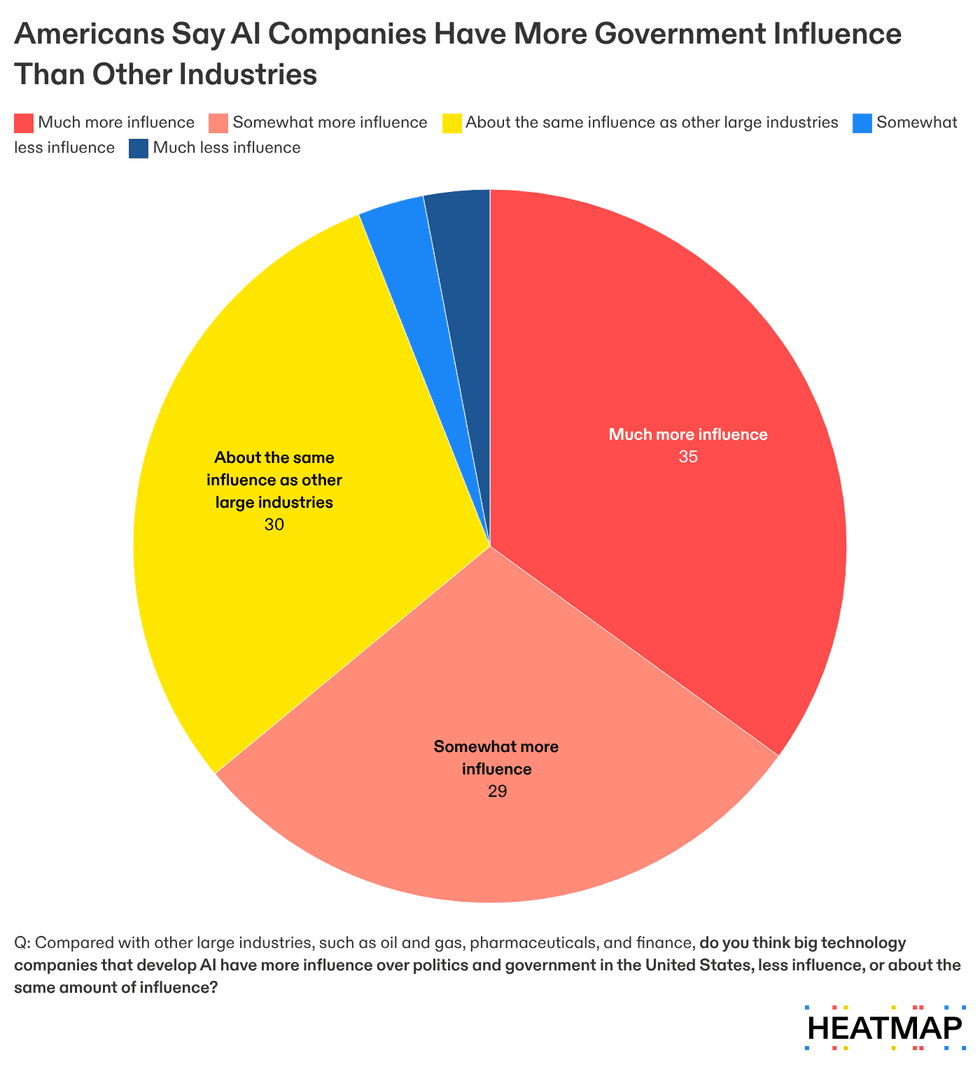
This echoes Heatmap Pro’s most recent polling, which shows that Americans say the tech industry has a uniquely firm hold over the Trump administration. When asked if large technology companies have more influence over the government than other large industries, like finance and oil and gas, 64% of Americans said yes.

It’s certainly true Democrats capitalized on public opinion souring on data centers with ads that sought to tie GOP candidates to the unpopular industry. Some of these ads focused solely on data centers, like this ad against Republican Representative Brad Finstad in Minnesota, whose district included the controversial Google data center project in Pine Island I’ve previously reported on. Finstad’s likely to lose his seat; his Democratic opponent, Jake Johnson, has claimed victory, but the race is likely to go to a recount. Democrats also ran data center-only ads in Wisconsin’s 3rd Congressional District, a community already angry about transmission lines that then voted for Democrat Rebecca Cooke to replace Republican incumbentDerrick Van Orden. And Democrats used this strategy in ads in Montana’s 1st Congressional District, which is now controlled by a Democrat, as well as in South Carolina’s 1st, which is now also blue.
However, there is also evidence that data centers did not decide key statewide races. David Crowley, a Democrat who was perceived as weaker on this issue, won the Wisconsin gubernatorial race by eight points, in keeping with the state’s leftward swing. The same is true for Byron Donalds, a Republican who overcame data center attacks to become Florida’s first Black governor.
This brings us to the second key question: Did data center development in local communities flip any votes? We have no way of knowing for sure, because data centers are unpopular across party lines and there’s evidence at least some voters saw opposing a data center as compatible with voting for their preferred political party because other issues also matter to them.
There is a crucial difference between data centers being unpopular and local data center development affecting how people vote for higher office. We see this in the midterms data, as communities actively fighting data centers in their backyards continued to vote Republican like before. I’d also note this data has significant limitations, as it’s challenging to separate a community getting bluer from the relevance or use of political attacks tied to data centers.
At most, where movement was registered, these sorts of towns, cities, and counties moved in line with the national partisan swing toward Democrats.
We can see this dynamic playing out in Ohio, where voters across the state weighed in on 21 ballot initiatives about data center development. In all cases, these ballot initiatives were either approved or rejected in order to block development — i.e., the data centers lost all of them. However, when you drill down to the precinct-level data, communities simultaneously voted against their local data center while continuing to support the Republican in higher office. Perhaps some folks split their tickets; others decidedly did not.
Take Conneaut, the northernmost city in Ohio, located in Ashtabula County on the rim of Lake Erie, which overwhelmingly voted to institute a moratorium on large data centers within city limits. Some precincts voted for Democrat Amy Acton to be governor, while others went overwhelmingly for Vivek Ramaswamy, the Republican candidate. Two-thirds of them also voted yes on the moratorium. (Precinct-level data here for transparency!)
The state’s 21 ballot initiatives were the project of Conserve Ohio, a new grassroots organization founded explicitly to advocate against data center development from an apolitical perspective. Austin Baurichter, one of the organization’s founders, told me at least 65% of the volunteers with his organization have been “historical Republicans” and “historical Trumpers,” and he acknowledged there is potential this issue has “moved people around politically."
Baurichter said he has no proof yet whether any of the ballot initiatives led communities that were once Republican to turn blue. He was open to the idea that may have happened somewhere in the state. But he also bristled at the suggestion, because what he’s seeing on the ground is what Heatmap polling also shows: Republicans are upset at data centers, and those feelings are apolitical and nonpartisan.
“The fact there was a blue wave indicates that people did something different at the polls, but I frame it less as a switching of parties and more as an abandoning of the two-party system,” he told me. “These efforts to understand are well expended. But I think a lot is up in the air.”
And more of the week’s top fights around development.
1. McCracken County, Kentucky – A rare bright spot for the data center sector quietly occurred in deep red Kentucky in a race defined by what’ll likely be the first project built on federal land.
2. Pulaski County, Arkansas – After a blue wave election in Little Rock, this county government is on a collision course with data center development.
3. Lyon County, Kansas – You probably heard about all the communities that voted on data center ballot initiatives during the midterms, but did you know at least one also restricted battery storage?
4. Central Maryland – Oh, one last piece of non-election news: The conflict over the Piedmont Reliability Project transmission lines is now before the Supreme Court.