This week’s midterm elections were undeniably horrible for the data center industry. But a closer look indicates dominant media narratives about the impact of AI infrastructure on voting behavior also deserve more scrutiny.
On election night, candidates who railed against data center sprawl during their campaigns won across the country, including statewide races in red areas. The most striking example was Gina Hinojosa, now governor-elect for the data center-centric state of Texas, who ran on instituting a complete pause on projects across the Lone Star State. So striking was her win, it sent AI and data center stocks into freefall. Cleanview, a clean energy news and data site, said Hinojosa’s pause, if put into effect, could affect up to 88.4 gigawatts of “planned” data center development, depending on how it's implemented.
It’s true data centers were this year’s election boogeyman. However, a deeper dive into the results we have thus far tells us crucial nuance is necessary in the discourse about the midterms and the impacts data centers had on voting behavior.
Two important questions must be asked. First, did data centers play a key role in the 2026 midterm elections? Yes — and no.
One can easily make the case that data centers were instrumental to Democrats winning big because, by and large, they chose data centers as a go-to punching bag in attack ads against Republican candidates. Analysis ahead of Election Day by Tech Oversight Project — an outfit run by former Democratic staffers — found 136 federal and gubernatorial races used “tech accountability messaging in paid media,” including 74% of the Democratic Congressional Campaign Committee’s target seats to flip for House control. Much of this advertising focused on tying GOP lawmakers to data centers, whether by connecting the GOP’s recent tax cuts bill to lower taxes on data centers or alleging Republicans held stocks in, or took donations from, data center developers.
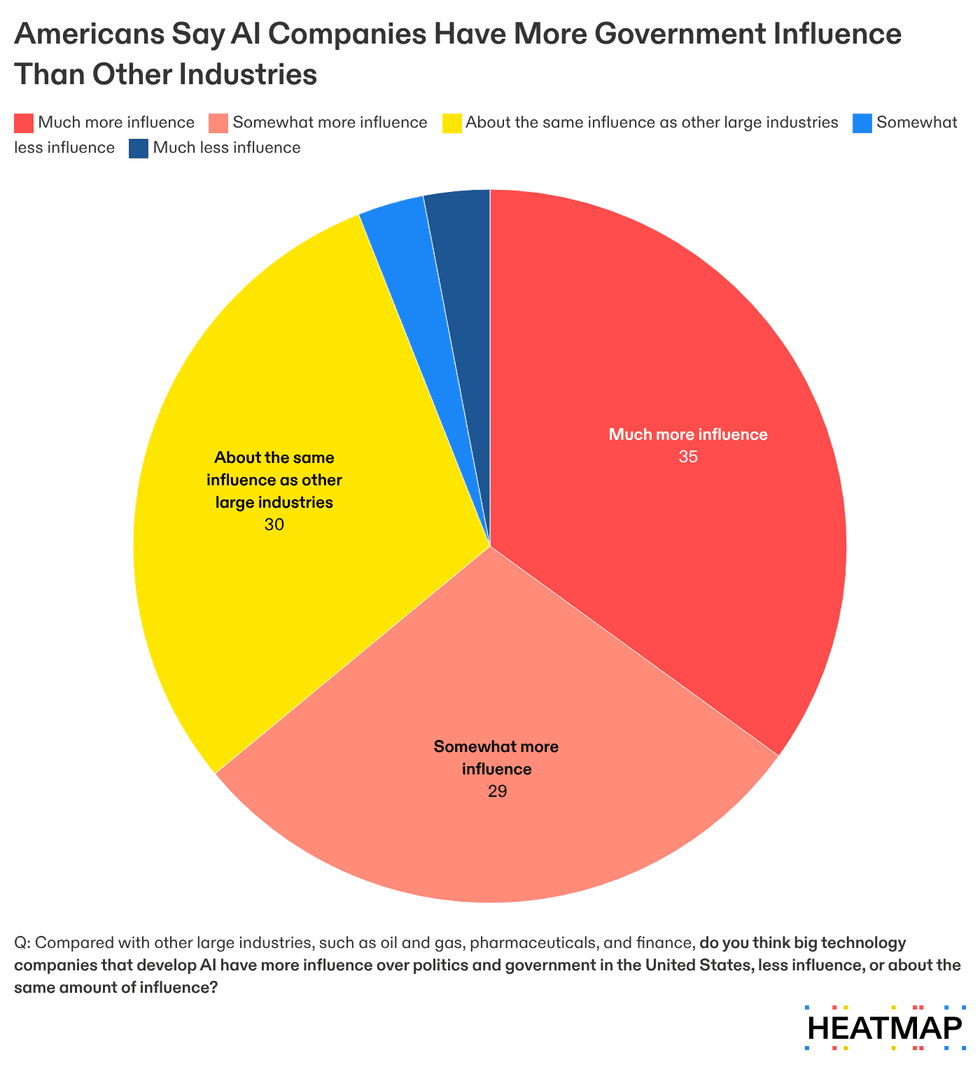
This echoes Heatmap Pro’s most recent polling, which shows that Americans say the tech industry has a uniquely firm hold over the Trump administration. When asked if large technology companies have more influence over the government than other large industries, like finance and oil and gas, 64% of Americans said yes.

It’s certainly true Democrats capitalized on public opinion souring on data centers with ads that sought to tie GOP candidates to the unpopular industry. Some of these ads focused solely on data centers, like this ad against Republican Representative Brad Finstad in Minnesota, whose district included the controversial Google data center project in Pine Island I’ve previously reported on. Finstad’s likely to lose his seat; his Democratic opponent, Jake Johnson, has claimed victory, but the race is likely to go to a recount. Democrats also ran data center-only ads in Wisconsin’s 3rd Congressional District, a community already angry about transmission lines that then voted for Democrat Rebecca Cooke to replace Republican incumbentDerrick Van Orden. And Democrats used this strategy in ads in Montana’s 1st Congressional District, which is now controlled by a Democrat, as well as in South Carolina’s 1st, which is now also blue.
However, there is also evidence that data centers did not decide key statewide races. David Crowley, a Democrat who was perceived as weaker on this issue, won the Wisconsin gubernatorial race by eight points, in keeping with the state’s leftward swing. The same is true for Byron Donalds, a Republican who overcame data center attacks to become Florida’s first Black governor.
This brings us to the second key question: Did data center development in local communities flip any votes? We have no way of knowing for sure, because data centers are unpopular across party lines and there’s evidence at least some voters saw opposing a data center as compatible with voting for their preferred political party because other issues also matter to them.
There is a crucial difference between data centers being unpopular and local data center development affecting how people vote for higher office. We see this in the midterms data, as communities actively fighting data centers in their backyards continued to vote Republican like before. I’d also note this data has significant limitations, as it’s challenging to separate a community getting bluer from the relevance or use of political attacks tied to data centers.
At most, where movement was registered, these sorts of towns, cities, and counties moved in line with the national partisan swing toward Democrats.
We can see this dynamic playing out in Ohio, where voters across the state weighed in on 21 ballot initiatives about data center development. In all cases, these ballot initiatives were either approved or rejected in order to block development — i.e., the data centers lost all of them. However, when you drill down to the precinct-level data, communities simultaneously voted against their local data center while continuing to support the Republican in higher office. Perhaps some folks split their tickets; others decidedly did not.
Take Conneaut, the northernmost city in Ohio, located in Ashtabula County on the rim of Lake Erie, which overwhelmingly voted to institute a moratorium on large data centers within city limits. Some precincts voted for Democrat Amy Acton to be governor, while others went overwhelmingly for Vivek Ramaswamy, the Republican candidate. Two-thirds of them also voted yes on the moratorium. (Precinct-level data here for transparency!)
The state’s 21 ballot initiatives were the project of Conserve Ohio, a new grassroots organization founded explicitly to advocate against data center development from an apolitical perspective. Austin Baurichter, one of the organization’s founders, told me at least 65% of the volunteers with his organization have been “historical Republicans” and “historical Trumpers,” and he acknowledged there is potential this issue has “moved people around politically."
Baurichter said he has no proof yet whether any of the ballot initiatives led communities that were once Republican to turn blue. He was open to the idea that may have happened somewhere in the state. But he also bristled at the suggestion, because what he’s seeing on the ground is what Heatmap polling also shows: Republicans are upset at data centers, and those feelings are apolitical and nonpartisan.
“The fact there was a blue wave indicates that people did something different at the polls, but I frame it less as a switching of parties and more as an abandoning of the two-party system,” he told me. “These efforts to understand are well expended. But I think a lot is up in the air.”