You’re out of free articles.
This Halloween, get 20% off using code ADVANCED
Log in
To continue reading, log in to your account.
Create a Free Account
To unlock more free articles, please create a free account.
Sign In or Create an Account.
By continuing, you agree to the Terms of Service and acknowledge our Privacy Policy
Welcome to Heatmap
Thank you for registering with Heatmap. Climate change is one of the greatest challenges of our lives, a force reshaping our economy, our politics, and our culture. We hope to be your trusted, friendly, and insightful guide to that transformation. Please enjoy your free articles. You can check your profile here .
subscribe to get Unlimited access
Offer for a Heatmap News Unlimited Access subscription; please note that your subscription will renew automatically unless you cancel prior to renewal. Cancellation takes effect at the end of your current billing period. We will let you know in advance of any price changes. Taxes may apply. Offer terms are subject to change.
Subscribe to get unlimited Access
Hey, you are out of free articles but you are only a few clicks away from full access. Subscribe below and take advantage of our introductory offer.
subscribe to get Unlimited access
Offer for a Heatmap News Unlimited Access subscription; please note that your subscription will renew automatically unless you cancel prior to renewal. Cancellation takes effect at the end of your current billing period. We will let you know in advance of any price changes. Taxes may apply. Offer terms are subject to change.
Create Your Account
Please Enter Your Password
Forgot your password?
Please enter the email address you use for your account so we can send you a link to reset your password:
They only ticked up by 5% this week.

Beyond the repudiation of Donald Trump, if there was one message voters sent on election night, it was that they really don’t like data centers.
Democrats who ran against rampant data center development won at both the gubernatorial level (Amy Acton in Ohio, Gina Hinojosa in Texas) and the senatorial level (Abdul El-Sayed in Michigan, Annie Andrews in South Carolina). The Wall Street Journal counted 125 Democrats nationwide who “targeted their opponents over data centers.”
“Data centers are the midterms’ other big loser,” according to Politico. “The Results Are In: Voters Hate Data Centers,” from Wired.
Commentators didn’t just notice that many anti-data-center candidates won, but that a number of local data center moratoria passed as well. “In nearly every case, it’'s about 67-80% opposing data centers. True in California, Ohio, everywhere,” Brad Carson, head of the artificial intelligence policy group Americans for Responsible Innovation tweeted. Added Democratic strategist David Shor on X, “Voters sided against data centers in 40 of 41 ballot measures, with basically no correlation to how red a county was.”
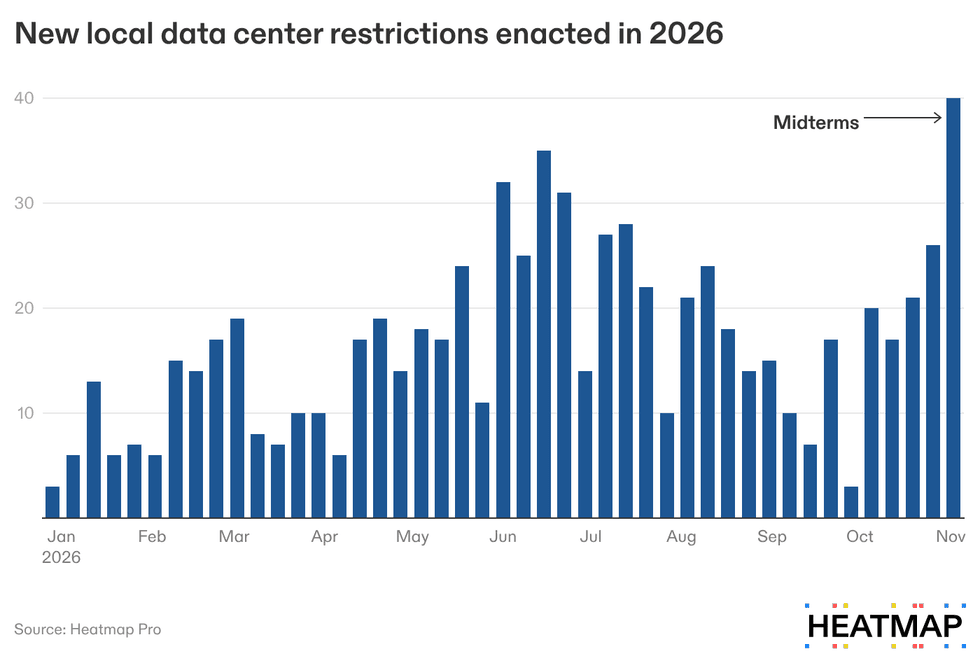
But as far as new legislation and ordinances go, November 3 was just another Tuesday in the long-running local campaign against data center development, Heatmap Pro data shows.
“Forty is a lot in one day,” Owen Curtin, a data analyst with our intelligence platform Heatmap Pro, admitted, but “in terms of the rate at which county governments are enacting legislation and the overwhelming public support for them, it’s not new.”
There have been over 830 restrictive measures passed this year, according to analysis from Heatmap Pro, which breaks down to just over 80 per month. The numbers picked up substantially in the summer and fall.

June 15 to 21 was the busiest week of the year for passing data center laws, at 35, and June the month with the most laws passed overall, with 133. Another95 restrictive laws were passed in July, followed by 86 in October.
Of the 40 ballot measures passed this week, only one applied at the county level (Morgan County, Illinois), where a great deal of data center permitting occurs. “While many municipalities permit data centers, a significant portion are permitted by county governments. Not all counties have the legal authority to pursue ballot measures, which is why most November 2 measures were at the municipal level,” Curtin explained.
“While the overwhelming support for local data center ballot measures is indicative of public sentiment (largely anti-data center), it doesn’t necessarily correlate with the regulatory landscape,” he went on. And here’s a fun fact: “There are over 19,000 municipalities in the U.S., so 40 bans are only 0.2% of all municipalities,” Curtain added. “If 40 municipalities banned data centers every day, it would take 475 days to ban data centers across the entire U.S.”
This Halloween, get 20% off using code ADVANCED
Log in
To continue reading, log in to your account.
Create a Free Account
To unlock more free articles, please create a free account.
Progressive candidate Jane Kim declared victory in the race for California Insurance Commissioner.
Few political wonks outside of California were likely paying much attention to the Golden State on Tuesday night, as Democrats’ anticipated blue wave crested. But the state did have one close, consequential race on the ballot: insurance commissioner. On Friday, Bernie Sanders-endorsed progressive Jane Kim won the race to lead the California Department of Insurance, which oversees the state’s $452 billion insurance market.
Kim declared victory over the more moderate State Senator Ben Allen, who was backed by the California Democratic Party, after reaching a nearly six-point lead on Friday. In a brief speech before supporters, Kim said Allen called to congratulate her that morning. (A spokesman for the Allen campaign confirmed the call to The Orange County Register.) Kim ran on a proposal for a state-run, single-payer insurance program that would cover homeowners against wildfire damage — though the plan would ultimately need approval from both the California legislature and Governor-elect Xavier Becerra.
The idea is that homeowners would automatically receive public coverage for wildfire-related losses, with payouts capped at roughly what it costs to rebuild a typical California home. Policyholders would keep their regular private insurance for other risks such as theft, burst pipes, or an ordinary kitchen fire. Kim says Californians wouldn’t pay more overall, since the money for the program would come from the share of premiums that already goes toward wildfire coverage, though each household’s bill would partly depend on its own wildfire risk.
“It would be nonprofit, and so any excess capital would stay in the state of California and would be used to drive down risk,” Kim told my colleague Matthew Zeitlin a few weeks ago. “That’s the most important piece about this actually, is that it would create another revenue stream for mitigation.”
The insurance commissioner job has taken on an increasing sense of urgency as wildfires — intensified by climate change — continue ripping through communities in California. Mounting losses from hotter, drier conditions combined with decades of new construction in the wildland-urban interface have squeezed insurers’ profits, leading many to drop policyholders in high-risk areas or simply stop writing new policies in the state altogether.
California’s homeowners insurance premiums climbed 84% between December 2020 and March of this year, according to Stanford researchers. Meanwhile, a growing number of residents have been pushed onto the state’s FAIR Plan, which my colleague Matthew described as “the barebones insurer of last resort.” The share of California’s single-family homes covered by the plan has nearly tripled over that same period, from under 2% to about 5%, as homeowners in even low- and moderate-risk wildfire areas increasingly find themselves with few alternatives.
The insurance crunch has become yet another front in California’s broader affordability crisis, alongside persistently high housing, electricity, and gasoline costs. Kim’s victory suggests frustrated voters are increasingly willing to support more radical solutions that once seemed politically out of reach. And while Kim doesn’t have a background in the insurance industry, she’s no stranger to public office. The former civil rights attorney served on the San Francisco Board of Supervisors from 2011 to 2019 before becoming a regional director for Sanders’ 2020 presidential campaign.
But throughout her run for the Insurance office, critics have continually questioned how, exactly, her plan would work. No state has attempted a public disaster insurance program like this before; critics argue there’s no relevant model to work off of, no white paper laying out the details, and no price tag attached to the idea. Kim herself acknowledges that there’s plenty of uncertainty surrounding the plan. “This is a concept and a proposal, and could look quite different by the time it works its way through the process,” she told Matthew. In other words, the program that eventually emerges from negotiations with lawmakers — if one does — could end up looking considerably different from what Kim campaigned on.
Her opponent, Allen, who chairs the state senate’s Energy, Utilities and Communications Committee, argued that creating a public wildfire insurance program would impose a significant financial burden on the state. The California Earthquake Authority, an agency that sells earthquake insurance and administers the state’s Wildfire Fund, examined the potential costs of such a program this spring, estimating it would require roughly $25 billion upfront to have a 75% chance of staying solvent for 20 years. But Kim points out in her policy brief that buying reinsurance — essentially insurance for the insurer — could cut that to about $6 billion.
Allen, on the other hand, pitched a series of reforms to the existing market, including speeding up rate reviews, rewarding homeowners and communities for wildfire mitigation, expanding financing for home-hardening projects, and discouraging development in high-risk areas.
Voters opted instead for the insurance revolution. But Kim argues that her plan isn’t totally without precedent. On the campaign trail, she frequently pointed to New Zealand, where the government’s Natural Hazards Commission provides homeowners with public coverage for disasters including earthquakes, landslides, volcanic eruptions, and tsunamis — though notably not ordinary wildfires. And while France and Spain also operate state-backed disaster insurance programs, these don’t cover wildfires either, a far more common occurrence in California than the comparably rare disasters these programs were built around abroad.
Ultimately, Kim’s ambitious plan will require a champion in the legislature to go anywhere. But in the meantime, there are other issues she could get to work on. On the campaign trail, she said she wants to push insurers to fund a disaster mitigation program run by the Department of Insurance, require companies selling auto policies in a region to also offer homeowners coverage there, and impose minimum loss ratios compelling home insurers to pay at least 65% of premiums in claims and auto insurers at least 70%. It’s unclear, however, whether Kim can implement either of the latter two proposals without new legislation.
Kim will also immediately face the question of what to do with outgoing Insurance Commissioner Ricardo Lara’s Sustainable Insurance Strategy reform package. Designed to entice insurers back to California, these new rules allow companies to set premiums using forward-looking risk models rather than relying on historical losses, and to pass a portion of their rising reinsurance costs onto policyholders. In exchange, insurers are required to write more policies in wildfire-prone areas.
Kim has criticized this approach, arguing that insurers have exploited loopholes to raise premiums on lower-risk customers while continuing to underserve high-risk communities, all without doing enough to address the underlying factors driving wildfire risk.
That leaves Kim in a tricky situation. Until she is able to secure legislative backing for some version of her proposed public insurance program, she’ll have to decide whether to scrap or simply build on the existing reforms. She hasn’t yet laid out any plan for doing so. But whatever direction she takes could ultimately reshape California’s insurance market well before a new state insurer gets off the ground.
A conversation with Rep. Mike Levin of California
It’s crunch time for the Senate’s bipartisan permitting reform and transmission bill. In three days, the bill’s authors plan to put the Bipartisan American Affordability and Jobs Act to a vote on the Senate floor. That means there’s probably only three days to finish up an amendment to the bill that addresses critics’ concerns without toppling the delicate balance the authors initially struck to foster bipartisan support.
BAAJA has major implications for climate policy, as it would make it much easier and cheaper to build high-voltage transmission lines that connect renewable energy from where it is generated to demand centers. It includes ratepayer protection provisions that require data centers to pay all of the costs of upgrading the grid so that they can hook up to it. The bill would also speed up permitting for energy projects of all stripes, from solar farms and geothermal plants to pipelines and liquified natural gas terminals.
The trade-offs, beyond the benefits for fossil fuels, include making it far more difficult — in some cases, potentially impossible — to revoke permits for a project once the federal government has issued them. While this might help solar and wind under Trump or a Trump-like president, critics are worried it will give Trump carte blanche to approve shoddy oil and gas projects with abandon in his remaining two years. The bill also limits public participation in the environmental review process, makes significant changes to landmark environmental laws like the Clean Water Act and the Endangered Species Act, and weakens tribal consultation under the National Historic Preservation Act.
Several Democratic Senators and House members who had yet to comment on the bill came out of the woodwork in the post-midterms glow to share where they stood. Ruben Gallego, the senator from Arizona and likely 2028 presidential candidate, told a Washington Sun reporter that the White House may not be so willing to negotiate six months from now after a possible impeachment. “Or maybe we get too close to an election and Vance doesn't want to negotiate, right?” he said. “So why not take this win now?”
Senator Mark Kelly, of Arizona, on the other hand, said he wants to wait and see if Democrats can get more of their priorities into the bill in the next Congress, according to Politico. That sentiment seems to be growing among Democrats in the House, where minority leader Hakeem Jeffries of New York has come out against the current iteration of the bill. “Leader Jeffries will not rubber-stamp legislation that emerges from the Senate without more constructive involvement with our Caucus as we fight to make life more affordable for the American people,” Jeffries’ spokesperson told Politico.
The political calculus on the bill is in the eye of the beholder. Proponents are sure this is the best chance Democrats are going to get to clear transmission bottlenecks that will open the door to a clean energy future. Skeptics are worried the risks are too great, or otherwise feel it’s worth attempting a better deal in the next Congress when Democrats have more power.
On Thursday, I spoke to Representative Mike Levin from California as he was coming down from the high of his own reelection win on Tuesday night. Levin told me he was decidedly undecided on the bill, and so we talked through how he’s thinking about it.
Let’s start with the big picture. What is your opinion of the legislation as written?
I think a few things. One, having such a huge democratic victory in the House and the Senate changes the dynamics around the deal and really around the negotiations — not just around permitting reform, but all the things that have been punted to the lame duck. I think there’s a list of like a dozen things.
The question is, do we choose to accept the permitting deal in its current construct with whatever technical changes there are in the manager’s amendment? Do we negotiate much broader changes this Congress with the massive vote we received on Monday? Or do we wait until the 120th Congress when Democrats have the pens?
The next thing we're going to learn, after we get the final numbers in the House and Senate, is what does the manager’s amendment actually look like? There’s risks to any of the options here. There are more conversations that our caucus needs to have on permitting in light of Tuesday. We’ve raised specific concerns to our colleagues in the Senate. I know others have as well, and I’m going to be watching closely to see if Martin [Heinrich] and Sheldon [Whitehouse] can address some of these concerns that we’ve raised.
What are your biggest concerns about the bill?
There’s a big picture test that I have, a three-prong test. First: Is it going to actually lower costs? This whole election has been about lowering costs for consumers. Second: Is it going to protect the environment, and specifically, will it promote clean air and clean water that communities need? And then, third: Will it actually do the job on access to clean energy?
And what I would say is: there are some real problems. I have a lot of good things to say about the transmission provisions. A lot of it mirrors what we’ve been working on in the Energy Bills Relief Act for a long time. But I think there are loopholes around project certainty language. I read my friend John Podesta’s phrase of “loaded Howitzer” in Heatmap. I see these loopholes as ripe for corruption and potentially allowing permits for fossil fuel projects, and that’s very concerning.
You have the historic preservation tribal issues, right? My friends in New Mexico have been very loud about that, and other places as well. They’re very unhappy about the [National Historic Preservation Act] process and tribal sovereignty.
And I worry in the context of the whole data center fight that there aren’t enough steps in here to improve transparency for the public through the permitting process. You can’t have projects that are shrouded in secrecy, and you need community engagement to lead to better and more successful projects. So those are a few things, and those are not small things.
What is your sense of the sentiment around the bill in the House in general? Are there House Republicans that are against it? Do you think it could get the votes in the House?
Mike Johnson obviously came out strongly for it, which may not help get House Democrats on board. I have to tell you, the fact that he was so enthusiastically for it — in my view that wasn’t a great tell.
In my own opinion, any bipartisan permitting bill or any bipartisan bill at all is going to require compromise, and we owe the negotiators the room to try to get to a deal to a certain extent. We shouldn’t let the perfect be the enemy of the good. But until we see the final text, it’s tough to take a stance on the bill, and that includes the managers’ amendment. And we need more assurances and progress from the administration than we’re getting.
Time is running out for that, it seems.
Yeah. They still refuse to implement our current laws in good faith, and that doesn’t give me confidence that they’re going to implement any new law in good faith.
The other thing that I don’t think really gets talked about in this context, but I see it as germane — at least in the behavior of the administration — is what happened on the Lindsey Graham sanctions bill. This bill was negotiated by the White House, and there were a lot of Dems that were for it. It was a close vote for me. I voted against because I could not trust the administration to proceed in good faith. I thought Trump would use the tariff authority and the sanctions waiver authority in an unintended way, and that’s exactly what happened. Lindsey Graham would never, in a million years, have been okay with how Trump waived sanctions on Russia using a bill intended to impose sanctions. Just the same, I could see a scenario where, with the permit-certainty language, it is in fact the loaded Howitzer that John Podesta described. That’s my two cents.
Some proponents of the bill have said the midterms are an argument to pass this bill because they showed how much voters care about affordability, and this bill, by their account, is all about affordability, and if newly elected Democrats want to do more on clean energy down the road, this is a prerequisite. What do you make of those arguments?
They want us to get stuff done. There’s no question about that. But I also think that they want us to get things done that actually are reflective of our priorities and our values. And in this case, the three things that I laid out are reflective of those priorities and values. Again, costs, environmental implications, and access to clean energy — and clearly there are big challenges with unintended environmental repercussions.
I found it interesting that in [the Rhodium Group’s] analysis, they basically omit the certainty provision from their analysis of the GHG impact because there’s really no way to know how the administration will interpret and potentially abuse that provision. There’s great potential for abuse with that provision; I think it needs to be reworked. And it’s naive to think all of a sudden that the Trump administration will behave any differently than they have in the first six years of their opportunity to run afoul of bedrock environmental law, kneecap clean energy, and double down on fossil fuels. I would expect more of the same.
The other thing I think is wrong is the presumption that everyone in the clean energy industry is all on board —you're not talking to enough actual project developers who may not be on board.
Do you see a clear pathway to do something like your Energy Bills Relief Act in the next Congress?
There's a tremendous opportunity to do the Energy Bills Relief Act in the next Congress. We obviously have to discuss with all of our many new and unexpected colleagues to get them on board, and we may have to make amendments to the bill as it was constituted in the 119th Congress. But we got 160 on board. We have lots and lots of new people, and we may, after making changes, find ourselves with a really strong number of people in support. And I’m not giving up on the Republicans that are left in the House, some of whom have claimed to be more pro-clean energy. We’ll get there, and in the meantime, there are things we can do right at the beginning around the war and tariffs — maybe around other ideas as Nikki Budzinski and I presented to Leader [Hakeem] Jeffries that I’ll let him run with as we scope out the first 100 hours, 100 days in the year of the new 120th Congress.
If you do have an opportunity to do something like the Energy Bills Relief Act next Congress, how do you get Trump to sign it? Or another permitting bill if this one doesn’t pass?
Well, I guess two ways. One is if you get the majority in the House and you get 60 votes in the Senate, you send it to the president’s desk. And if you were to get two-thirds in both houses, then it’d obviously be veto-proof. I would have thought veto-proof majorities to be incredibly difficult, but then we saw something on Tuesday I didn’t expect. We got 260, perhaps more, in the House, and you need 290 to get your two-thirds. And then in the Senate, we got 56, if we hold in Mississippi and Alaska, meaning you’d need 11 Senate Republicans. And you have a changed national mood, where I think a lot of those Republican senators who will be up for re-election — I'm pretty confident you probably could get four of them, but maybe you could get more, and you could get all the way to 11.
But if you were to send a bill to the president’s desk that, on balance, is positive. The president could do what he did for the Road to Housing Act — neither sign nor veto. He could go that route. So I think it’s a lot more possible now with the majorities that we have. What I don’t think we need to do is just accept that the only option is the current deal, have that pass into law with the downside that there are still some pretty stark environmental rollbacks, and the risk that we don't have any real indications that this administration will faithfully implement the bill.
There are two other options as well: Given what happened in the election, we can make our Senate colleagues come to the table and pass a bill that is more reflective of those things I mentioned — costs, environment, and clean energy.
Or a third option is my friend Jared Huffman, who says, ‘Wait until we retake the majority in January, try to strike a better deal,’ with the risk that Trump is not willing to work with us at all.
Another idea I've heard floated by proponents of the bill is: pass it as is, and if there are things that turn out to be really bad or that you want to change down the line, Congress can come at it again later on. What do you think about that strategy?
That's true. The challenge is how long would that take, and what damage would be done in the interim? If Trump does take the certainty sections and turns it into a free-for-all for fossil, then I think it’s going to be two years of some really bad stuff happening, two years of unintended consequences, and potentially longer than two years if you have a Republican winning the White House in 2028.
We’ve got to be clear-eyed about the deal as it stands. This is not the last time in human history that we will have Congress and the White House negotiating. It’s a great opportunity to try to get something done that will be very meaningful, particularly around the transmission piece. And again, I don’t believe in perfect being the enemy of the good, but I want to make sure that it’s actually good.
Just to make sure I'm 100% clear on where you stand on this right now, it sounds like you're still relatively undecided, given what the bill says at this moment?
I am waiting to take a stance on the bill until I see the final text. I am closely watching the Senate process, and again, I’m judging the bill by those three factors that I mentioned, and I won’t know where I stand until I see the final text. We also have to have family discussions back in Washington D.C. next week. It doesn’t do any good to negotiate with the press before we discuss amongst ourselves. I have seen a lot of my colleagues that are very, very interested in this. They reach out to me, and I give them the best information that I can. I can also tell you that I have tremendous respect for John Podesta’s opinion.
This interview was edited for length and clarity.
Talking with Arnab Pal, the executive director of Deploy Action.
This week’s conversation is with Arnab Pal, executive director of Deploy Action, president of Clean Infrastructure Advisors, and former principal advisor at the Energy Department’s Loan Programs Office under the Biden administration alongside Jigar Shah.
I reached out to Pal for guidance on where he saw state-level policy going around renewables development after the 2026 blue wave election. Simply put, few could’ve provided better guidance. We have no idea what could happen next after an unprecedented election result, but he couldn’t have been more clear-eyed and, as he put it to me, focused on the future. I appreciated our conversation and decided it was worthwhile to provide it to you in full.
The following transcript was lightly edited for clarity.
When it comes to state policy, what opportunities are created by this blue wave election?
I think this opens up a bunch of possibilities but I also think we also need to be very careful in understanding what the election was about in terms of what we focus on in the energy sector. The focus was on affordability. That was the number one message. On electricity, housing, gas.
The problems I see from these wave elections is that somebody wins — a party, an ideology — after campaigning on something and then they govern on something completely different. The message to take away here is, people can’t afford their day-to-day lives. What we’re working on at Deploy Action and other groups focused on electricity and energy, we’re all really focusing on the issue of consumer protection and affordability. We should not try to package in our own individual goals and call it affordability.
One of the starkest results, at least to me, was what happened in states where permitting had been streamlined for renewable energy — Wisconsin, Michigan, New York. The Republicans campaigned against those laws streamlining those permits and lost handily. How do you see these results affecting permitting certainty for renewable energy at the state level in parts of the country?
If it truly addresses affordability, I think permitting is certainly on the table. Especially because governors are going to be judged on what they accomplished and some of these states are going to be having a Democratic governor for the first time in one or two decades. I think they’re going to really hone in on that. And a lot of permitting is state-level. Conversations around federal permitting are often around transmission — a lot of the project-level is at the state level.
But permitting is really only one part of the puzzle. It’s the part everyone likes to focus on because it’s easier to understand. There’s also the market structures of how utilities operate. How they’re incentivized to make money. How they bring on new customers. That’s really going to determine how we bring down bills, or at the very least limit the increases in these bills over the next five or ten years.
Can you give some examples?
So one of the things we focus on [at Deploy Action] is trying to not change the utility business model but alter it to take into account efficiency, especially when it comes to transmission and distribution. Right now utilities’ cap-ex and their ability to earn a return on that is building transmission and distribution lines. In some places it’s generation too. What we’re saying is, we need to create an incentive structure where they’re first incentivized to use existing lines, so as you bring more customers online it reduces the need for new infrastructure per customer which will ultimately bring down costs for everyone.
The perfect example here, and another policy example here, is data centers. It’s completely understandable why they ran against them and why the public is not a fan. But there’s a way to do data centers intelligently in a way to reduce people’s bills. The way to do that is not these monstrosities but smaller data centers that can be coupled with battery storage and renewables instead of gas and diesel. These smaller ones can be used as their own distribution resource which allows you to bring on new paying customers without building more lines. These are things we’ve been working on in Virginia, in California to a lesser extent and in Pennsylvania, and the election opens up the possibility to do more of this work.
How do these state-level data center moratoria affect renewable energy development?
It depends.
I think there’s a very nuanced and smart compromise to be had. These new governors need to consider that instead of an outright ban there needs to be an understanding there are data centers of a certain size that can actually be beneficial to ratepayers and done without using massive amounts of water and renewables. The moratoria needs to turn into policy. The way to get a policy in place that’ll help people every day with their lives and their bills while actually preventing some of the harms people are thinking about with data centers is to set that size limit.
Do these pauses affect transmission development?
It shouldn’t theoretically. I think the argument that would come up though is people would say big data centers would mean more demand for more transmission. And yes, we want more demand growth but you want to build more transmission to bring down costs. You don’t want to build more transmission just to build more transmission.
What do you think is the biggest challenge this election result poses for renewable energy?
Focus.
Here’s the thing: It’s a new election. People will have tons of ideas. The renewables’ best argument is we are the cheapest solution and oftentimes the fastest solution. If what you’re trying to do is bring on new demand, whether it’s for EVs or for certain types of data centers, and then at the least cost supply for that demand.
There’s a lot of things we can focus on with renewables but if we stick to the purpose of this being to bring down people’s bills and create a steady grid for everyone then, well, the opportunities are strong and will be available to us in the industry.