You’re out of free articles.
This Halloween, get 20% off using code ADVANCED
Log in
To continue reading, log in to your account.
Create a Free Account
To unlock more free articles, please create a free account.
Sign In or Create an Account.
By continuing, you agree to the Terms of Service and acknowledge our Privacy Policy
Welcome to Heatmap
Thank you for registering with Heatmap. Climate change is one of the greatest challenges of our lives, a force reshaping our economy, our politics, and our culture. We hope to be your trusted, friendly, and insightful guide to that transformation. Please enjoy your free articles. You can check your profile here .
subscribe to get Unlimited access
Offer for a Heatmap News Unlimited Access subscription; please note that your subscription will renew automatically unless you cancel prior to renewal. Cancellation takes effect at the end of your current billing period. We will let you know in advance of any price changes. Taxes may apply. Offer terms are subject to change.
Subscribe to get unlimited Access
Hey, you are out of free articles but you are only a few clicks away from full access. Subscribe below and take advantage of our introductory offer.
subscribe to get Unlimited access
Offer for a Heatmap News Unlimited Access subscription; please note that your subscription will renew automatically unless you cancel prior to renewal. Cancellation takes effect at the end of your current billing period. We will let you know in advance of any price changes. Taxes may apply. Offer terms are subject to change.
Create Your Account
Please Enter Your Password
Forgot your password?
Please enter the email address you use for your account so we can send you a link to reset your password:
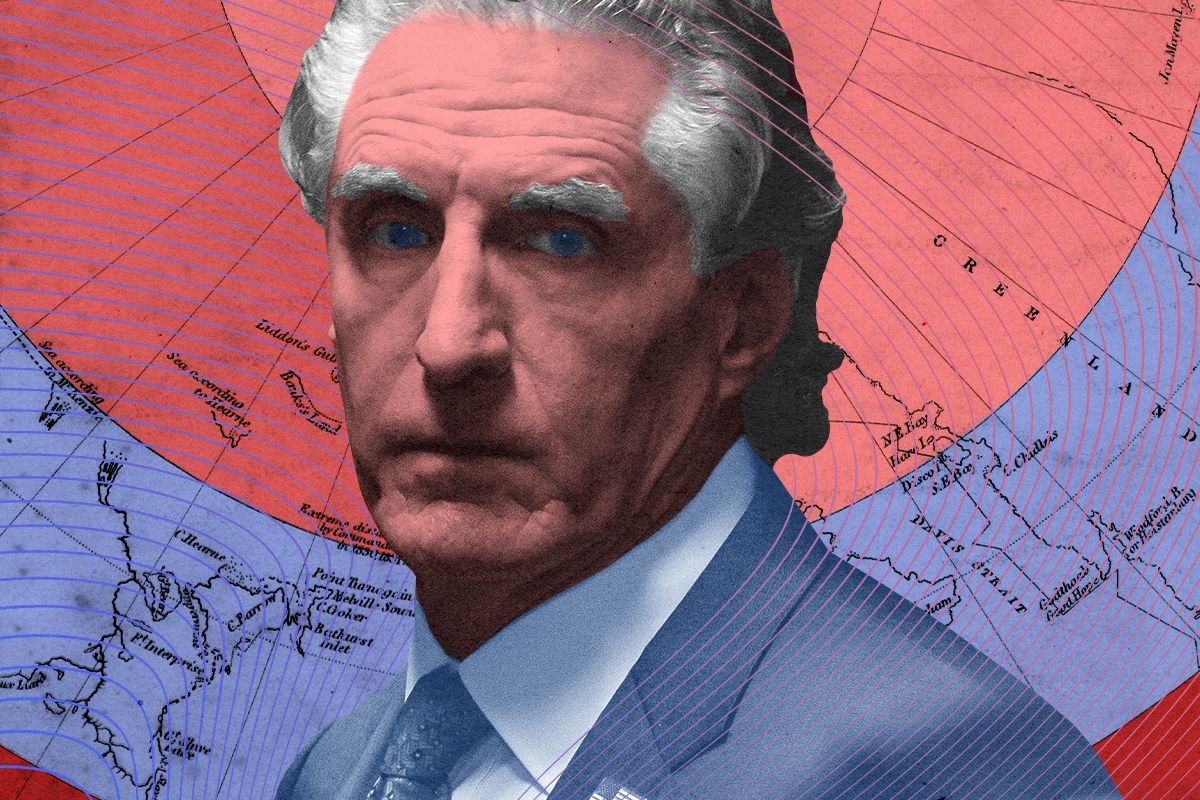
The interior secretary and former North Dakota governor used to praise liberty. Now he is betraying it.

One thing has long stood out about U.S. Interior Secretary Doug Burgum: Even before he ran for office, he talked a lot about freedom. It’s really striking, even for a Republican.
Perhaps you don’t know Burgum’s story. He grew up a shaggy-haired boy in tiny Arthur, North Dakota. In 1983, he mortgaged a part of his family farm to fund a software company, Great Plains Software. The company was a success, and it made him wealthy as a young man.
Burgum talked about the startup — and the new technology industry to which it belonged — as something nobler and higher than just a hustle. The software industry, he told lawmakers in 1998, helped make the people who participated in it free because it helped them flourish. “Part of the appeal of this industry is the freedom to succeed or fail based solely on one’s own abilities,” he said. He was known as a good boss.
Microsoft bought his company, making Burgum a billionaire. He stayed there for a few years, then became an investor and a real estate developer. In 2016, he ran to be North Dakota’s governor and won by a landslide.
Observing Burgum for a few years now, I’ve seen him talk about freedom in a few ways. He is a federalist. Although he praised the First Amendment’s liberties, which he describes as inherent and God-given, he speaks often about the Tenth Amendment, too — the part of the Bill of Rights that says powers not delegated to the federal government are retained by the states and the people.
That idea, he said while running for the Republican presidential nomination in 2023, was something national Republicans too often forgot. “When I see the Republican Party try to get into things where we’re also overreaching, it also goes against this principle. There isn’t a one-size-fits-all federal rule — it should be returned to the states,” Burgum said.
Even his criticism of President Joe Biden’s “green fantasy energy policies” was rooted in this understanding of freedom. It wasn’t just that Biden’s policies limited consumer choice, he said, but that they empowered freedom’s enemies. They kept U.S. oil in the ground while encouraging Americans to buy electric vehicles and critical minerals from China.
“To defeat those adversaries, we must have a leader who understands the power of free societies and free markets,” he said.
Burgum didn’t win the 2024 nomination, and he wasn’t — as some hoped — picked for vice president on the ticket, either. But he won control of Trump’s energy agenda. Today, Burgum not only runs the Interior Department, but also chairs the National Energy Dominance Council, an ad hoc body that oversees energy and environment policy.
He’s kept talking about freedom in his new role — and he connects liberty to the eternal human struggle to flourish. “Human flourishing in this world has always been dependent on affordable and reliable energy,” he told Stanford students last year.
Which is why I was astounded to see this post last week:
Now, Burgum is a light-hearted guy, and obviously, we’re meant to chuckle. It’s a joke. Alaska and Washington, D.C., are part of the “old interior,” but Greenland’s capital, Nuuk, is the “new interior” — future American territory.
Burgum defended himself on Fox News last Thursday. “Who knew that posting a factual map of Alaska and Greenland would be triggering to those folks who do not fully understand the importance of Greenland and the strategic nature of protecting the United States of America?” he said.
Burgum is wrong. His map was not factual: Greenland is not part of the American interior; it is part of Denmark. To describe it as the “interior” of America should humiliate Burgum’s liberty-loving soul. But what we can tell from this tweet is that Burgum is mentally preparing himself for a terrible betrayal of the values and ideas he once celebrated.
What would that betrayal be? Nothing less than the open theft of Greenlanders’ most fundamental freedoms. On Fox, Burgum said that Trump wanted to “buy” Greenland — but this is such a twisting and abrasing of the truth as to make a patriot yelp. Trump desires Greenland by any means, and he is willing to use the military to bully Denmark and the Greenlandic people into selling their sovereignty.
This is not friendly commerce between two equals, as a free market requires, but rather petty and corrupt gangsterism. Trump is shoving a gun in Denmark’s face, muttering, We can do this the easy way or the hard way. Burgum claims to see nothing wrong with this degeneracy.
He should. Less than two years ago, Burgum praised the Constitution and “the historic and aspirational vision presented by our Founding Fathers.” That cohort’s insight — the reason we remember its members now, despite their flaws — was that the most fundamental political freedom is political self-determination. “All men are, by nature, equal and free,” wrote James Wilson, one of only six men to sign both the Declaration and the Constitution. “No one has a right to any authority over another without his consent: all lawful government is founded on the consent of those who are subject to it.”
Yet Burgum would help establish Trump’s authority over more than 55,000 Greenlanders without their consent and over their objections — a government that would reek of illegality from its birthpangs. And Burgum would be its midwife. The Office of Insular Affairs, which he oversees as part of the Interior Department, manages America’s territories and freely associated states, such as Puerto Rico and Palau. Greenland could soon fall under its purview, too. Burgum could easily become Greenland’s colonial governor, its federal subjugator.
All lawful government is founded on the consent of those who are subject to it. I have been to Greenland. It is an austere and beautiful country, home to a population of independent and freedom-loving people who want to prosper, raise their families, farm, hunt, thrive, and flourish. It should sound familiar: Greenlanders are not so far from Burgum’s old North Dakota constituents.
Either Burgum will now see the resemblance and desist from Trump’s corrupt attack on liberty, democracy, and the principle of self-government itself — either he will block it, delay it, never defend it in public or in private, and never joke about the wicked betrayal of an ally again — either he will review and revise the resignation letter in his desk drawer — either he will, in other words, act as a free man, or he should stop lying to Americans about his love of freedom and admit that he now believes instead that might makes right — that Donald Trump’s word is law, or close enough to it — and clarify for us, at last, that he has already become one of the president’s moral degenerates.
“Ronald Reagan famously told us, ‘Freedom is never more than one generation away from extinction,’” an earlier version of Doug Burgum once told us. It was 2024, and he was running for president, addressing Republicans in Florida. His political prospects had never looked better.
Burgum paused for a second. He wanted the audience to think about the quote — to stick with Reagan’s words.
“Sometimes people remember that [line],” he said, “but they forget the second part of the quote, and I think it’s the most important: ‘Freedom must be fought for and protected, or we’ll spend our later years telling our grandchildren what it was like when America was free.’”
To fight and protect freedom — what would such an act demand of Doug Burgum in this moment, when a president is threatening America’s neighbors and trying to impose the very definition of unfreedom on its friends? Burgum was a thoughtful politician once: an independent and heterodox leader who loved liberty and wanted to see Americans flourish. Will he now do his duty to America and the world? Or will he push the country and its imperial subjects — no longer free citizens — into an unfreedom that will aggrieve and impoverish us well into our grandchildren’s lives. The choice is his. He has his freedom, now let him use it.
This Halloween, get 20% off using code ADVANCED
Log in
To continue reading, log in to your account.
Create a Free Account
To unlock more free articles, please create a free account.
BAAJA survived its first test, but Trump says the bill “hasn’t been fully negotiated.”
The Senate on Monday night moved to open debate on the Bipartisan American Affordability and Jobs Act — just after the president bizarrely threw cold water on the deal he struck for the bill.
Senators agreed to invoke cloture on a motion to proceed to the bill by a vote of 73–25, a forceful bipartisan tally that could bolster momentum behind the bill. Up next comes what Senator Sheldon Whitehouse, the Democrat from Rhode Island and one of the key sponsors of the bill, called a “healthy amendment process” at a press conference Monday morning. This will constitute the last remaining opening for senators and outside constituencies to try and change provisions they disagree with. How many amendments will make it to a vote, however, is not publicly known. Nor is how fast debate on the bill will move along, so best be patient.
I’m aware of pushes for at least two amendments to be considered — one ostensibly to remove the bill’s changes to the National Historic Preservation Act and another related to future administrations potentially revoking Trump-era permits. Some of the lawmakers who voted to proceed on the bill may become “nays” depending on how the amendment process goes.
In a normal world, this would be the clarifying moment for BAAJA, when the clouds would part and a pathway to passage and enactment would appear obvious. There are certainly rays of hope for the pro-BAAJA squad because a large bipartisan vote would help the legislation move briskly in the House.
But we still live in the Trump era, so instead, just as senators were preparing to vote, and after the White House released a formal statement endorsing the bill, the president told the world that actually, the deal wasn’t done.
Politico reported in September that the president told his aides he would direct the Pentagon to clear its queue of onshore wind projects to strike a deal on permitting. The White House has for weeks been telling reporters it’s been advancing wind projects through the Pentagon airspace clearance process in good faith. As we reported in late October, these claims have not always lined up with what the administration and renewable energy trade groups have been stating in federal court, where a judge months ago required the government to resume these once-routine height approvals.
For some reason, asked about this at a White House media briefing Monday evening, Trump told reporters from the press room podium that actually he won’t approve wind turbines even if the bill becomes law. Then he said, “The bill hasn’t been fully negotiated.” You can watch the full clip of the comments here.
It’s unclear whether these comments affected the bill’s odds at final passage, but they did lead to a very long all-caps post on X from Representative Jared Huffman, who’s in line to lead the House Committee on Natural Resources in the coming Congress. The White House has tried to clarify the president’s remarks, and Senator Whitehouse blamed the comments on Trump’s age. So just because we’re seeing legislative progress doesn’t mean the future will make sense.
Researchers, advocates, and funders gathered to discuss intervening in the global climate on purpose.
For decades, deliberately intervening in the Earth’s climate system was something most scientists and policymakers didn’t dare talk about. But last month, more than 250 people from six continents gathered in Reykjavik, Iceland for a three-day summit devoted entirely to willfully tinkering with the climate to make it more resilient.
The gathering served as a purposeful, if hesitant, coming out party for a field so controversial that just a few years ago, hundreds of researchers signed the Solar Geoengineering Non-Use Agreement, which called for an end to public funding for scientific research into the field. But this summit revealed that the sector — while still deeply divided over questions of money, governance, and deployment — is beginning to emerge from the shadows.
Why now? The consensus among climate scientists about our ability to mitigate warming is growing more dire by the day. The United Nations now acknowledges that limiting temperature to 1.5 degrees Celsius above pre-industrial levels is out of reach, putting more drastic adaptation solutions in play.
“It is increasingly clear to anyone who’s paying any attention that we are screwed, right? That we have blown past every possible reasonable threshold at which our existing theory of change can possibly lead to a safe and equitable climate future,” Joshua Elliott, chief scientist at Renaissance Philanthropy, told me. He directs the two-year-old nonprofit’s Advanced Research for Climate Emergencies initiative, which organized the event. “I feel like the second election of Trump was such a nail in the coffin.”
The three-day Global Risk and Stabilization Summit brought together scientists, engineers, funders, insurers, and at least one venture-backed startup to talk about everything from thickening Arctic sea ice to shielding Antarctic glaciers with underwater curtains to spraying reflective particles into the stratosphere to bounce a portion of incoming sunlight back into space. That last approach, a method of solar geoengineering known as stratospheric aerosol injection, tends to dominate geoengineering discussions, as it could theoretically cool the planet quickly and relatively cheaply.
That doesn’t mean it’s generally accepted, however. Far from it. The sessions at the ARC summit ran under Chatham House Rules, i.e. no reporting who said what — or even whether they were there at all — without explicit permission. ARC plans to release a synthesis report on the state of field next year, but in the meantime the conference website made clear: “Attending the summit does not imply that you endorse the report, any particular intervention, or the stabilization framing. Attending means you are taking part in the conversation and nothing more.”
This type of careful distancing is par for the course in geoengineering circles. Just as many mainstream climate advocates once viewed adaptation — and later carbon removal — as distractions from the need to cut emissions, geoengineering has suffered under the same criticisms. Its oftentimes sci-fi sounding interventions are already ripe conspiracy fodder. Add to that its underresearched environmental impacts and side effects, and some of these strategies could prove truly disastrous in the wrong hands.
But at least people are finally talking about it. In the weeks since the summit, attendees have published dozens of Substack and Linkedin posts about what they saw, heard, and took away from the conference. I talked to many of them about this first attempt to intentionally gather and grow the sector.
Naturally, they don’t all agree on the best path forward. Seemingly everyone acknowledges that conducting more research and designing better Earth monitoring systems is a no-lose situation. But big questions remain unresolved: what role private capital should play; how openly to discuss the possibility of near-term deployment; the somewhat uncomfortable overlap between climate engineering, defense, and national security; and how to educate policymakers and the general public about interventions that sound to some nefarious overlords trying to control the weather.
The field doesn’t even yet agree on what to call itself. The conference organizers prefer “Earth systems stabilization” to “geoengineering,” arguing that a sector like this should be defined by its goal rather than how it gets there. The terminology remains unsettled, however, with one critic, University of Waterloo economist and former geoengineering researcher Juan Moreno-Cruz telling me in an email that the renaming “feels like a campaign” with the “objective of moving more towards action.”
At this nascent stage, any one individual can have an outsized voice. Based on the published speaker list, as well as various recaps posted during and after the event, the guest list featured some of the field’s biggest names. That included David Keith, founder of the direct air capture company Carbon Engineering and a pioneer of solar geoengineering, which involves releasing aerosols like sulfates into the atmosphere to reflect a small portion of sunlight back into space. Also in attendance were Columbia University climate economist Gernot Wagner, Paris Agreement architect Sue Biniaz, and J.P. Morgan climate advisor Sarah Kapnick, alongside delegates from some of the big environmental NGOs, including the Environmental Defense Fund and Natural Resources Defense Council.
More potentially polarizing attendees included Yanai Yedvab, the CEO of solar geoengineering startup Stardust Solutions — one of the first for-profit entities to enter the space — and Lowercarbon Capital, the climate tech venture firm that led its Series A round.
The function that private sector funding and venture-style startups could or should play in this field remains one of the biggest points of tension. Many strongly believe that the only appropriate customer for a globally consequential intervention like stratospheric aerosol injection is a coalition of national governments. But there seems to be a preemptive acknowledgement among those I spoke with that getting the United Nations itself to align on research and potential terms of deployment is unlikely.
Paul Gambill, an ARC fellow and co-founder of Nori, an early carbon removal marketplace, told me that one session at the summit was titled “The Future is Minilateral,” a nod to the growing interest in a small bloc of countries — “maybe six or so” — working together on the issue. Several people I spoke with described a model in which governments would buy technology from a company like Stardust, but retain control over if, when, and how to deploy it.
But even within the ARC set, that framing seems to have skeptics. Noah Deich, another ARC fellow and carbon removal veteran who co-founded the nonprofit Carbon180, sees the profit motive as inherently dangerous. There’s no guarantee that the science will ever advance to the point where governments are comfortable becoming customers, but investors always want to see returns. That disconnect, he argues, creates the incentive to commercialize the technology before either the research or the public is ready.
“That to me is very, very concerning, and shows a lack of judgment at a first order for the people who have invested in this, and for the people who have accepted that private sector money,” Deich told me. “That makes me very, very wary about what they’re going to do when faced with the choice of, hey no government wants to do this. Or these governments have said it is illegal, and this one says it’s fine. Like, will they actually respect the ones that say it’s illegal?”
Others see private capital as all but inevitable. Susan Su, a climate tech investor and analyst, thinks the sector would do best to engage with the private sector strategically rather than fearfully. “Money in general comes with ideas, and in my view, that’s okay,” she told me. If a venture backer has their own notions about how and where to deploy stratospheric aerosol injection, for instance, that need not dictate the agenda. “It’s the entrepreneur’s or the initiative’s job to push back against those ideas and to shape them.”
Su also thinks the field ought to be more open to discussing deployment as a possible outcome from both the research and conditions on the ground, rather than treating it as the third rail. “There’s a sentiment of caution that I think is rooted in a previous era, where it’s been a long road to reach whatever limited consensus there is today that we should even research this,” she explained to me in an email. “With that much caveating, it’s hard to imagine why a funder would get excited to back something that everyone’s saying shouldn't exist.”
Still, it’s not hard to imagine a near-term future in which climate change presents an increasingly urgent national security concern, and the instant governments start treating geoengineering as a defense priority, the money could be practically limitless. Private geoengineering companies could function essentially as defense contractors, with militaries as their primary customers.
The comparison makes some understandably uneasy, as it risks framing climate interventions as weapons to be wielded by states with the resources to develop and deploy it. But however you look at it, “people are starting to realize, there’s no scenario where this stuff doesn’t become geopolitical very very fast,” Gambill told me. And that makes an already controversial field considerably messier.
One way to sidestep some of the thorniest questions around global governance could be to start with a focus on more localized interventions. In the Arctic, for example, companies such as Real Ice and Arctic Reflections are testing ways to thicken sea-ice by pumping seawater onto its surface during the winter. In Antarctica, researchers are studying the feasibility of underwater “seafloor curtains” in front of the Florida-sized Thwaites Glacier to keep warm ocean water from melting it from below. If that glacier were to fully collapse, it could raise global sea levels by up to two feet. There are also some truly low-tech options on the table, too: One calls for reintroducing bison to the Alaskan tundra, where their heavy footsteps would compact the snow and help keep the underlying permafrost frozen.
There’s even a more localized version of solar geoengineering. Called marine cloud brightening, it involves spraying a fine mist of seawater into low-lying clouds over the ocean. The salt particles encourage the formation of smaller cloud droplets, making the clouds brighter and more reflective, cooling the ocean and surface below. Unlike stratospheric aerosol injection, the impacts of which could persist for a year or more, a single deployment of marine cloud brightening lasts mere days, making it readily reversible and easier to test. Australian researchers have piloted this tech over the Great Barrier Reef.
"It feels like people read Kim Stanley Robinson’s novels and are trying to actually figure out if any of that stuff makes sense,” Deich told me. In Robinson’s acclaimed 2020 novel The Ministry for the Future, he imagines efforts at stratospheric aerosol injection, glacier stabilization, and large-scale rewilding in response to a fictional — but readily imaginable — catastrophic heat wave.
Deich worries, however, that he didn’t hear enough emphasis at the summit on the ongoing role carbon removal — not just emissions cuts — would have to play in a world even temporarily reliant on an intervention like stratospheric aerosol injection. That’s because of the risk of “termination shock”: If scientists suddenly halted solar geoengineering, the warming it had been masking would likely return within just a few years unless carbon removal efforts could draw down significant CO2 in the interim.
“The [carbon dioxide removal] community from the very early days tried very hard to say, first priority is obviously stopping emissions, but we also need to do removal, and we can’t wait for one to do the other,” Deich told me. “And I don’t see that same type of drumbeat being articulated by the SRM crowd.”
He and others are well aware of the moral hazard argument that has long dogged carbon removal: that this tech will give fossil fuel companies cover to keep emitting, and politicians an excuse to avoid the harder work of decarbonization. With carbon removal, however, that concern is generally simple to rebut. All recent IPCC reports have concluded that removals will be necessary to keep warming anywhere near safe levels. And in many cases, cutting emissions is still far cheaper than removing carbon after the fact.
But it’s a different calculus for an intervention like stratospheric aerosol injection, which is cheap by comparison and could lower global temperatures without doing anything to address the underlying emissions buildup. It’s easy to see how policymakers and the public could say, “Let’s let future generations deal with this building up of greenhouse gasses. We don’t really have to care about that now, we can just keep the temperatures a bit lower and buy ourselves time,” Robert Höglund, a carbon removal advisor and co-founder of the market tracker CDR.fyi, told me. “I think that’s fair. It’s a real risk.”
For its part, ARC plans to publish a report early next year bringing together the work of roughly 40 authors to lay out the state of the field’s science, governance, and social legitimacy. This will come alongside an open map of the interventions being studied and tested as well as funding and research gaps that remain. Rather than immediately holding another global summit, the organization plans to convene regional meetings next year primarily in low- and middle-income countries to explore possibilities for local research efforts in climate vulnerable nations. The next global gathering might then be scheduled for 2028.
In the meantime, many hope ARC and others will help shepherd along myriad research and communications efforts. Because if any message dominated the inaugural summit, it was: Geoengineering isn’t yet ready for prime time. There’s much more research to do, and significant stakeholder groundwork to lay, especially as the field considers how to best invite policymakers into the conversation.
“You cannot create a field. Nobody can declare it into existence,” ARC director Joshua Elliott told me of the effort to bring together the disparate experts working on climate stabilization. What organizations like ARC can do is build the infrastructure for it to emerge. That looks like convening researchers, advocates, and even skeptics; synthesizing siloed knowledge; opening the arguments to debate; establishing academic journals; and creating funding streams within governments and other institutions. But from there, the big decisions belong to others.
“That’s where our theory of change stops,” Elliott told me. ARC won’t decide whether the aerosols are injected into the atmosphere or Arctic ice is thickened. “It is the governments and the multilateral institutions that we have charged with making these decisions, despite however functional you think those institutions might be.”

Current conditions: Another atmospheric river is deluging the West Coast, this time in the Pacific Northwest • Dozens of U.S. cities notched record high temperatures in October • At least 11 of Thailand’s southern provinces are under emergency warnings for flooding and nearly 7-foot waves amid a surge of monsoon conditions.
The 31st annual global climate summit kicked off this morning in Antalya, a Turkish resort city on the country’s southern Mediterranean coast. Known as the 31st Conference of the Parties to the United Nations Framework Convention on Climate Change, or COP31, the event marks the second year in a row that virtually every nation on Earth will gather except the United States, after President Donald Trump withdrew the country from both the landmark 2015 Paris Agreement and from the larger global body shortly after his return to office last year. The biggest item on this year’s agenda, reports my colleague Emily Pontecorvo, is the “35x35” pledge, Turkey’s proposal to electrify 35% of the world’s final energy use by 2035. Today the world uses electricity for just 21% of end-use energy. As I reported last week, the latest projections from the Rhodium Group put the likely electrification rate worldwide at 28% by 2035.
Senate negotiators on Saturday released an update to the text of the bipartisan permitting reform deal, known as the “manager’s amendment.” The new version of the Bipartisan American Affordability and Jobs Act, or BAAJA, overhauls the provisions to make building transmission lines easier, addressing concerns that a proposal to allow federal and state permitting to begin at the same time threatens states’ power. It also adds benefits for power lines renovated with advanced transmission technologies to allow them to carry more electricity. “There’s something in these changes for everyone — environmentalists, tribes, utilities,” my colleagues Robinson Meyer and Jael Holzman wrote over the weekend, “but it remains to be seen if they put the bill into a Goldilocks zone.” Perhaps most importantly from a political perspective, the revised legislation veers away from some proposals Native American groups had called an infringement on tribal sovereignty. “Definitely not enough to satisfy all tribes — there are 575 across the U.S. — but nonetheless, notable and probably approaching something large tribes and tribes with significant interest in energy development can live with,” Julian Brave NoiseCat, a writer and the first Oscar-nominated Indigenous North American filmmaker, wrote in a post on X. Still, in a sign “that there’s real effort here to try to honor tribal consultation,” he noted that the manager’s amendment excludes the records tribes share with federal and state governments from Freedom of Information Act, which would “keep sensitive sacred sites from exposure.”
The chamber is scheduled to hold a procedural vote on the bill later today. Last night, Trump himself finally endorsed BAAJA, urging “all senators” to vote for the bill on Monday, calling it a “big win for U.S. energy independence and dominance” in a post on Truth Social.
Anthropic has struck a deal for 1.7 gigawatts of gas-fired engines to power its data centers. Valued at $3.4 billion, the Claude maker has agreed to help with engineering and construction to install the generators as part of the deal with San Antonio, Texas-based equipment supplier OnePWR Solutions, the Financial Times reported over the weekend. Anthropic stopped short of acquiring OnePWR itself, instead taking over the generator orderbook previously pledged to construction giant Caterpillar.
The deal got plenty of notice in the financial newswires, and yet the news was largely overshadowed in the artificial intelligence world by the blockbuster revelation that Jensen Huang, the chief executive of AI chipmaker Nvidia, had an extramarital relationship with a Chinese spy, prompting an investigation by his company’s board of directors.
Sign up to receive Heatmap AM in your inbox every morning:

Jean-Luc Mélenchon, France’s far-left presidential hopeful and the No. 2 candidate behind the far-right Marine Le Pen, has pledged to shut down the 18 nuclear power plants that provide the overwhelming majority of the country’s power and render its grid one of the cleanest in Europe. “We advocate a mixed economy guided by the ecological imperative,” Mélenchon said in a speech Saturday, in which he also promised to send French warships to Gaza to confront the Israeli military head on. The current nuclear power program, he said, “is dangerous, costly, and risky. We will abandon it.” Instead, he said, France would generate all its power from renewables, buttressing wind and solar with as-yet-unproven wave and tidal power technology. “If you criticize nuclear power in the same breath as you promote marine power, your policy isn’t a clown but rather the entire circus,” Seaver Wang, an oceanographer turned energy expert at the Breakthrough Institute in the U.S., wrote in a post on X.
Meanwhile, a political crisis in remote Paraguay has cast one of Latin America’s more promising would-be nuclear newcomers into uncertainty. Just last week, a source familiar with U.S. government plans to export nuclear technology told me Paraguay was near the top of the list of countries looking to set up a civilian nuclear program under Washington’s guidance. The two nations signed a memorandum of understanding in August, and U.S. Deputy Secretary of State Christopher Landau visited the country just last month as part of a trade delegation. Whether the landlocked South American nation bought reactors or not, Asunción had plans to ramp up mining of uranium and titanium, Mining.com reported. But President Santiago Peña’s abrupt resignation Thursday amid the collapse of Ueno Bank appears to bring any further progress to a halt, at least for now.
China’s registrations of new wind and solar projects fell over 11% in September compared to the previous month as the number of distributed renewable projects dipped. The country registered 3,536 solar projects and 15 wind projects that month, versus 3,972 solar and 29 wind projects in August, according to a Renewables Now analysis of official government data. That isn’t to say solar is slowing down. Newly registered utility-scale solar projects more than doubled to 53 in September from 23 in August.
Democrats’ strategy of finding candidates with strong local appeal continues paying off, even on the most down-ballot of races. Over the weekend, the Associated Press declared Democrat Brian Matlock the winner of the Arizona Mine Inspector race. With a white handlebar mustache, he certainly looks the part of the Southwestern mine inspector if ever there were one.