The world’s second largest exporter of liquified natural gas is off the market. Qatar’s state-owned energy company announced Monday morning that its LNG production and export operations were halting “due to military attacks on QatarEnergy’s operating facilities,” including the Raf Laffan plant, which accounts for about 20% of global LNG supplies, according to Bloomberg.
This is very good news for U.S. LNG exporters and very bad news for anyone who’s in the market for seaborne natural gas imports.
Exports from Qatar largely go to Asia, with China as the dominant buyer, according to data from the investment bank Jefferies. Qatar has been exporting LNG since 1996, and is the world’s second largest exporter behind the United States, according to the U.S. Energy Information Administration.
Even before the strikes on Qatar’s natural gas infrastructure, all traffic through the Strait of Hormuz, the vital waterway linking Gulf oil and gas production to the rest of the world, had “effectively ceased for the time being” due to insurers withdrawing from the market and reports of some ships being attacked, according to the energy consulting firm Wood Mackenzie.
But the Strait of Hormuz only connects the Persian Gulf to the Arabian Sea. Its closure does nothing to obstruct passage through, say, the Sabine Pass, which connects Sabine Lake to the Gulf of Mexico, and is the heart of the U.S. LNG industry. With natural gas prices already shooting up, U.S. exporters appear to be in for a bonanza.
“If you’re talking to one of the buyers of LNG from Qatar in Asia and you still need LNG, you’re going to have to bid up somewhere else,” Ira Joseph, senior research associate at the Center on Global Energy Policy at Columbia University, told me. “Financially, this is really good for U.S. LNG. It’s a massive windfall for them.”
And, Joseph said, the crisis is unlikely to feed into domestic electricity prices. While a report issued by the Department of Energy toward the end of the Biden administration found that higher natural gas exports would lead to higher domestic prices for natural gas (and thus higher electricity prices), for the moment at least, export capacity is essentially maxed out, meaning that the increased demand for gas will translate largely into higher prices, not greater supply.
Shares of U.S. LNG exporters were accordingly up in early afternoon trading. Venture, which operates the Plaquemines and Calcasieu Pass export terminals in Louisiana, saw its share price rise some 14.5% as of 2 p.m. Monday. Shares in Cheniere Energy, which shipped America’s first LNG cargos in 2016 from Sabine Pass and has additional operations in Texas, were up around 5.5%.
The one U.S. natural gas export project scheduled to start up soon is, of all things, a QatarEnergy-ExxonMobil joint venture just on the other side of the Texas border from the Cheniere Sabine Pass facility. Production is expected to begin there this month.
And Qatar is also in the midst of planning to expand export capacity at home: QatarEnergy awarded engineering and construction contracts for its North Field West project, a move Jefferies had described as part and parcel of Qatar’s strategy of being “the lowest cost LNG producer, [which] remains focused on market share and is unwilling to adjust supply to market conditions.”
Now that loose supplier is off the market.
“Everybody will be competing for the same molecule of LNG. And that makes things very difficult,” Massimo Di Odoardo, Wood Mackenzie’s vice president of gas and LNG research, said in a webinar hosted by the firm.
“The gas energy market is structurally more volatile than the oil market. There is no such thing as strategic reserves. There is no such thing as spare capacity. Whenever there’s a shock in the market, the effect on prices is normally very strong, and this is a massive shock in terms of lack of supply,” he said.
Some of the most dramatic effects of this competition for LNG are likely to be felt in South and Southeast Asia, to which Qatar is a major exporter and where importers don’t have the same ability to withstand higher prices as they do in, say, South Korea or Japan.
Rich countries “will perhaps look for LNG from other sources to backfill the shortfall of debt supply, Di Odoardo said. “Countries like India, Pakistan, and Bangladesh might be less inclined to pay these very high prices at the moment.”
Joseph agreed with this view. Of Qatar’s big customers, Joseph said, Japan, China, Taiwan, and South Korea will likely hang in. But for poorer countries, “if prices get too high, you’re not going to buy the LNG,” he told me. “The loss of this much LNG is not going to be solved just through higher prices.”
The shock to energy prices has given many observers flashbacks to 2022, when Russia’s invasion of Ukraine helped tip Pakistan — which is very populous, very poor, and very reliant on energy imports — into an economic crisis. As that conflict unfolded, natural gas imports were redirected towards richer countries that could pay up, while poorer countries were left stranded in energy poverty.
The current shock to the LNG market, meanwhile, comes at a time when much of the world is rethinking its reliance on the United States, whether as a military partner or an economic one.
The whole scenario contains a distinct irony.
The United States escalated tensions with Iran into a full-scaled military operation with the goal of eliminating the Islamic Republic’s ballistic missiles and nuclear program and even overthrowing its ruling regime. In response, Iran has lashed out not just at the United States and Israel, but also at its Arab neighbors, including some of the world’s largest oil and gas producers. As a result of that escalation, U.S. energy exporters can expect increased profits in the short term, and the U.S. will likely see more sustained interest in economic partnerships in the medium to long term.
“In the grand scheme of geopolitical risks, this puts a bigger risk on the Middle East versus other regions, and has to be positive in terms of how U.S. energy looks in the global context,” Di Odoardo said.







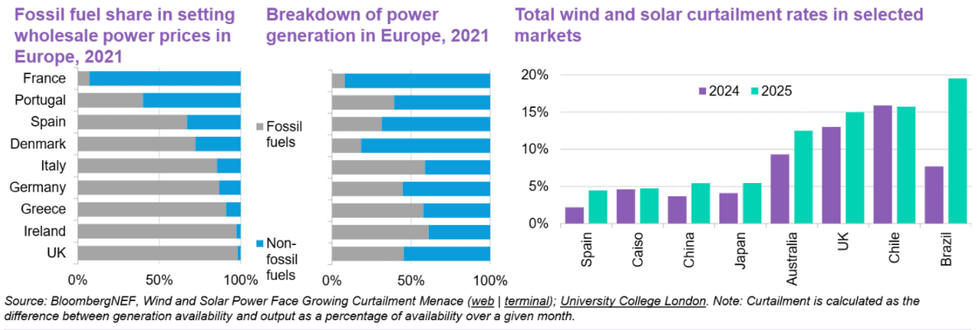 Curtailments are on the rise. BNEF