You’re out of free articles.
This Halloween, get 20% off using code ADVANCED
Log in
To continue reading, log in to your account.
Create a Free Account
To unlock more free articles, please create a free account.
Sign In or Create an Account.
By continuing, you agree to the Terms of Service and acknowledge our Privacy Policy
Welcome to Heatmap
Thank you for registering with Heatmap. Climate change is one of the greatest challenges of our lives, a force reshaping our economy, our politics, and our culture. We hope to be your trusted, friendly, and insightful guide to that transformation. Please enjoy your free articles. You can check your profile here .
subscribe to get Unlimited access
Offer for a Heatmap News Unlimited Access subscription; please note that your subscription will renew automatically unless you cancel prior to renewal. Cancellation takes effect at the end of your current billing period. We will let you know in advance of any price changes. Taxes may apply. Offer terms are subject to change.
Subscribe to get unlimited Access
Hey, you are out of free articles but you are only a few clicks away from full access. Subscribe below and take advantage of our introductory offer.
subscribe to get Unlimited access
Offer for a Heatmap News Unlimited Access subscription; please note that your subscription will renew automatically unless you cancel prior to renewal. Cancellation takes effect at the end of your current billing period. We will let you know in advance of any price changes. Taxes may apply. Offer terms are subject to change.
Create Your Account
Please Enter Your Password
Forgot your password?
Please enter the email address you use for your account so we can send you a link to reset your password:
Invest in Tomorrow Coalition says it took out clean energy adversaries in the midterms. Now it’s setting its sights on 2028.

A pro-renewables Super PAC – Invest in Tomorrow Coalition – is taking a victory lap, claiming it played a key role in the blue wave and announcing plans to be involved in the 2028 presidential primaries.
When I first heard of the Invest in Tomorrow Coalition, it was clearly a revenge operation. Backed by renewables companies and crypto magnate Chris Larsen, the Super PAC waded into primary elections this year to take out Republicans who voted to repeal most of the Inflation Reduction Act. Tom Matzzie, a renewables executive leading the Super PAC, described the organization to me as “focused on accountability for elected officials who decide they want to attack the clean energy industry.” Shortly afterwards, Invest in Tomorrow announced an investment in seven races before ultimately expanding to 18 races.
Now that the dust is settled, Matzzie told me that most of the races they intervened in wound up flipping red to blue: “I think we’re on track to win 12 or 13 of the 18 we invested in. We had seven or eight marquee races and we’re winning the majority of those. We were hopeful we’d get one in a tough district. We didn’t expect to get this many.”
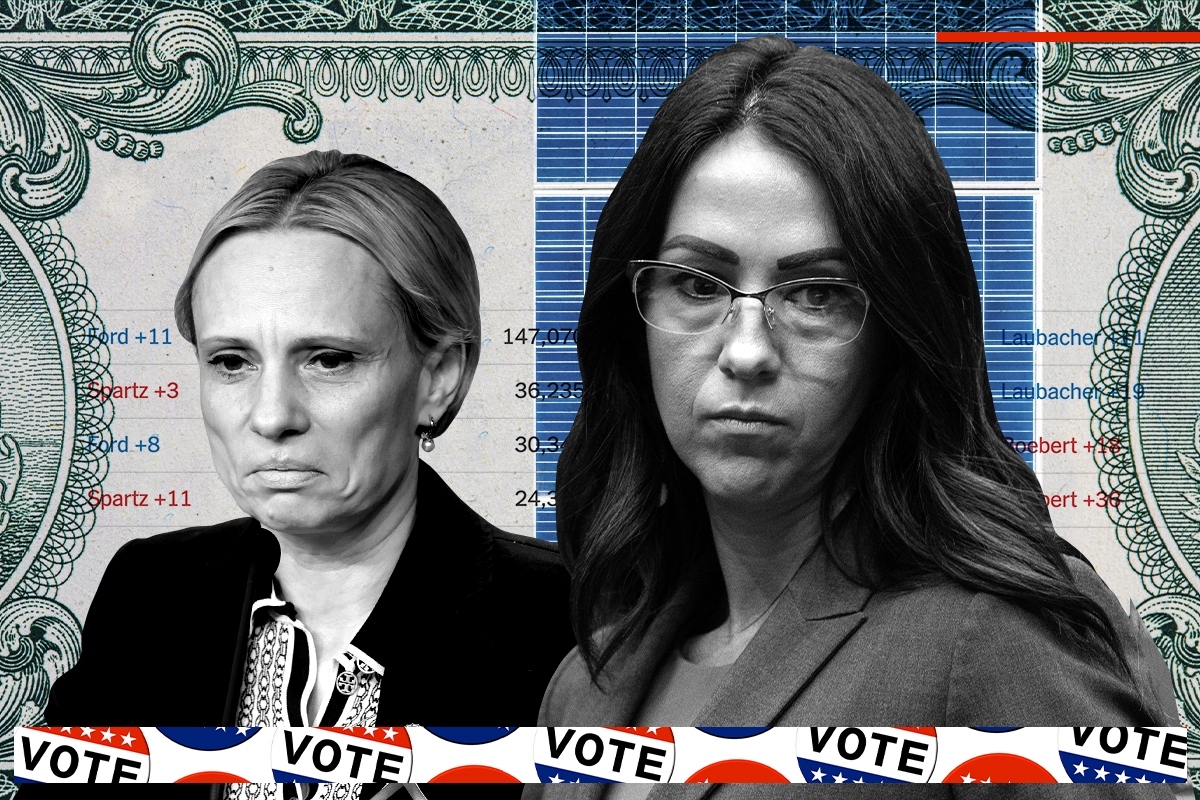
Their favorite trophy is Indiana’s 5th congressional district in the northern Indianapolis region, where Rep. Victoria Spartz lost a historically comfortable GOP seat to J.D. Ford, a Democratic state senator. Matzzie told me the Super PAC invested $2 million in the race to beat Spartz, which he claimed is more than both campaigns spent combined. (My search of FEC records shows that may be true, if you don’t count other outside assistance.)
After Spartz was declared the loser, the Super PAC sent an email blast to the media with a short statement: “Tell Victoria Spartz. We want her to know it was us.”
The Super PAC also claims at least partial responsibility for helping oust Rep. Lauren Boebert of Colorado, who lost by just a few thousand votes. I’m told they invested $1.5 million in the race, including on a digital ad centered around an incident where Boebert was escorted out of a live stage performance of “Beetlejuice.” The ad claimed Boebert couldn’t be trusted around children. It prompted Boebert to do a whole segment bashing the Super PAC while guest hosting former Rep. Matt Gaetz’s One America News show.
“Oh, I love it when they complain about us. I love it when they whine about us. We want them to spread the word to other members of Congress about what we’re doing,” Matzzie told me. “We want to send a message that we will do what is necessary to defeat you in your next election, including getting down in the mud if needed, and we have limits on what we say and won’t say, but it has to be truthful.”
Since it is already time for 2028 discussions, I asked Matzzie if the Super PAC had any ambitions to be involved in the presidential primaries next. Absolutely, he said. First that involvement will look like education. That could look like having pro-renewables voices urging GOP candidates to be more receptive to the sector, whether they be representatives of the business community or landowners with solar on their properties.
“The accountability part of this comes later as people firm up their point of view on what they’re running on and we don’t know what that is yet. We totally invite all of the candidates to be supportive of the clean energy industry if they’re running for president. That is our ideal outcome,” Matzzie said.
But if candidates don’t get the message will they go on the attack against primary candidates? “I have no hesitation about doing it.”
This Halloween, get 20% off using code ADVANCED
Log in
To continue reading, log in to your account.
Create a Free Account
To unlock more free articles, please create a free account.
On electrification’s shortfall, AI for nuclear, and Alva Energy’s big plans
Current conditions: Heavy rain is overflowing rivers in the Dominican Republic’s eastern inland towns, including Monte Plata, where floodwaters are washing away cars • With weeks to go before the Atlantic hurricane season officially ends, a new tropical storm may be forming between the Bahamas and Bermuda • It’s cloudy and 51 degrees Fahrenheit in London, where the British are marking Guy Fawkes Day, a holiday commemorating the 421st anniversary of the failed plot by English Catholics to assassinate King James VI of Scotland and I of England by blowing up the House of Parliament.
It’s a rebuke of President Donald Trump! A new era! A sign that President Lyndon B. Johnson’s prediction that the Democrats would lose the South until the end of young Bill Moyers’ lifetime (he died last year) was true! Maybe it’s all of these things. But one thing is certain: Democrats’ big victory Tuesday night halts what my colleague Robinson Meyer called “Trump’s energy revolution,” meant to defy the economics of renewables. There’s still much to dissect — we don’t even know who won shockingly competitive U.S. Senate races in Mississippi and Alaska. But my colleagues have a nice slate of stories to help us get started:
Vice President JD Vance is openly blaming the Trump administration’s war with Iran for Republicans’ midterm shellacking, and Democrats are formulating a new approach after campaigning against the conflict and its associated energy shock. Iran, meanwhile, is signaling its openness to peace talks, even as Tehran turns to guerrilla tactics to regain control over the Strait of Hormuz. All that looks to oil traders like more crude hitting the market. On Wednesday, the price of West Texas Intermediate crude, the U.S. benchmark, fell more than 8% to $88 per barrel. Brent crude, the global price measure, plunged nearly 9% to just under $95 per barrel. Murban crude, the stuff that leaves a Persian Gulf port in the United Arab Emirates, dropped 1% to just under $101 per barrel.

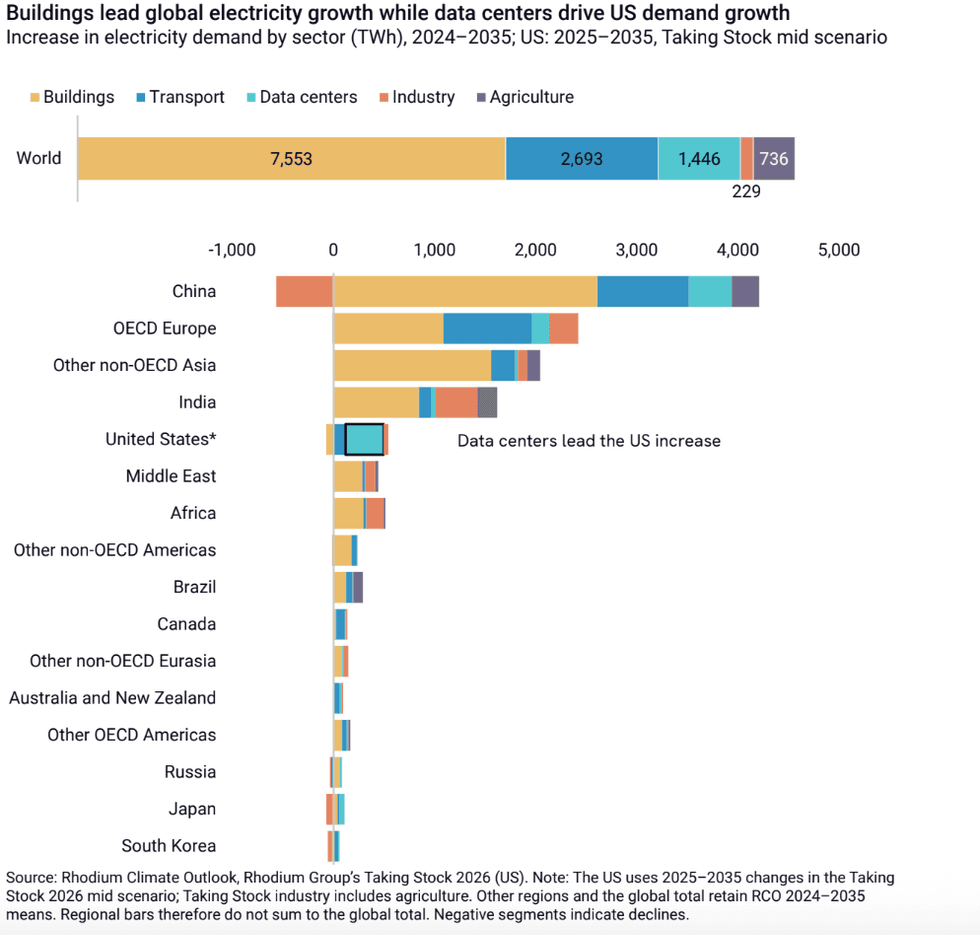
Big meals, big trucks, big computers — it’s the American way. Only one of those is a problem for electricity prices — a problem that’s also uniquely American. New projections from the Rhodium Group suggest that the U.S. is the only major market where data centers are the primary driver behind surging electricity demand, constituting between 62% and 77% of gross demand growth. In China, Europe, India, and the Middle East, residential and commercial buildings are by far the biggest new sources of demand for electricity to power air conditioning, heating, and appliances. Meanwhile, according to data from the consultancy Cleanview, upward of 41% of planned data centers in the U.S. are in states where newly elected governors are considering moratoria on new projects
.

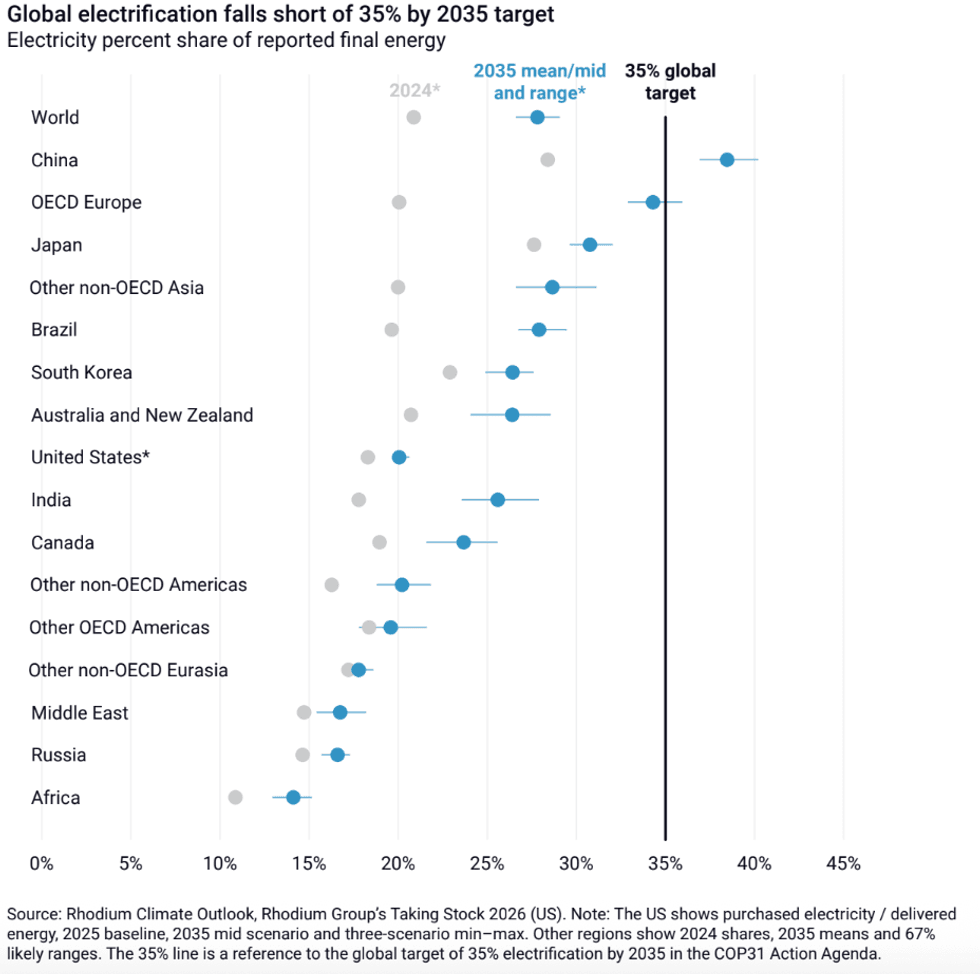
The Rhodium forecast also shows big global challenges for the fight to slow global warming. Electricity serves just 21% of the world’s end-use energy; by 2035, countries pledged to raise that figure to 35%. But the global average for electrification is on track to hit just 28% in the next nine years, threatening to maintain planet-heating pollution levels even as renewables surge and power emissions fall. Low-carbon sources of electricity are on track to generate upward of 80% of the power in China and the world’s richest economies, with variable renewables such as wind and solar producing the bulk of the output. Clean firm sources such as nuclear power and geothermal maintain a steady share of total output as variable sources eat into fossil fuels’ market. As a result, emissions shift to the parts of the world where fossil fuels will remain dominant. China and rich countries will account for 37% of emissions in 2050, down from 54% in 2024. India’s emissions will rise 26% by the middle of the century, and the entire African continent’s output by 37%. Worldwide industrial emissions are on track to stay static as the benefits of low-carbon steel are offset by the spike in production from coal-fired blast furnaces.
Sign up to receive Heatmap AM in your inbox every morning:
Whenever OpenAI or Anthropic releases a new model, the healthcare industry, say, can measure its capabilities by seeing how quickly it can pass a medical board test. Last year, the AI startup Atomic Canyon — which formed to help nuclear plant operators sift through mountains of documents using large language models — inked a deal with the Idaho National Laboratory to create a test that can check the software’s ability to work with a nuclear plant. Fourteen months later, the partnership has yielded results. On Thursday, I can report exclusively for this newsletter, Atomic Canyon is set to launch what it calls NuclearBench, the first open-source benchmark designed specifically to evaluate how LLMs perform on questions related to nuclear energy. “Think about it like an open-book exam for AI models,” Trey Lauderdale, Atomic Canyon’s founder and chief executive, told me. The company worked with INL to design a 280-question exam, which can then be administered to AI models, whose answers are judged by accuracy and context.
“As you’d expect, the more advanced models perform better. You’ve got OpenAI, Google, and Anthropic all vying at the top,” Lauderdale said. “Nothing we wouldn’t expect, but it’s nice to have actual metrics and information that validate general hypotheses you might have. You could instinctively say, This model is doing better. But it’s really important as an industry that you start benchmarking what these models can do.” Atomic Canyon’s test is not yet at the level of a medical board exam, he said. But the company plans to continuously update its exam to account for the growing sophistication of LLMs. Eventually, Lauderdale hopes to roll out more targeted tests focusing on safety and risk, reactor engineering, emergency preparedness, radiation, and other factors. “It’s the equivalent of the tests to become a general physician or those to become a cardiologist, dermatologist, or gastroenterologist,” he said.
Last month, I told you when tech giants announced a series of deals to help fund “uprates” at existing nuclear plants, renovations that potentially squeeze hundreds of megawatts of new generation out of reactors that are already running. The deals with Google and Amazon looked to generate more than a gigawatt of new power through uprates across PJM Interconnection, the most stressed grid system in the U.S. Now a startup specifically designed to affordably uprate reactors is considering projects to generate as much as 1.2 gigawatts of new power out of existing plants — and it just received a major endorsement from a utility industry heavyweight. I can exclusively report that, on Thursday, the developer Alva Energy plans to announce that Jeff Lyash, the former chief executive of the Tennessee Valley Authority and Ontario Power Generation, would join its board of directors. Lyash has plenty of nuclear experience. OPG, owned by Canada’s most populous province, operates the second-largest nuclear fleet in North America after the U.S.-based Constellation Energy. It’s also building the continent’s first small modular reactor, the first of GE Vernova Hitachi Nuclear Energy’s 300-megawatt units. The federally owned TVA, from which Lyash retired last year following Trump’s return to the White House, operates three nuclear plants and is building what’s expected to be America’s first SMR, the second GE-Hitachi BWRX-300 after OPG’s project at its Darlington plant. Lyash will be the fifth member of Alva’s board. After former Intel CEO Pat Gelsinger, he’s the second to come from outside the company; the other three board members are Alva’s co-founders.
“What’s been pretty amazing is that we’re starting to attract top-tier industry talent,” James Krellenstein, Alva’s chief executive and co-founder, told me. “Jeff joining the board has been pretty transformational because he brings a massive amount of experience in modifying existing plants.” At OPG in particular, Krellenstein said, Lyash oversaw refurbishments of the utility’s CANDU reactors. He also sits on the boards of the utility Dominion Energy, the Canadian construction giant Aecon, the industrial conglomerate Curtiss-Wright, and the European reactor startup Newcleo, which Krellenstein said lends Alva greater insight into other sectors’ large-scale project management. “What the economy of the United States is looking for is sources of clean, 24/7 power. Nuclear power uprates are a way in the short term to get that demand fulfilled in the United States while simultaneously rebuilding the execution capability necessary to create new plants. That’s the exact scaling strategy that Alva is working on.”
It’s no Norway, where electric vehicles make up nearly 99% of new car sales. But EVs’ share of Germany’s new car market soared to a record 37% last month, according to data from the country’s national motor vehicle authority, the Kraftfahrt-Bundesamt. That, according to Electrek, equates to 94,086 new battery-electric vehicles, up nearly 80% from the 53,425 sold a year earlier.
‘It’s truly possible that a lot of people will wake up and realize that the spell is broken from Trump.’
After Donald Trump won his second term two years ago, I wrote about “the death of climate tech” — or at least the death of the term. That largely held up. Climate-focused investors and startups increasingly dropped the label in favor of energy security, efficiency, and infrastructure resilience, often reframing their pitch to serve the booming data center industry along the way. Following the Democrats’ midterm sweep on Tuesday, I checked in with “climate tech” investors to see whether the industry might be ready for a rhetorical — and ideally literal — comeback.
On the rhetoric, they were largely unconvinced. On the substance, they were a bit more hopeful.
“This was not an election that was a referendum about climate or energy or anything even close to that,” Lara Pierpoint, managing director at the philanthropic climate tech firm Trellis Climate, told me. The consensus was that voters were far more concerned with affordability, Trump’s deep unpopularity, and, to some extent, the data center backlash. Sure, all of these issues touch on climate, but it was by no means anyone’s central message.
But that doesn’t mean Tuesday wasn’t still a win for the energy transition.
“This new Congress, controlled by Democrats, will focus mostly on energy affordability and access,” Gabriel Kra, managing director at Prelude Ventures, told me. That, he said, will likely encompass a push for more solar, wind, and batteries in energy planning — but “all in the name of affordability and reliability, not focused on climate.”
Susan Su, a climate investor and analyst, expects this El Niño cycle to bring climate back into the conversation, but “maybe more in the form of adaptation, extreme weather, and just resilience,” she told me.
“I don’t think we’re going to rush back to talk about climate this or that. I think we will rush back to acknowledging that this is the macro of all macros,” Andrew Beebe of Obvious Ventures told me, meaning climate remains one of the biggest forces shaping the global economy, whether or not investors and policymakers choose to call it that. “Maybe it’ll just get more attention in whatever name, I don’t really care.”
Still, investors aren’t expecting an immediate flood of federal climate action in the lame-duck session, although, of course, passing the permitting bill would ease the way for economy-wide electrification. And Kra told me it’s still too soon to know whether some of the Trump administration’s canceled or frozen grants for technologies like clean cement, steel, hydrogen, and carbon capture could be revived under a Democratic Congress. Restarting that funding would certainly offer a beacon of hope for clean industries that have yet to move down the cost curve and into the realm of true affordability.
Investors’ most realistic near-term hope is that Tuesday’s results mark the beginning of a more stable era for the clean energy ecosystem. “The Trump administration has just introduced so much chaos, and markets hate chaos. They love certainty,” Su told me. She pointed out that as the results rolled in, the 10-year Treasury yield dipped. Su read that as a sign that investors were rushing to lock in today’s higher rates, betting that a more stable political environment would lower borrowing costs down the road. That would both make first-of-a-kind projects cheaper to finance and push investors to chase riskier, higher-return bets in the venture market.
“Even just the perception of more certainty via a potential check on Trump — a legislative check on Trump — could bring cost of capital down, which is going to have a positive halo effect across our whole sector,” Su told me.
Kra expressed a similar hope: that the next two years will lay the groundwork for a more durable U.S. energy and industrial policy framework. “By durable, I mean guidelines and rules and laws that can survive a changed administration and a change of control of Congress,” he told me. “That will unlock affordable reshoring of American manufacturing. That will unlock an industrial and commercial response that will really catalyze growth in the economy, in clean electricity and energy, and in the innovation economy.”
I also heard some optimism that Republicans, battered by Tuesday’s results, might start to find their voice on clean energy as they begin to break free from Trump’s yoke. “My big hope would be that we finally enter a phase where Republicans can not be threatened to say what I think most of them already know, which is that the climate issues are real and need addressing,” Beebe told me. “It’s truly possible that a lot of people will wake up and realize that the spell is broken from Trump, and they will be able to, in the plain light of day, evaluate things at face value again.”
That could help depoliticize and expedite the rollout of technologies like electric vehicles and heat pumps, which have become partisan products in recent years. Meanwhile, Rajesh Swaminathan of Khosla Ventures told me via email that he sees lots of potential for bipartisan momentum behind superhot rock geothermal, fusion, critical minerals, and cost-competitive clean cement and steel.
Now, Su told me, it’s time for climate technologies that have talked a big game on affordability to prove it, giving investors and Republican skeptics no reason to dismiss them. “For years, founders have been talking about, ‘Oh, we’re not just cleaner, but we’re actually cheaper and better.’ Okay, so now it’s time to put your money where your mouth is,” she told me.
She’s also optimistic that this younger generation of newly elected lawmakers will be more open to the full spectrum of climate solutions, from adaptation and carbon removal to more speculative and unconventional ideas like solar geoengineering. “It’s not going to be Al Gore anymore,” she told me. “I think younger people have a very different view on, let’s do what we need to do to make ourselves have a livable future versus sticking to older mental models.”
But perhaps the most liberating takeaway from Tuesday night for Su and her fellow investors? “We don’t have to pretend that we’re friends with Donald Trump anymore.”
The odds of BAAJA passing likely grew a few degrees worse.
In the lead-up to the midterm elections, the outlook for passing the Senate’s bipartisan permitting reform deal during the lame-duck session was already highly uncertain. While environmental and clean energy advocates praised the transmission sections of the deal, a growing chorus warned of negative consequences from its provisions to fend off politically motivated attacks on energy projects, as well as its changes to tribal consultation in the federal permitting process. Prominent clean energy Democrats John Podesta and Representative Sean Casten of Illinois also piled on. President Trump, meanwhile, was not holding up his end of the bargain to release proposed wind projects held captive by Department of Defense reviews.
Post-election, the odds of the Bipartisan American Affordability and Jobs Act’s passage are likely a few degrees worse. Jared Huffman, the Democratic Representative from California who is next in line to lead the House Natural Resources Committee, reiterated his view that the Senate should hold off on a vote and take another pass at the bill in the next Congress, when Democrats have more leverage. Other Democrats who were sitting on the sidelines of the debate may also now feel emboldened by the party’s overwhelming win and agree that a better deal could be had by waiting.
Proponents of the bill view the election results as a clear endorsement of BAAJA. Energy bills were on the ballot, and “to reduce energy prices is to pass permitting reform,” Jason Grumet, the CEO of the American Clean Power Association, said during a call with reporters on Wednesday.
Jane Flegal, a senior fellow at the Searchlight Institute, argued on X that “most of the things” Democrats can do to address energy affordability at the federal level are in BAAJA, such as reforms to speed up the buildout of transmission lines, utility oversight, greater certainty for clean energy developers, and provisions to force data centers to cover their costs. “Dems shouldn’t wait on permitting. BAAJA is a good bill, and the filibuster and veto don’t go away in January,” she wrote. But the real reason not to wait, she added, is that if Democrats win the White House in 2028, they will need to “hit the ground running, especially on energy affordability,” and reform “takes years to implement.”
Joe Brazauskas, a partner at the government relations firm Bracewell, said during a post-election webinar on Wednesday that he’ll be watching for four indicators of how the permitting reform deal will fare in the coming days and weeks. First, will the senators who negotiated the deal come back with a major push for the bill?
So far, they don’t seem to be backing down from plans to put the package to a vote next Monday, November 9. “We don’t have more years to lose as clean energy projects sit on the sidelines, and there’s no guarantee Congress would ever find another compromise that would be able to pass the Senate,” Senator Sheldon Whitehouse of Rhode Island, one of the bill’s authors, told me in a statement. “Democrats ran and won on affordability, and this bill lowers costs for families and will allow us to start delivering on our election promises. It’s a bird in the hand. We’d be fools not to take it.”
Senator Martin Heinrich of New Mexico, the bill’s other Democrat author, provided similar comments to Politico. “We’ve been trying to pass permitting reform for the better part of a decade,” he said. “It doesn't necessarily get easier just because of who the chair is. This is the closest we have come to actually finding something that can get signed into law. I’m not going to wait.”
The second indicator is what Trump does next. Will he make any substantive wind farm approvals? Grumet said he doesn’t think the legislation will move forward unless a “significant number of those projects” being held up in the Department of Defense review process are released. With the Senate vote scheduled for Monday, the clock is ticking. Grumet was bullish that Trump would play ball, noting that “every interaction we’ve had with the administration affirms that they want to close this deal.”
There’s also the question of how hard the president will gun for the deal more generally. As I’ll explain, the bill could face steep hurdles with key Republicans in the House that may require the president’s cajoling to overcome. Several speakers in the Bracewell webinar suggested that Trump may want some legislative wins to cement his legacy. Whether that translates into a push in the lame duck, or a potential deal in the next Congress, remains to be seen.
The third indicator is whether and how the bill’s authors address the issues raised around tribal consultation and “project certainty” in an amendment before the vote. There are signs that these can be resolved. Before the election, Punchbowl News reported that the Coalition of Large Tribes, whose members control a large portion of tribal lands in the country, was negotiating to improve the bill with technical fixes rather than fighting it altogether. Several bill proponents also told me that fixes for project certainty were underway.
It’s still unclear, however, whether small technical fixes will be enough to rally more support for the bill in the House, or alternatively, if those changes turn out to be more substantive, whether they threaten the bill’s delicate bipartisan balance.
The last indicator is, will Democratic leadership support the bill? Senate Minority Leader Chuck Schumer has not yet shared his views. “The Democrats’ performance was so overwhelming last night that the outside groups that talk to Democrats, the ENGOs, have to be emboldened,” Brazauskas said. “They have very strong views on the Clean Water Act provisions, the Endangered Species Act provisions, Judicial Review, and I really think that that will impact how that’s viewed by Democrats on the Hill.”
If the bill does pass the Senate next week, it faces an uncertain road in the House, and not just because of opponents like Huffman. Republican leadership will have to make a strategic choice about where to send it.
The typical first step would be to refer it to the House Energy and Commerce Committee. At least as of a few weeks ago, however, the committee chair, Representative Brett Guthrie of Kentucky, was looking for changes to the transmission section of the bill, which would have costly consequences for Southeast electric utilities, as it would support the construction of new interregional transmission lines that compete with their business models.
If House leadership wants to avoid Guthrie’s committee, they could send the bill to the House Rules Committee, which could tee it up for a simple majority vote. The Rules Committee is also controlled mostly by southern Republicans, however, who may have some of the same sympathies as Guthrie. This is where Trump’s commitment to getting the deal done would likely be crucial.
Another option is to move the bill through “suspension of the rules,” a procedural tactic that allows the House to consider legislation without a rule from the Rules Committee — although this would mean the bill would require a two-thirds majority to pass. It is typically reserved for bills with broad consensus, such as when Congress renames post offices.
One final potential pathway is to attach a Senate-passed version of the bill to must-pass legislation, such as a government funding package or the annual military authorization bill. Congress successfully enacted the Energy Act of 2020 by attaching it to a consolidated appropriations measure after Donald Trump lost the presidential election to Joe Biden. That bill was not as controversial as BAAJA, however, and so the approach may be too risky.
Hanging over all of this, and affecting how the numbers stack up for a vote, is another question the Democratic landslide has now raised. How many House Republicans will even show up for work in the lame duck?