Current conditions: Unprecedented May heat is roasting Western Europe, with temperatures shattering records in at least 20 French towns and soaring to 95 degrees Fahrenheit in London • Bougainville, the autonomous and ethnically distinct region of Papua New Guinea that’s expected to vote for independence next year to become the world’s newest nation, is enduring a week of lightning storms and heavy rain • The Tajik city of Khorog, a provincial capital located in a canyon near the Afghan border, is bracing for snow.
THE TOP FIVE
1. Oil prices slide amid hopes for an extended Iran War ceasefire
The price per barrel of crude fell nearly 7% on Monday as Iranian negotiators arrived in Qatar for peace talks the same day two tankers carrying liquified natural gas passed through the Strait of Hormuz. The vessels shipping LNG from Qatar to China and Pakistan, respectively, successfully navigated the waterway at the mouth of the Persian Gulf on Monday. The signal of a loosening blockade comes two days after another tanker taking crude to China crossed the strait. While President Donald Trump said over the weekend that an agreement in principle to halt fighting with Tehran could come soon, The Wall Street Journal reported that it would take far longer to ease the bottlenecks created by the conflict. Despite reports of new U.S. strikes in Iran Monday night, prices fell another 4% in early trading Tuesday.
U.S. producers, meanwhile, are stepping up to fill the gap in oil and gas supply. On Saturday, the Financial Times reported that companies such as Diamondback, America’s third-largest producer in the Permian Basin, and shale driller Continental Resources were expanding drilling by more than 40% as a result of the war. U.S. companies have added at least 18 rigs since the start of the U.S.-Israeli bombing campaign. Increased production isn’t just happening at home, either. Exxon Mobil just began drilling a new offshore well near its new operations in Guyana, according to Upstream. Over at the British oil giant BP, however, this morning brought upheaval as the board of directors ousted its chairman after just six months.
2. A chemical leak in Southern California forces thousands to evacuate
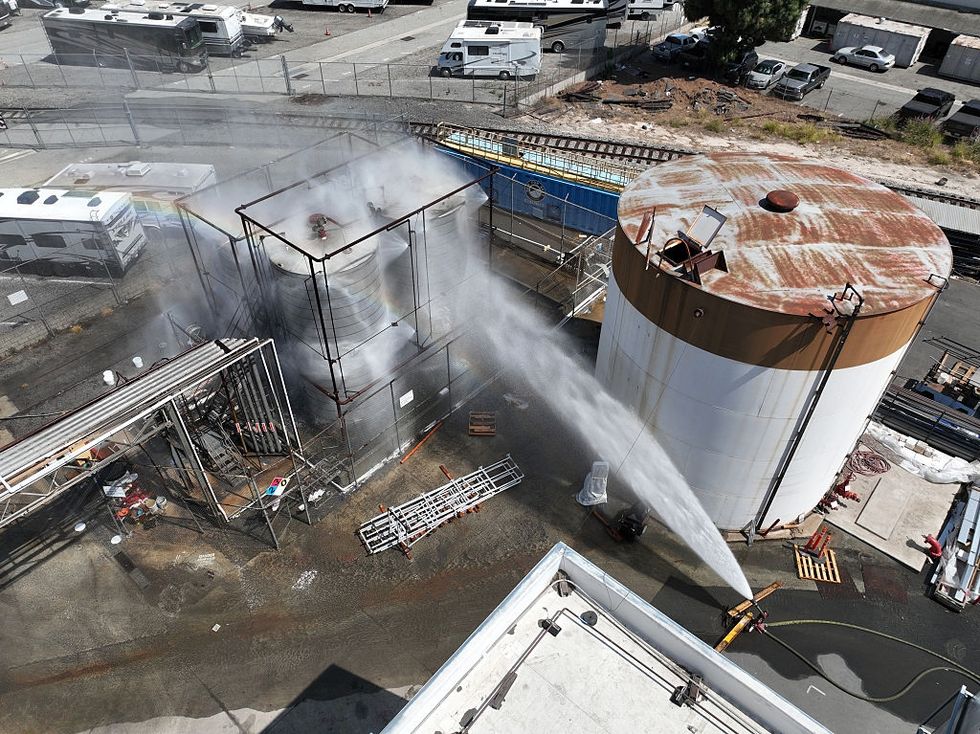
 Firefighters blast the tank with water. Allen J. Schaben/Los Angeles Times via Getty Images
California officials ordered as many as 50,000 Orange County residents to evacuate Sunday after a crack formed in a tank at an industrial facility holding 7,000 gallons of a highly flammable toxic chemical. The accident at the suburban Los Angeles plant owned by the British fighter jet supplier GKN Aerospace began on Thursday, when firefighters in Garden Grove, California, found that a tank containing methyl methacrylate, a feedstock used to make plastic, had started bulging with pressure and releasing gas as it overheated. By Saturday, a fissure had formed in the tank — one of three on site containing the chemical — in what NPR called “good news,” since the opening eased pressure, making an explosion less likely. So far, no one has been injured. “Safety at our facilities is paramount,” a GKN spokesperson told the Los Angeles Times. “We follow all standard safety protocols and processes and are regularly audited by numerous state and federal agencies.” But authorities as far east as Arizona were bracing for the possibility of an explosion. In an update posted on X Monday morning, Orange County’s interim fire chief announced that the threat of what’s called a “boiling liquid expanding vapor explosion,” or BLEVE (pronounced blevvy), “is now off the table,” adding that “that threat has been eliminated.”
While the accident will no doubt draw scrutiny to GKN’s record at the facility, known for producing parts for the Lockheed Martin F-35 fighter jet, the episode is unlikely to draw the same fervid response as the fire at California’s Moss Landing battery plant last January. That incident set off what Heatmap’s Jael Holzman pegged as nationwide backlash to batteries. So far, thankfully, cooler heads have prevailed in resisting the urge to demand a shutdown of all production of aircraft components as a result of an accident.
3. Exclusive: Trump’s vague rules are splitting the American solar market
The Trump administration’s yet-undefined rules for determining a key factor in solar projects’ eligibility for outgoing federal tax credits are bifurcating the U.S. market. The administration has yet to spell out in detail how companies should determine what percentage of their project inputs come from a so-called foreign entity of concern. While the list of FEOCs includes Russia, Iran, and North Korea, the main sticking point for developers is China, which dominates the global renewables supply chain. On one side are developers willing to roll the dice on imported equipment. On the other are companies avoiding the risk by buying panels either made in America, or in allied countries. To make navigating the process easier, the SEMA Coalition — an industry group representing U.S. solar manufacturers that support restrictions on cheap Chinese imports — put out a new report that includes a check list to determine whether a panel producer is likely to qualify for federal tax incentives or not. The paper, which was shared exclusively with me for this newsletter, was “informed by tax opinions, legal counsel who advise the SEMA Coalition’s members, as well as public documents.” The findings show that “some of these rules are ambiguous, while others are clear but challenging to comply with in practice.”
As I told you last week, American solar manufacturing is finally seeing something of a boom. Nearly 30 new utility-scale solar factories began production last year, providing more than enough capacity to meet U.S. demand.
Sign up to receive Heatmap AM in your inbox every morning:
4. The world’s largest miner has quietly abandoned billions of green projects
Amid a sweltering London heat wave in 2019, BHP laid out plans for the “biggest global mobilization since World War II” in the name of cutting back on fossil fuel use and fighting a climate that threat that “could be existential,” the world’s largest mining company’s then-CEO Andrew Mackenzie said at the time. Today, however, the giant is reversing course, quietly shelving billions of dollars in projects designed to cut emissions from its mining operations. An internal memo from last year leaked to Australia’s ABC News and The Guardian shows that the need for renewables at BHP’s iron-ore facility in Pilbara had “diminished,” and that a plan to hit net-zero by 2050 had a “low probability of success.”
5. California reaffirms its offshore wind target
The West Coast’s continental shelf drops off far more steeply into the Pacific than America’s East Coast slides into the Atlantic, making siting offshore wind turbines tricky off California’s shores. Nevertheless, a developer was trying to build the first floating offshore turbines in the U.S. — at least until the Trump administration struck a dubious deal to pay the company to quit. That agreement is drawing blowback from California regulators, as I told you earlier this month. But the Golden State isn’t abandoning its goals. On Monday, offshoreWIND.biz reported that the California Energy Commission had reaffirmed its target of 25 gigawatts of offshore turbine capacity by 2045. “At a time of global energy volatility, offshore wind is not just a climate strategy. It is part of a national security strategy,” Noel Hacegaba, chief executive at the Port of Long Beach, said in a statement. “The grid we built for the last century cannot carry us through the next. This is renewable energy’s moment.”
The market for offshore wind looks even brighter outside the U.S. Last week, the Danish Energy Agency received bids for two different offshore development areas totaling a combined 1.8 gigawatts of turbines, according to Renewables Now. In an interview with Wind Power Monthly, the chief executive of the automaker Volvo lauded Sweden’s offshore wind farms for giving manufacturers like his a “competitive edge.”
THE KICKER
Canadians can now cruise around the 10,000-year-old Columbia Icefield in a vehicle whose pollution isn’t adding to polar melting. On Monday, InsideEVs reported that the truck maker Pursuit had retrofitted one of its old diesel ice explorers to go electric with a huge, 528-kilowatt-hour battery. That’s big enough for about 30 trips up and down the Rocky Mountain icefield. The renovation involved keeping the old cabin but replacing the chassis and driveline with battery-propelled equipment. It is the world’s first all-electric ice explorer.


 Firefighters blast the tank with water. Allen J. Schaben/Los Angeles Times via Getty Images

 The Syncrude refinery at Mildred Lake in Alberta. Daphné LEMELIN / AFP via Getty Images