You’ve reached your free article limit
Log in
To continue reading, log in to your account.
Create a Free Account
To unlock more free articles, please create a free account.
Sign In or Create an Account.
By continuing, you agree to the Terms of Service and acknowledge our Privacy Policy
Welcome to Heatmap
Thank you for registering with Heatmap. Climate change is one of the greatest challenges of our lives, a force reshaping our economy, our politics, and our culture. We hope to be your trusted, friendly, and insightful guide to that transformation. Please enjoy your free articles. You can check your profile here .
subscribe to get Unlimited access
Offer for a Heatmap News Unlimited Access subscription; please note that your subscription will renew automatically unless you cancel prior to renewal. Cancellation takes effect at the end of your current billing period. We will let you know in advance of any price changes. Taxes may apply. Offer terms are subject to change.
Subscribe to get unlimited Access
Hey, you are out of free articles but you are only a few clicks away from full access. Subscribe below and take advantage of our introductory offer.
subscribe to get Unlimited access
Offer for a Heatmap News Unlimited Access subscription; please note that your subscription will renew automatically unless you cancel prior to renewal. Cancellation takes effect at the end of your current billing period. We will let you know in advance of any price changes. Taxes may apply. Offer terms are subject to change.
Create Your Account
Please Enter Your Password
Forgot your password?
Please enter the email address you use for your account so we can send you a link to reset your password:
On X-energy’s next plant, Italian power, and Chinese solar exports

Current conditions: A new nor’easter is washing the ocean over North Carolina’s Highway 12 right as crews complete reconstruction on the Outer Banks thoroughfare following last month’s storm • After whipping Mexico’s Pacific Coast with heavy rains, Hurricane Trudy has weakened to a Category 1 storm • Super Typhoon Champi knocked out power for more than half of Guam before barreling toward the Philippines as a potential Category 5 storm.
Last week was the worst week for the tech-heavy Nasdaq 100 Index since President Donald Trump’s tariffs roiled the market in April 2025. The reason? Hotter than expected federal data on inflation fueled fears of an interest rate hike that could prove devastating to the buildout of artificial intelligence infrastructure. Investors were already worrying the physical investments would cost more than giants such as ChatGPT-maker OpenAI or Claude-creator Anthropic are set to earn. But on Monday, semiconductor makers such as Oracle, Intel, and Micron Technology rallied as the AI rout came to an end. Yet CoreWeave, the cloud-computing heavyweight that led the selloff last week, closed slightly lower. The issue, investors told CNBC, is the company’s debt load. “The market tends to get worried about companies that have refinance risk when rates are higher, and CoreWeave was a little bit of the poster child,” John Lloyd, global head of multi-sector and corporate credit at Janus Henderson, whose firm owns CoreWeave bonds due in 2031, told the broadcaster. “They need the debt markets in order to grow, in some form or fashion.” That CoreWeave came close to bouncing back at all comes down at least in part to Ark Investment Management chief Cathie Wood opting to buy about $12 million of shares in the company amid the market plunge last week, a play for which The Street notes she’s known. Notably, Oracle, which was previously dubbed the “canary in the coal mine” for concern over AI debt, closed just 1% higher before plunging in after-market trading.
Microsoft, meanwhile, pulled out a major data center deal in the United Kingdom to anchor Nscale Global Holdings’ debut facility in the country, located in Loughton on the outskirts of London. But The Wall Street Journal reported that power supply issues ultimately caused Microsoft to back out of the 50-megawatt project, highlighting how hyperscalers can throw a major data center complex into disarray even at a later stage in the development. Nscale’s upcoming $35 billion stock market debut rests, as The Information noted, on its ability to build data centers.
Amazon is backing a deal for another power plant built with X-energy’s next-generation reactors. On Monday, the high temperature gas-cooled reactor startup, in which Amazon took an equity stake two years ago, signed a joint development agreement with American Electric Power to evaluate a potential 960-megawatt project at a former coal site in Sullivan County, Indiana. In a press release, AEP CEO Bill Fehrman said Amazon’s support provided “all necessary capital protections and financial safeguards that we have said are essential for any potential nuclear project to move forward.” That’s a notable departure from the line many utilities executives share in private, which is that — absent some kind of federal cost overrun insurance — building new reactors will prove too difficult a sell to shareholders. It’s part of a string of nuclear deals for Indiana, which currently has no operating atomic power reactors in its borders. On Monday evening, AtkinsRealis, the developer behind Canada’s signature CANDU reactor technology that can run on raw uranium, announced a memorandum of understanding to build up to 6 gigawatts of the pressurized heavy water reactors in Indiana. The state and the utility Hoosier Energy are the counterparties to the agreement.
In Arkansas, meanwhile, Google unveiled a new “enhanced partnership” with utility giant Entergy to power the tech giant’s West Memphis campus. As part of the agreement, Google pledged to support solar, battery, and transmission investments in Arkansas that the companies said would deliver “at least $500 million in new savings for all customers.”
Secretary of Energy Chris Wright called out New York Governor Kathy Hochul for holding up a natural gas pipeline he said would lower heating prices for residents in the Northeast as early as winter of 2028. During an appearance Monday on the Fox Business Network, Wright touted his agency’s decision last week to award Williams Companies $42 million through the wartime Defense Production Act to speed up construction of the Constitution Pipeline. “We wanted to get this in by winter of 2027 but delays and still opposition from energy-subtraction Democrats has unfortunately slowed the effort,” Wright said. “The delay right now is the governor here in New York State. We’ve been talking with her. We hope she’ll go along with this. Maybe after the election, I think she will.” The governors of all six New England states, he said, “are all on board with it.”
In a statement to me, Hochul spokesperson Ken Lovett called the announcement “nothing more than a political ploy to divert attention from Trump’s tariffs and his reckless war in Iran that have not only failed to bring down prices as the president promised, but have dramatically driven up home energy costs and gas prices at the pump.” He added that, “while the president continues to obsess over blocking renewable energy projects in order to focus on gas, oil, and even coal, Governor Hochul is focused on driving an all-of-the-above energy strategy designed to keep the lights on and costs down for New Yorkers.”
Sign up to receive Heatmap AM in your inbox every morning:

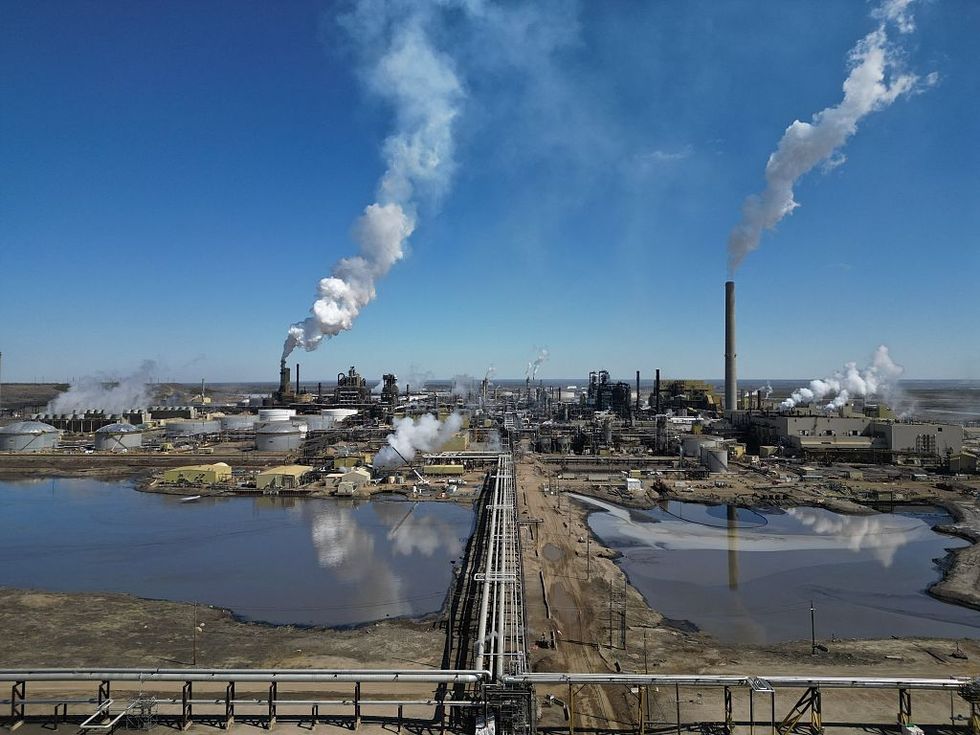
Albertans are the richest Canadians on average, thanks to the province’s oil and gas industry. They’re also — after the Quebecois, of course — among the Canadians with the strongest claim to a distinct identity from the national Anglo norm, often drawing comparisons to Texans within the U.S. Monday offered the biggest test yet of just how differently Alberta sees itself. Turns out whatever regional resentments Albertans may have against Ottawa after a decade of Liberal Party rule that frequently sought to restrict the oil and gas sector hasn’t been enough to merit secession. Voters overwhelmingly rejected a nonbinding referendum calling for a real vote on whether to split away from Canada and establish an independent Alberta. At least part of the reason may be that Prime Minister Mark Carney has put a new focus on beefing up Canada’s domestic energy industries in a bid to increase exports and make the country less reliant on an increasingly aggressive U.S. That includes building new pipelines. But a new analysis by Reuters warns that a successful infrastructure buildout won’t lead to another jobs boom in oil. Much of the growth in oil sands output, instead, “is likely to come from automation and efficiency gains rather than large-scale hiring,” the newswire reported, citing industry forecasts and nearly a dozen interviews with company officials, workers, politicians, and academics. Carney admitted as much when asked by the reporter during a visit to Alberta’s Fort McMurray this month: “I wouldn't use the term ‘boom.’ I would use ‘sustained growth.’”
Europe, meanwhile, is trying to keep its own populist blowback to rising prices contained. Right as violent protests over cost of living spread from France to Italy, the Italian government has struck a deal with the European Commission that Prime Minister Giorgia Meloni expects to slash household energy bills ahead of next year’s elections. Under the agreement, according to the Financial Times, Italy will be allowed to compensate gas-fired generators to keep wholesale electricity prices from rising above €59 per megawatt-hour, roughly $66. The European Union’s market rules require that the last and most expensive source of electricity tapped to meet demand serves as the wholesale price. But the EU’s executive chamber allowed for Italy to ease its rules after prices surged 45% higher than in nuclear-powered France and renewables-rich Spain last month.
China’s exports of solar panels fell 6.4% last month compared to the same period last year, according to Reuters. That marks the fifth straight year-on-year decline in 2026. It’s a sign that China is cracking down on its glut in solar manufacturing. But Beijing isn’t looking to lose its edge over the fastest growing electricity source in the world. Last week, Bloomberg reported that China had added 12 pieces of solar-related manufacturing equipment to its list of items restricted from export. That could make it much more difficult for U.S. manufacturers comply to stand up factories given the Trump administration’s 232 import restrictions on Chinese solar equipment, which take effect later this year. The results of the Department of Commerce’s Section 232 investigation into polysilicon, which my colleague Emily Pontecorvo and I covered here, are meant to be the Trump administration’s lifeline to solar manufacturers who lost a key incentive when federal tax credits expired, ending a bonus program for developers that use domestically-made panels.
One area where China has appeared to be gaining an edge — green hydrogen production — may still remain a competitive industry for Western manufacturers. Chinese electrolyzers, the machines needed to separate the H from H2O with electricity, cost less than half of those made outside the country, according to data from the International Energy Agency. But trade levies erase much of that advantage, ultimately reducing capital expenditures by only 8% for European projects using Chinese equipment, Hydrogen Insight reported.
Call it mine-to-battery manufacturing. As demand for batteries booked, Ivanhoe Electric had planned to differentiate itself by taking a fully integrated, farm-to-table approach, owning and operating its own copper mine, refining the metal, and ultimately turning that copper into cathodes for batteries all at its same site in Arizona. Now, however, there’s an even bigger sector demanding copper: Data centers. New data center projects are driving so much demand for copper that the company is considering selling its copper to buyers other than itself, Bloomberg reported.

Log in
To continue reading, log in to your account.
Create a Free Account
To unlock more free articles, please create a free account.
The company simplifies the process of getting consistent, apples-to-apples bids.
With commercial electricity prices steadily climbing, many businesses and real estate owners are increasingly eager to generate and store their own power onsite, cutting their bills and making costs more predictable. But figuring out whether solar and storage can actually pencil out — and under what conditions — can be a nightmare. Ask a handful of developers for a quote and you might get a rooftop solar array from one, a ground-mounted solar and battery system from another, and a gas turbine from a third, each with its own size, price, and financing terms.
That leaves buyers comparing apples to oranges. And for businesses evaluating a portfolio of potential projects, the process gets even messier. “These are very local-centric systems. Different interconnection requirements, different permits, different suppliers,” Gareth Evans, CEO of the onsite energy planning and procurement startup Veckta, told me. “There are hundreds of solar developers in every state.” The hard part, he added, is “knowing what supplier to go with, how to ask them the right questions in the right language, in the right format, so that you’re getting consistent bids back that you can compare and contrast.”
That’s the tension San Diego-based Veckta has built its business around. And on Tuesday, the startup announced an oversubscribed $11 million Series A to scale its solution. Origin Ventures led the round, with participation from others including the climate-focused investor VoLo Earth Ventures, which led Veckta’s $3.3 million pre-seed round in 2022.
The company starts with a single input: a property address. Veckta’s software analyzes over 5,000 data points, including utility rates, grid emissions, outage risk, local equipment and construction costs, and available incentives to assess — in under a minute — whether an onsite energy project makes financial sense. That helps buyers define their needs, from system size and installation type to contract terms, and ensures that potential suppliers are bidding on the same requirements. The result is a set of comparable proposals, without the upfront cost of hiring a consultant or supply chain expert.
Veckta’s platform includes more than 3,000 vetted suppliers. As bids come in, the startup automatically compares them based on factors including the supplier’s track record, warranties, equipment offerings, compliance with foreign entity of concern requirements, and ability to leverage federal and local incentives. From there, Veckta makes its recommendations. “Supplier A is your best option if you want U.S.-made equipment with the longest warranty, best guarantee, and they’ve done these projects before,” Evans explained, by way of example. “Supplier B is disqualified because they’ve never done a project in your state.”
Out of the roughly 34,000 customer sites Veckta has analyzed, Evans said 37% would see positive returns today by installing solar panels, battery storage systems, or both. That translates to $3.1 billion in potential project value, concentrated largely in markets with high electricity rates such as the Northeast and California, and among businesses facing steep peak-demand charges. But as utility rates continue to rise and installation costs fall, he expects onsite power to become cost-competitive with the grid at “almost 100%” of sites within five years. The startup estimates that would unlock a whopping $12 billion in potential project value.
Veckta wouldn’t capture all that itself, of course. Rather, it generates revenue in two ways: buyers pay an upfront platform fee, and the winning supplier pays a success fee once a contract is signed. Evans told me the startup has been net profitable for the past year, though he would not share specifics. So far in 2026, customers have signed contracts for onsite energy projects at 128 sites. These typically range from 250 kilowatts for businesses like car dealerships and retail stores to 10 megawatts or more for manufacturing facilities, warehouses, or cold storage facilities. “That ranges from Fortune 500s right down to your individual business owner,” Evans told me.
With this latest raise, Veckta plans to expand its supplier network and grow its sales, marketing, and customer support teams. It also wants to help customers capture additional revenue streams from their onsite energy systems, such as by connecting them with demand-response programs, using batteries to provide grid services like frequency regulation, and selling renewable energy credits.
Named customers include rental car company Enterprise Mobility, real estate investment trust Regency Centers, and auto dealership group Lithia & Driveway. About 80% of the projects the platform facilitates today involve rooftop solar paired with batteries, but the company has begun to branch out.
“We’ve done waste-heat-to-energy, we’ve done EV chargers, done backup generators, and then the latest is, we’ve just finished our first pilot on roof replacements,” Evans told me. “We are firm believers that for any complex purchase that is a non-commodity that you can’t just buy off the shelf, we are best placed to help our customers competitively source those deals.”
The Iran war has been a gift to the country’s vehicle, solar, and battery business.
This is Heatmap Daily, a weekday evening digest written by our executive editor.
Happy Monday and welcome back. For months now, we’ve been talking about how the U.S. and Israel’s war in Iran has been a boon for electric vehicles, clean energy, and (unfortunately) coal.
But today we got data that confirms: This clean energy export boom is not just a side story. It is one of the brighter spots in the overall Chinese economy, which remains the world’s second largest.
According to economic data released on Monday, China grew 4.5% during the summer quarter as compared to the quarter from a year earlier. That means the country will likely hit its growth target this year, albeit on the low end.
The country’s economic expansion wasn’t driven by domestic consumption, however. Consumer confidence remains low, and residential investment has yet to return after the property crash earlier this decade.
Instead, booming exports are now driving China’s economy. Exports were more than 36% higher in September than a year earlier, driven by chips, ships, electric vehicles, and solar panels and batteries. The country will likely record its biggest trade surplus ever this year.
Some of those categories are clearly flourishing thanks to the global AI boom — think chips and even batteries. But the preponderance of vehicle exports suggests surging oil prices aren’t hurting. Sales of ‘new energy vehicles,’ a category that includes 100% electric vehicles and plug-in hybrids, were up more than 13% on a year-over-year basis in September, according to the Chinese car manufacturer’s trade group. But exports of these vehicles are booming. Battery electric vehicles were up 130% last month compared to the same period in 2025, and plug-in hybrid exports were up more than 200%.
It’s interesting to consider how much the Chinese and U.S. economy are mirroring each other at this moment. Americans are dealing with a remarkable investment boom, which is buoying the labor market and stubbornly maintaining high inflationary pressure. China is struggling with deflation, and exports are its quickest path to growth. (Consumer sentiment in both countries, interestingly, seems to be in the doldrums, even though American consumers appear to be in much better shape.)
When thinking about what artificial intelligence could do for the United States over the next decade, some subject-matter prognosticators (and even some Anthropic employees) imagine a world of 4%, 5%, or even 7% GDP growth. Such a growth rate is difficult even to envision in the modern era, of course, and it seems like it could propel the U.S. economy to staggering prosperity.
I know better than to make a prediction about where we’re headed. But amateur economic commentators should keep China in mind, too: a country that dominates along many technological axes, but where the standard economic math of supply, demand, and consumer sentiment still holds. Except if the United States economy were to stumble, no exterior source of demand will come to our rescue.
Endurance Energy hoped its generator would run for a full year, but the team isn’t afraid of the “error” in “trial and error.”
About 300 miles off the Oregon coast, a mile beneath the ocean’s surface, a startup just drilled the world’s first subsea geothermal well. And for a grand total of exactly 8.7 seconds, its prototype power plant generated about 2 kilowatts of net power. It wasn’t quite the result the Seattle-based Endurance Energy was hoping for — the company’s goal was to run its 100-kilowatt generator for a full year. But it’s not nothing.
“We really proved with this mission that a geothermal well could be drilled and completed on the seafloor, and doing that within 21 months of the company existing I think is really a testament to our pace of progress,” Endurance CEO Andrew Redd told me.
A former SpaceX engineer — as so many climate tech founders seem to be — Redd appears quite comfortable with the rapid trial-and-error cycles that hard tech startups often demand. Or as he stated in the company’s press release, which provides a refreshingly frank account of what this first test did and didn’t accomplish, “We follow the adage ‘make it exist, then make it good.’”
Investors seem to be buying it. In June, the startup raised a $54 million Series A, led by Peter Thiel’s Founders Fund — Endurance’s second funding round in less than two years of existence. Still, the team certainly has their work cut out for them. The ocean is a notoriously difficult operating environment: Saltwater is corrosive and offshore infrastructure is difficult and expensive to build, maintain, and repair.
Indeed, Endurance spent the first 11 days of its three-week stint at sea debugging its drill, which the team had never operated underwater before. But with a vessel chartered and a locked-in deployment date, the company couldn’t afford to wait for everything to work out perfectly. “We were still working on that generator hours before it got on the seafloor,” Redd told me. He’s used to that sort of thing, though, comparing it to making final tweaks to rockets already sitting on the launchpad. “That’s kind of the name of the game,” he said.
The trial took place at Axial Seamount, an active underwater volcano and the only place in the world with a cluster of hydrothermal vents connected to shore by fiber optic cable, which allows the Endurance team to monitor and control its system in real time from Seattle. While this was the company’s fifth deep-sea mission, it was the team’s first attempt to actually drill their own well.
After lowering their drill about a mile below the surface, the team bored two holes and turned the second into a well about 2 inches wide, lining it with pipe and sealing it with cement. But after losing so much time to debugging, the team only managed to drill about 52 feet deep — far short of its original 200-foot target.
Water then flowed up the well at about 260 degrees Celsius (around 500 degrees Fahrenheit), but the narrow borehole proved too restrictive to deliver enough heat for the generator to operate. So the team pivoted, connecting the generator directly to a naturally flowing, hotter hydrothermal vent instead. The generator then ran for a total of 29 seconds, producing about 2 kilowatts of net power for 8.7 seconds. That represents the total electricity the turbine generated, minus the 7 to 8 kilowatts needed to run its supporting components, such as the refrigerant pump and other onboard equipment.
Then a software glitch triggered the onboard battery safety system, which shut down the plant. When the team tried to restart the system, the power cable feeding the refrigerant pump failed, leaving the pump unable to restart. That was the end of the road. The mission wrapped up after three weeks at sea, a far shorter run than the team had hoped.
“The success criteria would be if we had left with the generator still on the seafloor; that would have been an example of sustained net power, and we didn’t get there,” Redd told me. Instead, the team brought the system back to Endurance’s Seattle headquarters, where it’s fixing the software as well as refurbishing and upgrading the hardware — which includes changing how it builds and tests subsea cables — to prepare for another mission sometime this winter. This time, the goal will be to generate sustained power from a much deeper well.
The team will need to demonstrate progress soon to keep its next major milestone on track: a planned 2-megawatt deployment off the coast of Tonga by the end of 2027. The project aims to supply electricity directly to the Tongan grid, which today is heavily dependent on expensive, imported diesel. Redd expects subsea geothermal to be cost-competitive with that fuel in this first pilot.
Getting there, however, is a formidable engineering challenge. While it’s long been a subject of academic curiosity, no one prior to Endurance had ever drilled an offshore geothermal well before, meaning the team can’t simply transplant existing land-based technology to the seafloor. “Every component that you would use terrestrially now needs to be either modified or built completely from scratch,” Redd explained. “And so you multiply that across every component required to make these kinds of infrastructure projects happen, and it’s a lot of work.”
No kidding. But if Endurance can pull it off, Redd sees this resource as “the perfect energy source for the future.” A conference paper presented by the geoscience company Viridien last year estimates that offshore geothermal resources worldwide could yield about 6 terawatts of recoverable electric power — nearly twice the world’s current continuous electricity output.
“We can access terawatts of power. There’s no fuel. We can site next to extremely large cities around the Pacific. We have no surface presence,” Redd said, ticking off the advantages. Plus, the three necessary ingredients for a high-quality geothermal well — permeable rock, high heat, and water — are widely accessible offshore, he added. Eventually, he expects subsea geothermal to undercut natural gas in Endurance’s target markets: electricity grids, industrial facilities, and data centers across the Pacific Islands, the U.S. West Coast, and Northeast Asia, all of which sit along the undersea volcanic zone known as the “Ring of Fire.”
The way Redd sees it, advances in subsea technology pioneered by the offshore wind, oil, and gas industries have cleared much of the technological path to making underwater geothermal a viable clean energy resource. In his view, what’s been missing is simply the ambition to chase the opportunity in the private market. SpaceX, he said, really proved what’s possible for a scrappy startup to achieve.
“It is quite new at industrial scale for a small company with a bunch of fairly young people to go after something like this,” he told me. “Before SpaceX went to launch a rocket as a private company, no one thought you could get to orbit as a private company. And so that has really seeded this ambition.”