Current conditions: The fast-moving Palos Fire blazed through 17 acres in Los Angeles’ La Habra Heights, injuring two • Heavy rain in São Paulo collapsed a dilapidated building, killing six • The heat index in the Mississippi Valley is topping 110 degrees Fahrenheit.
THE TOP FIVE
1. Trump’s new data center defense: ‘It’s a hoax’
Two weeks after accusing data center opponents of wanting “to end up being backwards and poor,” President Donald Trump has landed on a new defense of the artificial intelligence buildout. It’s a lot like his old one for abdicating on the federal government’s responsibility to deal with climate-changing emissions. Essentially, it boils down to: My critics are making it all up. “It’s a hoax,” Trump told Nvidia CEO Jensen Huang during the five-minute call the executive put on speaker on stage at a conference Monday in Los Angeles. “The robots are not going to be taking over the world. That’s not going to happen.” He later posted on his Truth Social platform: “The AI Hoax being perpetrated by the Radical Left Dumocrats is reminiscent of their Global Warming Scam of not so long ago, where everyone was going to die from extreme heat. What happened? MAKE AMERICA GREAT AGAIN!!!” Three-quarters of Americans are now opposed to data centers in their backyards, according to Heatmap Pro’s poll from last month. But Trump has recently bucked with some populist positions on technology that have cross-partisan appeal. While law-and-order Republicans in red states are now turning against the Flock cameras that watch for petty crime, Trump defended the technology in a recent Air Force One chat with reporters. “Trump deserves more respect for his anti-slopulist instincts,” Peter Meijer, a former Republican member of Congress who voted to impeach Trump during his previous administration, wrote in a post on X.
Nvidia’s emissions, meanwhile, appear to be soaring. A new Greenpeace analysis of Nvidia’s own climate reports by the pro-renewables analyst Ketan Joshi found that emissions relating to the supply chain for chip manufacturing soared by 725% since 2020, adding nearly 10 million metric tons of carbon dioxide to the atmosphere.
2. Relicensing a hydropower dam has gotten 10 times harder since 1980
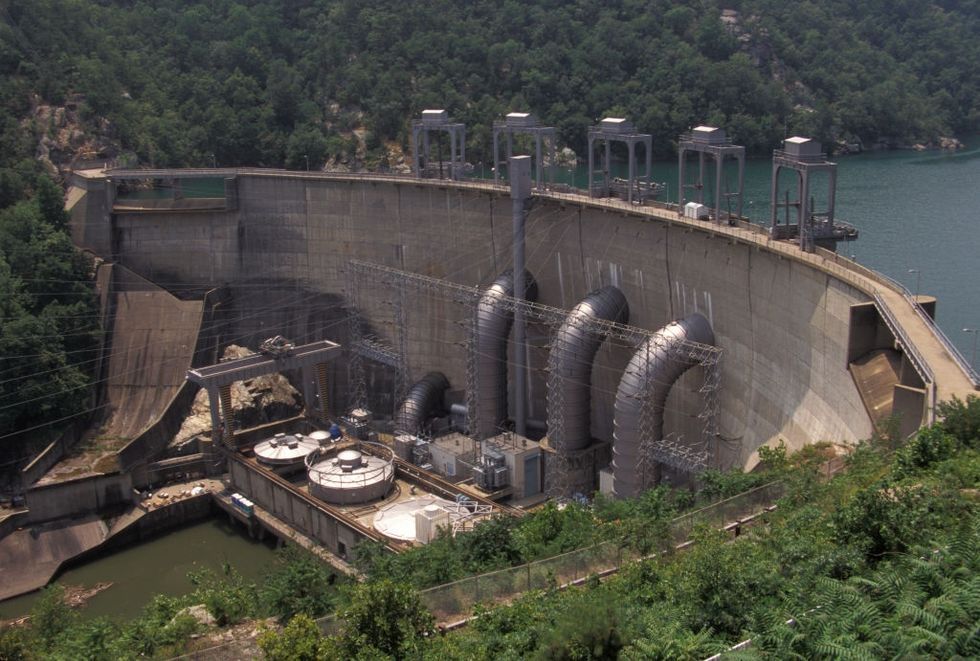
 The Smith Mountain Project, a 600-megawatt pumped storage facility in Virginia. Education Images/Universal Images Group via Getty Images
You wouldn’t believe some of the conditions I have heard placed on owners of hydroelectric dams seeking to relicense major clean power projects. There are obvious demands from regulators for things like new infrastructure to help migrating fish pass down a river. Then there are the less obvious, such as building an amphitheater for Boy Scouts or paving new roads far from a dam or its water source. In what the trade group called a first-of-its-kind analysis, the National Hydropower Association reviewed more than 5,000 mandatory conditions across 4,819 licensing documents filed between 1980 and 2026 in 46 states. Dam owners would need to agree to the legally binding requirements, imposed by either state or federal agencies, before a final operating license could be issued. Compared to earlier licenses, hydropower plants today “carry roughly 10 times as many mandatory conditions,” the trade association wrote in its report. “To make matters worse, many conditions are unrelated to energy production and are essentially ‘wish list’ items that hydropower producers are asked to fund, ranging from road construction unrelated to the projects to building fish passage far beyond where the fish actually are (or even could be),” the organization said. Over the next decade, 348 hydropower permits representing 12 gigawatts of capacity are due for relicensing. Many of those facilities are small, and the trend recently has been for companies to simply surrender their licenses and close up shop rather than make costly renovations.
“I urge anyone who cares about reliable, affordable power to read this groundbreaking study,” Malcolm Woolf, NHA’s top executive, said in a statement. “Hydropower, a superhero of the grid and an American icon of energy production, is at great risk due to a broken regulatory framework. Relicensing an existing hydropower facility often takes decades and costs millions of dollars. If these facilities go away, so does the affordable power they produce, the good jobs they create, and the critical infrastructure and ecosystem care they provide.”
3. South Korea seeks a stake in Westinghouse
Back in May, I told you that South Korea — arguably the most competent builder of atomic power reactors in the democratic world — was “coming to America’s nuclear rescue.” Last week, we discussed the possibility of Seoul’s state-owned nuclear company building reactors in the U.S. as part of a trade pact with the Trump administration. Now we have a clearer picture of where those negotiations may be going. On Tuesday, The Korea Economic Daily reported that South Korea is seeking a roughly 15% stake in Westinghouse, the maker of America’s flagship nuclear reactor, and a seat on its board as part of any deal with Washington. The move, the newspaper noted, is designed to “turn a U.S. request for Korean capital into a strategic foothold in America’s nuclear buildouts.” Ownership by one of America’s closest East Asian allies would be nothing new for Westinghouse, which was owned in the mid 2000s by the Japanese industrial giant Toshiba. Today Westinghouse is a privately held joint venture between the publicly traded investment behemoth Brookfield Asset Management and the Canadian uranium miner Cameco, but the company filed confidential paperwork to the Securities and Exchange Commission in July as a first step toward going public on the stock market.
The market only appears to be expanding. Global nuclear capacity could more than triple by 2060, according to this week’s latest forecast from the International Atomic Energy Agency, the United Nations affiliate that oversees nuclear technologies worldwide.
Sign up to receive Heatmap AM in your inbox every morning:
4. Americans are a lot more worried about data centers’ environmental impact than meat or air travel
Spend a few minutes scrolling through a comedy fan’s TikTok stream and you’ll find skits playing to the same memetic trope, an anthropomorphized caricature of an incompetent, mistake-prone AI agent guzzling and spilling lots of water. It’s no wonder the joke has already become hack. More than three-quarters of Americans are at least somewhat concerned about the environmental impact of AI, and half are extremely or very concerned, according to data from the latest annual poll from the University of Chicago’s Energy Policy Institute and the AP-NORC Center for Public Affairs Research. In every case, self-identified Democrats are more concerned about environmental issues than Republicans. While 40% of Democrats expressed concern over the environmental impacts of cryptocurrency, just 18% of Republicans said the same. With meat, the ration is 42% to 21%. With air travel, it's Democrats at 38% and Republicans at 17%. But interests converge slightly more on data centers, with 65% of Democrats and 42% Republicans extremely or very concerned about the environmental impacts of AI.
5. The U.S. doesn’t have the right ingredients to build out a national grid
In theory, the late 20th century liberalization of America’s electricity markets should have put a premium on transmission companies building new arteries in the system. In practice, the high cost and grave risk of taking on dozens, sometimes droves, of landowners for right of way to build a power line that stretches hundreds of miles across multiple regional grids makes the task almost impossible, particularly in markets where a power company can’t offset the cost of new lines with other sources of revenue such as generation or power sales. A new report by the Center for Public Enterprise has concluded that “only the federal government can intervene to sew together this national macrogrid by bridging the jurisdictional divides between utilities and regions, instituting planning pipelines with access to finance and cost recovery, and fixing interconnection procedures.” As of yet, that looks unlikely beyond the increased focus on regional planning under the Federal Energy Regulatory Commission’s Order 1920. The rule is facing legal challenges that aren’t expected to be resolved until next year, according to Ari Peskoe, director of Harvard Law School’s Electricity Law Initiative.
THE KICKER
When I visited Commonwealth Fusion Systems’ headquarters in Massachusetts earlier this summer, I saw how much progress the company had made toward building what could be the world’s first power-producing fusion reactor, called SPARC. To work, the interior of the torus-shaped, doughnut-like reactor needs to be very cold so magnets can pick up on the contrast in temperatures with the extremely hot plasma fusing together. That’s where the cryogenics come in. The facility’s cryogenics equipment is now up and running, the company said on Wednesday, marking yet another milestone toward next year’s anticipated start up. “That temperature, a few degrees above absolute zero, is what’ll enable our magnets to bottle up a superhot cloud of charged particles called a plasma so fusion can occur,” Adam Weiner, the director of cryogenics at Commonwealth Fusion Systems, said in a statement.



 The Smith Mountain Project, a 600-megawatt pumped storage facility in Virginia. Education Images/Universal Images Group via Getty Images


 A hot deal. Joe Raedle/Getty Images