You’re out of free articles.
Log in
To continue reading, log in to your account.
Create a Free Account
To unlock more free articles, please create a free account.
Sign In or Create an Account.
By continuing, you agree to the Terms of Service and acknowledge our Privacy Policy
Welcome to Heatmap
Thank you for registering with Heatmap. Climate change is one of the greatest challenges of our lives, a force reshaping our economy, our politics, and our culture. We hope to be your trusted, friendly, and insightful guide to that transformation. Please enjoy your free articles. You can check your profile here .
subscribe to get Unlimited access
Offer for a Heatmap News Unlimited Access subscription; please note that your subscription will renew automatically unless you cancel prior to renewal. Cancellation takes effect at the end of your current billing period. We will let you know in advance of any price changes. Taxes may apply. Offer terms are subject to change.
Subscribe to get unlimited Access
Hey, you are out of free articles but you are only a few clicks away from full access. Subscribe below and take advantage of our introductory offer.
subscribe to get Unlimited access
Offer for a Heatmap News Unlimited Access subscription; please note that your subscription will renew automatically unless you cancel prior to renewal. Cancellation takes effect at the end of your current billing period. We will let you know in advance of any price changes. Taxes may apply. Offer terms are subject to change.
Create Your Account
Please Enter Your Password
Forgot your password?
Please enter the email address you use for your account so we can send you a link to reset your password:
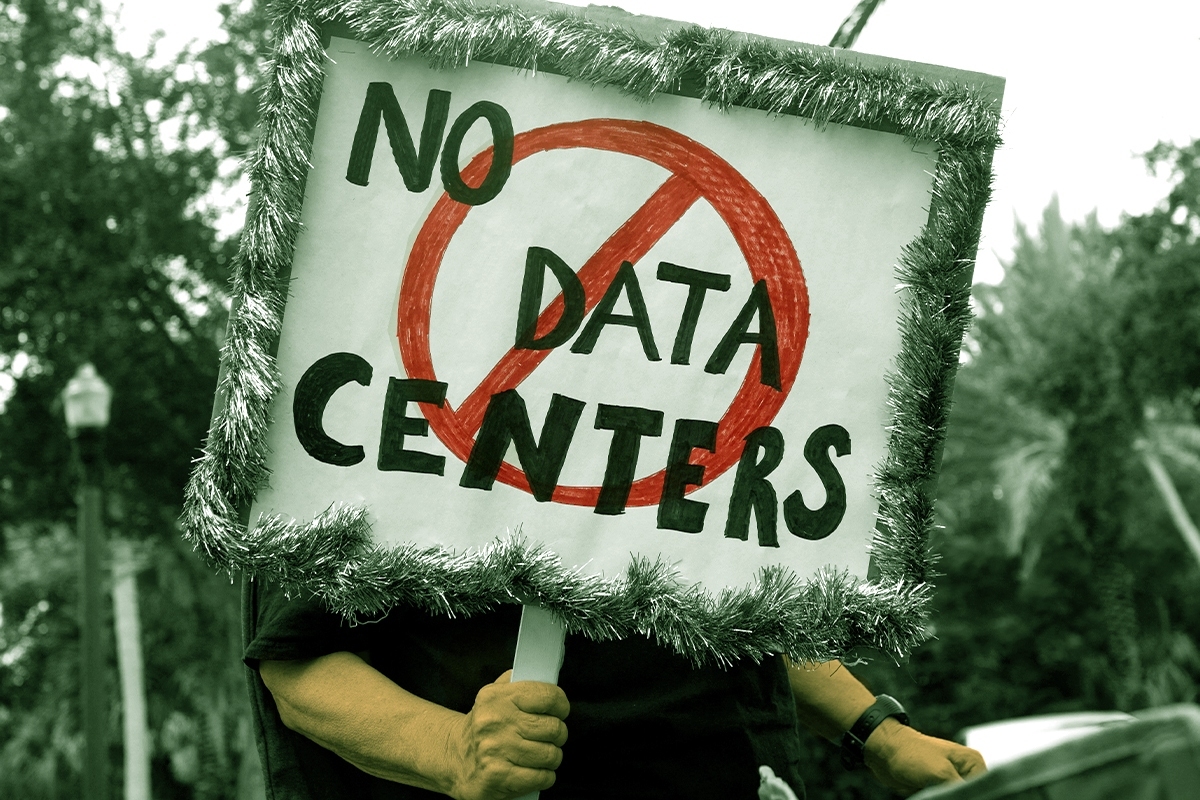
The U.S. public’s support for AI data centers has continued to collapse since the spring, a new Heatmap Pro poll shows.

The American public has soured even further on local data center development since the spring, new polling shows.
Three-quarters of Americans now say that they would oppose a new data center being built near where they live, according to a new Heatmap Pro poll conducted by Embold Research, and more than six in 10 Americans say they would strongly oppose such a proposal.
That’s by far the most negative response since Heatmap Pro started polling Americans about their receptivity to data centers roughly a year ago.
If you can think of a cohort of Americans, there’s a good chance they wouldn’t welcome a data center in their area. The shift against the facilities is represented across age, gender, income, partisan ID, and the rural-urban divide. Data centers are 43 points underwater with Republicans, 65 points underwater with independents, and 75 points underwater with Democrats.
Notably, local data centers are 63 points underwater with rural voters, a group that has skewed more Republican over the past decade. Urban and suburban voters are only a few points more supportive of the facilities.
What’s most remarkable is the pace of change: We’ve polled this same question four times in the past 12 months and haven’t changed its wording once — yet Americans have swung a remarkable 33 points against data centers in the intervening time. It’s a faster and deeper shift in American public opinion than I would have once thought possible on any issue.
We first asked the question last August. Back then, Americans were about evenly split on whether they would support or oppose a data center being built near their home, with roughly 43% in support and 42% opposed.
Attitudes had changed by February of this year, when we asked the question a second time. That time, a bare majority — 51% of Americans — said they would oppose a data center. Forty-eight percent of respondents said they would support it or weren’t sure.
The shock came in May, though, when seven in 10 Americans were opposed and 55% were “strongly” opposed. Yet since then, Americans have moved even further against the facilities. Now, just 4% of Americans say they would “strongly support” a data center proposed in their area. That figure stood at 13% last August.
The backlash has broken into the mainstream: Earlier this week, the podcaster and retired Philadelphia Eagles great Jason Kelce starred in an ad that advised Americans to mail their urine to AI data centers, which he said were wasting water. Local and national leaders have begun to recognize the scale of the backlash, too. In the Wisconsin governor’s race, candidates from both parties have hastened to distance themselves from data centers. New York Governor Kathy Hochul declared a one-year moratorium on the facilities last month, and even Texas Governor Greg Abbot has frozen some of the state’s data centers until they complete a mandatory audit. More than 530 counties and municipalities have restricted or banned construction of the facilities nationwide, according to Heatmap Pro data.
“There’s literally not a conversation that I have, not a stop that I make, where data centers and AI don’t come up,” Abdul El-Sayed, the Democratic Michigan Senate nominee, said earlier this summer. Look at the polling and you can see why.
The Heatmap Pro poll of 2,045 American registered voters was conducted by Embold Research via text-to-web responses from August 8 to 13, 2026. The survey included interviews with Americans in all 50 states and Washington, D.C. The margin of sampling error is plus or minus 2.3 percentage points.
Log in
To continue reading, log in to your account.
Create a Free Account
To unlock more free articles, please create a free account.
Agricultural equipment largely runs on diesel, and with the harvest season coming up, that spells bad news for farmers.
Gas prices are climbing again.
As the United States and Iran confusingly engage following the end of a 60-day “memorandum of understanding” between the two warring countries, the fuel market has begun to readjust yet again, continuing the volatility that has confounded analysts since mid-February. While the gasoline most drivers buy has seen its price increase — the national average gas price now sits at $4.09 a gallon, according to AAA, compared to $4 a month ago and $3.13 a year ago — the most dramatic increase has been in diesel. The price of that fuel — a crucial input to the agricultural economy, as well as an important heat source in certain parts of the U.S. — now sits at $5.50 a gallon, up around 14 cents on the week and close to its peak price for the year in June. It’s also dramatically higher than the $3.70 a gallon it was selling at a year ago.
“Diesel is probably the most important product when it comes down to the global economy in particular,” Tom Kloza, chief energy advisor for Gulf Oil, told me.
While there’s probably never a good time for fuel prices to spike, the increase in diesel prices right now will likely translate to increased costs for farmers as they rev up their equipment for the harvest season. If the price stays high, New Englanders who depend on fuel oil for heat will face increased costs.
“In the U.S., we’re looking at just stunning, stunning numbers with the harvest season coming up and the heating season maybe 60 days from now,” Kloza told me.
The continued disruption could mean record setting costs.
“We’re looking — without question — at the most expensive harvest season on record.”
The federal government’s response to these price spikes, to the extent it has one almost six months after the United States and Israel attacked Iran, has been to talk up oil exports that avoid the Strait of Hormuz and to encourage increased production and refining. Secretary of Energy Chris Wright told reporters on Monday that he had met with refiners to figure out what the government could do to boost output, but didn’t announce any specific next steps.
Congressional Democrats have seized on the high prices — and specifically the threat to farm country — to criticize the Trump administration.
“With global fuel supplies now severely disrupted, [farmers’] situation has been made even worse. And when farmers are forced to pay more for diesel, the prices at the grocery store go up for everyone,” Emmanuel Cleaver, a Democratic congressional representative from Missouri wrote on X.
The Farm Bureau, the agriculture industry’s biggest lobbying group, has warned for months of the effect of high input prices on fuel and fertilizers derived from hydrocarbons, writing in July, “Fertilizer and fuel costs were already elevated heading into 2026, and the conflict with Iran has added further pressure to those markets.”
The high price of diesel and the attendant strain on farmers and truckers has translated to high margins for refineries. The margin between diesel and crude prices has grown to over $100 a barrel, an all-time high, according to data collected by Bloomberg. Before this year, the previous high was under $90.
Even going into this new stage of the U.S.-Iran war, oil companies were already running their refining operations flat out, to record or near-record profits in the most recent quarter. Shell even reported that it was able to operate its refineries at beyond 100% of their capacity, something its chief executive Wael Sawan attributed to the Wall Street Journal to removing “bottlenecks.”
Overall refinery utilization in the U.S. has hit 97%, according to Patrick De Haan of GasBuddy, marking three consecutive months of utilization over 95%, a record.
It’s not just the widely documented strangulation of the Strait of Hormuz that’s driving up diesel prices. The Russian government has instituted a ban on diesel fuel exports through the beginning of next year due to persistent Ukrainian drone attacks on Russian refineries.
“My routine now starts with checking the overnight wires to see if there were any drone strikes on refineries. That’s what this business has come down to,” Kloza told me (drones hit a Russian refinery in Bashkortostan on Wednesday).
The United States faces this new stage of the Iran energy crisis having already boosted both its own exports of oil and authorized the release of over 170 million barrels of crude oil from the Strategic Petroleum Reserve.
Stockpiles of diesel and fuel oil in the United States currently stand at around 106 million barrels. Those inventories have fallen by 1.5 million barrels in the past week and “are about 13% below the five-year average for this time of year,” according to the EIA. Meanwhile, the U.S. Strategic Petroleum Reserve is holding just under 300 million barrels of crude oil, after releasing about 115 million barrels since the war began.
SPR releases will likely continue through September, Arnab Datta, the director of policy implementation at the Institute for Progress, told me. The effect those releases have on prices will largely depend on what forces they’re trying to counteract. A full, persistent closure of the Strait of Hormuz would likely overwhelm SPR releases, as could China deciding to rebuild its oil stockpiles.
“You get a Hormuz-level disruption of that size, no single stockpile really is going to be able to overcome that,” Datta said. “It depends on how much is coming out of Hormuz.”
On electrolyte factories, Josh Shapiro's flip, and Canadian clean power
Current conditions: Firefighters are encircling Belgium’s largest fire on record, just the latest blaze in Europe as historic heat waves roast the continent • The Canadian wildfire smoke that billowed into Michigan this summer cost the state nearly $6.7 billion • The string of storms that now includes the habagat, or southwest monsoon, hammering the Philippines has displaced 5.2 million Filipinos so far.
The Trump administration is barreling forward with a plan to open close to 45 million acres of wilderness in national forests to road construction and logging, removing protection The New York Times said has been in place for a quarter century. The U.S. Forest Service’s proposal would rescind a Clinton-era rule enacted in 2001 to bar roadways from routing through certain areas. The repeal is a major victory for Republican states and industry groups that lobbied for years to revoke the protections, and even unsuccessfully sued more than a dozen times to strike down the so-called roadless rule.
The new push comes a day after Customs and Border Protection paused work on a border barrier in Big Bend National Park after a flurry of videos showing bulldozers marring the protected landscape drove what the public lands-focused news site Public Domain called “a furious backlash.”
You know those thin white lines that trail behind airplanes? If you’re among the hordes of internet-poisoned conspiracy theorists, you may be certain these are called chemtrails, deliberately sprayed aerosols containing some secret mind control substance. In reality, these are condensation trails, or “contrails,” clouds of vapor that condense around soot particles from jet engine exhaust. Though they are not spreading any nefarious biochemical agents, contrails do take a climate toll, trapping outgoing infrared radiation like a blanket and adding to the greenhouse gas effect. Now Google is stepping in with a new program called Operation Blue Skies, in which the tech giant will partner with the British government and airlines to deploy its artificial intelligence technology to help create a zone in the North Atlantic free of any contrails. “While they may seem harmless, these warming contrails account for roughly one third of aviation’s total climate impact,” the two program managers in charge of effort, Paul Hodgson and Chaim Langermann, wrote in a blog post. “Our AI-powered forecasts have enabled flight crews and air traffic controllers to make targeted adjustments that avoid contrail-sensitive regions while remaining within normal flight operations. Now, we’re taking the next major step: expanding beyond individual airline trials to coordinated contrail mitigation across an entire flight corridor.”
The technology could, in theory, lay the groundwork for solar radiation management. Some conspiracists, without real evidence, suggest that contrails are, in fact, already a furtive government experiment to modify the atmosphere with aerosols that reflect the sun’s light back into space, a leading concept for how to artificially cool the planet and buy more time to tackle the causes of climate change. Those efforts are inching closer to reality — just read my colleague Robinson Meyer’s reporting on the world’s first major private geoengineering company’s fundraising or my reporting on when the startup revealed its proprietary reflective particle. Technology that could help coordinate flights to spray aerosols in the atmosphere, or can deliberately keep planes out of certain airspace, may prove central to deploying geoengineering at any real scale. Perhaps a public effort to explain contrails and deal with their actual downsides will earn more trust to experiment with things like solar radiation management. I wouldn’t hold my breath.
Solid-state technology could revolutionize batteries by making them charge faster, last longer, and pack more energy into less space. But the electrolytes needed for the ceramic or polymer interior that store and deliver the battery’s charge are not widely produced in the U.S. On Tuesday, the startup Anthro Energy broke ground on a new factory in Louisville, Kentucky, that is designed to produce enough battery materials for more than 300,000 electric vehicles. The facility is scheduled to start production in 2028, and will provide a definitive domestic source of materials that are otherwise largely sold by Chinese companies, David Mackanic, co-founder and CEO of Anthro Energy, told TechCrunch. The plant itself is a testament to the success of the Biden administration’s two landmark laws. It received $24.9 million from the Department of Energy under the 2021 Infrastructure Investment and Jobs Act, and another $18.4 million in investment tax credits under the 2022 Inflation Reduction Act.
Sign up to receive Heatmap AM in your inbox every morning:
Back in February, I told you about Pennsylvania Governor Josh Shapiro’s middleground approach on data centers. Instead of advocating a full-on moratorium on building the facilities, as progressives Senator Bernie Sanders of Vermont and New York Representative Alexandria Ocasio-Cortez proposed a month later, the centrist Democrat laid out “selective” new conditions for large data centers seeking Harrisburg’s approval, including recycling of cooling water, as the state became a hotbed for projects. Now Shapiro is making an about face. In what The Philadelphia Inquirer called “a major shift from his initial embrace of the increasingly unpopular projects,” the governor signed a sweeping executive order Tuesday requiring local approval for data centers to receive state permits. The move is not a moratorium. But the extent of the backlash — seven in 10 Americans now oppose data centers in their backyards, per Heatmap Pro’s polling — may mean the need for a local green light serves as an effective ban. The order also removes Amazon’s controversial $20 billion data center complex between Luzerne and Bucks counties from the state’s fast-track permitting program, which is now unavailable to any such projects. “I have no other choice than but to take this executive action to protect the good people of Pennsylvania from these predatory developers and from these projects that would negatively impact our communities,” Shapiro said after signing the order.

Canadian Prime Minister Mark Carney announced plans Monday to invest roughly $50.2 billion into upgrading the nation’s hydroelectric fleet and building new wind turbines, part of the Liberal government’s effort to build “a stronger, more independent, and more sustainable country.” Under the pact with provincial governments, Ottawa will upgrade and expand the behemoth hydroelectric Churchill Falls Generating Station, develop another hydroelectric project on Gull Island in Labrador, build onshore wind turbines, and construct new transmission lines. “Canada is extending its unique advantage in clean, reliable, and affordable power. Because when we master energy, we master our destiny,” Carney said in a statement. The investment comes as Canada is refurbishing and expanding its fleet of CANDUs, a natively-designed type of pressurized heavy water reactor that can run on raw uranium, as I previously reported here.
Romania, one of only seven countries with a pressurized heavy water reactor as part of its fleet, is struggling to generate electricity from its nuclear plants as the rivers Europe depends on for cooling water run low amid the latest heat wave. On Monday, the country’s Ministry of Energy brought a giant coal plant back online to meet surging demand as the nuclear stations idle, according to the Romanian news site Economedia.
Octopus Energy is, by its own press release’s pun, “stretching its tentacles beyond the home and onto the open road.” The U.S. subsidiary of the British renewable energy giant is making Octopus Charge, Europe’s largest electric vehicle charging platform, a public network in the U.S. The company’s app will allow drivers to chargers on the go. “Driving electric should be simple, wherever the journey leads,” Nick Chaset, chief executive of Octopus Energy U.S., said in a statement. “Drivers shouldn’t have to juggle multiple apps and accounts just to charge their cars.”
The last week of Wisconsin’s politics show the risks of the data center issue for Democrats — and decarbonization.
This is an edition of Heatmap Daily, an evening review of the day’s news written by our executive editor. Sign up for it here.
That was my takeaway after last week’s Wisconsin Democratic gubernatorial primary, where the liberal candidate David Crowley edged out a victory over the progressive insurgent Francesca Hong.
Hong, a socialist, had run an aggressively anti-data-center campaign, pledging to pause their development across the state and then “control-alt-delete” them with regulations. Yet as my colleague Jael Holzman recently detailed, Hong lost many of the state’s jurisdictions that have fought data centers the hardest. Port Washington, the site of an acrimonious battle over a $15 billion Oracle and OpenAI facility, went for Crowley by eight points. Hong could not even secure a majority in the small town of Wrightstown, even though voters passed a data center ban by referendum on the same night.
I found the result illuminating. I’ve spent much of the past few months covering the size and scale of the data center backlash. Yet viewed at a remove, the Hong-Crowley result looked like nothing so much as a traditional post-2016 Democratic map, with Hong taking progressive college towns like Madison and Crowley winning more moderate black and rural voters. You would have to squint hard to locate an emergent anti-AI axis in the results. And more critically, you would find little evidence that the data center backlash is changing how voters define themselves ideologically. If Americans hate data centers — and polling shows that they do — then the results suggest that there are limits to their antipathy.
I stand by that conclusion. Yet since then, data centers have become an even bigger issue in Wisconsin state politics, dominating the first week of the general election. In doing so, they’ve demonstrated the risk that the data center backlash poses for Democrats — as well as for decarbonization.
The saga began when Crowley, newly victorious, told NBC News that one of the issues where he “disagreed most” with Hong was data centers: He wanted stronger guardrails on new and existing data centers but didn’t support a moratorium, he said, because he didn’t want to forbid communities that want them from accepting the facilities. Tom Tiffany, the Republican gubernatorial nominee, pounced, sharing a deceptively cut clip of the interview (to put it generously) and framing Crowley as both pro-corporate and tragically woke. If Crowley most disagreed with Hong about data centers, Tiffany asked, does he agree with her about “abolishing the police or prisons?”
Tiffany followed up with a TV ad labeling his opponent “Data Center David Crowley.” “My priority is protecting Wisconsin families, taxpayers, farmland, and water, not turning our state into a data center hub for the 'entire globe," Tiffany said.
This move succeeded in splitting the left. The socialist influencer Hasan Piker — who endorsed and campaigned for Hong — criticized Crowley for not endorsing an outright moratorium on data centers. “david crowley i know you hate me but please don’t do this!” he said [sic].
Let us interject here to say: Crowley and Tiffany have many overlapping policies about data centers — and as we shall see, Crowley’s policies would be more restrictive. Neither candidate supports a data center moratorium, but both say that they would allow communities to veto a local proposal, ban the use of non-disclosure agreements in data center development, and require data centers to cover the cost of their grid upgrades. One of their most salient divisions is on tax policy: Tiffany now supports ending a state tax carveout for some data center equipment, while Crowley would preserve it.
Where the two candidates really disagree is not about data centers at all — it’s about clean energy. Tiffany has argued that data centers are, like renewables, a form of industrial development overtaking agricultural land. He wants to restrict them accordingly.
“We should not be converting our beautiful farmland here in Wisconsin to industrial-scale wind, solar, or data centers,” he posted on Facebook in June. “As the next governor of Wisconsin, I’m going to make sure we stop the conversion of our beautiful farmland in Wisconsin to these industrial sites.”
Tiffany has attacked Crowley, in fact, for saying that data centers should use 100% renewable energy, because that will require the conversion of even more farmland to energy development.
This isn’t a new hangup for Tiffany: He has long sought to block renewables from getting built on farmland. Since 2022, he has repeatedly sought to end federal tax incentives for solar and wind projects built on private agricultural land, and he has opposed individual solar projects in the state that he claimed used too much farmland. (The Trump administration, as part of its broader war on clean energy, has also cut some subsidies for solar on “prime farmland.”)
In other words, Tiffany is using data centers as a kind of trojan horse to restrict clean energy development. By appearing to seem more anti-data-center than Crowley in theory, he is going to be more anti-solar in practice. The stakes here are real for the clean energy industry and for decarbonization more broadly. As governor, Tiffany could implement his longstanding preferences by naming new members to the Wisconsin Public Service Commission, which oversees the state’s utilities. In a letter sent last year, he urged the commission to look more favorably at coal.
What remains notable about this story — and lost in much of the commentary — is that Crowley is not even a moderate on data centers. On some fronts, he would regulate data centers more aggressively than the Michigan Democratic Senate nominee Abdul El-Sayed would, even though the former has been branded as a pragmatist and the latter as a progressive.
Crowley, of course, wants data centers to use 100% renewable electricity and cover their full grid and infrastructure upgrade costs. El-Sayed hasn’t made the same commitment on clean energy. Crowley says data center developers “must build … with union labor,” while El-Sayed would require only that the facilities must be built by contractors with state-registered apprenticeship programs. I even think Crowley’s insistence on local control over data centers is a more expansive commitment than El-Sayed’s demand that communities must get a “meaningful say.” (El-Sayed’s language around water, by comparison, is more specific and binding, requiring data centers to use “closed loop systems.”)
You could say this is all a function of framing: It is Crowley who has declined to endorse a data center moratorium, while El-Sayed railed against data centers repeatedly on his campaign. On a vibes basis, El-Sayed is the more anti-data-center candidate. But policies are not made by atmospherics alone. And it is notable that socialists like Piker have endorsed El-Sayed’s approach while begging for Crowley to go further — when Crowley had the stricter policy all along.