Allison Clements:
OnEnergy is making data centers grid safe. On's medium voltage AI uninterruptible power system is the only UPS proven to meet ERCOT's interconnection requirements.
Allison Clements:
It's been validated at a Department of Energy lab and has three gigawatts deploying across four hyperscale campuses. The solution combines energy storage and power conditioning into a single technology, making it better than a BESS. This all-in-one power architecture meets your uptime needs with zero transfer time and exceeds grid operators' emerging ride-through and ramp rate requirements. The race is on. Learn more at on.energy. I'm Allison Clements, and welcome to Load-Bearing, a podcast about the people, power, and decisions behind America's data center boom.
Allison Clements:
For many communities, when a data center development comes up at a local meeting for the first time, it turns out that a lot of the key decisions, like how the project will be powered, exactly where it will be located, what the tax abatement situation is going to be, what kind of negotiations have happened with the utility, who's going to pay for what, have already been decided. And so I thought we could start setting some of the context for this series by having an episode where we explain this behind-the-scenes process, the steps involved and what happens before the public understands that a data center is coming to town. And as came through very strongly in the midterm elections, we know that all of those decisions are really important to people and that public and members of communities want to be involved and understand what's going on well before that local meeting gets noticed or passed around on social media.
Allison Clements:
We have a great guest to talk about this today. I'm excited to be here with Chris Crosby, the founder and CEO of Compass Data Centers. He founded this company in 2011 after several years already working in the data center industry, and he aims to now take a new approach to data center development by delivering not only data centers on an expedited timeline, but with a give-before-take philosophy that prioritizes the communities in which it operates. Alongside his work at Compass, Chris has been a leader in trying to shape the industry's future workforce through education. He serves on the SMU Engineering Advisory Board, and he's also launched a data center pathways program at Texas State Technical College to bring more workers into the new collar jobs created by this industry.
Allison Clements:
Compass has been recognized by the Financial Times as one of America's fastest growing companies and has appeared on Inc. Magazine's 5000 list every year since 2020. Chris, welcome to Low Bearing.
Chris Crosby:
Hey, Allison.
Allison Clements:
Well, I'm really glad you're here today. I didn't know about you when I was on the power side, but now that I have come over and I'm thinking about data center issues, certainly your name comes up all the time as someone who's looking forward, is thinking, how are we going to do this? And just kind of appreciating and being candid about where the industry is right now. So 15 years in, here we are. What's something about data center development that you understand very differently today than when you started Compass? Yeah.
Chris Crosby:
Boy, I'd even go back to when I was starting at Digital Realty prior to that. You know, the community aspect of things, the local nature of development and how personal and local that is. You know, I used to call it the black art was how you could work inside of a community and work a land deal and developing land. And that's, you know, there's so many soft skills and so many soft elements and how to do that. What one person needs or wants might be a pet project on the city side or a county side versus what the county actually needs versus what the city needs, aligning all of those elements together. It's difficult. And I would say that skill set is quite different, you know, in terms of data centers for the longest time. We were very attractive to people because we don't put emphasis on, you know, roads and relative to our square footage, the job counts are down. And so that was a positive because it was low impact and high value for those communities. And then, you know, the Trump executive order came out last December and the world changed overnight.
Allison Clements:
No kidding. So let's peel back a lot of those things you said.
Allison Clements:
But I think one helpful thing you can do for us is provide some context about the players and the data center development ecosystem. You know, many people think it's just the hyperscaler and the power company, right, and the community. But in reality, you've got oftentimes a developer, and then you've got the eventual owner-operator of the data center who may or may not be the developer. And then you've got the end user who might be a hyperscaler, but might also be a tenant like a Bank of America or a hospital system or something like that. And I think that's not a totally understood issue. And it has a lot of impact on community engagement, because if you're talking to the person at the front of the train, right, they're not the person necessarily who's going to be on the hook for the community relationship at the end. And so maybe to get started, you could just give us a quick primer on that. Who the players are in this space in terms of the developers, the owner-operators, and the end-use customers?
Chris Crosby:
It's a great question. And if we start with, you know, the types of data centers, there are the AI factories, the learning factories, the learning nodes where AI is occurring, and those tend to be very large. Those have also attracted a lot of the neoclouds, a lot of the newer providers into the space. They tend to be in rural communities, rural areas. They also tend to be a lot of the locations where they're talking about buying the meter power and bringing their own power and things along those lines. That's created most of the noise in the industry, I would say.
Allison Clements:
And those are the big projects?
Chris Crosby:
Those are the big ones, and they're predominantly used for training. So not really for the revenue side of the business, where cloud and inference and traditional enterprise applications live. And so we sit in that world, in the inference and cloud, but we do campuses and we only serve kind of the large hyperscalers as our clients. They then serve a whole bevy of folks, right? All the enterprises and businesses like ours, right? That live in the cloud and have all of our applications there. So Compass, ourselves, QTS, Vantage, you know, Digital Realty, we stop at the mechanical and electrical plant. We're all long-term owner operators, right? We're not selling our assets. We plan to operate them for a long period of time on behalf of our clients that take those over. Then our clients bring in their network gear, their server gear, their storage gear, and then operate their businesses from that.
Allison Clements:
Okay. And your clients who then have their own ecosystem of clients are leasing space from you?
Chris Crosby:
Yes, that's right.
Allison Clements:
For long-term contracts.
Chris Crosby:
Long-term lease. That's right.
Allison Clements:
That's helpful to understand.
Allison Clements:
So walk us through from Compass's perspective, the initial stages of building a data center from the land development to the going vertical. And that is kind of all the steps that you guys are thinking about as you come to a potential site or you're looking for a potential site.
Chris Crosby:
Yeah. So our land team will go out, they work closely with utility companies and then working in those communities to try to find the right mix of where you can have power as well as you can have a community that is interested in having a data center or potentially interested in having a data center. In the current world, that then turns into a bunch of education type of sessions to make sure that that community would like you to be there while simultaneously you're doing your due diligence of can you actually put a data center in this location. So that has accelerated in the modern world or in today's world. That's quite different than it used to be where you would do all of the due diligence thing, make sure you have the site. And then talk about the education of things.
Allison Clements:
Yeah. Did you think about it back then in the good old days when, you know, you came in with your black art box as you described it? Could you imagine kind of where we have come today related to community engagement development?
Chris Crosby:
Yes, we knew it was coming, but the velocity we could not have anticipated, right? The way how every single legitimate local concern exists. Got propagandized to be the same everywhere. Everything that could have gone wrong in any one community was every community. And so that was really fascinating how quickly that came. And that was due to social media, my clients, right? So, you know, it was fascinating to see how fast it came. So, you know, it hit our industry fast and we were flat-footed on it.
Allison Clements:
Yeah, it does seem like kind of a tidal wave coming at you guys.
Allison Clements:
And I guess I'll bring it back to this ecosystem concept for a minute, because if you're a powered land developer, say you're not two guys in a truck, but you're actually a serious powered land developer, well-financed, find some sites, build them in, you're making decisions on behalf of Compass, or even on behalf of your hyperscale tenants, potentially, at the end of the day, relative to the height of the building, the design, the power approach, including the backup power and the potential emissions of the backup power, the water usage, et cetera. How does that play? How does that make it more difficult?
Chris Crosby:
This is one of the things, look, I'm an entrepreneur and that was a great model. That model really hurts our industry right now. It's tying up a lot of queue positions. It's typically over negotiating for things within the community because they want to increase the value of the land that they're selling. And it is creating a tremendous amount of issues with land speculation that's out there. It's the number one phantom load issue we have.
Allison Clements:
Phantom load is the number one issue you think you guys have.
Chris Crosby:
I think that But the powered LAN that has queue positions, which is phantom load because they can't execute on that, is the number one issue we have because we're now considering making policy changes due to load that it can't come to fruition without somebody else to build it.
Allison Clements:
Yeah, we're going to dig into the phantom load question in a bit.
Allison Clements:
Let's start with Compass's approach. You talked about going from flatland all the way up to the vertical build and waiting for the tenants to bring in their own equipment, their own chips. What are your initial steps as Compass? What are you looking for in a site? What trade-offs are you thinking through? And what are kind of one or two top criteria driving decisions about a potential site and whether it's a good one?
Chris Crosby:
So for us, we have a prototypical approach. So we build the same thing. We're able to mass customize that for each client to their topology that they'd like to have and make their fit out environment the way they want it, whether it's 10 kilowatt racks or six megawatt rows, air, water, whatever. So that ability for us to do that, we're able to keep a footprint that is very predictable. So we optimize around our prototype as opposed to maximize around what a land site could do. So that makes us a little bit of a horse of a different color from a traditional real estate perspective.
Allison Clements:
So you kind of know what you're looking for?
Chris Crosby:
We do. We know it fits, we know it doesn't. We try to stay within a blast zone from an investment perspective of a certain size, not get too big. And we just exhibit a lot of discipline around what we will and we won't do as it relates to things. I think we say no a lot more than we say yes.
Allison Clements:
What's the kind of size range of your facilities, small to large?
Chris Crosby:
They're all about 275,000 square foot facilities, 40 megawatt in IT load, and usually a four data hall config. Could be two, could be one, but generally it's broken into 10 meg increments.
Allison Clements:
When you are building a site, do you typically have your tenant in mind or in tow already signed up?
Chris Crosby:
So every site that we get on, we do all of the land development, all of the power, bringing all the infrastructure, doing all of that. That is all speculative work for us. So as soon as we acquire that site, we're blowing and going. So all your offsites, everything else. During that timeframe, we typically have the site leased to our clients, but we go before we have a tenant.
Allison Clements:
Because you're there kind of all the way through the process, you have the ability to engage with the community early.
Chris Crosby:
Absolutely. We're going to be part of that community. We like to say we're a hundred year neighbor. So we're going to be part of that community. We think about community benefits as, you know, what are those capital elements that are necessary within that community that until our property taxes kick in, right, they really can't afford those sorts of things. So we try to work that with the community. And then we're also very active with the utilities. I mean, we are very close with the utilities and utility executives. We try to make sure that those ESAs are negotiated properly. We are doing things on behalf of our clients that they'll eventually inherit, and so trying to do that in the best way possible as well. But we're going to be part of those. Both the utility relationship as well as the community relationship are super critical to us.
Allison Clements:
Yeah. And in addition to this 100-year neighbor concept, you also have this philosophy of give before you take as Compass. And you've put together a resource called What Should Communities Ask For? So if you come into a community and you're sitting across the table from the city council or the town council, the county manager, and it's their first major data project, what are the first questions you would want them to ask a developer?
Chris Crosby:
The thing that we really ask for is we ask for the city folks to get in touch with the county folks and get on the same page about what's necessary for that community. So we like to find tangible things. And then we love investing in workforce and workforce development. So those are the two categories that we try to communicate within a community.
Allison Clements:
And it's hard to come up with a standard considering by nature, by definition, communities are individuals.
Chris Crosby:
Yeah, you don't want to come in and say, this is all we'll do. I mean, you actually want to come in and say, hey, what's the art of the possible within things? And I think for a lot of communities, why we put the checklist together is, you know, a lot of these communities haven't seen investment since railroad days. Nice. And you've got to remind people that this build out is the, I mean, this is the greatest transformative change since electricity. And, you know, it's exciting to think about data centers being at the core of this and what can we do for society. And that should be a positive message. It shouldn't be a taking message.
Allison Clements:
You've got railroad communities, you've got tobacco communities, you've got coal communities. We're going to be talking to the city manager of Hayden, Colorado, where a coal plant is shutting down later in the season. And in their town, they still don't want data centers, even though they're really looking for some sort of sustainable industry to replace the coal plant that has been the center of their town for a long time. And of course, not all data center companies are Compass. And so, like, if we zoom back a little bit and say, let's kind of talk about the bigger picture issues.
Allison Clements:
Obviously, the reason we're here is because data centers are facing such a tremendous amount of public and political backlash. You alluded to this at the beginning, but how much do you think of that criticism as justified right now?
Chris Crosby:
I think a hundred percent of the local concerns that get brought up are justifiable and that they're good questions and they require an answer.
Chris Crosby:
Do I think that you can paintbrush any industry as, you know, everything's good? No way. I mean, I look at fracking as an example. It's a, it's a good analogy. Just like in fracking, there's a lot of wildcatters and data centers. And I'm not saying that they're doing things malevolently, but naively, you know, like you don't know how to treat produced water, you don't know how to flare your well properly, you don't know like all of those things that happened in fracking by having new entrance, and it was a fast business, it was a loose business, and the industry themselves pulled themselves out of it right the pioneers the constellations like you bring your own standards to the table and you start setting expectations over what should be done. And I think we have the onus as an industry, That's why we started Infra for America, Infrastructure for America, alongside QTS and Vantage and Digital Realty to really set some bars about what people should expect, because there's a lot of legitimacy. You shouldn't have to live next to a noise plant. You shouldn't have to, you know, have light pollution in your kitchen window. There's basic things that just make sense. And some of those things I will say are on the county and officials and the city officials that zoned and entitled those things. They don't get a free pass on this. It's not 100% the bad data center company. That does come into play and is not talked about. Very similar, Alison, to your world on the power side. It's not like the regulators just get a free pass on some of the policies that have driven up rates.
Allison Clements:
That's right. So I come from a clean energy advocacy background, and it's sometimes I kind of find it humorous that I'm sitting here trying to help data centers do better because when we had concerns about fracking, half the country still thought fracking was a really great thing right from the start. And here we are, and the data center industry is kind of universally disliked by Americans. I've never seen a political issue where you have such consensus. And so it's like fracking on steroids, right? It's a social media age of being able to bond together and fight something.
Allison Clements:
And you've argued that communities should raise the bar for developers rather than simply saying yes. But a lot of communities, and including Deb Stewart from Mason, who we talked to last week, say, like, what are you talking about? We don't have the resources to come in and challenge these guys. This isn't an arm's length negotiation. How are we supposed to decide whether this is one of the good actors or one of the bad actors? When you say community, you should ask for all this stuff. How do you think the community should go about doing that?
Chris Crosby:
I think you lead by example and then you show. And you let the other communities where you lead by example talk for you. Because you have no reason to believe me. You know, I'm self-serving, I'm this, I'm that, right? But look at what we're doing. Look at the actions, not the words. And if you've got a data center and they're not proposing any setbacks or they're not giving you a study that shows the sound level of the property line or an EMF study that makes sure that their cattle aren't going to die because the data center's there, you address the issues and professionals do those things. And the more that we can communicate those things, the more it helps our industry.
Allison Clements:
I hear you on that. And when I think about the regulator's job, it's a bit of a similar tale, right? Like, I left FERC in June 2024, and we were just starting to talk about data centers. The Amazon Susquehanna plant in Pennsylvania application had just gotten filed. And fast forward two years, and you couldn't imagine the speed with what not just the communities, but the regulatory community has had to get up to speed on these things. Do you feel like on the policy side, the policymakers at the state level are doing a good job? Are they missing the ball on any particular issues?
Chris Crosby:
I think it's on our industry. It's why I'm spending so much time doing this. That's why I'm in a tie today. I'll be heading down to Austin. So I think it's important for us to do it. I don't think a lot of folks recognize the seriousness of how we need to take this and that this will all just be okay. We have an onus. We have a societal obligation here to do this and do it well.
Allison Clements:
Yeah. And not to get too meta, but how do you think, as someone who's just been sitting in it for 20 plus years, how do you think about this AI anxiety and this societal angst around it relative to the continuing need to build data centers?
Chris Crosby:
It's a great question around AI. I will tell you I'm an optimist. I'm an abundance theory person. And when I think about abundance creation and I look at AI, i look at all the jobs that we're creating that are net new jobs as a for example just on our stuff and it's a massive amount. I mean I think we have over 7,000 permanent factory jobs that just build stuff for Compass, you know, in addition to, the thousands of people that work at the campuses and you know when you look at that are those different jobs than maybe what got displaced by an AI? Sure. But how is that different than somebody that was cutting ice back in the late 1800s to refrigerate food? That job changed. And so I think the people that embrace change are going to do really, really well in this new world. And unfortunately, fear is professionalized in today's society. But I look at the opportunity as being massive. That's why we do so much in the workforce development.
Allison Clements:
I think that workforce development work is really important to emphasize. When you look at these big boxes driving out through Hashburn, Virginia, you don't see people. My understanding is that the number of jobs per data center are actually increasing these days.
Chris Crosby:
The campuses that we do, there is quite a bit. Like our Rado campus has 600 jobs between ourselves and the client at the campus on a full-time basis. That's pretty big. That's a lot of folks. But then there's four-to-one jobs sitting outside of that of all the people maintaining the air conditioners, maintaining the generator. I mean, we had to put a service center on the campus for technicians to sit in. So, like, there's an ecosystem in these things that's not well understood. I think when you talk about Ashburn, you talk about co-location, a co-location site does have less folks because, you know, there's more multi-tenant kind of co-location does on average. But when you look at the campuses, which are far outstripping the co-location facilities, the scale of campuses, there's quite a bit of jobs there, but you've got to look at the supporting elements.
Allison Clements:
That's fair. And when you say co-location, you mean?
Chris Crosby:
Like multiple enterprises inside the same building sharing infrastructure from a co-location provider like an Equinix or Digital Realty.
Allison Clements:
OnEnergy is making data centers grid safe. In fact, OnE builds and operates the only data center UPS system proven to meet ERCOT's interconnection requirements, and they have the data to prove it. OnE's AI UPS is validated at a Department of Energy lab and has three gigawatts deploying across four hyperscale campuses already. This all-in-one power architecture meets your uptime needs with zero transfer time and exceeds grid operators' emerging ride-through and ramp rate requirements. On.Energy's medium-voltage AI UPS protects your data center from the grid and the grid from your data center. The solution combines energy storage and power conditioning into a single technology, making it better than a BESS. The race is on. Learn more at On.Energy.
Allison Clements:
So coming back to where I know you want to talk about, which is this issue of speculative development and inflated load forecasts. My friend Dan Golding, who you know at ASG, has a whole no fake data centers campaign. He's made bumper stickers. He also takes this stuff very seriously. For listeners who may not know what that means, what is happening when you're talking about speculative data center development?
Chris Crosby:
So there was no bar to get a queue position for power. So if you request power by regulation, there's a must serve environment. And so until very recently, there weren't even large deposits that needed to be made for power positions. So Allison and I could go and say, hey, we're going to build a data center somewhere and we need 500 megawatts or we need a gigawatt of power and we'd get in a list. The queue is full of that right now. And you see various regulators and grid operators trying to vet it out in various forms, deposits or, proof of certain things, like in the state of Texas that Governor Abbott put together proving certain elements. But there's a lot of held positions that are out there already, and they're stuck. They're not going to get developed for whatever reason. When we're looking at it, I think the Vistra CEO just said in Wall Street Journal yesterday, you know, only 23% of their load requests are actionable. And that's where I think it's about. I think it's about 80% of the requests that are out there can't get executed on. Now we're changing policy because of it. That's a problem. And we've got to figure that out, but still allow entrepreneurs to be entrepreneurs. So how do you do that? And that's the challenge that regulators have.
Allison Clements:
And on the regulatory side, this is not our first rodeo, right? We've seen the electricity grid go from central station, large gas coal plants, some oil, hydro, very big and understood to be dispatchable resources, to a world filled with, you know, thousands of interconnection requests around the country for wind, solar, batteries, combinations thereof, and emerging technologies like advanced geothermal. I think we have our first SMR interconnection request in the queue in ERCOT now, which is pretty interesting. We failed at this as a power community for a decade. And, you know, when I was on FERC, we issued a rule which took two years from start to finish to get comment, to think it through, to put out something that all the commissioners could agree on. And it was incremental, right? It was a strong baseline. It's called Order 2023. It was a strong baseline for where the utilities and the grid operators should be related to interconnecting new power supply. And we're just seeing it play out again on the load side. And we know the answers to the questions. We still haven't quite figured it out on the supply side. And so, I don't know, do you have any particular tips for us?
Chris Crosby:
You know, it's funny. I posted on LinkedIn yesterday on it about, hey, maybe put a shovel in the ground in six months and otherwise you lose your queue position. There has to be some way that we can come up with something before we start changing policy everywhere because we don't need that quantum of growth. There's not enough equipment to meet the quantum of growth, right? There's only so many breakers in the world. There's only so many copper windings on a transformer. And so I think that that gap between where reality is and where the demand is, we've got to shake that and sift that and get to where, look, you can't just hold a queue position forever. You can't hold tens of gigawatts and billions of gallons of water and a bunch of stuff. Like, it's got to go back into the system somehow if you can't execute on it.
Allison Clements:
I think about the low forecast, I think, similarly in a way that you do, which is I don't necessarily get caught up in who's right about the tens or hundreds of gigawatts in any particular region of the country's queue. It's more like how much can the system take on? I think about it less from the supply chain as much from the grid reliability perspective. They're obviously related to each other. And when I hear about these threats of blackouts, I can imagine it in a ride through situation where you have a grid disturbance and everybody goes off at the same time. That's a real problem. Like regions are running to address it right now. NERC is running to address it right now. But it's not like the Dominion engineer or the PJM engineer or any of the utility engineers around the country are going to hook up one more data center if the network upgrades aren't in place to allow that system online. And so when you look at those load forecasts, how much do you discount them based on some of these issues? Yeah.
Chris Crosby:
When I add in what we like to do and what we worked on with EPRI with Flex and having our data centers be a grid resource, to where now you're in those four CP timeframes, you're in those difficult types of timeframes, you have planned outages, you've got a winter storm, a summer storm, and all of a sudden you can look at these loads as flexible loads. Now we become grid resources that even expanded even further. And I think that's of vital importance to us as a society. Who's going to pay for transmission upgrades if data centers don't help?
Allison Clements:
Right. If you step way back, you know, you've got a willing class of customers who want speed more than anything with a lot of cash to put into it and a grid that really needs the help. And what a mess of regulations we have in between here and there and trying to work that out.
Chris Crosby:
When you can say, I'd like to give you a hundred million dollars for transmission upgrades and they say, I can't accept it, that's a problem. That needs to get fixed because we can help. And if we're transforming the grid, I mean, you already look at the renewable growth that came from our industry. Like the amount of renewables that were driven from our industry is over 60%, right? So now if you add in that we could help with transforming the transmission in the country and assist with that, now everybody's bills are stable or going down. And that's a big win for our industry. Why wouldn't we want that as a societal social license?
Allison Clements:
Yeah, it's those pesky regulations that are genuinely trying to catch up, I think, because of the political moment. There's a move fast and potentially break things concern happening, certainly unintended consequences on that side. But, yeah.
Chris Crosby:
What if we bought land for transmission lines instead of using eminent domain? How can we help the situation? And some of it means that regulation environment for TSPs that have regulated returns and things like that. Some things have to change in the model to allow growth.
Allison Clements:
How fast is the market catching up? Like, I think that it's catching up really quickly. And I find that exhilarating almost. It's like, yeah, we'll just like re-engineer the way we do things. But how real is this kind of flexibility idea, the concept that data centers can be grid assets and not liabilities?
Chris Crosby:
Yeah, so we've been working on it for years now. We just are getting done with National Lab of the Rockies under DOE for how to pull off. We helped with that research and have them testing how we can come off the grid. We're getting our first 250 megawatt microgrid live with APS, which is pretty cool down in Phoenix market. So there's reality coming to the table at scale. And that is awesome. And when you think about the Pablos at ERCOT and being able to say, oh, hey, I'd like to take 30 megawatts off over here and 50 megawatts off over there and 100 megawatts off over there and having that be real, that's going to de-risk the whole grid. And now we have the time to make the upgrades that are necessary. So I'm super excited about it. I think it's awesome.
Allison Clements:
Where does the change come in? Is it literally in the chip design? Is it in system optimization? Is it simply in like outside the building where you're going to provide that flex from?
Chris Crosby:
It's just it's really coordinating it's having you know somebody that speaks greek talk to somebody that speaks russian and literally those worlds which have never really connected you know so many other large loads did have good utility relationships understand what the profiles were and things like that, right now because data centers happen so quickly and we give this bs maximum load design day, load ramp right which is not reality and our load profiles don't exactly look like that. And so we've got to get better at providing reality for what the load profiles look like. They've got to learn more about how our businesses work, the difference between an AI learning factory and a cloud inference data center. They're not all the same. Bitcoin's completely different. So there's an education gap across the board. And the beautiful thing about the industry is it's growing really fast. That also makes it hard.
Allison Clements:
Do you get the sense that the end-use customers are sending the right signals, clear enough signals to the market related to their expectations on, you know, some of this technology innovation on community benefit relationships and the other decisions that have to be made before they're coming to the table.
Chris Crosby:
No, but I don't think that's reasonable to expect that from them. Everything's changing very, very quickly for everybody. And they're gigantic. They're some of the largest companies in the world. So to expect them to have, perfect clarity over messaging, I think, would be a bridge too far.
Allison Clements:
Who should be saying it then, right, if they can't figure it out?
Chris Crosby:
They're trying to figure it out. But when you're looking at the type of growth that's been happening, we're very much a supply chain constrained industry, not a demand constrained industry. And that's unique as it relates to adoption and things like that. That has occurred and it's occurred for so many years because there's only so much stuff that you can get to build.
Allison Clements:
I maybe I'm giving them a harder time than you, but I do think there is still an opportunity for clarity and voices on some set of principles. And I admire your efforts to put together infrastructure for America. Can you tell us a little bit more about what the goal of that organization is?
Chris Crosby:
Yeah, the goal for Info4America is really to show what Class A looks like and educate about what kind of impact that Class A data centers can have in communities. We've put together a pledge that will allow other members to come in to it that should hopefully be published very soon. And then we'll have our supporters of Info4America, all of our suppliers and things that agree with the principles that we're bringing forward. Our goal is to raise the bar. And, you know, it's not going to work for everybody. It may not even work for some of our customer base. They may not agree with all of it. But we feel very, very strongly that this is where we need to go going forward for hyperscale data centers.
Allison Clements:
And there's that abundance optimism coming through. As a cynical optimist, I will end with a bigger question really at the heart of why I'm doing this podcast series. You seem to think, I guess I'll throw it out there, that responsible data center development is possible and that we're going to be able to get through this period of political whiplash, regulatory uncertainty and just straight out community distrust. Where do you see us going in the next five years?
Chris Crosby:
Look, it's not, it's not think it's investing in it. Like it's every day and working on it. We've lost our social license in many ways. We have to earn it back. And my encouragement to all of my peers is get in the game. I'm watching with our clients like Brad Smith at Microsoft doing fantastic work. Dina at Meta is doing fantastic. Like we need to get out there. We need to get into things. We need to not act like this is just something that's going to pass. Like this is very, very real. It's a tail risk that is imminent if we're not fully invested in it. So that's my call up to all the peers is get in the game. You know, if you're not in it, like get in the game, be talking to the communities, get there. Yeah, you're going to have people that don't want it. You're going to have people that don't. That's okay. You know, there's always people that don't want development. Nobody wanted the Golden Gate Bridge or the Eiffel Tower either. So we need to do this, but do it well.
Allison Clements:
Well, there you go. Thank you for taking this time today. You are out there talking about it by doing that with us. Appreciate you being here today, Chris.
Chris Crosby:
Thanks, Allison.
Allison Clements:
It's really great to hear the perspective of a data center owner-operator who is trying. I think Chris is genuinely trying, and you can hear that come through in his very clear perspective on where the industry has lost social license or maybe never had it and didn't take the time to development and the types of things that he and others are doing to try and get, as he says, back in the game. I think post-election, that's a really good message. And I appreciated Chris having this conversation and opening up on his thoughts related to where we go from here. Load Bearing is a podcast from Heatmap News and 804 Advisory. My thanks to the Heatmap team and Nick Woodbury for producing today's episode. Thanks as always to my friend Adam Rubenstein of Chamberlain fame for the music and a special thanks to my team who helped with this episode, Emily Pappas, Alex McDonough, Alden Stanley, and Tania Puscasu. That'll do it. I'm Alison Clements and this is Low Bearing. Thanks for listening and talk to you next week.

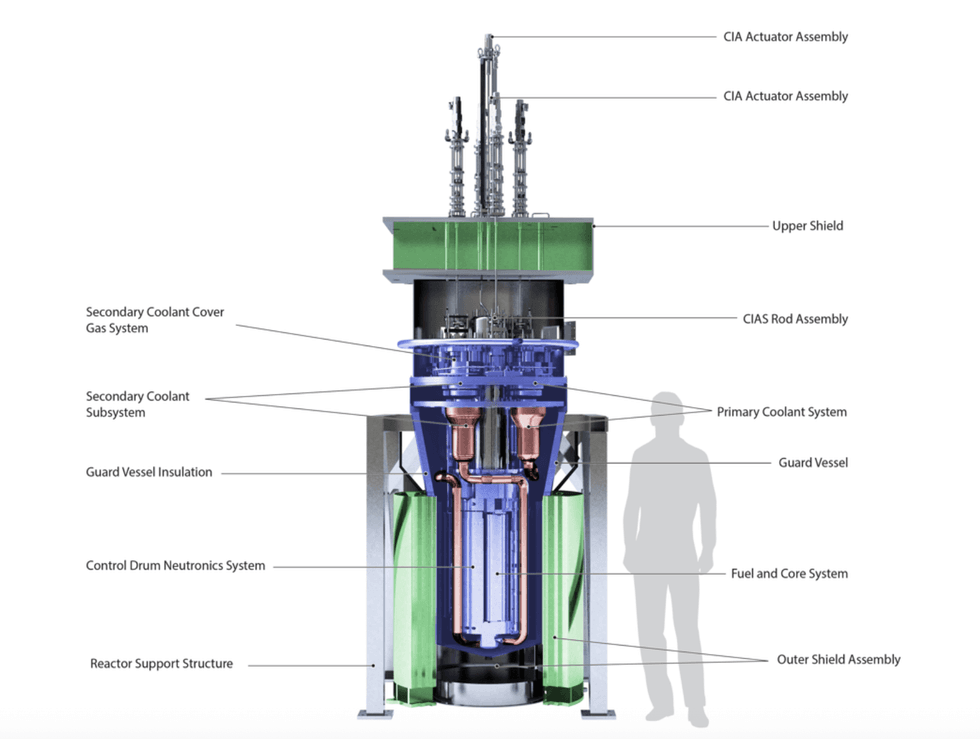 A cutaway of the MARVEL reactor, showing its size relative to a person. Idaho National Laboratory