This week brings encouraging news for companies on land and offshore, from the Netherlands to East Africa. First up — and in spite of a federal administration that appears to be actively hostile toward residential and commercial electrification and energy efficiency measures — California gubernatorial candidate Tom Steyer’s investment firm Galvanize just closed a fund devoted to decarbonizing real estate. Elsewhere, we have a Dutch startup pursuing a novel approach to clean heat production, a former Tesla exec rolling out electric motorbikes in East Africa, and an offshore wind developer plans to pair its floating platform with underwater data centers.
Galvanize Raises $370 Million Fund for Energy-Resilient Real Estate
With electricity costs on the rise and war in Iran pushing energy prices further upward, energy efficiency measures are looking more prudent — and more profitable — than ever. Amidst this backdrop, the asset manager and venture firm Galvanize announced the close of its first real estate fund, bringing in $370 million as the firm looks to make commercial buildings cleaner and better able to weather price fluctuations in global energy markets.
Galvanize, co-founded by the billionaire Tom Steyer, is already doling out this money, investing in 15 buildings across 11 cities so far. The firm targets real estate in cities where demand is outpacing supply, performing decarbonization upgrades such as installing on-site solar generation and undertaking energy efficiency retrofits such as improved insulation and weatherproof windows.
Galvanize is betting that fluctuations and increases in energy prices will grow faster than the cost of upgrading buildings to be more efficient and lower-emissions, making its strategy profitable in the long-term.
Dutch Startup Rift Nabs $132 Million to Make Clean Heat With Iron Fuel
While I’ve long followed thermal battery companies like Rondo and Antora, which use renewable energy to heat up hot rocks capable of delivering industrial heat, I was unaware of iron fuel’s potential to do much the same. That changed this week when the Dutch startup Rift announced it had raised $132 million to commercialize this technology.
The startup produces high-temperature heat by combusting iron powder with ambient air in a specialized boiler engineered to handle metal fuels. This process produces a flame that can reach 2,000 degrees Celsius without emitting any carbon dioxide. The resulting heat can then be delivered as steam, hot water, or hot air to industrial facilities, with the only byproduct being iron oxide (rust), which itself can then be collected and converted back into iron fuel by reacting it with hydrogen produced via low-carbon processes.
Rift’s latest funding comprises a $96.2 million Series B round involving several Netherlands-based investors, along with a $35.5 million grant from the EU Innovation Fund. Both pots of money will support the construction of the company’s first production facility for iron fuel boilers. Rift’s first customer is the building materials manufacturer Kingspan Unidek, with whom it’s developing a project that Rift says will result in over a million metric tons of avoided emissions over a 15-year period.
Zeno Secures $25 Million to Scale Battery-Swapping Electric Motorbikes
The electric vehicle transition looks pretty different in East Africa, where two-wheeled motorcycles dominate daily commuting and urban transit. These smaller, lighter vehicles are simple and cheap to electrify, and while their upfront cost is higher than gasoline-powered bikes, operating expenses can be 50% lower. This week, the market received a boost as e-motorbike startup Zeno announced a $25 million Series A round to scale production of its flagship bike.
The round was led by the climate tech VC Congruent Ventures, with support from other heavyweights such as Lowercarbon Capital. Zeno’s CEO Michael Spencer, who left Tesla in 2022 to start the company, sees a larger electrification opportunity in emerging economies than here in the U.S. As he told TechCrunch when Zeno emerged from stealth in fall 2024, “the Tesla master plan has more legs and more room to run with lower hurdles in emerging markets.”
Spencer saw particular potential to sell low-cost motorbikes with batteries that Zeno would own rather than the customer, meaning they can’t charge their bikes at home. Riders instead rely on swap stations where they can exchange depleted batteries for fully charged ones — much as the Chinese electric vehicle company Nio does with its cars.
Zeno designs and manufactures its own bikes and charging infrastructure, with 800 motorbikes sold and 150 charging and battery-swap stations installed across four cities across Kenya and Uganda. With this latest influx of cash, the company plans to fulfill its backlogged orderbook, which it says now has more than 25,000 retail and fleet customers.
This Offshore Wind Developer Wants to Co-Locate with Underwater Data Centers
Data centers developers are hitting bottlenecks securing energy, land, and social acceptance — so the startup Aikido wants to ship them out to sea, where it says “energy, cooling and space are abundant.” This week, the offshore wind developer revealed its novel floating turbine platform, designed to co-locate wind generation and battery storage with data centers submerged in compartments connected to the turbine itself.
The installation would still be grid-connected, but the idea is that the turbine and batteries will meet most of the data center’s energy needs, drawing on the grid mainly during the summer when the wind dies down. A 100-kilowatt proof of concept is already being developed in Norway, with the first commercial deployment slated for the U.K. sometime in 2028. Eventually, Aikido says it envisions building “gigawatt-scale” data centers at sea — an ambitious undertaking in a notoriously harsh environment.
But as CEO Sam Kanner reasoned in a press release, “before we go off-world, we should go offshore” — a likely jab at Elon Musk, who has repeatedly expressed his desire to launch data centers into space to rid himself of terrestrial concerns over real estate and energy.






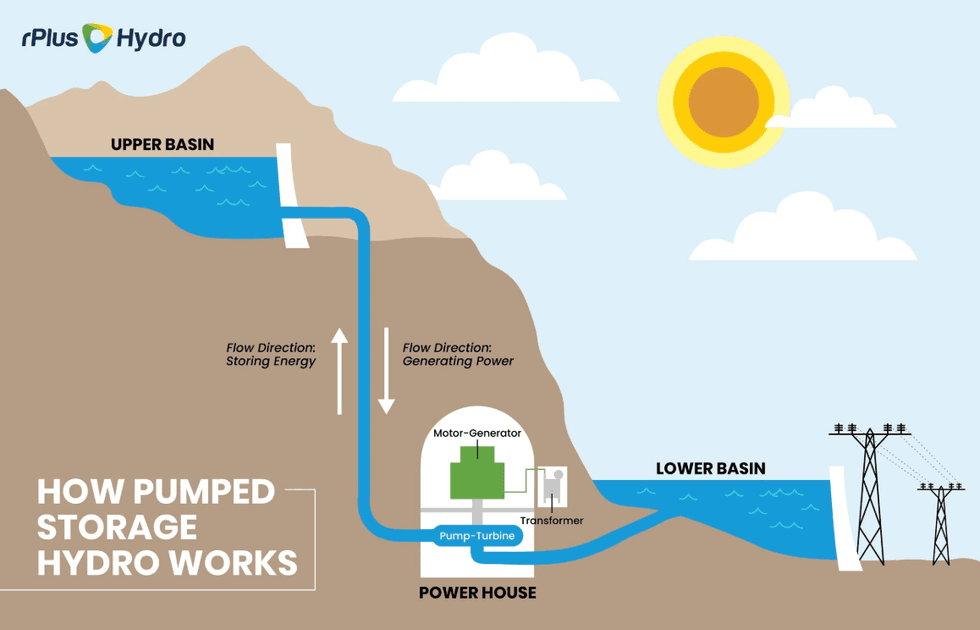 How the Seminoe pumped hydro project would work.rPlus Hydro