There are plenty of ways to leverage everyday household appliances to shift electricity demand and free up capacity on the grid. But when energy nerds talk about these opportunities, they’re mostly focused on distributed energy resources like smart thermostats, residential batteries, and electric vehicle chargers. Water heaters — the vast majority of which are not internet connected — rarely enter the conversation.
Boston-based startup Reservoir wants to change that, raising a $8 million seed round to bring its sexier, techier heat pump water heaters to market. Asymmetric Capital Partners led the round, alongside Founder Collective and the climate-focused investor MCJ.
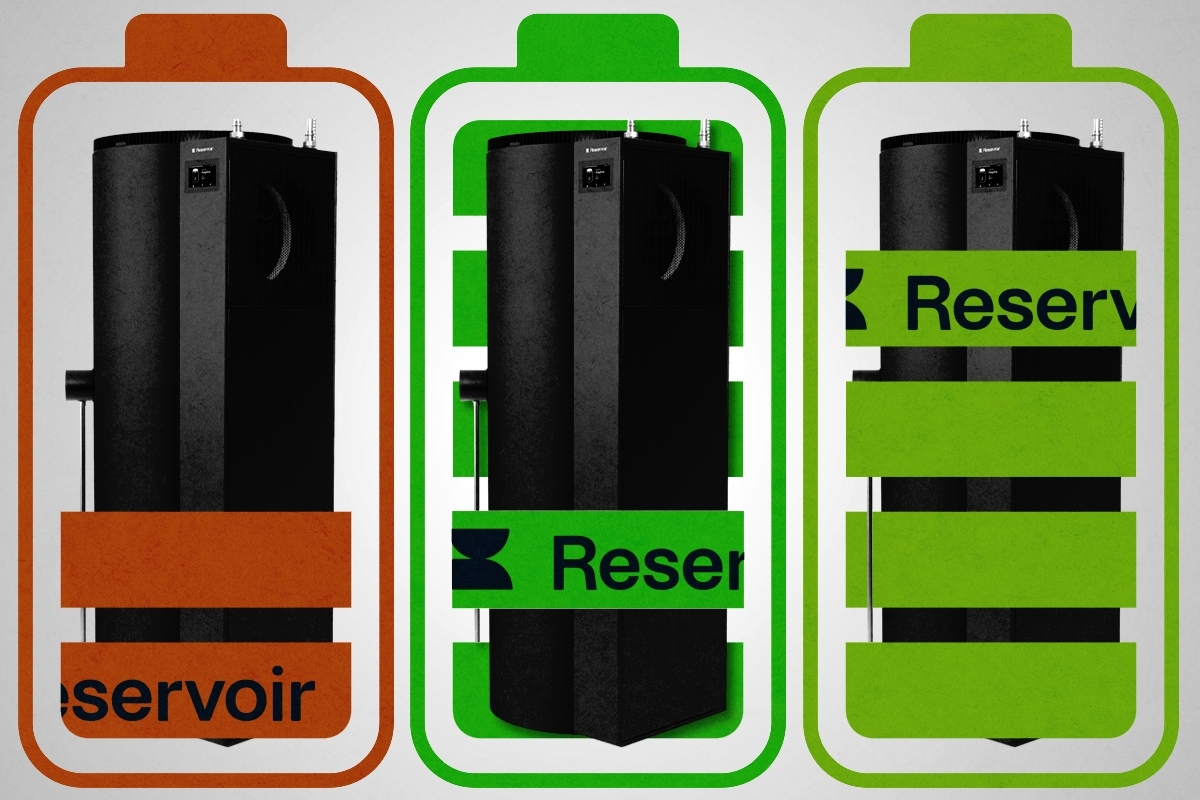
The startup has already installed its water heaters in nearly 100 homes around Boston. Each unit pairs an onboard computer with a heat pump, allowing it to learn a household’s hot water habits so it can begin preheating hours in advance of, say, your morning shower. That long lead time matters, as a heat pump can take five or six hours to warm up a standard 50-gallon tank. But if your schedule shifts and you need hot water at an atypical time, the unit comes equipped with backup resistance heating elements, allowing it to heat the tank quickly using the same technology many conventional water heaters do.
The company’s CEO, Luke Winston-Almanzar, was inspired to start the company when he realized that his water heater consumed more energy per year than it took to charge his electric car, but was dumber than his air fryer or watch.
“Most people don’t realize the water heater is the second biggest use of energy in the home. It’s almost 20%,” he told me, coming in behind space heating and cooling, which account for around half of a household’s total energy consumption. He saw an opportunity to help bring smart, energy efficient water heaters into the digital age, much the way Nest did for thermostats.
Simply switching to a heat pump water heater can already cut energy use by about 75% compared with standard electric models, which account for about half the nation’s fleet. And while most heat pump models now come equipped with internet connectivity and remote adjustment mechanisms, the startup’s predictive software is what truly sets it apart. While other units simply hold water at a consistent temperature, Reservoir squeezes out additional energy savings by only heating when it anticipates hot water will actually be needed, Winston-Almanzar told me. Ultimately, this adds up to an average $800 per year in customer savings compared to standard electric tanks, and around $150 for gas-powered tanks, according to the company’s estimates.
Scale that up to thousands of households, and water heaters become a grid resource that can participate in demand response programs and virtual power plants. “You get a smart water heater in homes — you can save people money, you can increase their comfort. But then you get 50,000 of them, and they’re connected, and you can actually offset Elon Musk’s data center,” Winston-Almanzar explained.
Because water heaters store thermal rather than electrical energy, they can’t send electricity back to the grid like residential battery storage systems can. But they can still shift when they consume electricity. For example, Reservoir can heat water in the early morning when demand on the grid is low and hold it until people start waking up and showering. Or for households that use more hot water in the evening, the system can heat up around midday when there’s lots of cheap, clean power on the grid. During times of peak demand, it can simply pause its heating cycle, drawing on the water it’s already stored.
While Reservoir hasn’t yet integrated its systems with a virtual power plant provider that could compensate customers for helping to alleviate strain on the grid, Winston-Almanzar sees this as a near-term opportunity. “What I’m sprinting towards is getting 1,000 units installed in Massachusetts because that gets us to the megawatt-hour-scale of thermal storage,” he told me, explaining that’s when VPP integration will start to make sense for a specific region.
Today, the startup’s base model retails for less than $4,000 fully installed, compared to $3,000 to $6,000 for a standard electric water heater, and includes all of Reservoir’s predictive capabilities. The company also offers a more feature-rich $5,450 model that has a “Party Mode,” which effectively stretches the capacity of a 50-gallon tank to deliver up to 150 gallons of hot water on high-demand days, such as when a household is hosting guests. This model can also proactively adjust the system when water pipes are at risk of freezing and offers “no-wait” showers, using a recirculation pump to deliver hot water instantaneously, without having to let the tap run first.
Those prices include the $1,050 rebate available for heat pump water heaters in Massachusetts, where Reservoir’s early installations are concentrated. While the Trump administration axed the Energy Efficient Home Improvement Credit, which covered 30% of the costs of eligible units up to $2,000, Winston-Almanzar says state-level incentives are helping fill the gap. The company has already expanded into Maine and New Hampshire, which offer their own rebates, and plans to enter additional major metro markets such as New York, Washington DC, Seattle, and San Francisco.
The company is also betting on its installation process as a competitive advantage. Rather than relying entirely on third-party contractors, Reservoir employs an in-house team of young, digitally native plumbers to install its systems — a team it expects will grow substantially as the company scales.
Ultimately, if Reservoir succeeds in becoming the Nest of water heaters, Winston-Almanzar predicts systems like his will eventually replace smart thermostats in VPP programs. “If you have a battery for where you need electrons moving, and you have a tank of water for when you need just heat moving, homeowners don’t even need to feel it,” he explained. While adjusting a customer’s thermostat can immediately impact their comfort, changing a water heater’s background operations will go largely unnoticed, he argued, making them a better option for VPP integration.
Turning one of a home’s largest energy loads into a giant grid battery that saves customers money certainly seems like a good bet. But it’s still early days. Reservoir will have to prove, through many thousands more installations, that the humble water heater truly has what it takes to become one of the grid’s most valuable distributed resources.