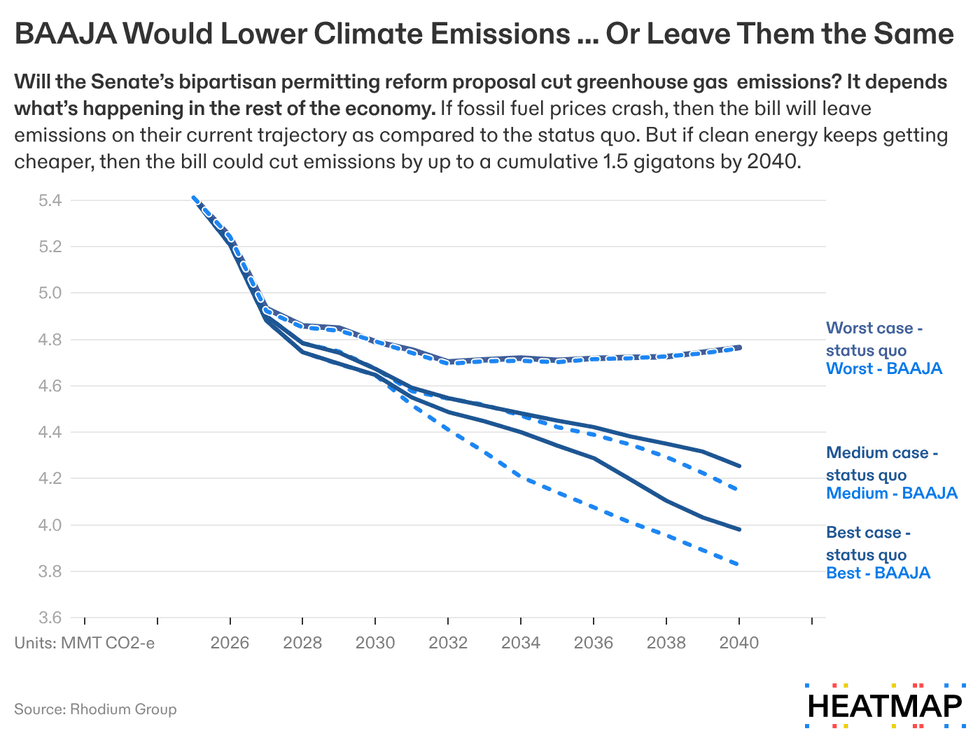
The bipartisan permitting reform bill is likely to slightly cut greenhouse gas emissions and lower electricity bills by 2040 — or at worst leave emissions on the same trajectory that they are on today — as compared to the status quo, according to a new analysis of many of its provisions by the Rhodium Group, an independent research firm.
The analysis examines the policies in the Bipartisan American Affordability and Jobs Act, or BAAJA, that would have the most-clear cut effects on climate pollution and the energy system. It is the most comprehensive account of the bill’s effects on emissions so far, although it does not examine all of its provisions.
The bill is hard to analyze because — unlike recent partisan energy bills, such as the Inflation Reduction Act or President Trump’s tax and spending bill — its effects on the climate are more ambiguous and often seem to counteract each other. BAAJA will make it easier to build not only long-distance transmission lines, which are essential for clean energy, but also natural gas pipelines, which can expand fossil fuel production.
Yet the climate benefits likely outweigh or balance out the harms, at least among the studied policies, the report finds. In the best case scenario, the bill could cut U.S. economy-wide emissions by 4%, reduce energy bills by $78 per year, and drive more than 200 gigawatts of new clean energy capacity by 2040, compared to status quo policy. In a worst case scenario, greenhouse gas emissions would remain unchanged on their current trajectory.
The results should be viewed as more directionally instructive than a precise accounting of the legislation, Ben King, an energy and climate director at Rhodium, told me.
“We don’t see emissions increasing because of the bill,” King said. “This bill should drive some emission reductions, it should drive some more clean energy on the grid, and it should drive electricity bills down. And given the complexity of the bill, that’s what we can say at this point.”
The analysis does not look at the bill’s permitting certainty provisions, which Democrats initially sought to stop President Trump’s war on wind but have become one of its thorniest sections. Rhodium’s modeling is also a crude tool for assessing transmission policy, since the model can look only at economic inputs such as supply and demand, and not the physical reality of the U.S. grid, such as where transmission lines run or where the bottlenecks are.
It is the second analysis to find that the bill could modestly lower carbon pollution. A more limited report focusing only on the power grid, published last week by the think tank Resources for the Future, found the legislation could cut electricity emissions by 6% while reducing electricity system costs by $350 billion through 2050.
The effects of the bill may sound small, but BAAJA is not a climate bill. It’s not engineered to reduce reliance on fossil fuels or boost clean energy technologies. Its overarching purpose is to address various federal bottlenecks that bog down America’s ability to build stuff, whether that’s a pipeline or a highway or a power line or a solar farm. So it’s not entirely surprising that it’s not expected to have a dramatic effect on emissions.
The reason it’s a priority for Senate climate champions is that many of its provisions are important precursors to decarbonizing the U.S. economy more quickly. By enabling faster expansion of the power grid, the bill would put the country in a much better position to transition to clean energy. After Joe Biden’s big climate bill, the Inflation Reduction Act, passed in 2022, Princeton University researchers found that the country’s slow buildout of transmission lines would be a major obstacle to gleaning the law’s benefits. Unless the country more than doubled the rate of transmission expansion, they wrote, more than 80% of the IRA’s emission reduction potential by 2030 would be lost.
BAAJA could nearly triple the build rate of high-voltage transmission, the Rhodium Group found, from an average of about 0.7 terawatt-miles added per year over the past decade to an average annual pace of 1.9 to 2.6 terawatt-miles through 2040. Because Republicans and President Trump have repealed so many of the IRA’s provisions, this won’t drive as much clean energy as the Princeton researchers expected, but Rhodium estimates that by 2040, BAAJA would help between 17 and 249 gigawatts of clean resources get built compared to a world without it.
The growing grid is the main reason why the bill cuts energy costs, because it enables more lower-cost resources to connect to the grid. The bill’s requirement that data centers pay the full cost of connecting to the grid also puts downward pressure on electricity rates.
“If your goal is to do climate policy in the future, this is an important down payment to making progress there,” King said.
The authors studied the bill’s provisions under a range of economic assumptions, including a “best case” scenario in which clean energy gets cheaper and easily outcompetes natural gas, and a “worst case” scenario where natural gas prices collapse and the inexpensive fuel keeps dominating the U.S. energy system.

The authors limited their analysis to the bill’s provisions that speed up transmission line and natural gas pipeline permitting. They assumed that when you make it easier to approve transmission lines, the lines get cheaper to build and get built more quickly. The same goes for gas pipelines. Then they looked at how the energy system would respond. Would we build more power plants? Would there be more natural gas production? Where will that gas go?
The caveats, aside from omitting the bill’s “project certainty” provisions, are that they did not account for policies that support geothermal energy, virtual power plants, advanced transmission technologies, or the ways in which the bill would reduce congestion on the grid — all of which could result in fewer emissions. At the same time, the modeling assumes that all of the data centers that get built between now and 2040 connect to the grid, even though today, many data centers are planning to run on inefficient off-grid natural gas plants. That means this modeling likely underestimates emissions from data centers. (Although the authors did a separate exercise that went deeper into data centers, which I’ll explain shortly.)
The report also limited its analysis to the United States. While the modeling found that liquified natural gas exports would increase by 8% to 15% under BAAJA, the authors did not account for how those exports could affect the energy mix or emissions in the rest of the world.
They found that the bill’s changes to the Clean Water Act and the National Environmental Policy Act would enable more gas pipeline development, which, in isolation, would increase emissions relative to a world without BAAJA. More pipelines means more production of oil and natural gas, which means higher methane and CO2 emissions throughout the fossil supply chain. Under a worst case scenario, they estimate a 4% increase in the amount of new gas capacity, although gas-fired generation as a whole increases by less than 1% in 2040. Even then, emissions would simply be flat compared to current expectations.
“On net, the emissions increases that we see there are outweighed by the emissions benefits that come from the transmission provisions of the bill,” King said.
The report also studied how BAAJA might affect data center emissions. Its “base case” scenario — which includes all the analysis I’ve shared with you so far — assumes data centers will make up about 17% of electricity demand by 2040. That figure already supposes huge growth in data center energy consumption, because data centers only use about 5% of U.S. electricity today.
But what if data center demand grows even faster than that? The authors modeled two additional scenarios to see what would happen if data center electricity demand instead accounted for more than a quarter of U.S. electricity demand in 2040.
While BAAJA would make it easier for data centers to connect to the grid, it also includes ratepayer protection provisions that would make it more expensive to do so — roughly 10% more for a 1 gigawatt data center, Rhodium estimates. Determining whether that will drive developers on-grid or off-grid was beyond the scope of the analysis, so the modelers looked at the two extremes — a world where all additional data center demand hooks up to the grid and one where none of it does.
For the on-grid scenario, whether or not that additional demand is met with mostly gas plants or cleaner sources largely depends on the price of fossil versus clean generation. But even if most of the demand was met by natural gas plants on the grid, emissions would still be 30% lower than if it was met by natural gas plants off the grid, Rhodium found.
Editor’s note: This article originally misstated the scope and timing of electricity systems savings in the Resources for the Future study. It has been corrected in this version.