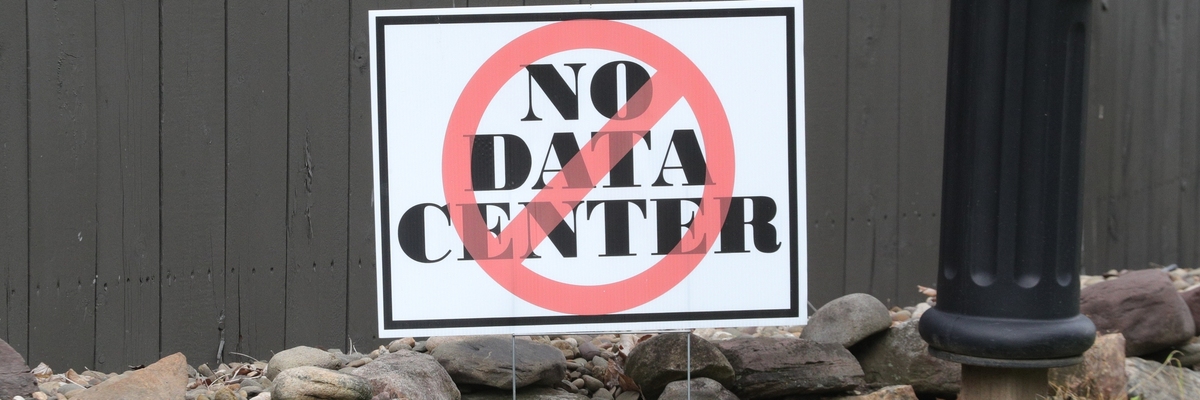
Every few days, I think the data center backlash has reached its apex — surely it can’t become an even bigger issue in American politics. Then it surprises me again.
On Monday evening, the reaction got as close to President Donald Trump as it’s ever come, when six protesters interrupted his speech at a General Motors facility in Michigan to oppose the computing facilities. Although they were drowned out by the pro-Trump crowd, a new Fox News poll suggests their chants of “data centers no, people pay the bill” probably found some agreement in the crowd. Just as our own Heatmap Pro polling identified earlier this summer, that poll revealed U.S. voters would oppose the construction of a new AI data center in their area by a 40 point margin.
Most interesting, I think, is that MAGA voters and Republican men are among the electorate’s most pro-data-center contingent, according to the Fox poll. (Our Heatmap Pro poll has found similar, though we didn’t ask about “MAGA” status per se.) But even those demographics are virtually evenly split along pro- and anti-data center lines. White women with college degrees are unified against the facilities.
We’ll get a better sense of how data centers play in politics over the next two weeks. In the Michigan and Wisconsin primaries, insurgent candidates across the political spectrum have rallied against the facilities. In Wisconsin, the state legislator and Democratic Socialists of America member Francesca Hong has promised to enact a statewide data center moratorium if she is elected governor. A new State Navigate poll, published today, found that not only is she leading the field in the Democratic primary, but also that data centers are among voters’ top concern in the race, ranking alongside health care and affordability.
In fairness, every candidate in Wisconsin’s governor’s race seems to want to slow down data center development in some way. Democrats across the board would end tax incentives for the facilities. Some conservatives would like to slow down more than just computing projects. Tom Tiffany, the Republican frontrunner, has said he wants to give towns and counties more control over stopping data center and clean energy projects. “No taxpayer subsidies for industrial-scale solar, wind, or data centers,” he posted on Facebook earlier this year. “Without our farmland, we lose the heart of Wisconsin.” (Earlier this year, my colleague Jael Holzman wrote about why the data center backlash is splashing over into renewable opposition.)
In Michigan, the epidemiologist and former public health official Abdul El-Sayed, who is trying to win the Democratic Senate primary, hasn’t promised a moratorium but says the computing facilities should follow certain “terms of engagement,” such as protecting locals from rate hikes and by using closed-loop water systems. “There’s literally not a conversation that I have, not a stop that I make, where data centers and AI don’t come up,” he told CNBC last month.
There, too, not all the opposition is coming from Democrats. The longshop GOP governor candidate Perry Johnson has campaigned against certain data center projects.
Suffice it to say I expect to keep being surprised. In fact, I was surprised by the backlash while writing this very newsletter. Earlier this evening, the country legend Willie Nelson urged Texans to “fight against data centers invading our land” and appeared to oppose a particular project in central Texas. What can I say? I expect data centers to always be on my mind — or, well, to be on it for the foreseeable future.