You’re out of free articles.
Log in
To continue reading, log in to your account.
Create a Free Account
To unlock more free articles, please create a free account.
Sign In or Create an Account.
By continuing, you agree to the Terms of Service and acknowledge our Privacy Policy
Welcome to Heatmap
Thank you for registering with Heatmap. Climate change is one of the greatest challenges of our lives, a force reshaping our economy, our politics, and our culture. We hope to be your trusted, friendly, and insightful guide to that transformation. Please enjoy your free articles. You can check your profile here .
subscribe to get Unlimited access
Offer for a Heatmap News Unlimited Access subscription; please note that your subscription will renew automatically unless you cancel prior to renewal. Cancellation takes effect at the end of your current billing period. We will let you know in advance of any price changes. Taxes may apply. Offer terms are subject to change.
Subscribe to get unlimited Access
Hey, you are out of free articles but you are only a few clicks away from full access. Subscribe below and take advantage of our introductory offer.
subscribe to get Unlimited access
Offer for a Heatmap News Unlimited Access subscription; please note that your subscription will renew automatically unless you cancel prior to renewal. Cancellation takes effect at the end of your current billing period. We will let you know in advance of any price changes. Taxes may apply. Offer terms are subject to change.
Create Your Account
Please Enter Your Password
Forgot your password?
Please enter the email address you use for your account so we can send you a link to reset your password:

Today’s top-of-the-line electric vehicles are self-driving computers on wheels built to feel as futuristic and digital as possible. They come with artificial intelligence-powered assistants, enormous touchscreen interfaces, and huge batteries.
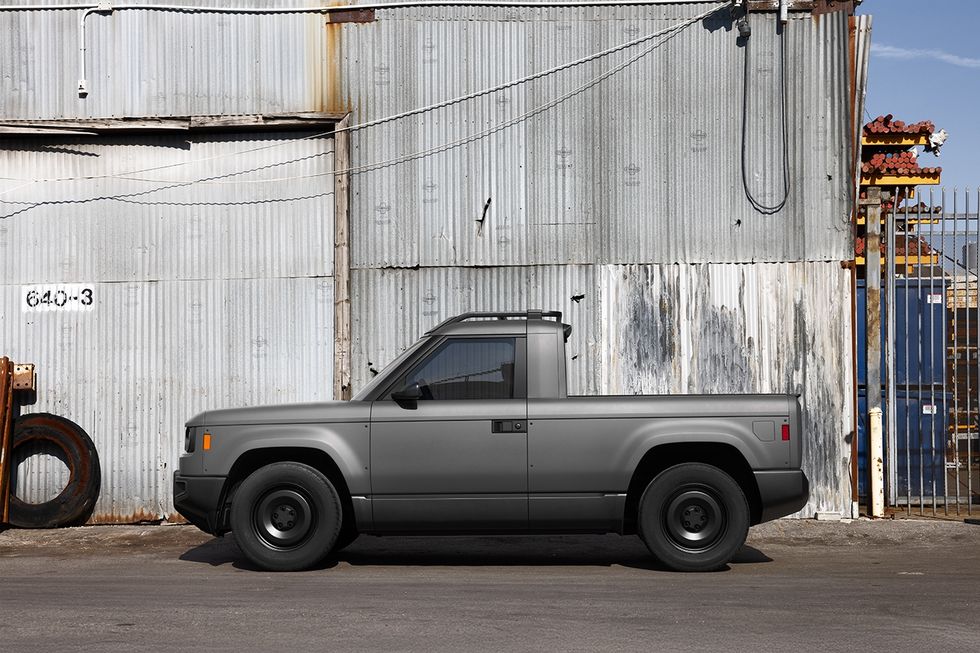
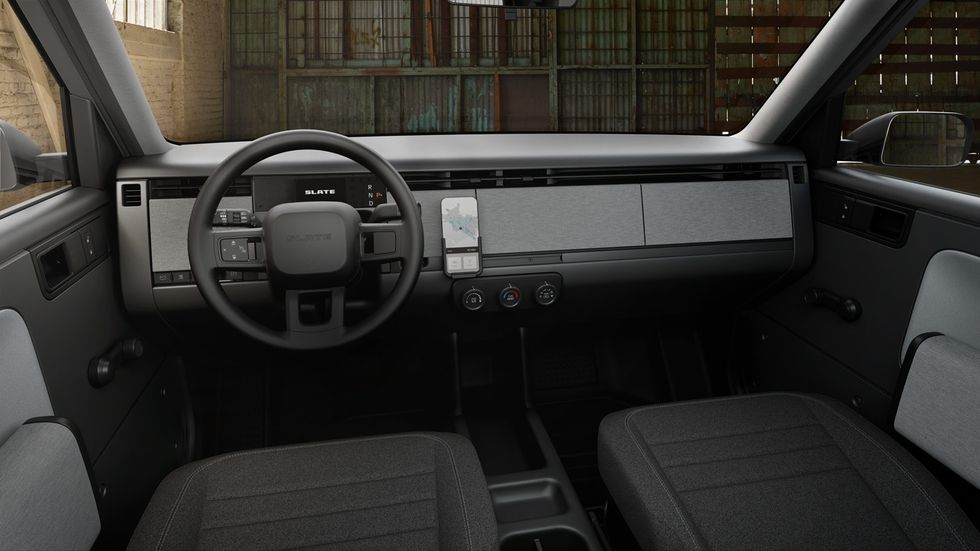
The Slate pickup truck’s signature feature? Hand-crank windows.
As Slate Auto has developed its attempt at the bare-bones EV over the past couple of years, its 1990s-nostalgic manual windows became a symbolic choice, one meant to signal just how far it was willing to go in pursuit of affordability. On Wednesday, Slate gave us a fuller picture, revealing the details about its vehicle and providing a glimpse at how the Jeff Bezos-backed startup plans to sell an EV truck at an entry-level price. But while the pickup’s lack of power windows or a built-in stereo system are attention-grabbers, a lot of the savings lie under the skin.
Just how cheap is it? The “Blank Slate,” a version of the truck with zero bells and whistles, starts a hair under $25,000. This is a compact truck in the spirit of decades past, with two seats up front and nothing more. For a Slate that seats more than a couple, choose the SUV or fastback configuration that bumps up the price to about $30,000 or $32,000, respectively.

From there, Slate’s à la carte model takes over. Choosing a wrap to make your whole truck a color other than gray costs $499, though blessedly, Slate provides dozens of color choices as opposed to the handful of neutrals and muted colors offered on a typical new car. The portal to design one’s Slate becomes a rabbit hole of possible choices — custom taillight designs, roof racks, and wheels — all of which add a little or a lot to the price of the truck. These add-ons can quickly propel a Slate deep into the mid- or even high-$30,000s range if you’re not careful. The point, though, is that the $25,000 EV is front and center.
To achieve this starting price required a heavy dose of vintage or simplified tech. Roll-down windows and no built-in stereo speak to drivers who aren’t automotive engineering experts. But as reviewers and online commenters have noted, crank windows aren’t a make-or-break money-saver — they might knock off $20 or $40 per vehicle — and so few companies use them now that Slate had to go out of its way to source them from Brazil.

A bigger cost-cutter was Slate’s embrace of old-school manufacturing and its willingness to consider “yestertech” that’s still perfectly serviceable, but has fallen out of use because better systems have come along. The chassis, for example, is made of ordinary steel — 250 pieces welded together as opposed to the more efficient stamping methods that have taken over automotive manufacturing. While Slate has a familiar, inexpensive MacPherson suspension up front, its rear uses a design called the De Dion that dates back to the late 1800s. (The Autopian has a nice technical write-up about why this choice makes sense.)
We often default to calling EVs smartphones on wheels because of the Tesla approach to making them — the so-called software-defined vehicle that routes its main functions through touchscreen interfaces and gets new features via over-the-air updates. So perhaps a comparison to the phone industry is apt. In the same way budget-conscious buyers were waiting for Apple to make the “affordable iPhone,” drivers have been waiting for the automakers to roll out the entry-level EV. But instead of the cheap Tesla, what we got is the Slate, which is something more like a flip phone on wheels.
That’s not to say it won’t succeed. Flip phones are enjoying a resurgence, after all, powered by their low price and by growing dissatisfaction with life in this age of touchscreens. But Slate’s unusual position in the car industry makes it difficult to predict how American drivers will respond. For those shopping solely on price, Slate may not measure up. The cheapest gas-powered cars in America include the likes of the Toyota Corolla, Hyundai Elantra, and Volkswagen Jetta, and their starting price in the mid-$20,000s includes the basic creature comforts you’d expect from a modern car, not to mention seating for at least four. In a world that still had the $7,500 federal tax credit for buying an EV, the Slate would undercut these gas-burners. In this world, it can’t (though you could add a slew of options to the Slate before it would cost the same as the $35,000 electric truck under development at Ford’s skunkworks operation).

What Slate has going for it, though, is its ability to become the exact car you’d like. Normal cars come with three or four “trim levels,” each of which adds a thousand dollars or two in exchange for more features. In practice, many people are stuck with whatever version they can actually track down at a dealership. Slate follows the Tesla-Rivian model of direct-to-consumer sales, and its trademark customizability means buyers are limited to picking from two or three versions of a car, but can design every single piece of their truck.
To be sure, lots of people don’t want this. Many are presumably happier buying a car off the familiar lot without the mental overload of choosing every single thing about their vehicle. The question is whether a quorum of drivers are ready for a new way to buy a car — or at least, so fed up with fluctuating gas prices and the out-of-control prices of new vehicles that they’re ready to take a chance on rolling their windows again.
Log in
To continue reading, log in to your account.
Create a Free Account
To unlock more free articles, please create a free account.
Current conditions: France just recorded its hottest day ever, with Wednesday’s temperatures soaring to just under 111 degrees Fahrenheit; nearly 50 people died drowning while seeking respite from the heat • A pair of 7.1-magnitude earthquakes struck Venezuela, collapsing buildings in Caracas • Wind has whipped the Cottonwood Fire, one of six wildfires raging in Utah, into a larger blaze now covering 60,000 acres — and it’s still at 0% containment.
New Jersey Representative Frank Pallone, the ranking Democrat on the House Energy and Commerce committee, joined calls for a national moratorium on data center construction ahead of Wednesday afternoon’s markup of a series of bills related to the buildout of infrastructure to support artificial intelligence software. In a statement, Pallone described the bills as a “useful first step,” but one that, “compared to the challenges the American power grid is facing,” amounts to “not nearly enough.” Rather, he backed a “national AI data center moratorium until we can find a way to ensure they don’t harm our nation’s air, water, and power bills.” Pallone’s new public position makes him one of the highest-ranking Democrats yet to back the idea, championed by the likes of Representative Alexandria Ocasio-Cortez, of halting permitting on new data centers in response to the growing blowback from voters.
Pallone’s shift comes in response to the Ratepayer Protection Act, which would enshrine into law the voluntary pledge tech companies signed with the White House to pay for grid costs from their server farms. Heatmap’s Matthew Zeitlin wrote earlier this week that the bill was “not so much an anti-artificial intelligence or anti-data center bill, but rather a move to insulate further data center development from political pressure stemming from rising electricity costs.” When Pallone made his statement a day later, Matthew wrote: “Well, at least one influential lawmaker seems to agree with me.”
The Iran War has cost the average American car owner an extra $156 and the average SUV driver another $232 in gasoline costs, according to new data from the policy shop Third Way. But the newly mapped analysis, shared exclusively with me, shows that Republican-leaning states in the Mountain West and beyond paid some of the highest prices for a conflict. Alaska saw one of the biggest spikes, with gas prices rising by $1.40 per gallon, a 39% increase. Wyoming followed close behind, with prices soaring by $1.37 per gallon, a 50% surge. Prices in Utah, meanwhile, climbed by $1.30, or 47%. That stands in contrast to many big Democratic-leaning states. New York’s gas prices rose by $1.23, or 41%, while California’s prices went up $0.94, or 20%. That, of course, doesn’t reflect where the prices were already high. I just returned this week from a trip to Los Angeles, where gas was nearly twice as expensive as in New York City.
Century Aluminum, America’s largest primary aluminum producer and the developer behind the first new U.S. smelter in 50 years, has inked a deal with a green cement startup to supply a key raw material. Brimstone, known as a major player in the race to commercialize green cement, also generates alumina. On Wednesday, the startup unveiled a memorandum of understanding with Century Aluminum to establish a domestic “mine to metal supply chain” for aluminum made from scratch rather than scrap. “Foreign sources, including China, currently dominate global alumina production. Brimstone is bringing alumina production home and doing it at a globally competitive price,” Brimstone CEO Cody Finke said in a press release. “Brimstone is upending the massive global imbalance by producing alumina from rock quarried here in the United States.”
Sign up to receive Heatmap AM in your inbox every morning:
Until the nation’s flagship reactor project came online and transformed Southern Company’s Alvin W. Vogtle Generating Station in eastern Georgia into America’s most powerful atomic electrical plant, Arizona’s Palo Verde Generating Station was the No.1 nuclear facility by size in the country. The desert state is now looking to reclaim its mantle. The trio of utilities Arizona Public Service, Salt River Project, and Tucson Electric Power said Wednesday they are continuing “to work together to explore adding nuclear generation in Arizona.” The next step, the companies said, is a siting study that’s expected to be completed within the next six months. The Arizona Corporation Commission, the regulator in charge of utilities in the state, is holding an informational workshop today.
Meanwhile, the developer behind Canada’s flagship reactor design — which, because it’s cooled with pressurized heavy water, can run on raw uranium — just submitted initial paperwork to the Nuclear Regulatory Commission to start the licensing process to approve what’s known as the CANDU. Pronounced CAN-do and produced by manufacturer AtkinsRéalis, the reactor is the workhorse of the Canadian and Indian fleets and can be built reliably, but requires more maintenance than the light water reactors that run on enriched uranium and make up the entire U.S. fleet. “As the United States enters a new chapter in its civilian nuclear program, AtkinsRéalis is uniquely positioned, as the steward of CANDU technology, to help advance the country’s ambitious energy policy through proven, low-cost reactor technology with a world-class reputation,” Ian L. Edwards, the company’s president and chief executive, said in a statement. As I told you last month, the CANDU is at the heart of Canada’s new nuclear strategy.

The world needs a lot more copper. And while siting and building new mines takes time, two of the planet’s biggest producers are preparing to increase production at existing mines. On Wednesday, London-based Anglo American and the Chilean state-owned Codelco inked a deal to increase production through a joint venture at Los Bronces and Andina copper mines in the South American nation. The joint mining plan is expected to unlock 2.7 million metric tons of additional copper over a 21-year period, delivering an average of 12,000 tons per year. The increase comes with “minimal capital investment” and should bring the new supply online by 2030. “This agreement represents a more efficient and responsible way to develop one of the world’s leading copper districts,” Bernardo Fontaine, Codelco’s chairman, said in a statement. “It allows us to make better use of existing infrastructure, capture greater benefits for Chile, and move forward with a long-term vision based on operational excellence, sustainability, and the responsible use of resources.”
If green hydrogen is the stuff made with clean electricity and water and blue hydrogen is made with natural gas equipped with carbon capture, then the orange stuff is found in underground rock formations where naturally occurring gas forms and then is encouraged to continue forming through artificial means. Heatmap’s Katie Brigham did a good job of explaining the concept here. Well, now a French renewables developer FDE is promising to start producing orange hydrogen “by late 2028 or early 2029” after finding a naturally-occurring underground reservoir in northern France that can be tapped and stimulated to produce additional fuel, Hydrogen Insight reported.
How China saved the world from $200 oil.
Turn your mind back to early March, soon after Iran announced that it was closing the Strait of Hormuz. Energy experts told us to expect calamity.
Roughly 20% of the world’s oil and liquified natural gas supply moved through the narrow waterway, they said, and we would not soon be able to replace it. Oil prices would rocket to $150 or $200 a barrel. The world faced the worst energy supply shock in history.
We braced ourselves. We waited. And then … it didn’t happen.
Sure, the global oil benchmark rose to about $115 a barrel. Energy prices increased everywhere, and Southeast Asia faced a real crunch. But the worst consequences never hit. Europe didn’t run out of jet fuel, we didn’t get $8 gas across the United States, and the global economy did not shut down. Why?
We can now say with confidence: China bailed us out (and itself out, too). Without fanfare, the country slashed its energy imports and conducted a massive release from its strategic stockpiles of crude oil and liquid fuels. It eliminated something like 5 million daily barrels of oil demand, or about 5% of global oil demand.
Although it might seem technical, the implications of that silent intervention are huge for geopolitics, climate policy, and the future of the oil market. That’s why it’s the topic of today’s episode of Shift Key, Heatmap’s podcast. I encourage you to listen to my conversation with oil analyst Rory Johnston as he walks me through the wonky details — how we know China did this (math and satellite imagery), whether it has a modern precedent (it doesn’t), and what it all means (potentially a lot). He calls this public discovery of China’s latent power “the most important thing” we learned from the Iran war.
Anyway, I won’t ruin the conversation. (You can listen to Shift Key for free on any podcast platform, by the way.) But I do want to mull some of the implications here. The most important, to my mind, has to do with market power.
Get Heatmap in your inbox daily.
In oil markets, we often talk about “swing producers.” Saudi Arabia and other OPEC+ countries can shift the global oil price not just because they oversee a large share of the world’s oil production, but also because they can flex domestic production at will. They can increase or decrease their own output to affect the global marginal barrel’s price, stabilizing prices (or hiking them) as needed. (This originates partly from geological luck; Saudi Arabia’s reserves seem particularly well suited to rapid ramp-ups or ramp-downs in drilling and pumping.)
That suggests a mirrored role: a “swing consumer.” What if a country had such large oil stockpiles that it could ramp up or ramp down its imports at will, such that it could move global demand for oil at the margin? Such a thing has never existed in the history of the global oil market, at least to my knowledge. America has experimented with mini-versions of this idea in the past; the Biden administration released oil from the Strategic Petroleum Reserve in 2022 to depress prices after Russia invaded Ukraine. Outside of oil, China already plays a similar role in many global mineral markets, single-handedly shifting global prices for iron, lithium, copper, and other commodities.
But China's actions over the past few months suggest that its domestic oil stockpiles might now be so big that the country can play a swing role in global liquid fuels markets. After President Trump announced that he had reached a deal with Iran, I reflected in this newsletter on the fact that the world now had two energy systems, at least in the transport sector: a legacy liquid fuels system and a rival electricity system. These systems’ supply is divided among the world’s powers. The U.S. is the largest oil and gas producer in the world, but China is the largest manufacturer of solar panels, EVs, and batteries.
Yet if China is also now the world's swing consumer of oil, it suggests the country now has much more influence over the world’s most critical energy inputs in any form — fossil, electric, or mineral — than we had once thought. That isn’t my only Heatmap-relevant takeaway from the Iran war. But it is one I suspect we will remember for years to come.
New Jersey’s Frank Pallone, ranking member on the House Energy and Commerce Committee, says “this simply cannot continue.”
It was just yesterday that I wrote about the Ratepayer Protection Act, a bill that would transform into law the voluntary pledge big tech companies signed with the White House to take on additional electric grid costs from their data centers. My argument was that it’s not so much an anti-artificial intelligence or anti-data center bill, but rather a move to insulate further data center development from political pressure stemming from rising electricity costs.
Well, at least one influential lawmaker seems to agree with me. The Democratic ranking member of the House Energy and Commerce Committee, New Jersey Representative Frank Pallone, called for a national data center moratorium before the Wednesday afternoon markup of a series of data center-related bills, the Ratepayer Protection Act among them.
Pallone described the proposals being discussed at the markup as a “useful first step,” but that “compared to the challenges the American power grid is facing, they are not nearly enough.” Instead, he called for “a national AI data center moratorium until we can find a way to ensure they don't harm our nation's air, water, and power bills.”
Pallone cited a slew of efforts in his home state to slow the rapid proliferation of data centers, including a resolution in Asbury Park calling for a statewide moratorium and the city of New Brunswick rejecting a planned data center project earlier this year.
“This simply cannot continue,” Pallone said of the pace of data center development. (When asked for comment, Pallone’s office pointed to his prepared remarks.)
Pallone is not the first Democrat to call for a data center moratorium, but he’s the moratorium supporter who is most closely involved in energy policy at the national level. Senator Bernie Sanders and Representative Alexandria Ocasio-Cortez, two of Congress’ most prominent progressive Democrats, have called for a nationwide moratorium, sponsoring a bill that would enact “a reasonable pause to the development of AI to ensure the safety of humanity,” including a halt to data center construction until a laundry list of conditions were met related to both energy prices and AI safeguards.
The Democrat-controlled New York State legislature also passed a one-year data center moratorium earlier this month, although the bill is still sitting on the desk of Governor Kathy Hochul, a Democrat, awaiting her signature or veto.
Politicians calling for moratoria are trying to catch up with a public that has quickly soured on data centers. A majority of the American public supports a nationwide moratorium, according to polling done by Heatmap, with 40% of respondents giving the idea their strong support.
One reason why Americans increasingly oppose data centers is that they blame the developments for inflating their electricity bills. When Heatmap polled this question last August, 28% of respondents blamed “the construction of new data centers” for rising electricity prices. When we asked again last month, 53% did.
Analysts have looked at electricity price increases in the past five to 10 years and found little consistent relationship with data center construction, though that is not necessarily true everywhere and at all times.
In New Jersey, which is part of the PJM Interconnection electricity market, prices have likely risen based on current and planned data center construction within a grid area that has long had trouble bringing on new generation or building out sufficient transmission. PJM’s independent market monitor has attributed $23 billion in added costs to “existing and forecast data center load” in the system’s capacity auctions.
New Jersey Governor Mikie Sherrill implemented a rate freeze almost immediately following her inauguration earlier this year after years of price hikes and rising bills. Average electricity bills in the state have risen from around $91 per month to $140 per month, according to the Heatmap-MIT Electricity Price Hub, while electricity prices have risen almost 52% in the past five years.
Pallone was skeptical that any intermediate steps have or could work to protect ratepayers.
“Promises by the data center industry and Big Tech that these facilities will bring down costs have fallen flat,” Pallone said at Wednesday’s markup. The Federal Energy Regulatory Commission’s efforts to prompt regional electricity markets to overhaul their interconnection policies “may have promise, but it will take months, if not years, to come to fruition,” he said. The Ratepayer Protection Pledge, meanwhile, has “no enforcement,” and constitutes a “toothless promise from Big Tech.”
“Americans across the country have expressed concern and opposition to the rampant construction of AI data centers, and Congress should take this political groundswell seriously with a data center moratorium,” Pallone concluded. “That's what we need.”