This is an edition of Heatmap Daily, an evening review of the day’s news written by our executive editor. Sign up for it here.
Good afternoon and happy Friday.
Let’s start with the news: The new episode of our podcast, Shift Key, is my full interview with U.S. Energy Secretary Chris Wright, which we recorded at Heatmap House in New York on Wednesday.
Listen to it here. You can find it on Heatmap’s website or wherever you get your podcasts. You don’t need to be a Heatmap subscriber to tune in.
My colleagues at Heatmap have covered a few takeaways from our conversation — including Secretary Wright’s prediction that there will not be a “blanket ban” on U.S. diesel exports, which he then hedged slightly — but we haven’t previewed everything, and I think the conversation is still worth your time. A few highlights:
We discussed the Trump administration’s lengthy war on wind and whether it might end in the future. “I do believe a successful permitting reform … changes the playing field for anything you want to build in this country, including wind,” Wright said. He also explained why he thought congressional Democrats should trust the administration’s word about that.
Wright hit on the Energy Department’s program to build a new fleet of nuclear reactors across the country, which could (if successful) bring roughly 10 gigawatts of zero-carbon electricity capacity online across five sites. There are now “well more than five” companies interested in entering the deal, he said, meaning that five will soon be selected. Allegedly there was a dinner last night to discuss the program, but we haven’t heard anything more about it.
Also up for discussion: whether the United States is leaning too hard into natural gas, how China has buttressed the global economy from the Strait of Hormuz oil shock, and why Wright thinks China is now the “swing importer” of oil globally and has successfully “taken off the peaks” of global pricing.
“If [China] were listening to me for their energy policy — and they are not — but if they were, I’d have them ramp up those refineries more rapidly because they have oil, the world has oil, but we’re very, very tight on refining capacity right now,” he said.
It was a fascinating conversation. Some of it pointed to ways that American energy policy will need to evolve in the future, regardless of which president or party is in charge. You can find it wherever you get your podcasts: Apple Podcasts, Spotify, Amazon, YouTube.
***
I’d be loath not to mention — at least briefly — all the movement in the past week on permitting reform.
When we last checked in on permitting over the summer, Daniel Palken, the head of infrastructure at Arnold Ventures, helped me understand the emerging outline of a bipartisan compromise deal on energy and infrastructure permitting. Senator Martin Heinrich of New Mexico also sketched the state of negotiations for us in August.
Since then, I had heard that Senate negotiators were making progress, but had not heard many concrete details. But this week we saw a flurry of activity. At the beginning of the week, the White House seemed to want to move quickly to seal a compromise, promising to allow stalled solar and wind projects to proceed in return for getting something inked before the midterm elections. (That said, actually getting a law passed before the November 3 elections would have required Speaker Mike Johnson to bring his caucus back to Washington, D.C.)
But late on Wednesday, Senate Democrats signaled that they want to slow down the talks and seemingly delay any deal until after November. “We believe there is a good deal to be had,” the lead Democratic negotiators, Senator Heinrich and Senator Sheldon Whitehouse, said in a statement today. But “getting that [deal] right has to matter more than election-year deadlines.”
As a reminder, any permitting deal will need at least 60 votes in the Senate in order to clear the filibuster hurdle. That means such a deal will almost certainly need to be bipartisan — and therefore that a deal can only come together in a political environment where legislators from both parties feel like they can plausibly prosper in the near-term by making it easier to build. Right now, it seems like both parties do feel that way, even if they’re bickering about whether to get a deal done before or after November.
I have been careful not to endorse any bill until I see it, of course. It will all depend on what’s in the final text. But it would be a mistake, I think, for House and Senate Democrats to let this legislating opportunity pass them by if they are indeed so close to a deal that the decarbonization hawks Whitehouse and Heinrich feel good about. Just because Congress reaches a deal now doesn’t mean it can’t reach another one in the future. As we’ve discussed on Shift Key, recent history suggests that when lawmakers adjust one part of the law or one statute, they feel more comfortable returning to it in the future, making further addendums as needed.
Remember: Because federal permitting laws chiefly constrain what the government can do, they act as a brake primarily on public infrastructure. It took years, recall, for state and local governments in New York to get the permits necessary to implement their own scheme to tax traffic congestion in New York City. If you want to build big new infrastructure in the United States, be it high-speed trains, transmission lines, or zero-carbon power plants — and if you specifically want the government to build public works faster and better than it has in recent decades — then you should want a different federal permitting scheme than we have now. Let’s hope congressional Democrats remember that in the days, weeks, and months to come.








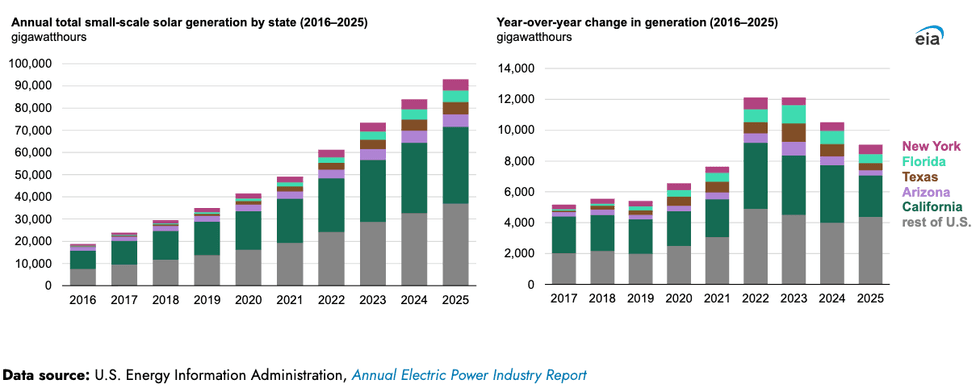 Solar capacity keeps growing. GoodPower