This is Heatmap Daily, a weekday digest written by our executive editor. Subscribe here.
Covering energy and climate change sometimes means seeing certain stories in a different light than others. And a particularly vivid hue illuminated The Wall Street Journal’s report today that the Japanese conglomerate SoftBank Group is taking a $3.7 billion loss on several gigawatts’ worth of natural gas turbines.
For the Journal, the big news is that SoftBank and its billionaire founder, Masayoshi Son, are failing to capitalize on the artificial intelligence boom. But at Heatmap, we’re thinking about the turbines.
The data center boom and the return of electricity load growth has depleted the world’s supply of natural gas turbines. SoftBank had purchased reservations for about 13 gigawatts of turbines, according to the Journal. That’s a staggering amount of electricity — it could meet New York City’s maximum power draw on the hottest part of a summer’s day. The conglomerate now seems set to dump reservations for about four gigawatts’ worth. Keeping a reservation, it turns out, really is harder than making it.
Most of those rotors were reportedly from GE Vernova, one of the world’s largest producers of gas turbines. GE Vernova’s order list for gas turbines has been filled for nearly two years and the waiting list now stretches into 2031. That has led data center developers, hungry to get power as soon as possible, to reach for ever dirtier forms of electricity generation, including diesel generators and even old jet engines.
On that front, SoftBank’s failure to sell the turbines to a higher bidder suggests (albeit weakly) that demand for energy-producing assets might not be as strong as the AI boom’s backers once thought. SoftBank was already set to send about 9 gigawatts of turbines to the enormous Trump-backed OpenAI data center in Pike County, Ohio. The roughly remaining four gigawatts will be released back their manufacturers. (One thing this news can’t quite tell us, alas, is what type of turbine set-up will be used in the Pike County facility, which will be the world’s largest gas-fired power plant if it is build to completion. Recent public filings have suggested the facility isn’t planning on using any turbines in the more efficient combined-cycle configuration, which would mean the plant’s carbon intensity will be worse than most other new natural gas plants. But we’d love to hear any tips on this front.)
To zoom out for a second, I’m struck by how the AI bubble has been replaced by an AI muddle. As I wrote this, news emerged that Nvidia is preparing to fire its CEO, Jensen Huang, for his affair with a Chinese woman who is alleged to be a spy. (He had at least one more affair with another Nvidia executive, according to The New York Times.) Under Huang’s leadership, Nvidia has invested in a sprawling and sometimes circular network of energy-related companies, including Emerald AI, a startup that helps data centers flex their electricity consumption, and Redwood Materials, a battery recycler and producer led by the former Tesla executive J.B. Straubel. Huang has used Nvidia’s enormous balance sheet to buy down the risk of other AI and AI-related companies, propelling the overall AI trade to become the biggest story in American markets.
Now that balance sheet is in peril: Nvidia’s stock is already down 11% over the past five days, and it has fallen another 8% in after-hours trading since news broke of Huang’s ouster. If the chip designer’s financial network began to fray — or even if the next CEO had a lower risk appetite than Huang — then its demise could impact a much larger set of firms.
Even before the Huang scandal broke, companies at the center of the AI trade were showing signs of weakness. Alphabet, Meta, and Microsoft are all down on the month. Nvidia was already lagging by about 10% on the month before its hebdomas horribilis began, too. The memory and chip makers Micron and Applied Materials are both down more than 25% in about the same period, and GE Vernova and Oklo have fallen nearly 20%. Although the data center company Coreweave rebounded on an earnings beat today, it’s still down 24% on the month and nearly 50% since May.
The market rout isn’t total — Anthropic seems likely to enjoy one of the largest IPOs ever in the next week (although perhaps not with quite as large a valuation as its investors once imagined). And the underlying technology of AI seems to be getting worryingly better all the time. But even though the politics of data centers and AI seem set to dominate the new Washington, I’m wondering if data centers as a mainstream economic trend might have already peaked. Americans voted for a more subdued AI boom in the midterms. Now it seems like they might get it ahead of schedule.









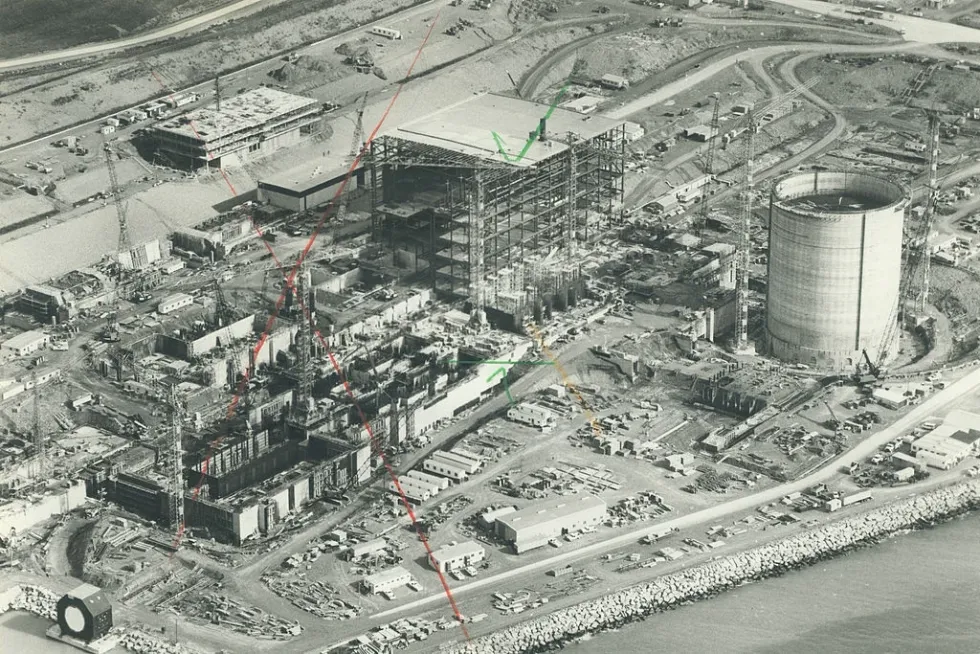 The 1983 construction of the existing CANDUs at Darlington. Photo: David Cooper/Toronto Star via Getty Images