You’re out of free articles.
Log in
To continue reading, log in to your account.
Create a Free Account
To unlock more free articles, please create a free account.
Sign In or Create an Account.
By continuing, you agree to the Terms of Service and acknowledge our Privacy Policy
Welcome to Heatmap
Thank you for registering with Heatmap. Climate change is one of the greatest challenges of our lives, a force reshaping our economy, our politics, and our culture. We hope to be your trusted, friendly, and insightful guide to that transformation. Please enjoy your free articles. You can check your profile here .
subscribe to get Unlimited access
Offer for a Heatmap News Unlimited Access subscription; please note that your subscription will renew automatically unless you cancel prior to renewal. Cancellation takes effect at the end of your current billing period. We will let you know in advance of any price changes. Taxes may apply. Offer terms are subject to change.
Subscribe to get unlimited Access
Hey, you are out of free articles but you are only a few clicks away from full access. Subscribe below and take advantage of our introductory offer.
subscribe to get Unlimited access
Offer for a Heatmap News Unlimited Access subscription; please note that your subscription will renew automatically unless you cancel prior to renewal. Cancellation takes effect at the end of your current billing period. We will let you know in advance of any price changes. Taxes may apply. Offer terms are subject to change.
Create Your Account
Please Enter Your Password
Forgot your password?
Please enter the email address you use for your account so we can send you a link to reset your password:
The startup and the city announced the contract on Tuesday.
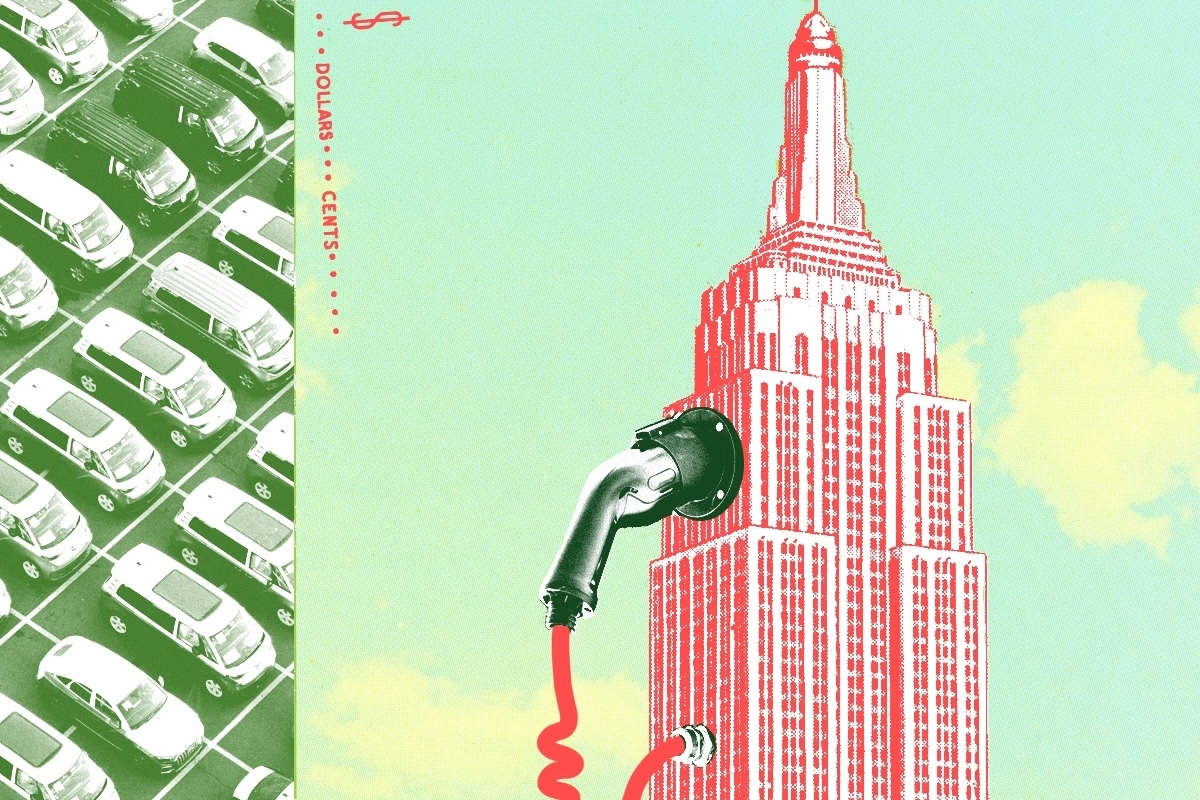
The City of New York announced on Tuesday that it will partner with curbside charging startup it’s electric to expand the city’s PlugNYC electric vehicle charging network from 88 curbside charge points today to around 700 by 2030.
“To put in perspective how important this is,” Tiya Gordon, it’s electric’s co-founder and COO, told me. “London and New York City have similar populations. But London has around 27,000 curbside EV chargers while New York City has just 88 so this is a major opportunity for expansion.”
The $60.2 million contract, which covers both installation and five years of operation, is part of New York’s Green Rides Initiative, which aims to replace all rideshare vehicles on the city’s streets with either zero-emission or wheelchair-accessible alternatives by 2030. The program began in 2021 with a pilot in partnership with electric utility Con Edison and EV charging startup FLO. Phase one of the new agreement will involve replacing those chargers with it’s electric models by early 2027, followed by a second phase that will involve installing 600 additional chargers across the city’s five boroughs — the largest municipal curbside charging buildout in the country to date.
The new charging stations will have four chargers apiece for a total of nearly 150 new stations, are just the first step towards addressing this explosion in demand. Each station will come equipped with Level 2 chargers, which can charge a vehicle to 100% of its battery level within seven hours. The city says it will encourage off-peak or overnight charging through “pricing [focused] on affordability while encouraging reasonable turnover,” such as the pilot program’s time-differentiated pricing structure. Where feasible, the stations will beature docking connections to charge e-bikes.
As of February, approximately 13% of New York City’s rideshare vehicles were electric, but that number is growing as both Uber and Lyft’s aim to electrify their entire U.S. fleets by 2030. According to Gordon, commuting to rapid charging stations throughout the city and waiting for a station to become available while on shift costs drivers 30% of their income. Rapid chargers exacerbate the problem; they slow down significantly once the charge reaches 80% to prevent the EV battery from overheating, forcing drivers to either wait for significantly longer or make more frequent stops to charge.
“They’re losing a lot of their income in driving to the limited number of public fast charging stations in New York City — because there’s just two in Brooklyn, two in Manhattan, and a few at the airports,” Gordon said. “Access to curbside charging solves the majority of their problems as they can charge off-shift with a Level 2 charger on the curbside overnight.”
To enable drivers to charge while not on shift, the city will select locations where a greater concentration of rideshare drivers live, especially in outer boroughs far away from the suburban driveways or paid parking garages that typically house charging stations. Incorporating input from drivers, the Department of Transportation has already selected 10 neighborhoods across the city, including Stapleton in Staten Island and Unionport in the Bronx.
it’s electric itself is headquartered in the Brooklyn Navy Yard and manufactures its sleek, futuristic charging stations in Long Island City, Queens. Gordon first conceived of the company while walking through Brooklyn during the Covid-19 pandemic with her co-founder, Nathan King, commiserating over the struggle to find an affordable, convenient place to charge an EV. As the company grew, Gordon and King chose to keep manufacturing local not only to avoid tariff or supply chain complications, but also to deliver jobs in New York City across the entire value chain of an electric charging station — manufacturing, installation, operations, and maintenance. The company contracts with manufacturer Boyce Technologies, which also supplies the Help Point kiosks in the city’s subway system.
it’s electric’s design eliminates a bottleneck that often delays the construction of EV charging stations: the utility interconnection and permitting process. Instead of tapping into the grid, its chargers taps into the electricity supply in nearby buildings via a shallow conduit just below the sidewalk, leveraging spare electrical capacity. The charging stations meter and pay for their own electricity use, and in exchange for the building’s surplus power, it’s electric shares its revenue with building owners. While the first tranche of charging stations the company launches in New York City will be traditional utility-connected chargers, the NYC Department of Transportation confirmed to me that it may use the capacity-sharing design in future expansions.
Though it’s electric has installed these capacity-sharing chargers in major U.S. cities including Boston, Philadelphia, San Francisco, Detroit, and Washington D.C., the New York City project represents a major step up in scale — the 700 chargers it will deliver for New York City comprise almost half of the 2,000 chargers in its current pipeline. To support these projects and hire additional staff, the company also announced on Tuesday that it has raised a new bridge round of seed funding led by Halogen Ventures, bringing its total funding to $15 million.
Gordon thinks the expansion of EV charging in New York City is significant not just for her company, but for the EV industry on the whole. “It signals to the world that the U.S. is not backing down from electrification and is still moving forward in meaningful ways,” she told me. Next, Gordon is eyeing the global market. “The technology that we have really differentiates us because we can power our chargers from a variety of sources — the utility connection, an adjacent building, or even wooden utility poles overhead. The next announcements from it’s electric will center around our expansion from NYC to other countries.”
Log in
To continue reading, log in to your account.
Create a Free Account
To unlock more free articles, please create a free account.
On a Russia-Ukraine truce, Dems’ climate shift, and Ambler Road
Current conditions: Temperatures in Laredo, Texas, are soaring past 103 degrees Fahrenheit amid a heat wave scorching the Southern and Central United States • Tropical Storm Norbert is weakening in the Pacific right as another depression is strengthening into Tropical Storm Odalys • South Africa’s KwaZulu-Natal is facing severe thunderstorms with winds of up to 50 miles per hour.
President Donald Trump declared a truce Monday morning between Russia and Ukraine over energy infrastructure, claiming that both countries had agreed to stop attacking refineries, pipelines, and power plants going forward despite those facilities representing frequent targets since the war began in 2022. In a post on his Truth Social platform, the U.S. leader said record-high diesel prices were “mostly caused by the Russia/Ukraine war, not Iran,” suggesting prices would come down now that “Ukraine has agreed to not hit Russian energy targets” and “Russia has agreed to do likewise.” Neither Kyiv nor Moscow has confirmed the pact, according to Reuters.
Meanwhile, the price of Brent crude, the global oil benchmark set out of Europe, briefly surpassed $109 per barrel before coming back down to $106 by the time the market closed Monday. West Texas Intermediate, out of the U.S., hit about $102, while Murban crude from the United Arab Emirates shot up 10% to $131 per barrel. The latest surge came after Saudi Arabia halted shipments via its East-West Pipeline, the main conduit through which the kingdom has exported oil since the Strait of Hormuz’s closure stopped tankers from leaving the Persian Gulf.
The average fuel surcharge for grain shipments on U.S. railways more than doubled over the past year, in the latest sign of how soaring energy prices will spur inflation of food costs. The surcharge skyrocketed 153% to 48 cents per rail car-mile by the second week of September, according to a Reuters analysis of U.S. Department of Agriculture data. The surcharges accounted for 11% of the total rail transportation costs for shipping corn and soybeans, compared to 5% a year ago. Railroads collected about $3 billion in fuel surcharges in the second quarter of this year, covering 90% of diesel costs. The situation highlights why now is “the worst time for diesel to get expensive,” my colleague Matthew Zeitlin wrote last month, since harvest season is around the corner and most farming equipment runs on the fuel.
House Democrats are out with their first new climate agenda since the Green New Deal’s glory days of 2020. This time, however, it’s more of what the top Democrat behind the proposal called “a workable plan for long term economic and job growth” than an emissions-cutting blitz. My colleague Emily Pontecorvo has a detailed breakdown of what’s in it, but here are the five big takeaways:
“We’re not introducing a bill after this,” Representative Kathy Castor, the Florida Democrat who oversaw the project to draft the agenda, told Emily. “We’re providing it to policymakers in Washington for them to build the bipartisan support you need to get something across the finish line. The Trump administration is going to be there for two more years. What can we get done now that would have bipartisan support?”
Sign up to receive Heatmap AM in your inbox every morning:
The U.S. needs $110 billion to build 45 gigawatts of new power generation through 2030 to meet the surging demand from data centers, according to a Moody’s Ratings analysis. More than 30 gigawatts of that supply is slated to come from natural gas-fired plants, with solar and storage making up much of the rest and nuclear restarts accounting for less than 5%, Bloomberg reported. That all sounds like a lot. But consider that the U.S. started this year on track to add 86 gigawatts of new generation, much of which it from solar and storage, according to data from the U.S. Energy Information Administration. In other words, we deployed nearly twice as much new generation in the past year as we would need for data centers through the end of this decade.
The nation’s largest operator of nuclear and geothermal power plants, Constellation Energy, certainly sees gas as the likelier near-term source of power generation in New England. On Monday, Utility Dive reported that the utility giant plans to buy the 609-megawatt Rhode Island State Energy Center from Shell Energy for $715 million. It’s easy to see why gas looks like a safe bet. Three Massachusetts utilities are now suing Hydro-Quebec, the state-owned utility in Canada’s French-speaking province, over a shortfall in deliveries during particularly hot days this summer — while Hydro-Quebec is, in turn, suing for payments it says the American power companies owe, according to Canary Media. That electricity drama is unfolding as New Englanders prepare to “pay through the nose to stay warm this winter” as the price of heating fuel soars, Matthew wrote last week.

Almost exactly a year ago, Trump issued an executive order approving the long-stalled federal project to build a road through the Alaskan wilderness to support production of minerals from the remote Ambler Mining District. Now the U.S. government is taking a 10% stake in Trilogy Metals, the 50% co-owner of a joint venture with the Australian miner South32 focused on extracting copper, zinc, and other metals from the site. As part of the deal, the company said in a press release, the Department of Defense “committed to work in good faith to help facilitate financing required for construction of the proposed 211-mile, industrial-use-only Ambler Road.”
The Pentagon also inked a $450 million deal with The Elmet Group, an integrated miner and processor, with $150 million earmarked for Toronto-based Blue Moon Metals’ tungsten mine in Nevada, Mining.com reported.
There’s still an open debate about how much of the nuclear supply chain Saudi Arabia would be allowed to control under the kingdom’s coveted deal with the Trump administration. Whether the Saudis should enrich — or, even more worrying from a nonproliferation standpoint, recycle — nuclear fuel will generate heated discussion in the years to come. But it looks increasingly likely that the oil-rich nation will mine at least some of its own uranium. “Exploration and geological studies at the Jabal Sayid project in Madinah have revealed estimated resources of around 110 million tonnes of ore with high concentrations of rare earth minerals, especially the heavy elements, alongside promising concentrations of uranium,” Prince Abdulaziz bin Salman, the kingdom’s energy minister, told Arab News.
For the first time in six years, House Democrats have put forward a climate platform.
Well, sort of. On Tuesday, a subset of nine House Democrats who are part of the Sustainable Energy and Environment Coalition published a menu of hundreds of policy proposals called the Thriving Economy Project. It’s a federal blueprint for the age of AI, surging energy demand, worsening natural disasters, and growing geopolitical uncertainty.
Kathy Castor, a representative from Florida who led the project, told me that instead of a platform, I should think of the project as “a workable plan for long term economic and job growth.”
“We’re not introducing a bill after this,” she said. “We’re providing it to policymakers in Washington for them to build the bipartisan support you need to get something across the finish line. The Trump administration is going to be there for two more years. What can we get done now that would have bipartisan support?”
Nevertheless, this is still the most sweeping environment and energy policy document Democrats have published since 2020, when the House Select Committee on the Climate Crisis — which Castor also chaired — published a nearly 550-page plan to “solve the climate crisis.” Much of that work became a part of the 2021 bipartisan infrastructure law and the 2022 Inflation Reduction Act. Of course, significant chunks of those laws, including tax credits for wind and solar projects, were later dismantled by the Trump administration in the One Big Beautiful Bill Act.
The Climate Crisis Committee disbanded in 2023, but the Thriving Economy Project is, in some ways, a continuation of its work. The document itself is the product of an independent nonprofit, which Democrats from the Sustainable Energy and Environment Coalition enlisted to probe experts, local leaders, companies, and advocates around the country for ideas about what Congress should do to create jobs, lower energy costs, foster innovation, and shore up communities. The nonprofit, known as the Sustainable Energy and Environment Coalition Institute, convened working groups, roundtables, and listening sessions. It also issued a public Request for Information that generated more than 1,300 policy recommendations from around 150 responders, including businesses and trade associations, local governments, nonprofits, and universities, the report said, and assembled a “20-person steering committee of ideologically diverse experts” to challenge its own assumptions.
The resulting report asserts that it is “not a consensus document, nor was it ever intended to be. It is a menu of ideas that have been challenged, refined, and improved by people approaching the same problems from very different perspectives.”
Perhaps that’s why the document reads a little bit like throwing spaghetti at the wall. There’s plenty in it that could conceivably be bipartisan, but there’s also a lot that stands no chance of passing under Trump, even if Democrats take the House and Senate in November’s midterm elections. In that light, it’s both a menu for the next two years and a window into how Democrats are generally thinking about climate policy in the post-IRA era. Here are five of my takeaways after going through it.
The authors do not spill any digital ink lamenting Trump’s dismantling of the IRA. They do, however, propose restoring a bunch of what’s been lost and building on the lessons learned from the brief time the policies were in effect.
For example, the report suggests reinstating federal tax credits for home energy efficiency improvements and residential clean energy systems such as rooftop solar, but recommends offering the credits as a point-of-sale rebate rather than a return claimed on the buyer’s taxes. That would be similar to the way electric vehicle buyers could transfer their tax credit to the dealer to get the discount on their purchase immediately. The goal, according to the report, is to “minimize the upfront costs and administrative frictions for consumer-facing incentives.”
Speaking of the electric vehicle tax credit, bringing it back is also on the menu, justified as a demand pull to support domestic supply chains and as a complement to the manufacturing tax credits, which largely survived the IRA purge (more on that below). Interestingly, a separate section of the report proposes a perhaps more politically palatable consumer rebate for new vehicles based on fuel efficiency rather than a strict EV-only subsidy, framing the idea as an option to address “unaffordable gasoline.”
There is a meaty section on extending and expanding the manufacturing tax credits, which, as you may remember, will no longer apply to wind turbine components after 2027, thanks to Trump’s One Big Beautiful Bill Act. The report suggests cancelling that early termination. It also proposes extending the subsidy to a long list of additional advanced energy technologies, including power transformers, industrial heat pumps, and long duration energy storage components. Additionally, there are several sections on improving federal support for early-stage technologies, helping them get through the “valley of death” to commercial deployment — a major theme in both the bipartisan infrastructure law and IRA.
Notably absent is any discussion of reinstating the tax credits for wind and solar generation. When I asked Castor about that, she said “a lot of that ground had been plowed already,” referring to the contentious battle over the credits during the OBBBA negotiations. “In this Congress, that’s not going to happen. This effort is driven by solving problems ASAP where we think there can be bipartisan support going forward.”
The report intentionally stays away from one of the most significant ways Congress could speed up solutions to address rising energy demand: permitting reform. A disclaimer at the top notes that since Congress was actively debating legislation on that issue while the report was being written, the authors chose not to tackle it directly.
It does, however, spend plenty of time working around the edges on ways to clear up clogged interconnection queues and fix bottlenecks to getting more transmission online. For one, it suggests more funding for the Department of Energy’s Transmission Facilitation Program, which allows the agency to temporarily serve as an anchor customer for new transmission lines. Creating a 30% investment tax credit for transmission lines is another idea in the report.
A lot of the recommendations revolve around improving grid planning and integrating grid-enhancing technologies, advanced conductors, and energy storage into the process. The report suggests establishing a national transmission conductor standard, for example, setting a minimum efficiency level for the wires strung along transmission lines to reduce waste.
Beyond transmission, there are a slew of ideas for reforming energy markets to better support demand response and virtual power plants. Congress could create federal guidance for how grid operators and state regulators assess the value of energy storage to the grid, and direct the DOE to provide more technical assistance to operators on incorporating flexible resources that can shift load, relieve congestion, and integrate more renewables into the grid.
One of the biggest challenges Democrats will have to contend with is writing policy that can endure past a change in party control. Trump has found myriad ways to block projects approved by the previous administration and withhold congressionally mandated funding. The courts are still deciding whether his administration’s methods are actually legal. Nonetheless, the report reflects an interest in creating more certainty for federal grantees and restoring trust in the federal government as a funding partner.
For one, it explicitly recommends that Congress restore awards that were legally obligated under IRA programs such as the Greenhouse Gas Reduction Fund, the Environmental and Climate Justice Block Grants, the Community Change Grants, and the Neighborhood Access and Equity Grants that the Trump administration has attempted to terminate — though it stops short of specifying how.
In the future, though, it recommends that federal funding be funneled through “trusted third-party fiscal intermediaries to allow for nimbler program management and structural insulation from political shifts.” Congress should also more narrowly define the circumstances under which an award can be terminated, it says, offering the suggested language: “funds awarded under [identified programs] may not be rescinded, reprogrammed, or deferred except by law.”
In cases where an administration does rescind or terminate funding, it recommends that Congress put in law that any legal challenge to the termination belongs in the U.S. District Courts. The Department of Justice is attempting to argue that the disputes over Trump’s grant terminations constitute breach of contract claims, and therefore belong in the court of federal claims. If the cases end up there, however, the grantees will only be able to sue for damages — they won’t be eligible to get their grants reinstated. A provision explicitly placing these cases in the district court would ensure awardees have a path to actually contributing to congressionally-mandated goals.
While these provisions are promising, however, it’s hard to imagine that Trump would sign off on them.
One of the most obvious differences between the world we live in now and the world lawmakers occupied in 2020 is that the race for artificial intelligence is in full swing, driving a surge in electricity demand the country has not seen in decades. Data centers have become the locus of a number of intersecting issues — permitting obstacles for energy infrastructure, rising electricity costs, local opposition to anything getting built at all, fear of AI, and concerns about cybersecurity.
The Thriving Economy Project treats data centers as a central organizing problem across several of its chapters. It offers policies to address environmental concerns such as requiring data centers to use closed-loop cooling systems to reduce water use. It proposes unifying the piecemeal approach states are taking to meet data center electricity demand under a federal standard that would require large loads to pay the full cost of connecting to the grid.
There’s a whole section on the challenges of meeting data centers’ power needs that contains more than two dozen policy ideas. A few that stand out include mandatory energy and water use disclosure requirements, a federal Energy Star-equivalent for AI tools, and the creation of a “U.S. Electron Accelerator.” That last idea is one of the most interesting proposals I came across. Data centers would pay into a fund for every kilowatt-hour of their demand not met with clean electrons generated at the same time and in the same location. The funds would then be available to help data centers cover the premium for procuring round-the-clock clean electricity from nuclear and geothermal plants.
Similarly, the report suggests requiring data centers to pay into a fund to support the Low Income Home Energy Assistance Program and the Weatherization Assistance Program, two perennially underfunded federal programs that help Americans who are struggling to pay their energy bills.
It also raises the concern that data centers powered by behind-the-meter natural gas plants will drive up the price of natural gas for other customers, thereby increasing home heating and residential electricity bills. The report suggests several ideas to reduce natural gas price volatility, including taxing oil and gas companies to create a “strategic energy affordability reserve.” If the president declares an “energy affordability emergency,” it says, the funds can be released to states to help residents pay their bills. Additionally, Congress could create an “energy price safety valve” to temporarily ban exports of key fuels when prices spike.
A lot of the Thriving Economy Project reads like a manual for playing defense in an increasingly dangerous world. It is consumed with addressing risk — the risk of cybersecurity attacks on our electric grid, water systems, and airports, and of global supply shocks that throttle domestic energy prices and supply chains. While discussion of “climate change” as a problem to tackle is notably absent from the report, a rhetorical shift I wrote more about here, adapting to the realities of a warming planet is one of its main preoccupations.
It suggests establishing a federal climate relocation program, for example, and setting federal climate-adapted transportation standards, such as elevation in flood zones and transit facility shading. There’s a recommendation to build a “national climate-health early warning system” to alert people about extreme heat, wildfire smoke, vector-borne diseases, and harmful algal blooms. Along those lines, it suggests that severe wildfire smoke events qualify for federal disaster assistance. At the same time, federal disaster assistance is too fragmented across various agencies, it says, and the government could establish a single, mobile-friendly app “as the front door to all federal individual disaster aid.”
It recommends creating an independent National Disaster Safety Board, an independent watchdog to investigate deaths and damages after a disaster and issue recommendations for how governments at all levels can prevent these losses the next time. Congress could also establish a national climate risk disclosure standard for the real estate industry, giving homebuyers access to more consistent, transparent data about property risks.
These are just a few of many dozens of proposals to improve federal leadership on this especially local, disjointed issue.
A new set of policy proposals from House illustrates a marked change in rhetoric since 2020.
Nine House Democrats from the Sustainable Energy and Environment Coalition published a sweeping federal policy blueprint on Tuesday called the Thriving Economy Project. While it is explicitly not a policy platform, it is the first window we’ve gotten into how lawmakers are thinking about their next set of climate moves in the post-One Big Beautiful Bill Act era.
The last time House Democrats published a major energy and environment policy document was in 2020, when the House Select Committee on the Climate Crisis released the aptly titled report “Solving the Climate Crisis.” The Thriving Economy Project covers many of the same themes as that 2020 platform — energy, agriculture, disaster recovery, innovation. It even contains some of the same policy proposals. But as the contrast in titles suggests, the approach is markedly different.
The 2026 version doesn’t call itself climate policy at all. Though it contains plenty of proposals to support cleaner energy and reduced emissions, it frames them in terms of affordability, economic opportunity, resilience, and competitiveness, rather than as a means to stop planetary warming. The words “climate change” aren’t entirely absent, but they appear primarily as the context for proposals to improve disaster preparedness, response, and recovery, or to adapt infrastructure to higher seas and hotter days.
This isn’t a huge shock. We’ve written quite a bit at Heatmap about how climate change advocacy is shifting away from talking about the crisis directly to messaging about the benefits of actions that just so happen to cut carbon or shore up communities against disasters. When I compared the number of times certain words and phrases appeared in the 2020 package versus this new one, the evidence of that rhetorical shift was decisive.
Mentions of “climate change” dropped from more than 500 to 22. Whereas the 2020 package cited the “climate crisis” more than 150 times, the new report casually references it in just four places. In 2020, Democrats framed their entire platform around hitting “net-zero” by 2050, citing the goal 139 times. Net-zero appears just once in the new package in a chapter about investing in innovation. According to the International Energy Agency’s “Net Zero Roadmap,” it says, about a third of the emissions reductions required to get there “will come from technologies still under development.”
While lawmakers took a stand six years ago to fight for “environmental justice,” that term is wholly absent from the new report. Instead of pushing for policies that improve outcomes for “communities of color,” a phrase which appears just five times in the Thriving Economy Project, it focuses on building “thriving communities” and improving outcomes for “low income” and “underserved” populations.
It’s easy to be cynical about the political calculation these rhetorical shifts reflect, but the two policy platforms were also written for different audiences. Florida Representative Kathy Castor, a Democrat who led the creation of both versions, told me that the goal of the Thriving Economy Project was to come up with policies that could be adopted in the next two years. “This effort is driven by solving problems ASAP where we think there can be bipartisan support,” she said. The 2020 document, by contrast, was a wishlist for a future Democrat-led Congress and administration. Much of what was in it later became part of the Infrastructure Investment and Jobs Act and the IRA, but has since been dismantled under Trump.
The increased frequency of certain other terms — such as “energy security,” “cybersecurity,” and “geopolitical” — is also a reminder that between the war over Ukraine, the war in Iran, and the AI race, a lot really has changed since 2020.
Just because the report is not explicitly about climate change doesn’t mean it’s not a climate policy document, however. When I asked Sean Casten, a Democratic representative from Illinois who also worked on the project, whether he considered the policies to be about addressing climate change, he responded that there was no way to talk about energy or home insurance and not talk about climate. “You also don’t necessarily have to use the word climate to talk about all of those things, right?” he added.