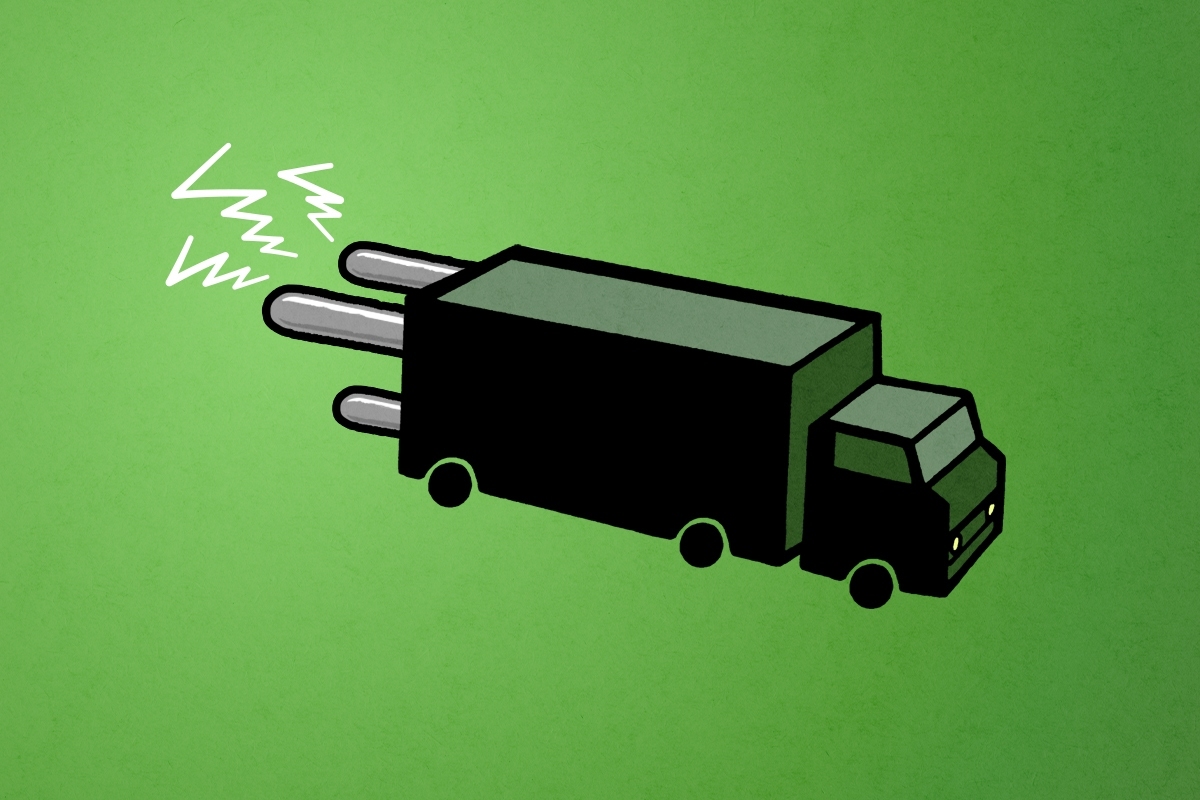
The electrification of semi trucks started with baby steps. First came EV semis for short-haul routes, those where the vehicle can do all its business on a single charge. We’re talking big rigs that make drayage runs to ferry shipping containers between ports and nearby warehouses, or delivery vans that spend their day puttering around the city.
It makes sense. Semis are huge and heavy; it takes a long time to charge a big enough battery to move one. That first batch of EV trucks could return to base and recharge their batteries overnight, with no rush to get them right back on the road. But for electric semis to make regional runs — and someday national ones — they need fast-charging truck stops that can deploy much more juice than an ordinary passenger EV requires.
That infrastructure is coming. At last week’s ACT Expo in Las Vegas — where trucking and fleet professionals trade notes on how electrification, advanced fuels, and AI — the conversation centered on the rise of megawatt charging, tech that will make it possible for electric trucks to make runs that are viable only for diesel-powered trucks today.
Most EV semi truck charging to date has been done at speeds of up to 350 kilowatts. That’s fast for a passenger vehicle. Hyundai, for example, claims that a car like the Ioniq 5 can go from 10% to 80% charge in around 15 minutes. But a semi’s energy requirements are a different ballgame. At those speeds, a truck needs hours to top off — unacceptable for a trucker on a tight schedule.
The next step, megawatt charging, is a misnomer. Technically, this category includes any charger over 600 kilowatts, though it stretches up to 1.2 megawatts. That is the theoretical maximum of the Tesla Megacharger, the high-speed charger built specifically for the Tesla Semi that has just gone into mass production. The 1.2-megawatt version is promised to fill about 60% of the truck battery in about half an hour (the duration of the mandated break a trucker must take after eight hours on the road). Henry Johnson of Alpitronic, a company building out high-powered charging in Europe, said even just 700 to 800 kilowatts is enough to charge trucks with all the juice they’ll need for the rest of their journey in about 45 minutes.
Indeed, megawatt charging has already taken root in Europe, which is ahead of the United States in EV trucking (one of the ACT panels was titled, “Megawatt Charging in Europe: Lessons for the U.S. Market”). The availability of such speeds will soon accelerate here, though. “Megawatt charging is coming this year,” said Patrick Macdonald-King, CEO of the Daimler-backed group Greenlane that is set to build a network of electric and hydrogen refueling stations for trucks in America. “We’re not building anything without it,” he says.
Greenlane has a flagship station open near San Bernardino, California, including a couple dozen plugs at around 400 kilowatts, but future stations planned to service trucks traveling between L.A. and Phoenix or Dallas and Houston will feature megawatt-speed plugs. Tesla has built Megachargers stations at its factories and opened one specifically for Pepsi, an early adopter client. Its first public megawatt charging station in the Inland Empire, the urban sprawl inland of Los Angeles, opened for business in March.
Part of what makes this leap possible is the plug. Existing EV trucks have used the CCS charging standard, but an increasing number of them are now equipped to work with MCS, the Megawatt Charging Standard, which can reach speeds beyond CCS. The MCS plug is not only fast, it’s also unique to big trucks, which negates current problems such as a semi truck pulling up to a charging station only to find that a CCS-using passenger car is hogging the plug.
The megawatt era could also lead to consolidation that makes it simpler to expand semi charging around the country. There’s a case to be made for both the CCS and MCS plugs to stay in use, with CCS serving the cheaper, slower kind of charging that some need. But just as passenger EVs have now almost universally coalesced around the NACS plug that Tesla invented, the same thing could happen for MCS. Tesla, for example, is offering a 125-kilowatt Basecharger for companies who want Tesla Semis but don’t need the power of a 1.2-megawatt Megacharger, with the less powerful option going for $40,000 rather than $188,000. But it, too, uses only MCS. John Smith, incoming CEO of the spun-off company FedEx Freight, called for as much during his conference keynote. “We need a universal standard,” he said. “Every truck must be able to go to every charger.”
It will be years before there is a nationwide patchwork of megawatt truck stops along all of America’s major highways, the kind that exists now to make it possible to drive nearly anywhere in this country in an electric car. The good thing about trucking, though, is that it’s predictable. You don’t need to build a whole network of chargers anywhere ordinary citizens might want to drive. You only need it where you already know trucks are destined to go.
Providing fast-charging on heavily used freight corridors in California and Texas can allow fleets to electrify those routes — and see a preview of life with the benefits of electrification, such as more predictable maintenance and the freedom from wartime diesel price shocks.