The Regional Greenhouse Gas Initiative has been quietly accelerating the energy transition in the Mid-Atlantic and Northeast since 2005. Lately, however, the noise around the carbon market has gotten louder as many of the compact’s member states have seen rising energy prices dominate their local politics.
What is RGGI, exactly? How does it work? And what does it have to do with the race for the 2028 Democratic presidential nomination?
Read on:
What is RGGI?
The Regional Greenhouse Gas Initiative is a cap and trade market with roots in a multistate compact formed in 2005 involving Connecticut, Delaware, Maine, New Hampshire, New Jersey, New York, and Vermont.
The goal was to reduce emissions, and the mechanism would be regular auctions for emissions “allowances,” which large carbon-emitting electricity generators would have to purchase at auction. Over time, the total number of allowances in circulation would shrink, making each one more expensive and encouraging companies to reduce their emissions. The cap started at 188 million short tons of carbon and has been dropping steadily ever since, with an eventual target of under 10 million by 2037.
By the time of the first auction in 2008, six states were fully participating — Delaware, New Hampshire, New Jersey, and New York were out; Maryland, Massachusetts, and Rhode Island were in — and together they raised almost $39 million. By the second auction later that year, 10 states — the six from the previous auction, plus New York, New Jersey, New Hampshire, and Delaware — were fully participating.
Membership has grown and shrunk over the years (for reasons we’ll cover below) but the current makeup is the same as it was at the end of 2008.
Where does the money from the auctions go?
When carbon pricing schemes were first dreamt up by economists, the basic thinking was that by taxing something bad (carbon emissions) you could reduce taxes on something good (like wages or income). Real existing carbon pricing schemes, however, have tended to put their proceeds toward further decarbonization rather than reducing taxes or other costs.
In the case of the RGGI, the bulk of revenue goes to fund state climate programs. About two-thirds of investments from RGGI revenues in 2023 went to energy efficiency programs, which have received 56% of the system’s cumulative investments. By contrast, 15% of the 2023 investments (and 15% of the all-time investments) went to “direct bill assistance,” i.e. lowering utility bills.
Have emissions gone down?
Carbon dioxide emissions from the power sector have fallen by 40% to 50% in the RGGI territory since the program began — faster than in the U.S. as a whole.
That’s in part because the areas covered by RGGI have seen some of the sharpest transitions away from coal-fired power. New England, for instance, saw its last coal plant shut down late last year.
But it’s not always easy to figure out what was the effect of RGGI versus broader shifts in the energy industry. In the emissions-trading system’s early years, allowance prices were very low, and actual emissions fell well below the cap. That was largely due to factors affecting the country as a whole, including sluggish demand growth for electricity. The fracking boom also sent natural gas prices plunging, accelerating the switch from coal to gas and decelerating carbon dioxide emissions from the power sector (although this effect may have been more limited in the RGGI region, much of which has insufficient natural gas pipeline capacity).
That said, RGGI still might have helped tip the scales, Dallas Burtraw, a senior fellow at Resources for the Future, told me.
“It takes only a modest carbon price to really push out coal,” he said, pointing to the experience of RGGI and arguing that it could be replicated in other states. A 2016 paper by Man-Kuen Kim and Taehoo kim published in Energy Economics found “strong evidence that coal to gas switching has been actually accelerated by RGGI implementation.”
That trick doesn’t work as well now as it used to, though. “For the first 10 years or so, the primary margin for achieving emission reductions was substitution from coal to gas,” Burtraw told me. Then renewables prices began to drop “precipitously” in the early 2010s, opening up the opportunity for more thoroughgoing decarbonization beyond just getting rid of coal. “Going forward, I think program advocates would say that now you’re seeing the move from gas to renewables with storage,” he said.
When RGGI went through its regular program review in 2012 (these happen every few years; the third was completed last year), the target had to be wrenched downward to account for the actual path of emissions, which had dropped far more quickly than the cap.
“Soon after the start of RGGI, it became apparent that the number of allowances in the emissions budget was higher than actual emissions. Allowance prices consequently dropped, making it particularly inexpensive to purchase allowances and bank them for use in later periods,” a case study published by the Environmental Defense Fund found. In other words, because there was such a gap between the proscribed cap and actual emissions, generators had been able to squirrel away enough allowances to make future caps ineffective.
There must be some people who don’t like RGGI. What’s their deal?
The arguments against the RGGI have been relatively constant and will be familiar to anyone following debates over energy and climate policy: RGGI raises prices for consumers, its opponents say. It pushes out reliable and cheaper energy sources, and thereby threatens jobs in fossil fuel generation and infrastructure. Also the particulars of how a state joins or exits the group have often come up for debate.
About that — why have some states gone in and out of RGGI?
Three states have proved troublesome, including one original member and two later joiners: New Jersey, Virginia, and Pennsylvania. All three states are sizable energy consumers, and Virginia and Pennsylvania have substantial fossil fuel infrastructure and production.
New Jersey quickly expressed its discontent. In 2011, New Jersey’s Republican Governor Chris Christie decided to take the state out of the market, saying that it was unnecessary and costly. Democrat Phil Murphy, Christie’s successor, brought it back in 2020 as part of a broader agenda to decarbonize New Jersey’s economy.
Pennsylvania attempted to join next, in 2019, but ran into legal hurdles almost immediately. Governor Tom Wolf, a Democrat, issued an executive order in 2019 to set up carbon trading in the state, and state regulators got to work drawing up rules to allow Pennsylvania to link up with RGGI, formally joining in 2022.
But the following year, a Pennsylvania court ruled that the state was not able to participate because the regulatory work ordered by Wolf had been approved by the legislature. The case worked its way up to the state’s highest court last spring, but got tossed in January after Governor Josh Shapiro, a Democrat, made a budget deal with the state legislature late last year removing Pennsylvania from RGGI once and for all — more on that below.
Virginia was the last new state to join in 2020, under Democratic Governor Ralph Northam, who said that by joining, Virginia was “sending a powerful signal that our commonwealth is committed to fighting climate change and securing a clean energy future.” A year later, however, Democrats lost the governorship to Republican Glenn Youngkin, who defeated former governor Terry McAuliffe in the 2021 election. Youngkin then removed Virginia from RGGI at the end of 2023.
Youngkin described the exit — technically a choice made by state regulators — as a “commonsense decision by the Air Board to repeal RGGI protects Virginians from the failed program that is not only a regressive tax on families and businesses across the Commonwealth, but also does nothing to reduce pollution.”
Okay, so what’s going on with Pennsylvania?
Pennsylvania fits uneasily into the Northeastern–blue hue of the RGGI’s core states. It’s larger than any state in the system besides New York, right down the center politically, and is a substantial producer and exporter of electricity, much of it coming from fossil fuels (and nuclear power). It also has lower electricity costs than its neighbors to the east.
Pennsylvania’s governor, Josh Shapiro, is widely expected to run for the Democratic presidential nomination in 2028, and has put reining in electricity costs at the center of his messaging of late. He sued PJM, the mid-Atlantic electricity market at the end of 2024, and won a settlement to cap costs in the system’s capacity auctions. He also helped negotiate a “statement of principles” with the White House in order to potentially get those caps extended. And earlier this month, he met with utility executives “to discuss steps they can take to lower utility costs and protect consumers,” Will Simons, a spokesperson for the governor, said.
Pennsylvania’s permanent and undisputed inclusion in the RGGI system would be a coup. Unlike its neighbor RGGI states, including Maryland, Delaware, New Jersey, and New York, Pennsylvania still has a meaningful coal industry, meaning that its emissions could potentially fall substantially with a modest carbon price. It would also provide some relief to the rest of the system by notching significant emissions reductions at lower cost, meaning that electricity prices would likely be minimally affected or even go down, according to research done in 2023 by Burtraw, Angela Pachon, and Maya Domeshek.
“Pennsylvania is the source of a lot of low-cost emission reductions precisely because it still retains that coal-to-gas margin,” Burtraw said. “It looks the way the Northeastern states looked 15 years ago.”
But alas, it won’t happen. As part of a budget deal with Republicans reached late last year, Pennsylvania exited RGGI. That Shapiro would be willing to sacrifice RGGI isn’t shocking considering his record — when he ran for governor in 2021, he often put more emphasis on investing in clean energy than restricting fossil fuels. As governor, he has pushed for regulatory reforms, and even a Pennsylvania-specific cap and trade program, but Senate Republicans made RGGI exit the price of any energy policy talks.
What’s going on with the other members?
Virginia may be ready to return to the fold.
“For me, this is about cost savings,” newly installed governor Abigail Spanberger said in her inaugural address. “RGGI generated hundreds of millions of dollars for Virginia — dollars that went directly to flood mitigation, energy efficiency programs, and lowering bills for families who need help most.” Furthermore, “withdrawing from RGGI did not lower energy costs,” she said. “In fact, the opposite happened — it just took money out of Virginia’s pocket,” referring to lost gains from RGGI auctions. (Research by Burtraw, Maya Domeshek, and Karen Palmer found that RGGI participation was the “lowest-cost way” of achieving the state’s statutory emissions reductions goals and that the funded investments in efficiency will likely drive down household costs.)
Virginia’s newly elected Attorney General Jay Jones also reversed the position of his Republican predecessor, signing on to litigation against Youngkin’s withdrawal from the program, arguing that the governor lacked the legal authority to withdraw from the program in the first place —the inverse of Pennsylvania’s legal tangle over RGGI.
What about New Jersey?
New Jersey, too, has a new governor, Democrat Mikie Sherrill. In a set of executive orders, signed before she had even finished her inaugural address, Sherrill directed New Jersey economic, environment, and utility regulatory officials to “confer about the use of Regional Greenhouse Gas Initiative … proceeds for ratepayer relief,” and “include an explanation of how they intend to address ratepayer relief in the 2026-2028 RGGI Strategic Funding Plan.”
Ratepayers are already due to receive RGGI funding under New Jersey’s current strategic funding plan, as are environmental protection and energy efficiency programs, renewable and transmission investments, and a grab-bag of other climate related projects. New Jersey utility regulators last fall made a $430 million distribution to ratepayers in the form of two $50 bill credits, with additional $25 a month credits for low-income ratepayers.
This seems kind of volatile. What does that bode for the future?
The evolution of RGGI — and its use by New Jersey to reduce electricity bills in particular — shows how carbon mitigation programs have had to adapt to political realities.
“In the political context of the moment, I think it’s totally fair,” Burtraw told me of Sherrill’s plan. “It’s the worst good idea of what you can do with the carbon proceeds. Everybody in the room can come up with better ideas: Oh, we should be doing this investment, or we should be doing energy efficiency, or we should subsidize renewables. Show me that those ideas are a higher value use for that money and I’m all in. But we could at least be doing this.”
What remains to be seen is whether other states pick up the torch from Sherrill and start using RGGI as a way to more directly combat electricity price hikes. Her actions “could create ripple effects for other states that may face similar concerns,” Olivia Windorf, U.S. policy fellow at the Center for Climate and Energy Solutions, told me.
While RGGI tends to be in the news in the individual states only when there’s some controversy about entering or exiting the program, “the focus on electricity prices and affordability is putting a new spotlight on it,” Windorf said.
More aggressive or creative uses of the proceeds would put RGGI closer to the center of debates around affordability. “I think it will help address affordability concerns in a way that's really tangible,” Windorf said. “So it’s not abstract how carbon markets and RGGI can help through this time of load growth and energy transition. It can be a tool rather than a burden.”
Editor’s note: This story has been updated to correct the candidates for the governorship of Virginia in 2021.






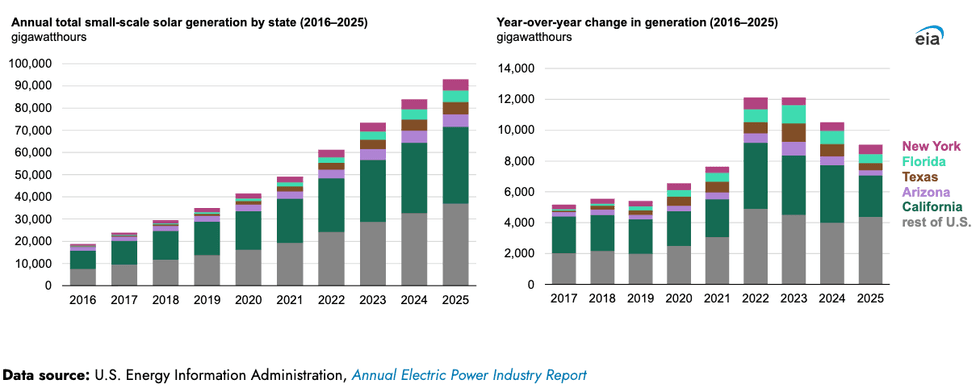 Solar capacity keeps growing. GoodPower