You’re out of free articles.
Log in
To continue reading, log in to your account.
Create a Free Account
To unlock more free articles, please create a free account.
Sign In or Create an Account.
By continuing, you agree to the Terms of Service and acknowledge our Privacy Policy
Welcome to Heatmap
Thank you for registering with Heatmap. Climate change is one of the greatest challenges of our lives, a force reshaping our economy, our politics, and our culture. We hope to be your trusted, friendly, and insightful guide to that transformation. Please enjoy your free articles. You can check your profile here .
subscribe to get Unlimited access
Offer for a Heatmap News Unlimited Access subscription; please note that your subscription will renew automatically unless you cancel prior to renewal. Cancellation takes effect at the end of your current billing period. We will let you know in advance of any price changes. Taxes may apply. Offer terms are subject to change.
Subscribe to get unlimited Access
Hey, you are out of free articles but you are only a few clicks away from full access. Subscribe below and take advantage of our introductory offer.
subscribe to get Unlimited access
Offer for a Heatmap News Unlimited Access subscription; please note that your subscription will renew automatically unless you cancel prior to renewal. Cancellation takes effect at the end of your current billing period. We will let you know in advance of any price changes. Taxes may apply. Offer terms are subject to change.
Create Your Account
Please Enter Your Password
Forgot your password?
Please enter the email address you use for your account so we can send you a link to reset your password:
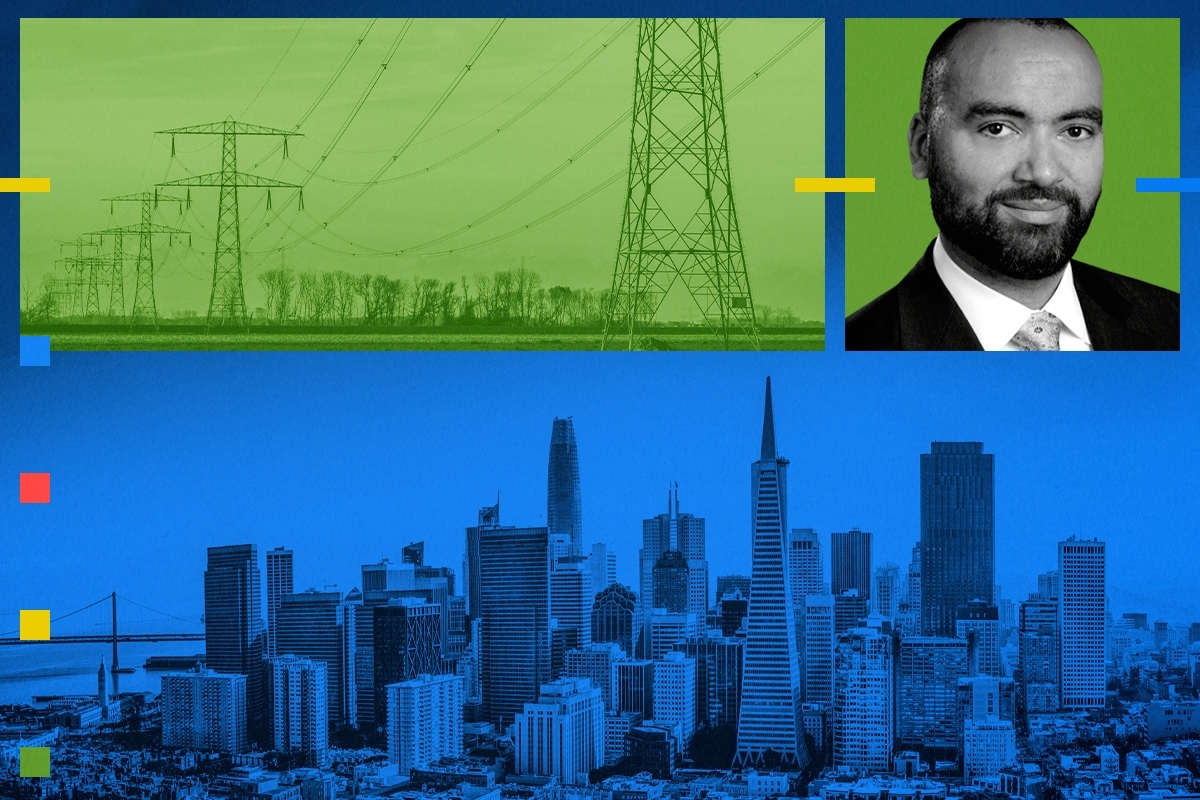
At San Francisco Climate Week, John Reynolds discussed how the state is juggling wildfire prevention, climate goals, and more.

Blessed with ample sun and wind for renewables but bedeviled by high electricity prices and natural disasters, California encapsulates the promise and peril of the United States’ energy transition.
So it was fitting that Heatmap House, a day of conversations and roundtables with leading policymakers, executives, and investors at San Francisco Climate Week, kicked off with John Reynolds, president of the California Public Utilities Commission.
The CPUC oversees the most-populous state’s utilities and has the power to approve or veto electricity and natural gas rate increases. At Heatmap House, Reynolds — “one of California’'s most important climate policymakers,” as Heatmap’s Robinson Meyer called him — affirmed that affordability has been top of mind as power bills have risen to become a mainstream political issue across the country. California’s electricity prices are the second-highest in the nation, behind only Hawaii, according to the Electricity Price Hub.
“I’d really like to see us drive down the portion of household income that is consumed by energy prices,” Reynolds said in a one-on-one interview with Rob. “That’s a really important metric for making sure that we’re doing our job to deliver a system that’s efficient at meeting customer needs and is able to support the growth of our economy.”
The Golden State’s power premium has been exacerbated by the fallout from multiple wildfires that have devastated various parts of the state in recent years, which have necessitated costly grid upgrades such as undergrounding power lines. California-based utility PG&E has also invested in more futuristic fire solutions such as “vegetation management robots, power pole sensors, advanced fire detection cameras, and autonomous drones, with much of this enhanced by an artificial intelligence-powered analytics platforms,” as Heatmap’s Katie Brigham wrote shortly after last year’s fires in Los Angeles.
Affordability affects not just Californians’ financial wellbeing, but also the state’s ability to decarbonize quickly. “The affordability challenge that we’re seeing in electric and gas service is one that is going to make it more difficult to meet our climate goals as a state,” Reynolds said.
One contentious — and somewhat byzantine — aspect of California’s energy transition is how much of a financial incentive the CPUC should offer for residents to install rooftop solar. Net metering is a billing system that rewards households with solar panels for sending excess generation back to the grid. Three years ago, the CPUC adopted a new standard that substantially lowered the rate at which solar panel users were compensated.
“We had to slow the bleeding,” Reynolds said, referring to the greater financial burden paid by utility customers without solar panels. “The net billing tariff did slow the bleeding, but it didn’t stop it.”
Asked whether he is focused more on electricity rates (the amount a customer pays per kilowatt-hour) or bills (the amount a utility charges a ratepayer), Reynolds said both are important.
“If we can drive down electric rates, we’re going to enable more electrification of transportation and of buildings,” Reynolds said. “It’s really important to look at bills, because that is fundamentally what hits households. People’s wallets are limited by their bills, not by their rates.”
Log in
To continue reading, log in to your account.
Create a Free Account
To unlock more free articles, please create a free account.
The state has terminated an agreement to develop substations and other necessary grid infrastructure to serve the now-canceled developments.
Crucial transmission for future offshore wind energy in New Jersey is scrapped for now.
The New Jersey Board of Public Utilities on Wednesday canceled the agreement it reached with PJM Interconnection in 2021 to develop wires and substations necessary to send electricity generated by offshore wind across the state. The board terminated this agreement because much of New Jersey’s expected offshore wind capacity has either been canceled by developers or indefinitely stalled by President Donald Trump, including the now-scrapped TotalEnergies projects scrubbed in a settlement with his administration.
“New Jersey is now facing a situation in which there will be no identified, large-scale in-state generation projects under active development that can make use of [the agreement] on the timeline the state and PJM initially envisioned,” the board wrote in a letter to PJM requesting termination of the agreement.
Wind energy backers are not taking this lying down. “We cannot fault the Sherrill Administration for making this decision today, but this must only be a temporary setback,” Robert Freudenberg of the New Jersey and New York-focused environmental advocacy group Regional Plan Association, said in a statement released after the agreement was canceled.
I chronicled the fight over this specific transmission infrastructure before Trump 2.0 entered office and the White House went nuclear on offshore wind. Known as the Larrabee Pre-Built Infrastructure, the proposed BPU-backed network of lines and electrical equipment resulted from years of environmental and sociological study. It was intended to connect wind projects in the Atlantic Ocean to key points on the overall grid onshore.
Activists opposed to putting turbines in the ocean saw stopping the wires as a strategy for delaying the overall construction timelines for offshore wind, intensifying both the costs and permitting headaches for all state and development stakeholders involved. Some of those fighting the wires did so based on fears that electromagnetic radiation from the transmission lines would make them sick.
The only question mark remaining is whether this means the state will try to still proceed with building any of the transmission given rising electricity demand and if these plans may be revisited at a later date. The board’s letter to PJM nods to the future, asserting that new “alternative pathways to coordinated transmission” exist because of new guidance from the Federal Energy Regulatory Commission. These pathways “may serve” future offshore wind projects should they be pursued, stated the letter.
Of course, anything related to offshore wind will still be conditional on the White House.
This year’s ocean-heating phenomenon could make climate change seem less bad than it really is — at least in the U.S.
You may have heard that we could be in for a “super” or even a “super duper” El Niño this year. The difference is non-technical, a matter of how warm the sea surface temperature in the El Niño-Southern Oscillation region of the central-eastern Pacific Ocean gets. An El Niño forms when the region is at least half a degree Celsius warmer than average, which causes more heat to be released into the atmosphere and affects global weather patterns. A super El Niño describes an anomaly of 2 degrees or higher. Some models predict an anomaly of over 3 degrees higher than average for this year.
If a super El Niño forms — and that is still a big if, about a one-in-four chance — it would be the fourth such event in just over 40 years. But the impacts could be even more severe, simply because the world is hotter today than it was in the previous super El Niño years of 1983, 1998, and 2016.
“2016 would be an unusually cold year if it occurred today,” Zeke Hausfather, the climate research lead for payment processing giant Stripe and a research scientist at Berkeley Earth, told me. “1998 would be exceptionally cold.”
And yet in a strange twist, a 2026-2027 El Niño event might actually make Americans care less about climate change. Though many parts of the world are likely to get clobbered by El Niño’s characteristic combination of hotter, drier weather, the phenomenon has the potential to alleviate some of the extreme weather we’ve seen recently in the United States.
For example, warmer, wetter conditions in the southern U.S., milder winters in the north, and increased wind shear in the Atlantic hurricane basin are all classic El Niño signatures in North America.
“It may actually mean a better snow season for the Western U.S. and the mountains, hopefully recovering our snowpack if it’s not too warm,” Hausfather said. “We might benefit from higher rainfall” next winter, which could help lift widespread drought conditions in the southwest. High wind shear usually results in reduced hurricane activity in the Atlantic by depriving the storm systems of their heat engines and causing them to be too lopsided to organize into a full-blown cyclone.
Though the body of evidence for climate change remains incontrovertible, the temporary reprieve in some of its more visible effects will almost certainly make some Americans less concerned. Blame it on evolutionary biology. Brett Pelham, a social psychologist at Montgomery College who researches egocentrism and biases, told me that humans are hardwired to pay attention to the conditions happening directly around them. “That’s great if you’re living 20,000 or 80,000 years ago,” he said. “But today, we’re pumping tons of greenhouse gases into the atmosphere, and it’s a recipe for disaster because people only care deeply about that problem if they feel the heat on a pretty chronic basis where they live.”
People are generally less likely to believe the planet is warming on a snowy day in March than they are in the summer, and a lower average state temperature is about as reliable a predictor of climate change skepticism as being a Republican, even when controlling for income, party affiliation, education, and age. Given that it is, in theory, easier to convince someone living in scorching hot Phoenix that greenhouse gases are warming the atmosphere than someone living by a lake in Minnesota, if an El Niño mellows out some extreme weather trends in the U.S. this year and next, it could also mellow some of the sense of urgency to act.
“It’s a definite implication of my work that day-to-day variation, monthly variation, and geographical variation matter,” Pelham said.
“If my data are true,” he added, “it’s going to be true on average that in places that have an unseasonably cool summer or winter, there’s going to be a temporary shift in the average attitude.”
Such shifts affect the average by just a few points either way — “they’re not night and day, like ‘I believed in climate change and now I don’t,’” Pelham stressed. But it’s undoubtedly ironic — and concerning — that heading into what could be one of the hottest years on the planet in recent history, Americans may be predisposed to feeling relatively safe.
Other parts of the world won’t have such luxury. Even a normal-strength El Niño, which looks all but certain to form this year, could cause major damage, from wildfires in parched Indonesia to catastrophic floods in East Africa to water rationing in South America. In Peru and Ecuador, El Niño is already a “current event,” Ángel F. Adames Corraliza, an atmospheric researcher at the University of Wisconsin-Madison and a 2025 MacArthur Fellow, told me. Warm coastal conditions off the continent — a known, albeit not guaranteed, global El Niño precursor — are causing deluges, landslides, and heat waves in the upper northwest corner of South America. “You can see how the impacts start extending towards other parts of the world until it reaches us,” he said.
It is possible to combat local biases. Pelham told me other researchers have found that images can break through our egocentrism. So “if we see more pictures of melting glaciers or waters rising in our own backyards, we would start to say, ‘Oh my goodness, we really have to do something about this global problem,” he said.
But to that end, coverage of climate change that might have this effect is becoming rarer. Stories about global warming have dropped about 38% since 2021; even people working in climate-related industries have “a kind of exhaustion with ‘climate’ as the right frame through which to understand the fractious mixture of electrification, pollution reduction, clean energy development, and other goals that people who care about climate change actually pursue,” my colleague Robinson Meyer wrote based on the results of latest Heatmap Insiders Survey.
Of course, there is no promise that the U.S. will skirt disaster because of El Niño. Increased rainfall means more floods and landslides; if the El Niño pushes temperatures up too high, snowpack will once again be an issue next winter. All it takes is one big hurricane forming and making landfall for it to be considered a bad storm year, which is as much a roll of the dice as anything else. And because El Niño releases ocean heat into the atmosphere, the periods immediately following it are often about two-tenths of a degree Celsius warmer, increasing the severity of heat waves and droughts. Compounded by climate change, that puts 2027 on track to be potentially the hottest year the planet has seen in human history.
“We might be at 1.45 degrees Celsius [above preindustrial levels] next year from human activity, and we might end up at 1.65 degrees because there’s a very strong El Niño,” Hausfather said. But for context, “we are seeing that much warmth added to the climate system from human activity roughly every decade,” he told me. That is, “— we’re adding a permanent super El Niño-worth of heat to the climate system” via the continued burning of fossil fuels.
There couldn’t be a worse time to let up on our collective sense of climate urgency, to put it mildly. But if El Niño makes conditions in the U.S. appear any better, then even if there’s disaster elsewhere, “you’re going to give a sigh of relief,” Pelham predicted. “You’re going to feel like [climate change is] not as bad as people have hyped it up to be.”
Current conditions: Wildfires are raging across the Southeast, with more than 27,000 acres alight in southern Georgia alone • At least two separate blazes have also broken out in Japan’s northeastern Iwate prefecture • A late blizzard is dumping as much as 20 inches of snow on northern Manitoba, Canada.
Yet another French energy giant is lining up for a payout from the Trump administration to abandon its offshore wind projects in the United States. Utility giant Engie is in talks with the federal government about a “possible refund” for its U.S. offshore wind leases as President Donald Trump looks to halt expansion of an energy source that’s quickly growing in Europe and Asia. Since Trump returned to office last year, the company has paused development on three offshore wind projects and already took a loss on its joint venture Ocean Winds. In an interview with Reuters, Engie CEO Catherine MacGregor confirmed that the utility was pursuing the kind of deal that French oil and gas giant TotalEnergies negotiated in recent weeks. “We’ll see about these terms. An agreement is possible depending on the discussions.” She noted that she wasn’t against offshore wind. “Economically and also in terms of public acceptance, I strongly believe in offshore wind power. Of course, you have to plan the projects well, you have to involve the fishermen,” she added. Still, “new offshore wind projects are going to be complicated regardless of the administration.”
The $1 billion TotalEnergies deal may also stand on shaky ground. As Heatmap’s Emily Pontecorvo reported in back-to-back scoops, documents suggest the Trump administration’s legal argument for drawing on a federal settlement fund rests on shaky ground. Other documents show that TotalEnergies isn't required to make any new investments in U.S. oil and gas under the agreement, contrary to what Trump officials said about the deal.

Long accused of maintaining an overcapacity of factories to churn out solar panels, China’s photovoltaic output is now in soaring demand as the world scrambles to cope with the energy shock brought on by the Iran War’s closure of the Strait of Hormuz. New data from the think tank Ember shows that China’s solar exports reached a record 68 gigawatts in March, double the previous month. When Ember analyzed the Chinese customs authority data, its researchers found that the exports are equivalent to Spain’s entire solar capacity, surpassing the previous record set in August 2025 by 49%. At least 50 countries — you read that right — set all-time records for Chinese solar imports in March, with another 60 seeing the highest levels in six months. Compared to February numbers (the war began on February 28), Chinese solar exports grew by 141% to India, 384% to Malaysia, 391% to Ethiopia, and 519% to Nigeria.
“Fossil shocks are boosting the solar surge,” Euan Graham, senior analyst at Ember, said in a statement. “Solar has already become the engine of the global economy, and now the current fossil fuel price shocks are taking it up a gear. Countries are importing solar panels at record levels, and building up their own domestic assembly and manufacturing capabilities to address surging global demand.”
Elon Musk is betting even bigger on artificial intelligence. Tesla plans to boost spending to $25 billion this year as the electric automaker cum battery and solar giant invests in self-driving taxis, zero-emissions trucks, robots, and a sweeping new chip factory to power its AI ambitions. During a call with investors on Thursday, Musk said there would be a “very significant increase in capital expenditure” this year, which “will be well justified considering substantially increased revenue streams,” according to the Financial Times. The forecast is nearly triple the $8.5 billion Tesla spent last year.
The shift comes as the U.S. faces what Heatmap contributor Andrew Moseman called the “great American EV contraction” that took place after the Trump administration ended federal tax credits for electric vehicles last fall.
Sign up to receive Heatmap AM in your inbox every morning:
In a nuclear industry filled with startups promising to reinvent the reactor, Blue Energy stands out as a company promising instead to transform how good old-fashioned light water reactors are built. The firm wants to prefabricate its small modular reactors in a factory, making each one as uniform and replicable as possible. “For the first time, a nuclear project is designed so that it doesn’t need to rely primarily on taxpayer dollars and ratepayers to backstop risk,” Jake Jurewicz, Blue Energy chief executive and co-founder, told S&P Global. In a press release, Jurewicz called its forthcoming debut facility, a 1.5-gigawatt complex in Texas, “the first project-financeable nuclear plant.”
Shares in GE Vernova spiked 14% on Wednesday after the energy industrial giant reported surging demand for its gas turbines and nuclear reactors to power the AI boom in its latest quarterly earnings. As I told you yesterday, GE Vernova’s head of government affairs and policy, Roger Martella, said this week that the project to build North America’s first small modular reactor at Ontario Power Generation’s Darlington plant was on track to produce power by 2030. In a note to investors, the investment bank Jeffries said soaring gas demand and “green-shoots for nuclear” sent the price upward.
If online gambling services like Kalshi and Polymarket allow people to bet on something, do the incentives for the worse outcome change? Turns out, obviously, the answer is yes. Just consider this example. Polymarket allowed people to bet on daily temperatures from some official weather stations. Now Météo-France, the official French meteorological agency, is accusing someone of using an artificial heat source to manipulate reads at a station and win bets.