You’re out of free articles.
Log in
To continue reading, log in to your account.
Create a Free Account
To unlock more free articles, please create a free account.
Sign In or Create an Account.
By continuing, you agree to the Terms of Service and acknowledge our Privacy Policy
Welcome to Heatmap
Thank you for registering with Heatmap. Climate change is one of the greatest challenges of our lives, a force reshaping our economy, our politics, and our culture. We hope to be your trusted, friendly, and insightful guide to that transformation. Please enjoy your free articles. You can check your profile here .
subscribe to get Unlimited access
Offer for a Heatmap News Unlimited Access subscription; please note that your subscription will renew automatically unless you cancel prior to renewal. Cancellation takes effect at the end of your current billing period. We will let you know in advance of any price changes. Taxes may apply. Offer terms are subject to change.
Subscribe to get unlimited Access
Hey, you are out of free articles but you are only a few clicks away from full access. Subscribe below and take advantage of our introductory offer.
subscribe to get Unlimited access
Offer for a Heatmap News Unlimited Access subscription; please note that your subscription will renew automatically unless you cancel prior to renewal. Cancellation takes effect at the end of your current billing period. We will let you know in advance of any price changes. Taxes may apply. Offer terms are subject to change.
Create Your Account
Please Enter Your Password
Forgot your password?
Please enter the email address you use for your account so we can send you a link to reset your password:
The state is the first to backtrack on binding emissions legislation.

A wave of climate action swept the country’s statehouses in the early 2020s, with nearly two dozen states setting targets to slash their emissions. New York was ahead of the pack and among the most ambitious, passing the Climate Leadership and Community Protection Act, or CLCPA, in the summer of 2019 to achieve net zero emissions by 2050.
Now, however, the Empire State will distinguish itself as the first of the bunch to walk back its landmark climate law in the wake of Trump’s re-election.
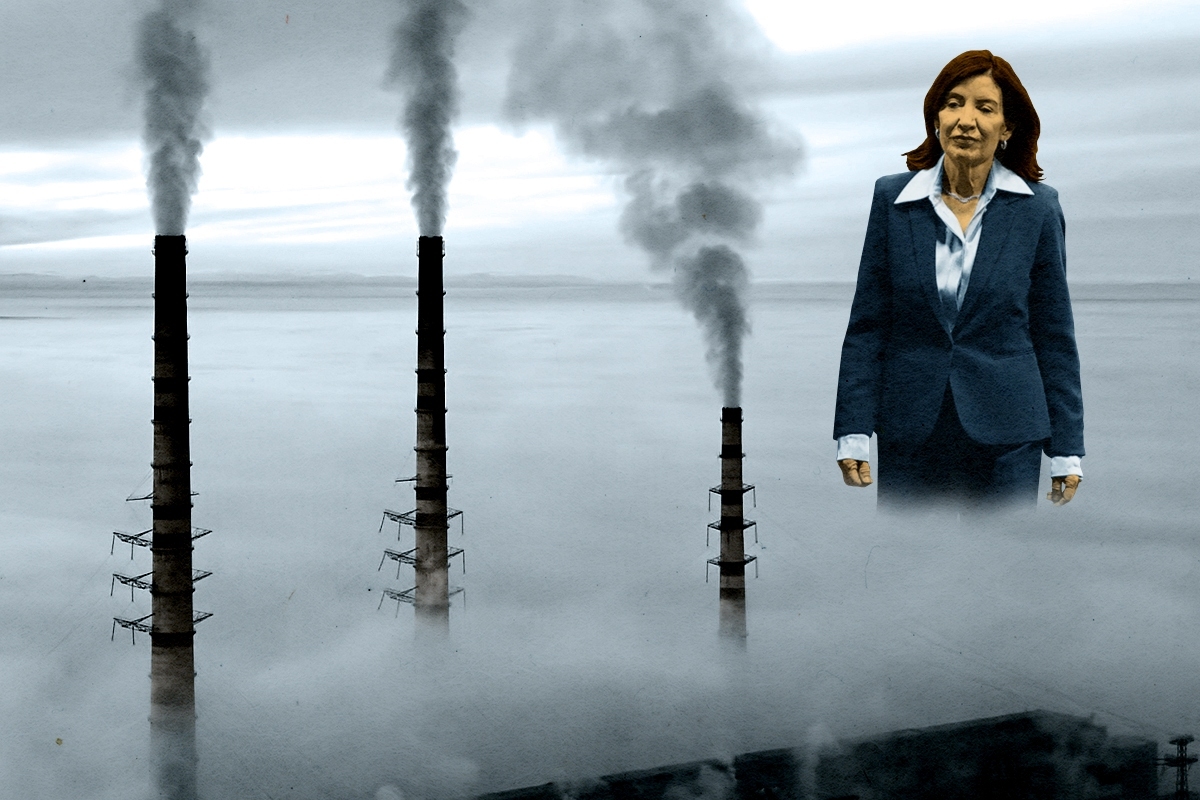
The New York legislature released the text of the deal it reached with Governor Kathy Hochul to reform the state’s climate law on Tuesday. The deal includes two consequential changes: delaying a plan to regulate carbon from 2024 (it was already behind schedule) until 2028, and modifying how the state accounts for the powerful greenhouse gas methane in a way that will look like the state has accomplished deeper reductions than under the current method.
The governor has been signalling her intent to weaken the CLCPA for months, arguing that as written, it would have imposed untenable costs on New Yorkers. “Reality has been harsh,” she said during a press conference about the budget agreement in early May, before the text was released. “We cannot meet the current timelines without driving energy costs higher.”
Local environmental groups were widely critical of the deal, with New York Renews calling it a “major blow for New Yorkers and for the country” that would set “a dangerous precedent,” and Environmental Advocates NY deeming the rollbacks “bad politics and bad policy.”
Some remained hopeful that the changes would not derail the state’s progress by much, however. “There’s no way to sugarcoat it, this is a setback,” Jackson Morris, the director of state power sector, climate and energy for the Natural Resources Defense Council, told me. “At the same time, I don’t think it’s a setback that we can’t recover from.”
The CLCPA set targets to cut economy-wide emissions 40% by 2030 relative to 1990 levels, and achieve net zero emissions by 2050. It also codified an earlier plan to source 70% of the state’s electricity from renewable sources by 2030 and power the state entirely with zero-emissions resources by 2040.
New York didn’t make up these targets. They’re based on reports from the U.S. Global Change Research Program and the United Nations Intergovernmental Panel on Climate Change, which mapped out how the world could minimize the risks of climate change in line with the Paris Agreement. After Donald Trump announced he would pull the U.S. out of the Paris Agreement when he first took office in 2017, a number of Democratic governors banded together to show that America was still “all in” to achieve the pact’s goals, leading to a flurry of state climate laws in the years that followed.
Hochul’s budget deal doesn’t change the renewable electricity targets or the overall trajectory of the original law. Instead, it delays the regulations that would make the economy-wide emissions reductions possible to achieve.
The CLCPA directed state agencies to promulgate rules and regulations by 2024 that would put New York on the path to achieve the 2030 and 2050 targets. In the years since the law passed, the state has been developing a cap-and-invest program that would tax carbon emissions progressively over time, and use the proceeds to fund clean energy programs throughout the state. This program was the crux of Hochul’s affordability concerns, as it would make energy more expensive for some New Yorkers in the near term.
The budget deal moves the deadline for the regulations to the end of 2028. Crucially, it also does not require that those regulations help the state achieve the 2030 emissions target. Instead, it specifies that the regulations be designed to achieve a new goal of reducing emissions 60% by 2040, in addition to the original net zero by 2050 target.
Morris, of the NRDC, was quick to note that the deal does not get rid of the 2030 target. While there will be no state programs aimed at achieving it, it still provides a statutory foundation that agencies such as the Department of Environmental Conservation can point to as a reason to reject fossil fuel project permits, for example, he said. Meanwhile, Morris is optimistic that the new 2028 deadline and 2040 target can keep the state on track.
“We obviously prefer that none of this is happening,” he said. “But because it’s happening, I think that’s one aspect of this deal that we see as providing some ground to stand on.”
One of the aspects of the CLCPA that made it more ambitious than other state climate laws was the way it required New York to account for methane. The budget deal will eliminate this edge.
There were two key components to New York’s unique methane rules. The first was that they forced the state to take responsibility for methane emissions that occurred outside its borders that were nevertheless tied to its natural gas use. For instance, a major source of methane emissions is leakage from the infrastructure used to drill, process, and transport natural gas. New York banned fracking in 2014, and the state gets most of its natural gas via pipeline from Pennsylvania and West Virginia. Under Hochul’s changes, the state can take these “imported” emissions off its books.
The second is a bit more convoluted and has to do with how methane behaves in the atmosphere. When governments or companies set emissions targets, they typically convert all greenhouse gases into “carbon dioxide equivalents” so that they can set one round number goal for all emissions, like New York’s 60% reduction by 2040. There’s no single way to do this, since unlike carbon dioxide, which remains in the atmosphere for centuries, methane breaks down quickly. Over 20 years, one metric ton of methane has a similar effect to about 80 metric tons of carbon, but over 100 years, it’s more akin to 25 metric tons of carbon. New York uses the 20-year effect as its conversion factor, but under the budget deal, it will switch to the 100-year method. That will make its methane emissions suddenly appear much lower, and thus make the state look further along in fighting climate change without actually changing anything about its strategy.
This will ease the pressure on the state to electrify buildings, clean up landfills, and take other difficult steps to cut methane emissions. It will also, however, align New York’s methane math with that of most U.S. states and much of the rest of the world.
The national climate advocacy group Evergreen Action, which focuses on state policy, is less concerned about the changes to the climate law and more concerned about how they happened. Justin Balik, the nonprofit’s vice president for states, told me that Hochul never brought her concerns to environmental stakeholders or asked for policy proposals for how to accelerate clean energy while lowering costs.
“We need to see more urgency from the governor and the legislature to actually do the things that will result in emissions reductions and cutting costs for people,” Balik told me, “and less fretting about the targets that are written into law.”
Balik argued that the changes will do nothing to address the factors that are increasing energy rates. He cited the state’s dependence on natural gas as a key driver, as natural gas prices can fluctuate dramatically due to geopolitics and supply and demand. If anything, he said, delaying the cap-and-invest regulations will delay clean energy deployment and exacerbate affordability by deferring the revenue the state would have collected to and used to fund emissions-cutting programs and rate relief.
The budget deal attempts to make up for the shortfall with a $1 billion allocation to the state’s Sustainable Future Fund, which will support state programs to cut emissions from buildings and roads with heat pumps, thermal energy networks, electric school buses, and fast-charging stations.
Evergreen, NRDC, and other groups now have their sights set on the 2028 regulations.
“If we can move forward quickly with a robust process to stand up that cap-and-invest construct in New York State, and get it cutting pollution and generating billions of dollars in revenue for reinvestment in communities, that's going to be a huge breakthrough for the state of New York,” Morris said.

Log in
To continue reading, log in to your account.
Create a Free Account
To unlock more free articles, please create a free account.
A new Searchlight Institute report joins a growing chorus arguing that corporate climate targets do more harm than good.
When Jane Flegal was working in market development for Frontier Climate, a $1 billion initiative to catalyze advances in carbon removal, she had what she called a “radicalizing experience.”
Frontier went out to corporate sustainability teams, selling them on large carbon removal offtake agreements with vetted startups developing technologies to suck measurable amounts of carbon directly out of the air. These were more expensive than the carbon offsets companies could buy to support forest conservation or clean cookstoves in Africa, but the investment would support innovation important for fighting climate change. In return, the companies would eventually be able to count the resulting carbon removal toward their net zero emissions targets.
Most companies, however, were more concerned about the cost. “We were trying to get companies to spend more than $1,000 per ton on a new technology we know the world needs,” Flegal told me. “Making that pitch to a corporation when they could also just go make the exact same claim with a $4-a-ton carbon offset credit was a crazy-making experience.”
The revelation, for Flegal, was that the prevailing paradigm for corporate climate action — a single-minded focus on carbon accounting — was not just inadequate, but actively harmful to bringing about the systems-level change required to decarbonize the economy. It incentivized companies to optimize for reducing their individual reported carbon footprints and failed to recognize arguably more impactful contributions to systems change. “Most of the best things they could be doing are just not legible at all in the existing accounting frameworks,” she said.
Flegal fleshed out her critique in a paper published Monday by the Searchlight Institute, a center-left think tank where she is now a senior fellow. The data center boom has exacerbated these perverse incentives, she argues. Tech companies are pursuing corporate power purchase agreements to fulfill their individual clean energy commitments, but mostly failing to help break down the structural barriers to decarbonizing the grid, such as transmission constraints and interconnection backlogs.
The paper challenges the logic of treating a “complex, global, sociotechnical problem as if it were a matter of property rights,” where investors and the public expect companies to own their individual carbon messes. Flegal proposes some alternative measures by which to evaluate corporate climate ambition. One is the quality of a company’s investments — are they causing more clean energy or crucial climate infrastructure to get built than would be otherwise based on market conditions? How many miles of transmission have they financed, or policy proceedings have they influenced? She also calls for companies to be explicit about their theory of change and report how they are taking action consistent with that theory.
“I recognize that these are not perfect metrics, but let’s be real, neither are the ones we have today,” she told me. “The danger of the ones we have today is that they imply a false precision that could be worse for climate outcomes than just being honest about uncertainty.”
The climate community has always fought about carbon accounting, but recently the quarrel has reached a fever pitch. The Greenhouse Gas Protocol, a nonprofit that sets voluntary standards for how companies should measure their emissions, is in the middle of overhauling its rules, a process that has sparked major schisms over how to account for companies’ clean electricity purchases, the carbon stored in forests, and other complex aspects of corporate carbon bookkeeping.
At the same time, the Science Based Targets Initiative, a separate group that acts as an arbiter of whether companies’ climate plans are consistent with the goal of holding atmospheric warming to 1.5 degrees Celsius, has been updating its own standard for “corporate net zero.” A third group, the International Organization for Standardization, is also revising its greenhouse gas reporting rulebooks.
The challenge across all of these efforts is developing standards that are scientifically rigorous but not so rigid as to discourage companies from acting. Companies are lobbying these revision processes to get the rules they want, but many experts worry the outcomes will enable greenwashing.
Flegal joins a growing chorus of thought leaders arguing that this system that feigns precision and prioritizes compliance with an impossible bottom line risks pushing companies away from doing anything at all. Some propose getting rid of individual carbon targets altogether in favor of more qualitative reporting, while others advocate for creating a separate space for companies to earn recognition for their harder-to-measure “contributions” to fighting climate change.
In September, Michael Gillenwater, the executive director of the Greenhouse Gas Management Institute, who has been working on carbon accounting issues for more than 20 years, called for a “paradigm shift” in corporate climate reporting. He and Derik Broekhoff of the Stockholm Environment Institute, another 20-year soldier in this space, argue that boiling down a company’s climate impact to a single inventory of emissions traps “companies in a ’doom loop’ where they are simultaneously criticized for not taking full responsibility for indirect emissions and for greenwashing when they attempt to address these emissions through market-based mechanisms,” such as renewable energy certificates.
They propose instead a “multi-statement” reporting framework in which companies would separate their actual, physical emissions from their investments in carbon offsets, renewable energy certificates, and other market-based tools for climate mitigation. This system reframes carbon credits from “compensating” for a company’s ongoing emissions to playing a more philanthropic role in achieving global net zero and “eliminates the perception that companies can be absolved of responsibility through offsetting,” they write. They also propose a third section where companies would report on remaining barriers to decarbonizing their particular business. Companies could set targets for each section individually, but would not be allowed to combine them into a single performance metric.
Robert Hoglund, the co-founder of the carbon removal tracking site CDR.fyi and head of climate at Milkywire, a corporate advisory firm, published yet another idea in a paper earlier this month. He and his co-author argue that the distinction existing frameworks make between a company’s “direct” and “indirect” emissions doesn’t actually illuminate what’s within its control to reduce. They recommend companies split their net zero targets into two categories, separating “unconditional” emissions cuts — those that are currently feasible — from “conditional” reductions, or those that depend on changes in policy, infrastructure, technoeconomics, etc.
Creating a conditional target “does not make it optional,” they write. “It creates an obligation to help build the world the target assumes. That means policy advocacy, supplier engagement, financing climate solutions, supporting carbon removal, and other system-changing actions are not side activities but flow from the target itself.”
The Science Based Targets Initiative published its new net zero standard this past week, and it appears to adopt at least some of the ideas Flegal, Gillenwater, and Hoglund proposed — namely, attention to systemic constraints. It shifts from looking only at absolute emission reductions to recognizing companies for putting their “best efforts” toward net zero. It stops short, however, of explaining how SBTi will judge what counts as a “best effort.”
Based on an initial read, Hoglund told me he thought SBTi made a lot of positive changes. Flegal hadn’t had a chance to dig into them yet when we spoke. Another critic I spoke to was less pleased.
If Lisa Sachs, the director of Columbia University’s Center on Sustainable Investment, had her way, companies would get rid of net zero targets altogether. She published her own treatise on the subject in May, pointing out that corporate net zero “relies on a mistaken aggregation logic.” It assumes that if every company works to reduce, offset, or neutralize their own emissions, the efforts will sum up to global net zero. Like Flegal, she told me that not only is that impossible without systems change, but she fears that company-level net zero goals “disincentivize the things companies can and should do that would have maximum systems impact.”
While it’s relatively common today for companies to talk openly about the systemic barriers they face in decarbonizing, it’s much more rare for them to say what they’re doing about it. I asked Flegal whether she truly believed sustainability officers would be able to get CEO approval for investments in “systems change,” which is more difficult to break down into clear KPIs.
She pointed out that a lot of companies already make significant philanthropic investments, and this could be put in that bucket. In some cases, like when grid constraints are a barrier to powering a new facility, they could argue that investing in transmission lines is a strategic move and not just part of their climate commitment.
Actions like lobbying in support of regulatory reform and other policy changes seem like a harder sell. The investor-led initiative Climate Action 100+ tracks how companies are attempting to influence climate-related policy debates, and has consistently found that few companies — just 2%, in the latest count — align their lobbying activities with their climate goals.
Reading these papers took me back to 2019 and 2020, when many companies first made net zero commitments. In one sense, it felt like a sea change — all these powerful corporations publicly dedicating themselves to a net zero future — but it was also dubious. They all seemed to have a different definition of what “net zero” meant. For some oil and gas companies, it meant zero-ing out the emissions from their operations, but not from the oil and gas they sold. A lot of companies made the pledge without providing any details about how they would achieve it. SBTi started developing its first net zero standard in 2020 to address this problem by creating a common definition and set of expectations. While having SBTi validate a company’s net zero target is entirely voluntary, more than 11,000 companies have done it.
When I mentioned this history to Flegal and Sachs, they countered that the problem SBTi is trying to address is downstream of the actual problem — that a voluntary net zero framework for companies creates incentives that are not aligned with what really matters for decarbonization.
Both also raised the opportunity cost of the enormous intellectual and financial capital that has gone into refining all of these accounting methodologies and producing reams of reporting to comply with them. “All of these organizations and rule setters for the rule setters for the rule setters, I think we’ve gotten lost in the sauce a bit,” Flegal said.
“These frameworks have become a business — literally a business, in SBTi’s case,” Sachs said, since it has a for-profit arm that validates companies’ reporting for a fee. “I’d rather have a few leaders who raise the tide than to have 11,000 companies aligned with SBTi, and to be finding ourselves in five years figuring out another way to lower the standard.”
Current conditions: The Pacific has officially entered El Niño, and the warmer-than-average weather pattern is expected to be stronger than usual • Heavy rains are deluging China’s Hunan and Guangxi provinces • While Puerto Ricans living in New York just threw the diaspora’s annual parade, thousands of Boricuas living on the island are enduring days of water shortages so severe the U.S. territory’s governor activated the National Guard.
In a pair of Sunday evening posts on Truth Social, President Donald Trump said a “great deal” with Iran to end the conflict and reopen the Strait of Hormuz without any tolls was “now complete.” As part of the truce, Trump said he would “authorize the immediate removal of the United States Naval blockade” at the mouth of the Persian Gulf. The waterway through which up to a quarter of the global seaborne oil trade travels will remain closed until the deal is signed on Friday, Trump said, “for purposes of mine removal,” meaning Iran will collect the explosives its military planted around the strait to prevent vessels from passing. “Ships of the World, start your engines,” Trump wrote. “Let the oil flow!”
My colleague Emily Pontecorvo had a big scoop on Friday: The Trump administration is no longer defending the president’s moratorium on permitting wind projects. The Department of Justice filed a motion last week to dismiss its appeal of a federal court’s December decision vacating the order to halt wind energy approvals. Ending the White House’s all-of-government assault on wind and solar projects has been a key demand from Democrats seeking compromise for a permitting reform package. Experts say the procedural move in this case is a bullish sign for the various bills before Congress now. “The door to federal permitting is now unlocked again and each developer will be able to make the case for permitting their individual project based on the facts and the law,” Kit Kennedy, the managing director for power, climate, and energy at the Natural Resources Defense Council, told Emily.
The thaw in the permitting freeze comes as the SunZia Wind Project, the largest wind farm in the United States, is preparing to begin commercial operations in the coming days. The development in New Mexico, which has a total net summer generating capacity of 3,650 megawatts, is made up of 916 turbines.

Trump wants to temporarily suspend the federal tax on gasoline to ease surging fuel prices caused by the war with Iran. His proposal would waive the tax of $0.184 per gallon, but doing so requires an act of Congress. According to a new analysis from the Budget Lab at Yale University shared exclusively with Heatmap, lifting the levy would pay Americans back about $37 of the roughly $250 in higher gasoline costs paid over the course of three months. While richer households would spend a smaller share of total income on fuel, they would accrue more per-dollar benefits than lower-income Americans. Likewise, the gas tax holiday would afford more rewards to heavy drivers.
Sign up to receive Heatmap AM in your inbox every morning:
It started out as a British nonprofit devoted to documenting, standardizing, and tracking how much carbon dioxide various partner organizations produce. Dubbed the Carbon Disclosure Project, the group, founded in 2000, had emerged as one of the central authorities on an issue increasingly baked into financial reporting rules. Now known only by its acronym, CDP said last week it would split its organization in two, segmenting a charitable, science-focused nonprofit called the CDP Foundation from a new commercial entity designed to deliver environmental data and disclosure services for a fee. The London private equity giant Permira will back the for-profit CDP’s launch. “For 25 years, CDP has been at the forefront of environmental disclosure, transforming it from the sidelines to the centre of decision-making,” the organization said in a statement. “To meet the scale and speed of today’s environmental challenges and market expectations, CDP is sharpening its focus, enabling stronger science-led disclosure and greater investment in technology to simplify the disclosure experience and deliver more decision-useful insights.”
Tennessee Senator Marsha Blackburn, a key GOP tech policy reform voice in the Senate running for governor in her home state, just came out against a data center next to Nashville Zoo. “Tennessee should be thoughtful and considerate when deciding where data centers are located. The proposed site near the Nashville Zoo is neither,” she wrote in a post on X. “Let’s revisit this placement.” It’s yet another sign that the backlash against data centers is, as Heatmap’s Jael Holzman wrote, splintering the right.
The geothermal industry is gearing up for a next-generation boom. Until Fervo Energy’s big stock market debut last month, the big publicly-traded player in the business was Ormat Technologies, a conventional geothermal giant that both builds power stations and manufactures the parts needed for plants. Now, at the industry’s big trade show in Calgary this week, Ormat is unveiling a 100-megawatt power generation system designed for unconventional wells like those Fervo or Ormat’s partner Sage Geosystems are drilling. It’s a sign, Think GeoEnergy reported, that Ormat is seeking “to accelerate the commercial deployment of next-generation geothermal projects.”
Welcoming the world’s first clean energy trillionaire.
SpaceX is now a public company. The rocket and satellite maker’s shares began trading this morning, surging 19% from their initial price of $135 to more than $160 at the market close. With the sale, Elon Musk became the world’s first trillionaire; his wealth has roughly tripled since President Donald Trump won re-election in 2024.
I’ll let other observers judge the IPO’s success, the firm’s long-term prospects, and the meaning of a world where we now have trillionaires. So I will make a few other points:
I remain agog at Musk’s ability to raise enormous amounts of cash from public equity markets to do hardware and manufacturing development. To some degree, the idea of a venture-backed firm doing hardware engineering — or what some now call “deep tech” — is Musk’s most impressive creation. The SpaceX IPO raised $75 billion today. That money will now go in part to scaling and commercializing rockets, factory equipment, and allegedly, at some point in the future, orbiting data centers.
Let’s not forget how crucial the U.S. government is to Musk’s story. In the world of climate, energy and manufacturing, we wail about financing’s “missing middle,” the elusive type of investment that can help scale and deploy early-stage technologies by bridging the gap between expensive venture capital and cheap bank lending. But this is at least partially a solved problem. SpaceX and Tesla survived the valley of death with government help: The Energy Department’s Loan Programs Office (which the Trump administration has dubbed the Office of Energy Dominance Financing) extended a $465 million loan to Tesla to build its Fremont, California, factory in 2010; NASA’s 2008 commercial resupply contract gave SpaceX guaranteed offtake for its Falcon rocket. Neither firm would likely have survived without those key injections of financial certainty.
To some degree, Musk has already made his mark on the American economy by creating a new culture of manufacturing engineering. I cannot recommend enough my colleagues Matthew Zeitlin and Emily Pontecorvo’s report on the new cadre of climate tech founders who came up at SpaceX and Tesla. As it happens, I spent Wednesday touring a clean energy factory founded by a Tesla alumnus, and I was struck by how many signs of Musk’s bottlenecks-focused management approach were visible, even at a company seemingly run more humanely than Musk’s famously “hardcore” firms.
Sign up to get Heatmap in your inbox daily.
To that point, Emily and Matt asked a number of clean tech executives who worked for SpaceX or Tesla what they learned from the experience. Their responses are fascinating; you can read them in full here. These comments from Justin Lopas, the COO of Base Power, stuck out — he was asked the “one thing” he learned from working for Musk:
You can get way more done in a day and can move way faster than you think. This does not mean necessarily more hours (although solving any hard problem requires that too), but instead being thoughtful about sequencing work, not accepting delays from suppliers or external counterparties without solid rationale, parallel pathing, accelerating critical learnings to early in the project, etc
To step back, one irony of Elon Musk’s situation — at least to me — is that relatively few American politicians are eager to talk about what has actually driven his wealth. I’m not just talking about his firms’ reliance on public financing, although that counts too. I mean Tesla itself. Although Musk now describes that business as a “robotics company,” it is and remains an electric vehicle and battery manufacturer. (It recently began high-volume production of the Tesla Semi, a potentially game-changing long-haul electric truck.) After today, Musk’s Tesla stake makes up less than half of his wealth, but, still, he would not be a trillionaire without EVs, solar panels, and batteries.
But that is not a particularly convenient fact. That Musk is a clean energy trillionaire remains unpalatable to Republicans, who would prefer to cast EVs as an inferior substitute made to satisfy government mandates. And Musk’s antisemitism, far-right politics, and gleeful destruction of the U.S. Agency for International Development — not to mention Tesla’s violation of labor law — have obviously destroyed his reputation among Democrats.
Yet his elevation to a 13-digit net worth nonetheless marks a new era in American capitalism. The richest Americans in history have almost always been oilmen: John D. Rockefeller became the country’s first billionaire by creating the Standard Oil trust; when he died in 1937, his net worth of $1.4 billion represented 1% to 2% of the country’s gross domestic product. In the 1960s, J. Paul Getty became the country’s richest person by negotiating Saudi and Kuwaiti oil concessions. Yet Musk became a billionaire not by harnessing commodities, but through his mastery of software, hardware, and clean energy.
Musk’s fortune now exceeds 3% of U.S. GDP. He is the richest American in history, judged as a share of national production. And it was electricity, lithium, and modern factory production — and, if you wish, the kerosene and methane that fuel SpaceX’s rockets — that got him there. As the science fiction writer William Gibson almost said, the future is already here; it’s just not evenly distributed in your retirement portfolio yet.
Many thanks for reading, and have a wonderful weekend.